
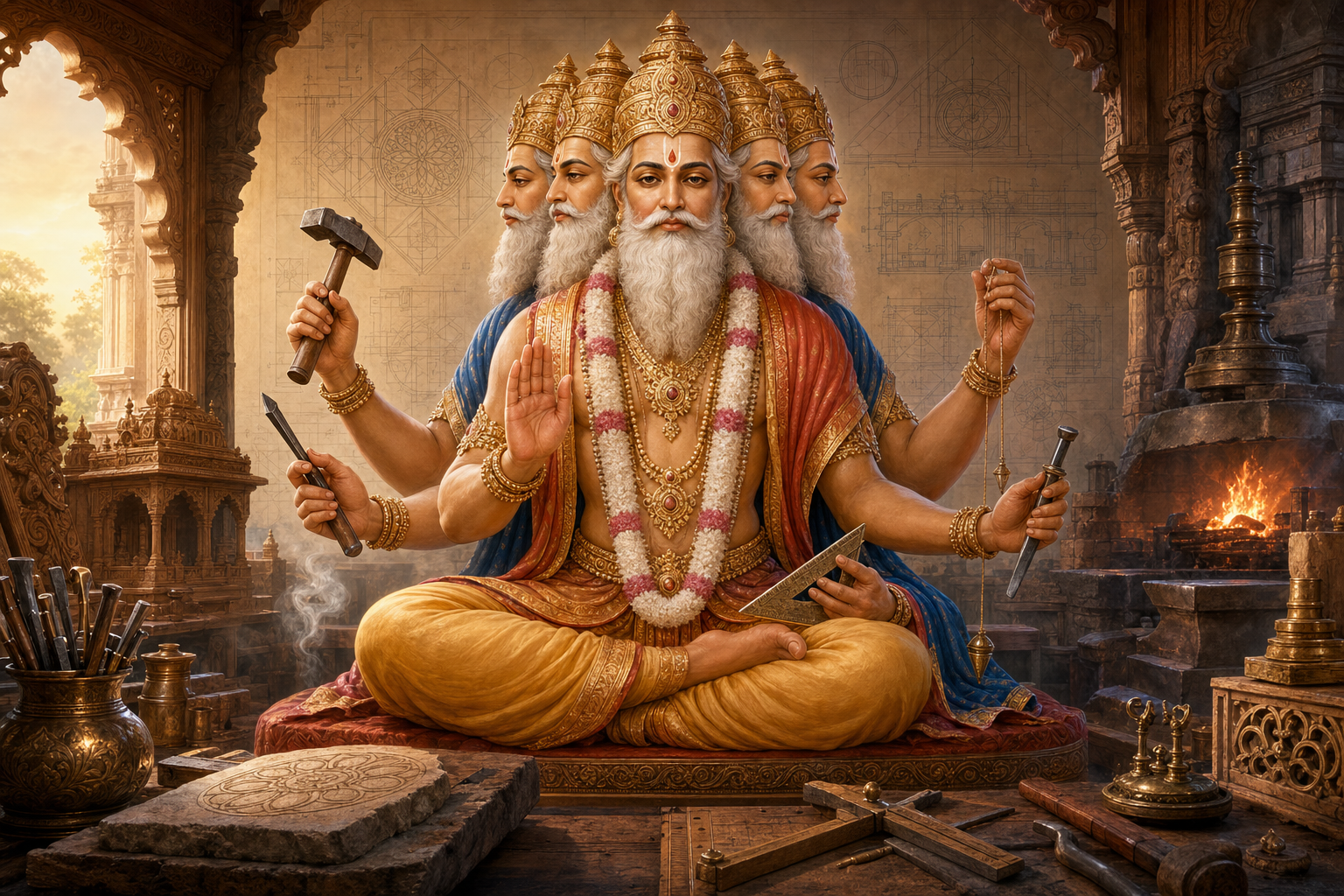
You may be looking at a five-faced image in a temple, workshop, procession, or family shrine and wondering what, exactly, you are seeing. Is every face a separately named form? Does each one correspond to an element or direction? And how can you explain the image without turning a living tradition into an unsupported chart?
Begin with the whole composition. The faces, hands, implements, placement, and local worship belong together. Panchmukhi Vishwakarma is best understood not as five disconnected personalities but as a complete vision of creative intelligence: aware in every direction, capable in many disciplines, and responsible for what it brings into the world.
First establish what you are actually looking at
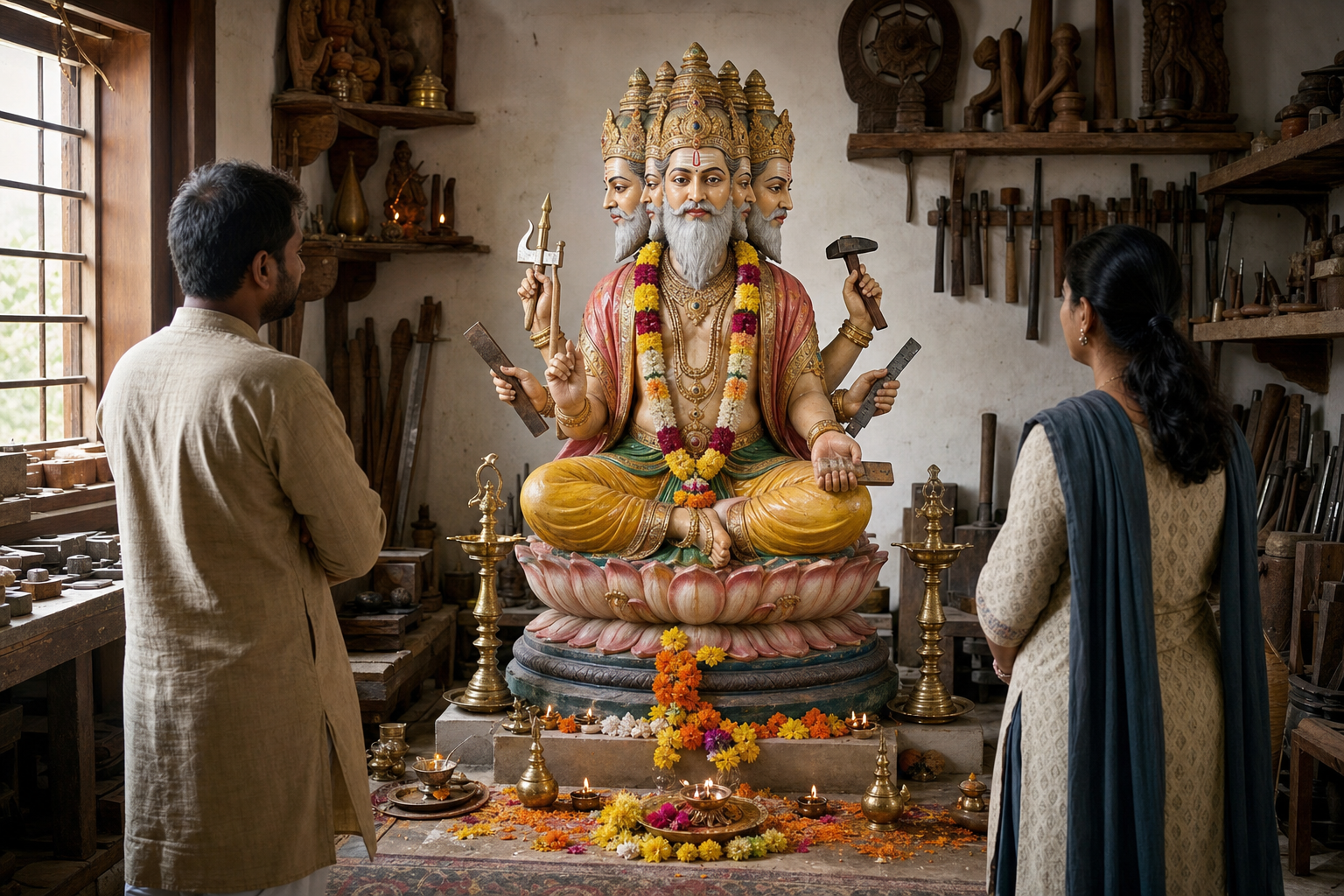
Panchmukhi and Panchamukhi both mean five-faced. Vishwakarma is revered as the celestial architect and divine craftsman, while the five-faced manifestation presents his powers in an expanded form. The familiar single-faced image is more widespread, but five-faced worship has a living regional presence in parts of Bengal and South India.
Five faces alone are not enough to identify a deity. Multi-faced forms occur elsewhere in Hindu iconography, and an isolated photograph can conceal the clues that distinguish one form from another. Use the following order of evidence:
- Start with the local name. An inscription, shrine tradition, festival identification, family account, or explanation from the worshipping community is stronger evidence than resemblance alone.
- Confirm that the image intentionally represents five faces, rather than one principal face surrounded by unrelated decorative heads or attendants. A frontal photograph may not show the full arrangement, so inspect side and rear views when possible.
- Look for multiple hands bearing implements associated with craft, design, construction, or skilled making. Do not guess the identity of an indistinct implement merely to complete a list.
- Record the setting. A household shrine, artisan guild, workshop, temple, factory observance, or Vishwakarma Puja installation can explain how the image functions in practice.
- Note the provenance, but do not turn it into an exclusion rule. An association with Bengal or South India supports identification; an image found elsewhere is not automatically inauthentic because traditions and communities travel.
If you are cataloguing a photograph, ask for an uncropped image that includes the pedestal, surrounding shrine, hands, and implements. If you are writing a museum or educational caption, separate what the community identifies from what you infer visually. That small discipline prevents a plausible interpretation from being repeated later as a fixed canonical fact.
The five faces express completeness, not five biographies
The central idea is comprehensive vision. A single forward-facing head establishes one principal viewpoint; five faces break that limitation. They suggest creative awareness that surveys the whole field rather than attending to one task, direction, or consequence in isolation. Each face can therefore evoke a distinct aspect of intelligence and protective care while remaining inseparable from the complete form.
This is why Panchmukhi Vishwakarma can be read through several pancha, or fivefold, frameworks familiar to Indic thought:
- Through space, the faces may suggest the cardinal directions together with a vertical or transcendent axis. This is a reading of spatial completeness, not automatic proof that a particular visible face must be assigned to a particular direction.
- Through the material world, they can recall the pancha bhutas, the five elements from which embodied and constructed existence is understood.
- Through human experience, they can recall fivefold arrangements of senses and faculties, bringing perception and action into the same symbolic field.
- Through craftsmanship, the many viewpoints suggest that sound creation requires more than technical execution. Knowledge, attention, ethical purpose, and awareness of consequences must cooperate.
These are complementary lenses, not necessarily a face-by-face decoding key. A common mistake is to take a general fivefold symbolism and convert it into a rigid diagram: this face is always this element, this colour, this name, and this direction. Such an exact scheme may belong to a particular regional, temple, artisan, or textual tradition, but it should not be presented as universal without evidence from that tradition.
Use a three-level test when explaining the icon:
- You can state confidently that the five-faced form conveys comprehensive creative and protective power.
- You can present the elements, senses, faculties, directions, and disciplines as possible or complementary fivefold readings.
- You should verify exact names, colours, directional assignments, implements, and face-specific meanings with the local lineage or applicable iconographic canon.
The Shilpa Shastras matter here because traditional image-making concerns proportion, purpose, and sanctity as well as outward appearance. Yet invoking the Shilpa Shastras is not a substitute for identifying the particular convention an image follows. When regional practice supplies a more exact explanation, preserve its regional character instead of enlarging it into a rule for every Panchmukhi Vishwakarma image.
Read the faces, hands, implements, and setting as one sentence
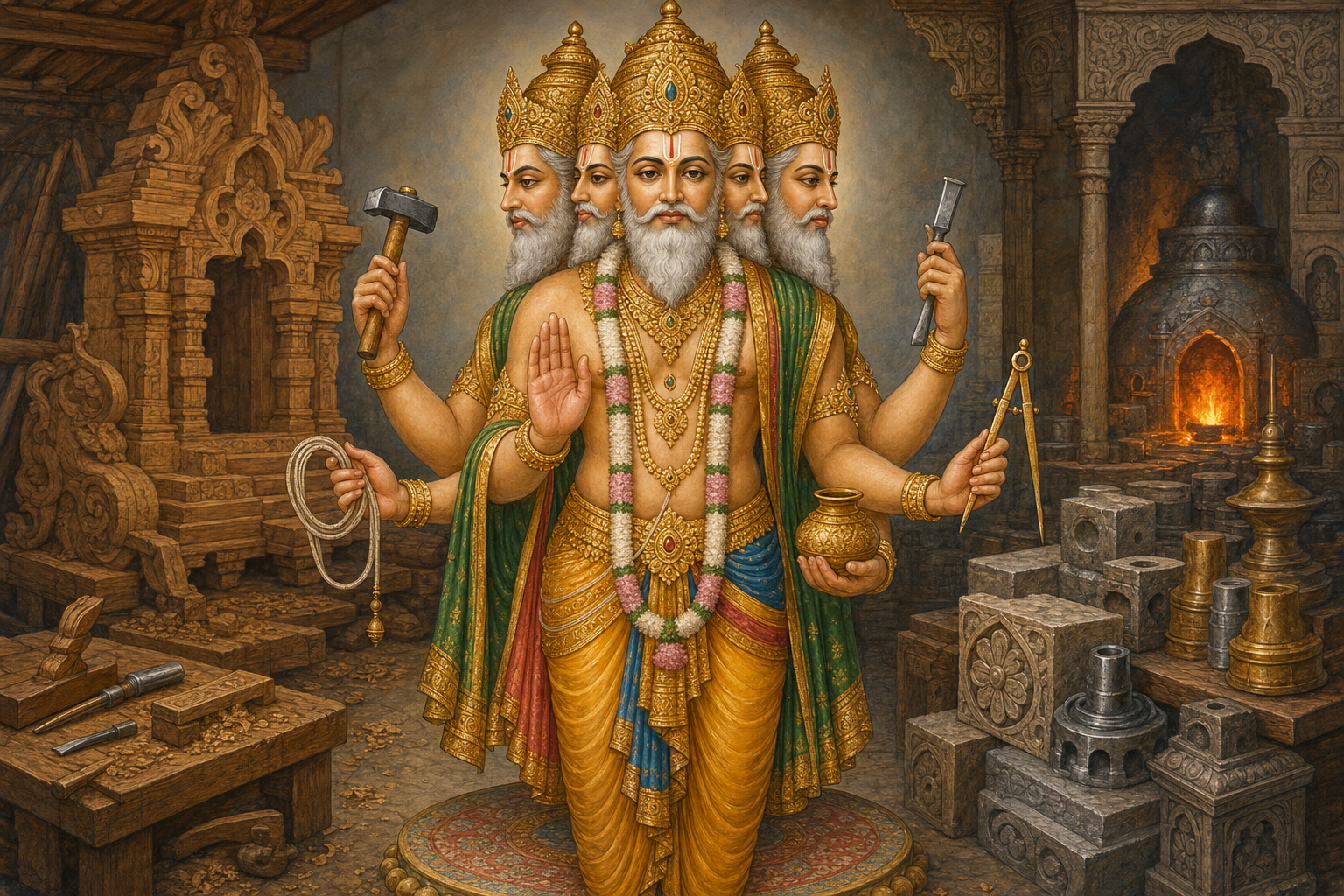
The icon’s meaning does not stop at the heads. The multiple hands and craft implements show intelligence becoming skilled action. The faces establish breadth of awareness; the hands establish capacity; the implements connect that capacity with the disciplines through which people measure, design, shape, join, and build.
A reliable visual reading moves through the image in this order:
- Read the faces as a declaration that creation must be seen from more than one side.
- Read the multiple hands as coordinated ability rather than mere abundance. Good making requires different actions to serve one purpose.
- Identify only those implements you can actually recognise or confirm. Their collective importance is clear even when a damaged sculpture or low-resolution image prevents exact identification.
- Observe how the image is placed and used. A workshop shrine emphasises the sanctity of labour and tools; a temple setting may place the same theology within a broader devotional programme.
- Ask what the local community says the image requires of a maker. That answer often reveals whether precision, service, protection, continuity, or another duty is being emphasised.
This method also produces a careful caption. Use this pattern: Panchmukhi Vishwakarma, the five-faced manifestation of the divine craftsman, presents creative awareness extending across multiple directions and disciplines. His many hands and implements join knowledge with skilled work. This example belongs to the tradition of a named region, community, shrine, or workshop, and its more exact face assignments follow that local convention.
Notice what the caption does not do. It does not invent a complete inventory from an unclear image. It does not claim that one regional interpretation governs all of Bharat. It gives the reader a sound theological centre while leaving room for the specific tradition to speak in its own voice.
A workshop shrine turns iconography into a discipline of work
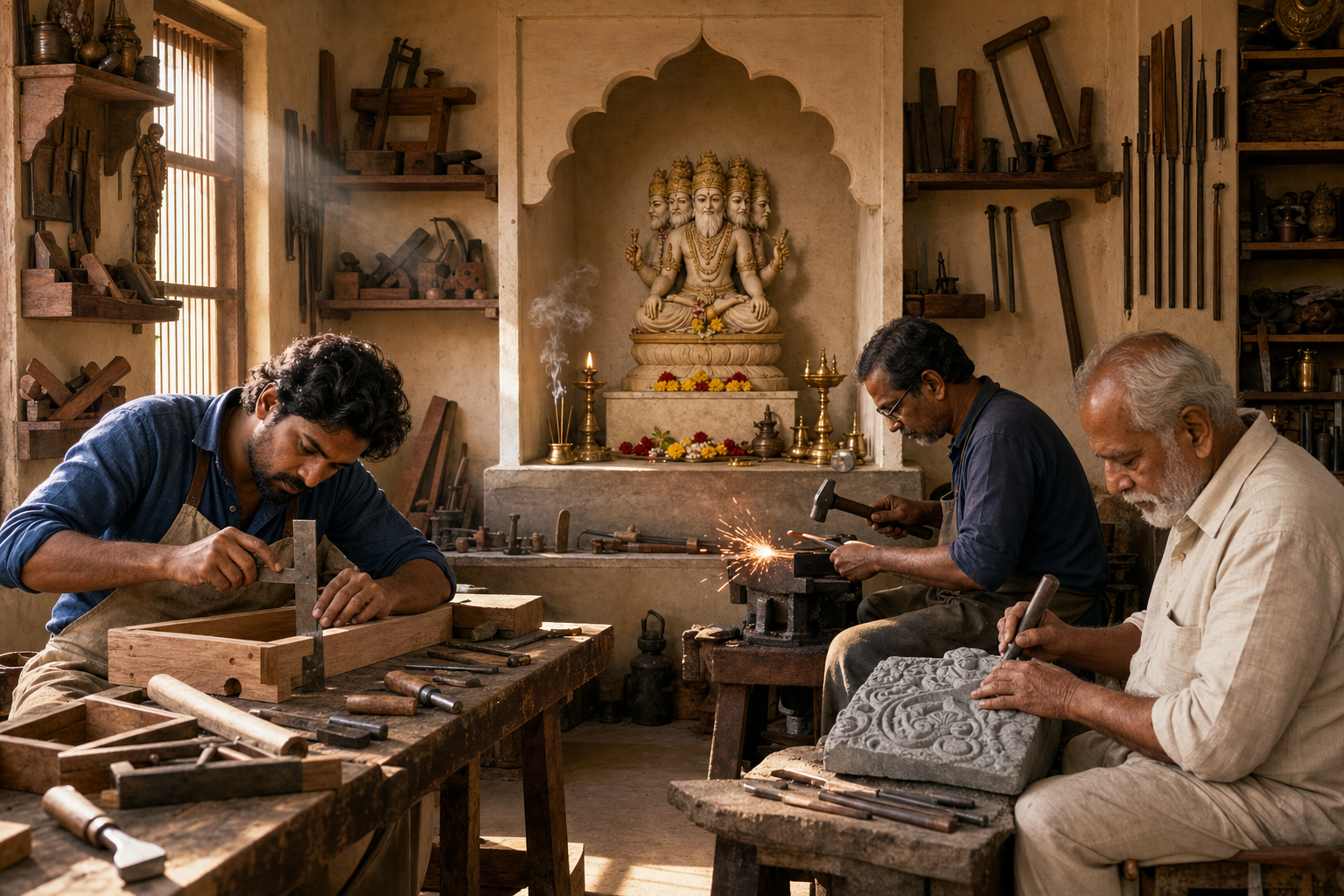
The presence of Panchmukhi Vishwakarma in a workshop, guild space, classroom, or factory is not incidental decoration. It brings the moral consequences of making into the place where decisions are taken. A tool can create beauty and usefulness, but careless use can also produce waste, weakness, or danger. Worship places skill under dharma rather than treating technical ability as self-justifying.
During Vishwakarma Puja, tools may be rested, cleaned, honoured, and recommitted to service. The sequence matters. Stopping interrupts habitual use. Cleaning demands attention to the actual instrument. Reverential placement rejects contempt for manual labour. Recommitment asks what the next use of that tool will serve.
If you want to bring this spirit into a studio, classroom, or professional team, keep the ritual details faithful to your family, guild, or temple tradition. Then make the ethical part concrete:
- Pause ordinary work instead of treating the puja as something performed while production continues unchanged.
- Clean and arrange the tools or instruments that actually carry the work, including the less prestigious ones on which accuracy depends.
- Honour the people whose trained hands and judgement make those tools useful. Reverence for Vishwakarma should deepen respect for artisans and labour rather than erase them.
- Name one lapse that must not be carried back into the work: poor attention, avoidable waste, compromised quality, neglected safety, or design that ignores the people affected by it.
- Choose one correction that can be recognised in practice after the observance. A devotional promise becomes meaningful when it changes how the next object, structure, drawing, or system is made.
This is not a productivity technique or a guarantee of commercial success. Students and professionals may seek clarity of mind and steadiness of hand, but the deeper demand is responsibility. Patience, humility, accuracy, and service turn skilled labour into sadhana because they change the quality and intention of the work itself.
The ethic reaches beyond one kind of sacred building. Temples, stupas, basadis, and gurdwaras all depend on disciplined craft, inherited knowledge, and work performed for a community. That shared respect does not make their theologies or icons interchangeable. It shows how right livelihood, service, and care for sacred space can form a civilisational conversation across Hindu, Buddhist, Jain, and Sikh life.
Use a five-question review before you approve what you make
Panchmukhi Vishwakarma is especially useful when a project has become too specialised for any one person to see whole. An engineer may solve the mechanism while missing the social cost. A designer may refine appearance while ignoring maintenance. A manager may gain speed by weakening safety or durability. The five-faced perspective asks you to widen the review before the work is fixed and difficult to change.
| Lens | Question to ask | Warning sign |
|---|---|---|
| Substance | Are the materials, energy, and physical resources suited to the purpose, with waste and ecological effects made visible? | The design succeeds only by shifting damage somewhere the maker does not have to see. |
| Method | Can the chosen technique deliver precision, safety, reliability, and the intended quality? | Speed or convenience is being used to excuse a known weakness in execution. |
| Attention | Do the people doing the work have the clarity, competence, patience, and humility to detect and correct error? | Expertise is treated as freedom from review, learning, or correction. |
| Duty | Whom does the finished work serve, and who carries its risks or burdens? | Efficiency is celebrated even though the outcome is unsafe, unfair, or indifferent to human need. |
| Setting | Does the work respect its users, community, environment, and inherited cultural setting? | A technically successful result weakens the place or relationships into which it is introduced. |
Do not answer these questions with ceremonial words. Write one specific correction beside every weak answer, and settle who must address it before approval. The purpose is integration: science with sustainability, usefulness with beauty, efficiency with fairness, and innovation with ecological responsibility. That is how a five-faced sacred image becomes a practical compass without being reduced to corporate decoration.
Key takeaways
- Identify Panchmukhi Vishwakarma through the combined evidence of five faces, multiple hands, craft implements, setting, provenance, and local identification.
- Read the five faces primarily as completeness of creative and protective awareness, not as five independent deities or biographies.
- Treat the five elements, senses, faculties, directions, and creative disciplines as complementary frameworks unless a local tradition supplies exact assignments.
- Do not invent names, colours, directions, or implements from an unclear image. Exact iconographic claims require exact regional or canonical support.
- Understand Vishwakarma Puja as a recommitment of tools and skill to quality, safety, beauty, service, and dharma.
- Apply the icon’s integrative vision by reviewing substance, method, attention, duty, and setting before approving a project.
If you are commissioning a new Panchmukhi Vishwakarma image, bring the artisan and the community’s ritual or iconographic custodian into the same conversation before the design is fixed. Agree on the local face arrangement, implements, proportions, intended placement, and ritual use. That is how you preserve a living form: not by copying five heads from an anonymous image, but by allowing skilled creation to remain accountable to tradition and dharma.
References
