
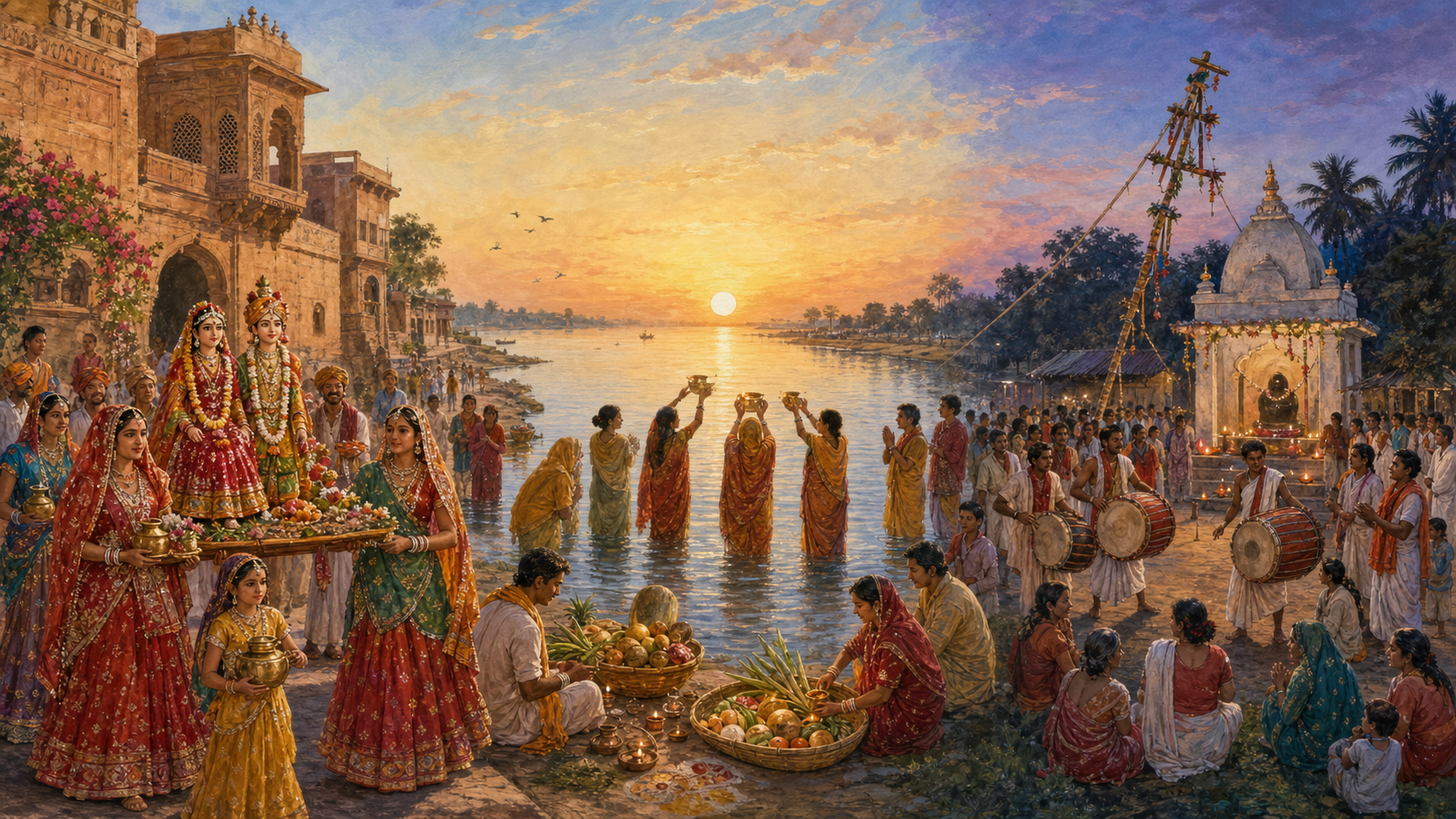
If you are trying to plan your family’s Chaitra observances, the calendar can look contradictory. Gauri Tritiya falls on March 21 in 2026, Chaiti Chhath runs from March 22 through March 25, and Bengal’s Neel Puja and Charak Puja arrive on April 12 and April 13. These dates do not compete with one another. They belong to different regional ways of inhabiting Chaitra.
Your first decision, therefore, is not which festival best represents the month. It is which inherited practice, regional calendar and devotional commitment your household is actually following. Once you answer that, the proper date, form of worship, food preparation and community role become much clearer.
First identify which Chaitra clock your observance follows
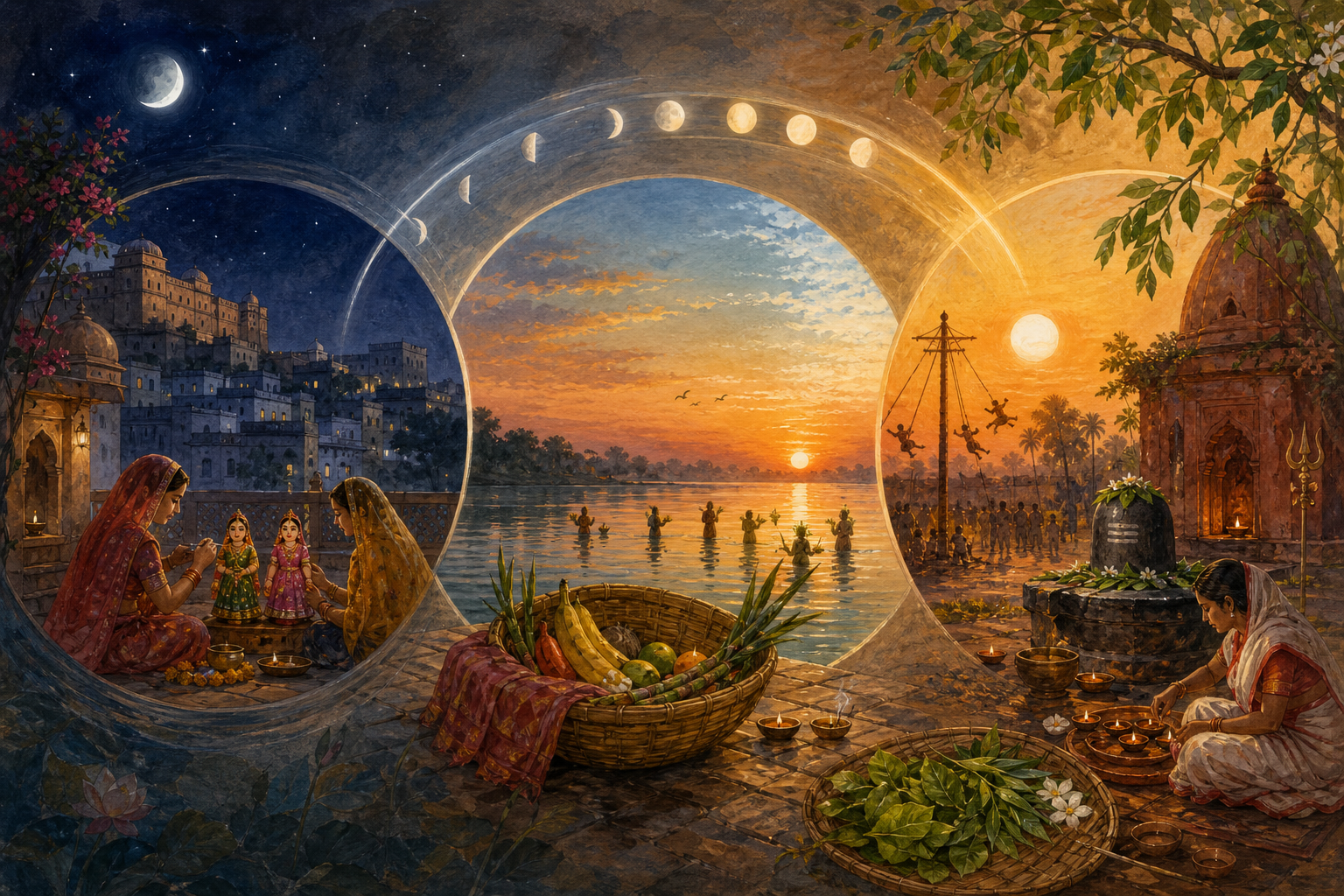
Two kinds of sacred timing appear in these observances. Soubhagya Gauri Vratam and Chaiti Chhath follow lunar tithis: Gauri worship is anchored to Chaitra Shukla Tritiya, while Chhath reaches its central offerings on Chaitra Shukla Shashthi. A tithi does not begin automatically at midnight or remain confined to one civil date. It follows the changing angular relationship between the Moon and the Sun, so its beginning and end can fall during the day.
That is why the relevant rule must travel with the ritual. For Gauri Tritiya, many households use the civil date on which Tritiya is present at sunrise, although some regional customs privilege a substantial midday or evening Tritiya. For Chaiti Chhath, local sunset and sunrise directly govern Sandhya Arghya and Usha Arghya. A generic all-India event listing can give you a planning date, but it cannot replace a Panchang calculated for your location.
Charak Puja follows a different threshold. It culminates on the last day of the Bengali month of Chaitra, at Chaitra Sankranti and the approach of Mesha Sankranti. It therefore belongs to the end of the Bengali agrarian year and the eve of the Bengali New Year. The result is a useful correction to the idea that all Chaitra festivals should occupy the same part of a Gregorian month: the lunar bright-fortnight celebrations and Bengal’s solar year-end observance are measuring different sacred moments.
North Indian Purnimanta and southern Amanta month-reckoning can also make calendar labels look different. The Purnimanta system counts Chaitra from the day after Phalguna Purnima, while the Amanta system begins it after Phalguna Amavasya. The astronomical tithi remains the common marker, however. A Gauri vrata attached to Chaitra Shukla Tritiya does not become a different vrata merely because two calendars organize their months differently.
Before purchasing puja materials or announcing a community date, write down four answers:
- What is the exact name used by your family: Gangaur, Soubhagya Gauri Vratam, Chaiti Chhath, Neel Puja, Charak Puja or another inherited name?
- Which region and household tradition carried the observance to you?
- Is its decisive marker a lunar tithi, a local sunrise or sunset, or the Bengali solar transition?
- Which Panchang or panjika does your temple, family elder or regional association normally follow for your present location?
Those questions prevent the most common planning mistake: selecting a date first and trying to fit a regional tradition into it afterward.
The working Chaitra calendar for 2026
Use the following dates as a planning map. Reconfirm local tithi boundaries and sunrise or sunset times before fixing the principal puja.
| Civil date in 2026 | Observance | Regional centre | Timing principle | What you need to plan |
|---|---|---|---|---|
| March 21 | Soubhagya Gauri Vratam or Gangaur | Rajasthan and adjoining regions, with Gauri Tritiya forms in other households | Chaitra Shukla Tritiya | Gauri or Isar-Gauri worship, vrata, offerings and community or home puja |
| March 22 | Chaiti Chhath: Nahay-Khay | Bihar, Jharkhand, eastern Uttar Pradesh and the Mithila-Terai belt | First day of the four-day vrata | Purificatory bath, clean cooking space and one sattvik meal |
| March 23 | Chaiti Chhath: Kharna | The same Chhath regions and diaspora communities | Second day; fast concludes after sunset before the stricter phase | Kharna prasad and preparation for the extended fast |
| March 24 | Chaiti Chhath: Sandhya Arghya | River, pond, lake and seafront communities | Offering to the setting sun | Local sunset, safe ghat access, soop, prasad and lamps |
| March 25 | Chaiti Chhath: Usha Arghya and Parana | Chhath-observing households and communities | Offering to the rising sun | Local sunrise, conclusion of the fast and prasad distribution |
| April 12 | Neel Puja | Bengal and related Bengali-speaking communities | Eve of Charak Puja | Shiva worship, abhishekam, bilva leaves, lamp and a personal resolve of service |
| April 13 | Charak Puja and the Gajan culmination | West Bengal, Bangladesh, Tripura and Assam’s Barak Valley | Last Bengali Chaitra day and Chaitra Sankranti | Safe community worship, procession, mela, folk arts and service |
The practical distinction matters. Chaiti Chhath is not merely the sunset gathering on March 24; it is a four-day vrata beginning on March 22. Neel Puja and Charak likewise form a two-day rhythm, not two interchangeable names for one event. Gauri Tritiya is anchored to its own tithi and devotional purpose. Put the complete ritual unit on your family calendar rather than recording only its most visible public moment.
Three observances, three forms of responsibility
Gangaur and Soubhagya Gauri Vratam: make harmony an active duty
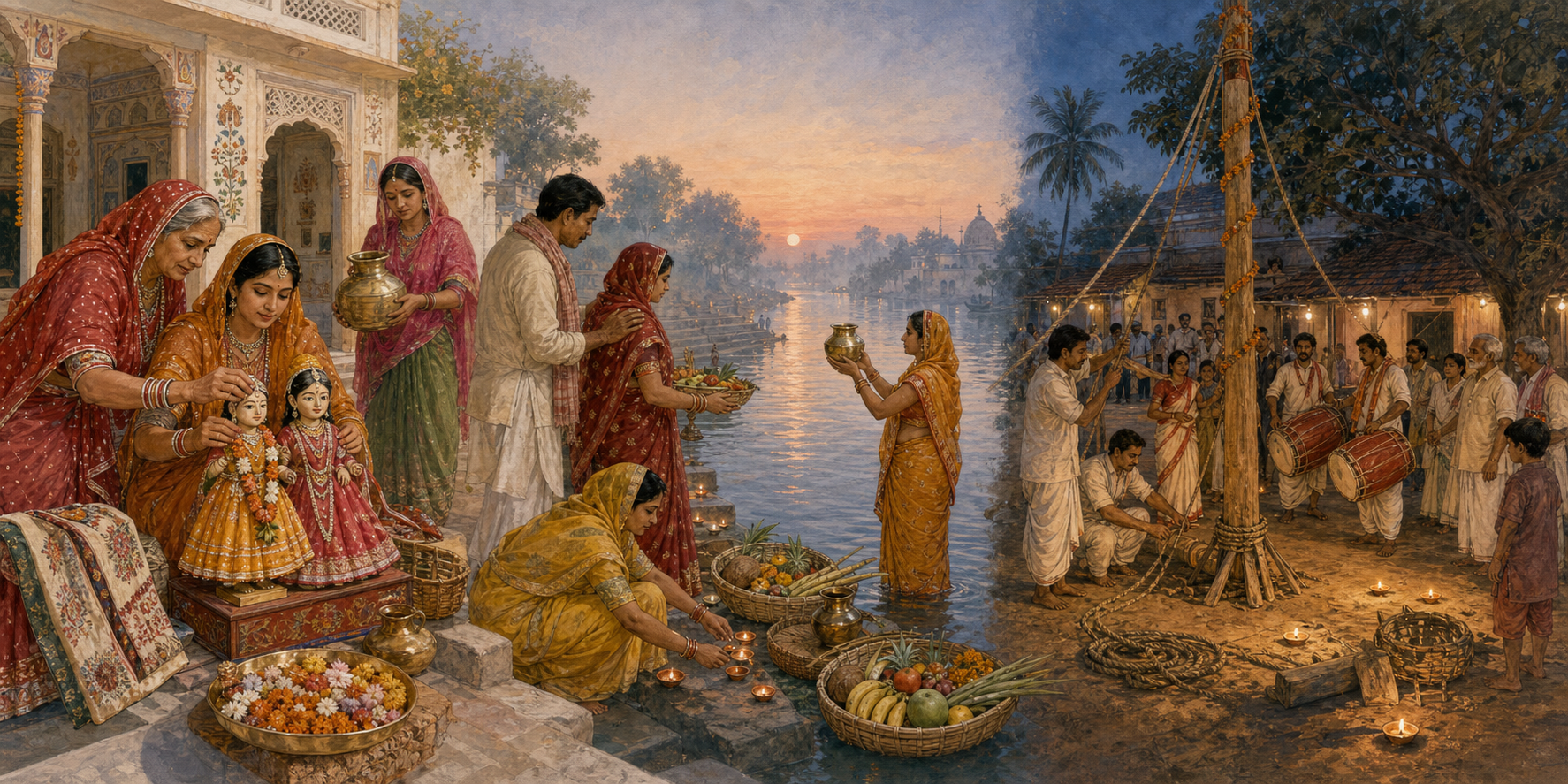
Gauri Tritiya invokes Parvati as Gauri, the auspicious and sustaining form of Devi. In Rajasthan, paired images of Isar and Gauri make the relationship between Shiva and Shakti publicly visible through Gangaur processions and folk traditions. Elsewhere, the same tithi may be observed as Soubhagya Gauri Vratam, Soubhagya Thadiya, Gauri Tritiya, Ganagouri Puja or Dola Gauri Vratam.
Married women traditionally undertake the vrata for marital well-being and the health and longevity of their spouses. Unmarried women may pray for a virtuous and compatible partner. That customary focus need not make everyone else a spectator. Many families include men and other relatives in preparing the altar, arranging offerings, joining the prayers and honoring the larger ideal of grihastha dharma: a household sustained through mutual care rather than one person’s devotion alone.
For a home observance on March 21, use a sequence your household can complete attentively:
- Clean the altar and add rangoli or kolam according to family custom.
- Install a clay or wooden image of Gauri, paired Isar-Gauri images where customary, or a decorated kalasha with leaves, coconut, turmeric, kumkum and flowers.
- Take a clear sankalpa for saubhagya, peace and family well-being, then invoke Ganesha before beginning the principal worship.
- Offer the customary upacharas to Gauri. A brief Uma-Maheshwara puja can keep the emphasis on companionship, balance and mutual respect.
- Recite a familiar invocation such as Om Gauryai Namah, Om Parvatyai Namah or Sarva-mangala-mangalye. If your family knows a longer stotra, use it without turning speed or quantity into the measure of devotion.
- Conclude with arati and prasada. Where haldi-kumkum or the honoring of sumangalis belongs to your custom, prepare turmeric, kumkum and modest items of shringara without making display the centre of the day.
Fasting is not uniform. Some devotees take fruit or light fasting food until puja is completed, while stricter forms also exist. Choose the form your health and household tradition can responsibly sustain. The vrata’s ethical centre is disciplined care; physical severity is not a substitute for it.
Chaiti Chhath: plan the whole vow, not just the photographs at the ghat
Chaiti Chhath is a demanding domestic and communal discipline dedicated to Surya and revered through Chhathi Maiya. It is especially rooted in Bihar, Jharkhand, eastern Uttar Pradesh and the Mithila-Terai belt. Its ritual form is strikingly non-iconic: clean food, water, the visible sun and the devotee’s vow do most of the theological work.
The four days have distinct purposes:
- On Nahay-Khay, March 22, the household establishes purity through bathing, cleaning the kitchen and preparing a single sattvik meal. Lauki-bhat, chana dal and ghee are common components.
- On Kharna, March 23, a day-long fast ends after sunset with a restrained prasad such as jaggery kheer, ghee-smeared chapati and bananas. Many devotees then begin a roughly 36-hour nirjala fast that continues until the dawn offering.
- On Sandhya Arghya, March 24, devotees approach the water with bamboo soop or daura carrying thekua, fruit, rice sweets, coconut, sugarcane and lamps. The offering is made to the setting sun at the locally correct sunset.
- On Usha Arghya, March 25, the vow reaches completion before the rising sun. Parana follows, and prasad is shared with relatives, neighbors and the wider community.
If one member of your family is undertaking the vrata, everyone else should plan around that person’s limited energy instead of treating the devotee as the event organizer. Other relatives can clean the cooking area, source ingredients, prepare baskets, check the ghat route, carry supplies, help elders and manage prasad distribution. That division of work lets austerity remain prayerful rather than becoming an avoidable logistical strain.
A prolonged nirjala vrata is a serious physical austerity. If a health constraint makes strict fasting unsafe, do not copy another person’s regimen merely to reproduce its outward form. Take individual medical guidance where needed and participate through a health-appropriate family role, prayer, preparation or service. The safety measures at the water also matter: adequate lighting, controlled entry and exit, first-aid arrangements and a clear place for elders are expressions of dharma, not distractions from it.
Keep plastic away from the offerings and the water. Bamboo baskets, earthen lamps, leaf plates and clay utensils already fit the material language of Chhath. Arrange waste collection before the gathering begins, because a cleanup announced after the ghat is littered has arrived one step too late.
Neel Puja and Charak: turn austerity toward protection and service
Neel Puja centres Shiva as Neelkantha, whose absorption of poison during the samudra manthan preserves cosmic order. The devotional ideal is therefore not pain for its own sake. It is the strength to contain hardship without passing its poison into the community. That ideal leads into the wider Gajan cycle of vows, restraint and simple living, culminating in Charak Puja at the turning of the Bengali year.
A household observance on April 12 can remain simple: clean the shrine, offer water, milk or panchamrita to the Shiva linga according to custom, place bilva leaves, light a ghee lamp, chant Om Namah Shivaya, meditate on the Neelkantha ideal and make one concrete pledge of service for the coming year. On April 13, you can carry that intention into a community Charak observance through collective chanting, circumambulation, prasada, folk performance or seva.
The tall Charak-gach is not merely fairground equipment. It serves as a ritual axis around which processions and the symbolism of the turning year move. Historical Gajan and Charak practices included fire-walking, piercing and high swinging. Do not imitate these acts informally or treat bodily danger as proof of greater devotion. Many communities now preserve the meaning through symbolic circumambulation, carefully staged theatre, dance, humane safety systems, tree planting, medical camps, community kitchens and other non-harmful forms of self-offering.
The mela also deserves deliberate attention. Folk songs about Shiva, percussion, local theatre, crafts, seasonal foods and, in some places, seed exchange connect worship to cultural memory and agrarian preparedness. When you buy directly from an artisan, listen to a regional song with your children or support a safe folk performance, you help keep the festival’s knowledge-bearing institutions alive. The fair is not an optional commercial fringe around the puja; it is one of the places where ritual memory passes between generations.
Build an observance that remains recognizably yours
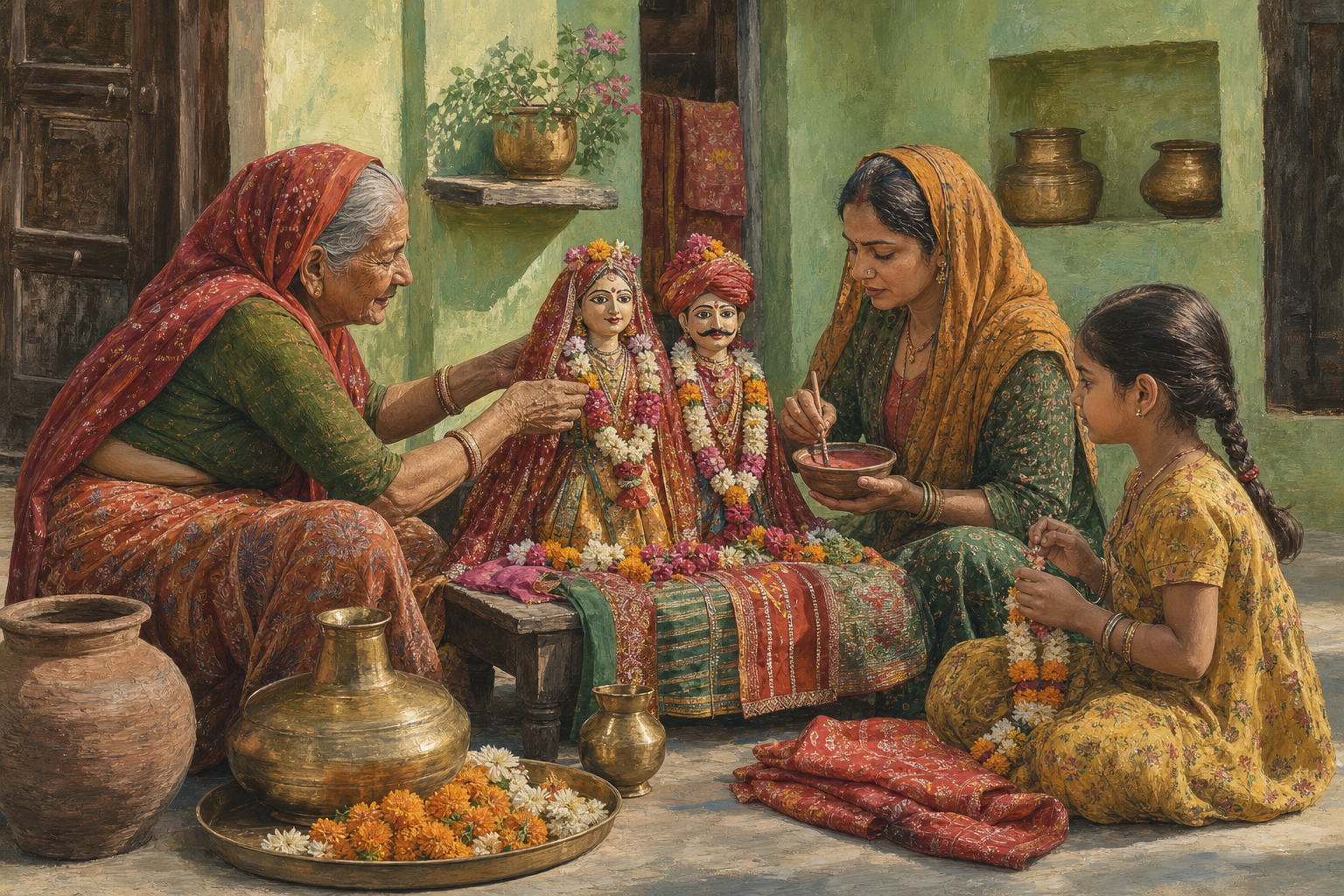
A date alone cannot preserve a tradition. Your plan also needs the correct devotional centre, sequence, material culture and community responsibility. A useful household method is:
- Name the lineage of the observance. Record the family term, region, deity and person who taught the present generation.
- Confirm the local sacred time. For Gauri Tritiya, verify the applicable Tritiya rule; for Chhath, obtain local sunset and sunrise; for Neel and Charak, consult the Bengali panjika used by your community.
- Protect the complete ritual unit. Reserve March 22 through March 25 if your household is keeping Chaiti Chhath, and April 12 and April 13 if it is observing the Neel-Charak sequence.
- Choose a truthful scale. A careful home puja is better than an elaborate public imitation that your family cannot perform safely or explain.
- Assign ritual and service roles separately. Decide who keeps the vrata, who cooks, who checks timings, who supports elders, who manages lamps and who handles cleanup.
- Preserve at least one language-bearing element: a Bhojpuri, Maithili or Magahi Chhath geet; a Rajasthani Gangaur song; or a Bengali Shiva or Gajan song. Explain its place in the ritual rather than playing it as anonymous festival music.
- Give the vow a public consequence. A clean ghat, shared prasada, support for artisans, a community meal, a tree-planting effort or another appropriate act of service makes collective welfare visible.
When one household carries more than one regional tradition
A family with Rajasthani, Bihari, Jharkhandi, Purvanchali or Bengali inheritance may legitimately keep more than one Chaitra observance. Do not force them into a synthetic pan-Indian ceremony. Keep the name, deity, tithi or solar marker, food rules and devotional intention of each practice distinct. Gauri worship should remain Gauri worship; Surya arghya should remain Chhath; Shiva-centred Neel and Charak rites should retain their Bengali year-end setting.
The unity lies deeper than identical ritual. Gangaur turns domestic auspiciousness into mutual responsibility. Chhath joins self-discipline to gratitude for light, water and nourishment. Charak joins tapas to courage, agrarian renewal and communal welfare. Purity, restraint, ahimsa, gratitude and seva form a shared dharmic grammar without erasing regional vocabulary.
When you live outside the region that formed the festival
Distance changes logistics, not the need for precision. Chhath communities in major Indian cities and abroad use suitable local water bodies while retaining bamboo baskets, earthen lamps, regional songs and the two solar offerings. Bengali-speaking communities in Bangladesh, Tripura and Assam’s Barak Valley preserve Charak with their own drumming, songs, decorations and foods. Gangaur likewise carries its identity through paired Isar-Gauri forms, songs, processions and household Gauri worship.
Start with what cannot be improvised: the correct local time, a safe worship site and the full sequence of the vow. Then preserve a few high-meaning details rather than accumulating generic decoration. A correctly timed arghya, a family recipe prepared under the vrata’s purity rules, a song in the inherited language and a child who knows why it is sung carry more tradition than a room full of objects without context.
If you are joining a regional observance that is not your inherited custom, enter as a participant and helper. Learn the name of each ritual stage, follow the host community’s food and purity rules, and take on practical seva. Curiosity is welcome; redesigning the vow around what looks visually impressive is not.
Key takeaways
- There is no single civil date for all Chaitra observances. Lunar tithis, local sunrise and sunset, and Bengal’s solar year-end produce different but coherent calendars.
- In 2026, Gauri Tritiya falls on March 21; Chaiti Chhath runs from March 22 to March 25; Neel Puja is on April 12; and Charak Puja is on April 13, subject to local Panchang or panjika confirmation.
- Keep the entire observance, not only its public climax: four days for Chaiti Chhath and the two-day Neel-Charak rhythm.
- Do not flatten Gangaur, Chhath and Charak into interchangeable spring festivals. Preserve each one’s deity, timing, food discipline, ritual sequence and regional language.
- Strict fasting and historical Charak austerities should never be copied without regard for health and physical safety. A simplified, non-harmful role can preserve devotional intent.
- Clean water, biodegradable materials, support for elders, folk arts, artisans and community service are part of responsible observance, not optional additions.
Begin with one page in your family calendar: write the inherited name of the observance, the local Panchang you will consult, every date the complete sequence requires and the person responsible for each ritual or service task. That small act will let you enter Chaitra with clarity while giving the next generation something more durable than a list of festival dates.
References
- DharmaRenaissance Blog — Charak Puja 2026 (Neel Puja): A Sacred, In-Depth Guide to Dates, Gajan Rituals and Meaning in Bengal
- DharmaRenaissance Blog — Chaiti Chhath 2026: Definitive 4-Day Guide to Dates, Rituals, and Devotional Sunrise Offerings
- DharmaRenaissance Blog — Soubhagya Gauri Vratam 2026 (Gangaur): Date, Puja Vidhi, Chaitra Tritiya Significance & Traditions
