

If you need to choose a time on March 12 for sadhana, a sankalpa, an important signature, or the first step of a new undertaking, do not begin with a clock time copied from a national calendar. Begin with your location. The day’s Tithi can be stated for India, but Rahu Kalam and the other practical muhurta windows move with local sunrise and sunset.
For Thursday, March 12, 2026, the useful planning sequence is straightforward: identify what the day contains, calculate the three adverse daylight segments, choose a window suited to your task, and add Nakshatra, Yoga, Karana, or Choghadiya only when the decision warrants that extra precision.
Read the date correctly before choosing a time
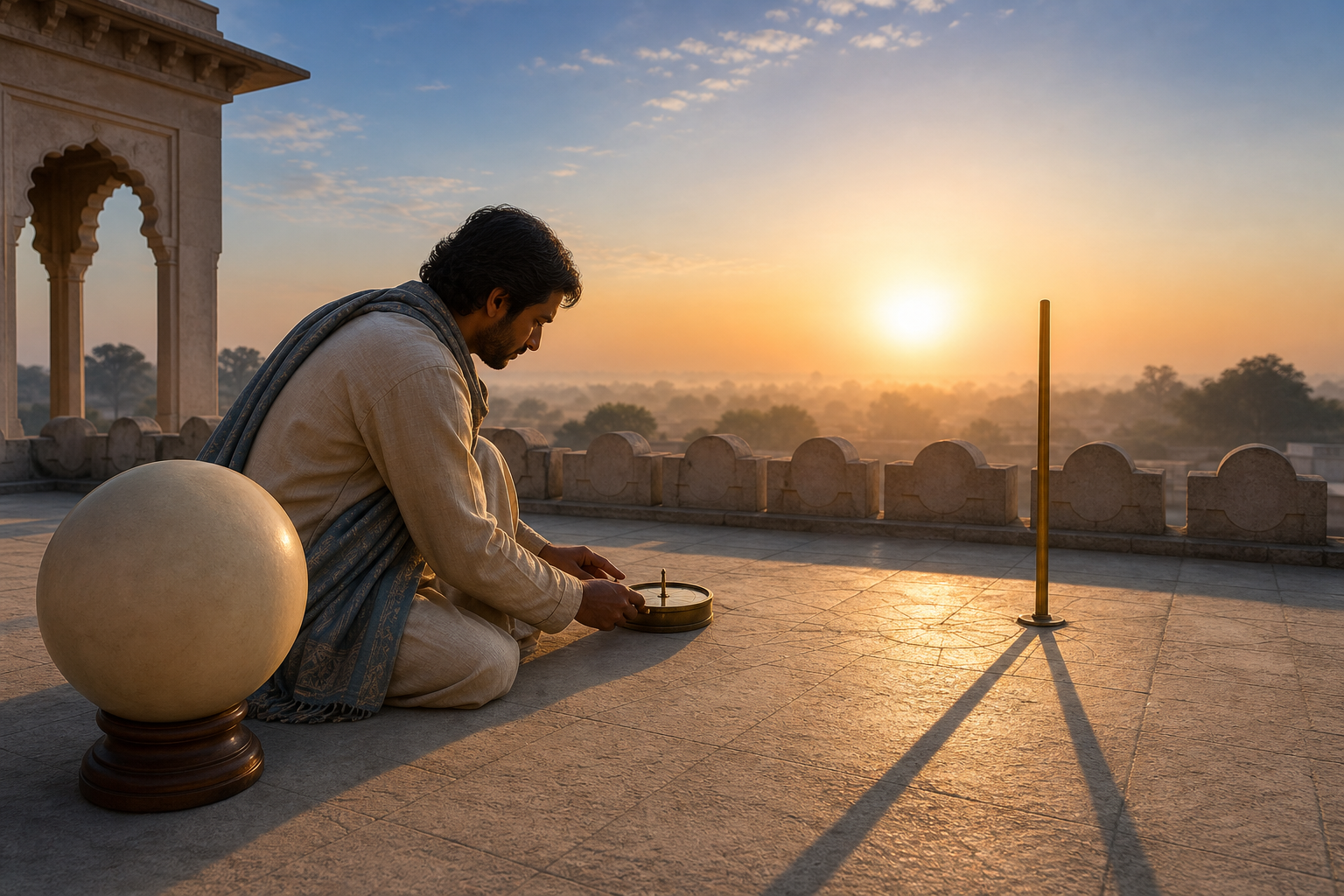
In the India-centric reckoning, the civil date opens in Krishna Paksha Ashtami. Ashtami ends at 02:17 on March 12, after which Krishna Paksha Navami prevails for the remainder of the day. A morning or daytime observance in India therefore belongs to Navami, even though the Tithi at civil midnight was Ashtami.
This distinction matters because a Tithi is not another name for a weekday or calendar date. It is one of the 12-degree stages formed by the changing angular separation of the Sun and Moon. A Tithi can begin or end at any clock time, so midnight does not control the transition.
You may also encounter two different month names for the same day. In the amanta system followed across much of western and southern Bharat, this is Phalguna Krishna Navami. In the purnimanta system common in northern Bharat, it is Chaitra Krishna Navami. Neither label is an error. The two systems place the lunar-month boundary differently while agreeing on the running Tithi.
The indicative lunar picture places the Moon in Vrishabha, or Taurus, for much of the Indian civil day, probably moving through Rohini toward Mrigashirsha. Treat that as the day’s broad texture, not as an exact event time. The combination is traditionally read as steady and methodical, making sustained work, careful planning, patient refinement, and orderly follow-through more natural choices than a hurried display.
Your city and chosen hour can change the precise Nakshatra span and Chandra Rashi. If a ceremony, major commitment, or irreversible decision depends on them, verify both in a location-aware Panchang rather than relying on the India-wide indication.
Calculate Thursday’s adverse periods from local daylight

Rahu Kalam, Yamaganda, and Gulika are not fixed clock appointments. They are produced by dividing the interval from local sunrise to local sunset into eight equal parts. A timetable calculated for Delhi cannot simply be carried to Toronto, London, Singapore, or even another Indian city without checking the local solar times.
- Record March 12 sunrise and sunset for the city where the action will actually occur.
- Put both times in the same local time zone and calculate the total daylight length.
- Divide that daylight length by eight. Call the result one block.
- Count the eight blocks forward from sunrise, retaining exact minutes rather than rounding each boundary separately.
- On Thursday, mark the third block as Gulika, the sixth as Rahu Kalam, and the seventh as Yamaganda.
If S is sunrise and B is one-eighth of the daylight interval, the working formulas are:
| Period | Thursday daylight block | Local interval | Planning response |
|---|---|---|---|
| Gulika | Third | S + 2B to S + 3B | Do not choose it merely because it is otherwise convenient; keep a new beginning outside it. |
| Rahu Kalam | Sixth | S + 5B to S + 6B | Avoid launching, signing, or performing the decisive first act of a new undertaking. |
| Yamaganda | Seventh | S + 6B to S + 7B | Keep initiatory work out of this block and move it to a verified favorable interval. |
This calculation gives you the first filter, not the final muhurta. It tells you where not to place a beginning. Routine work already in progress does not have to stop every time an adverse block begins, but the defining first act should be scheduled elsewhere when you have a genuine choice.
If your household uses Choghadiya, calculate it separately for day and night. Each interval is divided into eight local blocks. Amrit, Shubh, and Labh are generally preferred; Char is usable for neutral or functional activity; Udveg, Rog, and Kaal are normally avoided for beginnings. Do not divide a standard 24-hour clock into equal three-hour pieces, because seasonal day and night lengths are not necessarily equal.
Match the muhurta to the work you are actually doing
A favorable label is useful only when it fits the act. Meditation at Brahma Muhurta, a concise signature at Abhijit, and a difficult closure at Vijaya are three different uses of sacred time.
- Brahma Muhurta: Anchor your predawn practice at approximately 1 hour 36 minutes before local sunrise. Use the quiet for japa, meditation, pranayama, gentle yoga, or scriptural study. Because the anchor moves with sunrise, recalculate it for your city instead of reusing a time from another date.
- Abhijit Muhurta: Find the midpoint between local sunrise and sunset, then use approximately 24 minutes on either side of that midpoint as a working window. This roughly 48-minute interval suits a clear sankalpa, a key submission, a short inauguration, or the decisive signature on work that has already been examined properly.
- Vijaya Muhurta: Look near the point approximately 1 hour 36 minutes before local sunset for a window lasting about 48 minutes. It is traditionally selected for constructive assertion, resolving an obstruction, or bringing an important effort to a successful close.
Vijaya requires particular care on this Thursday. It falls late in the daylight arc, while Thursday’s Rahu Kalam and Yamaganda occupy the sixth and seventh daylight blocks. Depending on local day length, the intervals can sit close together or overlap. Do not approve Vijaya from its name alone; compare its exact local boundaries against all three adverse periods.
For a high-stakes ceremony or commitment, refine the surviving window with Nakshatra, Yoga, and Karana. Yoga combines the solar and lunar longitudes into a cycle of 27 measures, while Karana is half a Tithi. Vishti, also called Bhadra, is commonly avoided for initiations. The running Yoga and Karana cannot be inferred safely from the civil date alone, so confirm them for the place and exact time of action.
Keep practical consequence separate from ritual timing. An auspicious interval cannot repair unfair contractual terms, an incomplete financial review, a missing legal requirement, or an unsafe decision. Complete the relevant professional checks first. If a binding deadline makes your preferred muhurta impossible, meet the obligation safely and use a favorable interval for the sankalpa, prayer, or first preparatory act instead of risking a penalty or breach.
Build a realistic March 12 schedule
Do this planning on March 11, not while the desired window is already passing. A workable schedule needs only one page:
- Name the action precisely. Write down the act that constitutes the beginning: making the sankalpa, submitting the form, signing the agreement, opening the session, or commencing the recitation. Preparation and routine follow-through are not necessarily the beginning.
- Fix the place of action. Use the location where the decisive act occurs. For a remote transaction, that may not be the same city as every participant.
- Enter local sunrise and sunset. Calculate the eight daylight blocks and cross out Thursday’s third, sixth, and seventh segments.
- Place spiritual practice first. Reserve the predawn Brahma Muhurta anchor for inward work before daytime obligations consume the schedule.
- Choose one primary daytime window. Use Abhijit for a concise initiation or signature. Use Vijaya for resolution or closure only after checking its late-day overlap.
- Apply secondary filters only as needed. Use Choghadiya for everyday regional planning. Add exact Nakshatra, Yoga, and Karana for a major ritual, samskara, or consequential undertaking.
- Record a fallback. If the preferred window disappears after all exclusions, move the initiatory act rather than squeezing it against an uncertain boundary.
Krishna Paksha Navami also gives you a sound fallback when no major beginning is necessary. Use the day for svadhyaya, disciplined repetition, quiet seva, review, and the patient completion of existing work. The waning fortnight supports an inward, simplifying rhythm; you do not have to manufacture a grand launch merely because you consulted the Panchang.
Choose one devotional practice consistent with your own lineage. A Vaishnava may recite the Vishnu Sahasranama or repeat Om Namo Narayanaya. A Shaiva may undertake Om Namah Shivaya or a meditative Rudra recitation. A Jain practitioner may use the Navkar Mantra and reflect on Ahimsa or Aparigraha. A Buddhist may practise mindfulness, metta, and compassion. A Sikh may undertake Naam Simran and contemplate the Mool Mantar. Depth in one chosen practice is more useful than assembling a crowded programme.
Key takeaways for March 12
- In the India-centric reckoning, Ashtami ends at 02:17 on March 12, 2026; Krishna Paksha Navami then continues through the rest of the civil day.
- Phalguna Krishna Navami in the amanta calendar and Chaitra Krishna Navami in the purnimanta calendar describe the same running Tithi within different month systems.
- Calculate all clock windows from the sunrise and sunset of the place where the decisive action occurs.
- For Thursday, exclude the third daylight segment for Gulika, the sixth for Rahu Kalam, and the seventh for Yamaganda.
- Use Brahma Muhurta for sadhana, Abhijit for a concise beginning, and Vijaya for assertion or closure after checking for adverse overlap.
- For a consequential or ritually sensitive event, verify the exact Nakshatra, Chandra Rashi, Yoga, and Karana with a location-aware Panchang.
Before March 12 begins, write your local solar times, calculate the three excluded blocks, and identify both a preferred window and a fallback. That small preparation lets you honour the Panchang without turning the day into a search for an imaginary perfect minute.
References
