

You notice the need before anyone names it. An elderly devotee is missing appointments. A family needs meals after a crisis. A visiting teacher’s schedule has become unmanageable. A community kitchen is depending on the same exhausted volunteers. You want to help, but you also want to avoid intrusion, dependency, unsafe improvisation, or burnout.
The answer is not less seva. It is seva with a dependable form: the person’s actual need comes first, responsibilities are explicit, consent continues throughout the relationship, and the community shares the work. That is how a devotional impulse becomes ethical community care.
Key takeaways
- Begin with the burden the person wants relieved, not the role a volunteer wants to perform.
- Define the task, its limits, the responsible person, a backup, and the point at which professional help is required.
- Treat competence as part of devotion. Sacred intention does not compensate for unsafe food, missed messages, careless health support, or broken confidentiality.
- Preserve dignity through choice, privacy, predictable service, and a clear way to decline help or raise a concern.
- Protect the sevaka’s sadhana, sleep, and time off. A service that consumes its caretakers will eventually fail the people who depend on it.
Start with the burden, not the service role
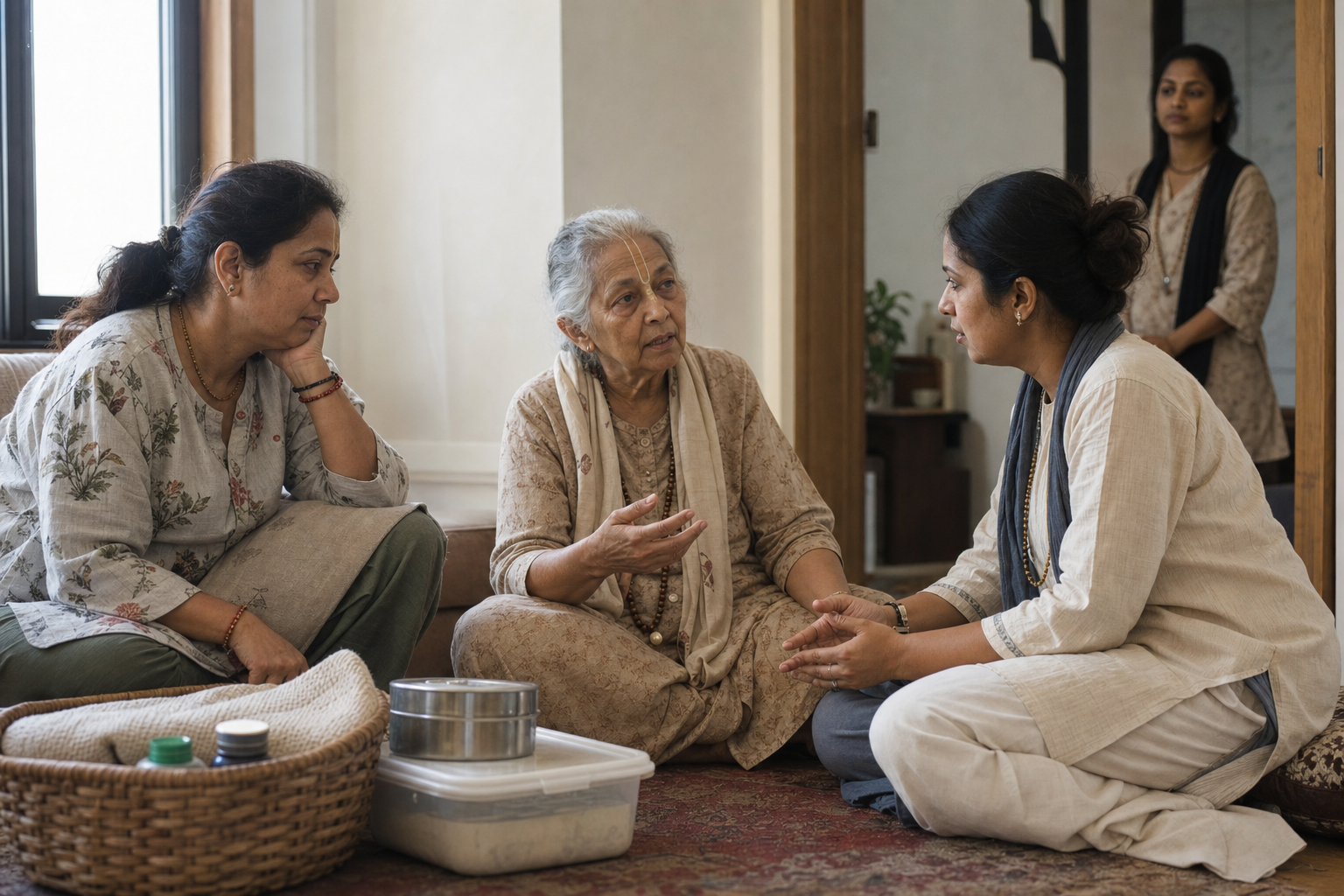
Vaishnava seva has an inward and an outward test. Inwardly, the sevaka offers effort to Bhagavan without seeking status or control. Outwardly, the effort must actually relieve a burden while respecting the person receiving care. Good intention passes only the first test.
A durable Vaishnava care model brings devotion, practical competence, and ethical responsibility into the same act. Remove devotion and service can become cold administration. Remove competence and it becomes unreliable. Remove ethics and even affectionate care can become coercive, unsafe, or humiliating.
Before accepting a recurring seva, ask the person receiving care a few direct questions:
- What do you want help with?
- What would a useful result look like for you?
- What may we share with other volunteers, and what must remain private?
- Are there tasks you do not want us to perform?
- Who should be contacted if the usual plan cannot be followed?
- What would make you want to pause or end this arrangement?
These questions prevent a common mistake: deciding that someone needs spiritual encouragement when the immediate problem is transport, food, rest, translation, paperwork, or a reliable phone call. Spiritual companionship may be welcome, but it should not be imposed as the price of practical help.
Sort the request by the kind of response it requires. A practical need can be assigned to a capable volunteer. A recurring need requires a schedule and backup. A health or safety concern may require a clinician, safeguarding lead, or local emergency service. A spiritual request belongs with someone trusted and qualified for that form of guidance. One devoted person should not quietly absorb every category.
Dignity also affects how care is offered. A flat $5 Krishna Lunch served on a reliable five-day rhythm gives students an ordinary way to obtain an affordable meal without having to present themselves as charity cases. The lesson is broader than pricing: design the service so participation feels normal. Publish the schedule. Explain what is available. Avoid unnecessary eligibility tests. Do not make recipients recount private hardship to every volunteer they meet.
Your first planning question, then, is not “What seva can we launch?” It is “Which recurring burden can we remove reliably without taking away the person’s voice?” The answer will tell you what to build.
Put consent, boundaries, and escalation in writing

Informality feels warm when everyone understands the arrangement. It becomes dangerous when expectations differ. The devotee believes transport includes every appointment; the driver expected an occasional trip. A sevaka thinks schedule management permits answering private correspondence. A person receiving care thinks a confidential disclosure will stay private, while the volunteer assumes it may be discussed with temple leadership.
A brief written seva agreement prevents much of this confusion. It does not need legalistic language. Record the following in words everyone involved can understand:
- Purpose: the burden this seva is intended to relieve.
- Included tasks: the work volunteers have agreed to perform.
- Excluded tasks: work that requires another role, additional consent, or professional competence.
- Decision rights: what the recipient decides, what the sevaka may decide, and what needs leadership approval.
- Communication: the preferred channel, reasonable response expectations, and who receives updates.
- Privacy: what may be recorded or shared, with whom, and for what purpose.
- Safety escalation: whom to contact when the situation exceeds the volunteer’s role.
- Costs: who may incur expenses, how approval works, and how receipts are handled.
- Backup and handoff: who takes over when the usual sevaka is unavailable.
- Review and exit: how either person can change or end the arrangement without retaliation or spiritual pressure.
This matters because personal seva can reach into schedules, sadhana, health support, travel, correspondence, and documentation. Each area grants a different kind of access. Permission to arrange a journey is not permission to read unrelated messages. Permission to prepare prasada is not permission to decide what someone must eat. Permission to remind a devotee about an agreed appointment is not authority over the rest of the day.
Consent is not a ceremonial approval collected at the beginning. It must continue. Ask again when the task changes, a new volunteer joins, private information must be shared, or a temporary arrangement becomes recurring. A respectful no does not become disobedience merely because the request arose in a devotional setting.
This principle is especially important in guru-seva. Service to a guru honors the parampara when it remains anchored in scripture, accountability, and community norms rather than personality worship. Reverence does not give any individual unlimited control over another devotee’s time, body, money, communications, or conscience. Questions and grievances should be able to reach a responsible person other than the one being served.
Health-related seva needs a particularly clear line. A volunteer may arrange transport, prepare an agreed meal, help book an appointment, or give a reminder that the person requested. The volunteer should not diagnose symptoms, alter medication, conceal a serious concern, or present devotional practice as a substitute for clinical care. If a situation appears urgent or dangerous, contact an appropriate professional or local emergency service instead of improvising.
A useful boundary survives a change of personnel. If only one charismatic or unusually devoted person knows what the role means, the community does not yet have a care system. It has a dependency.
Make dignity visible in the daily operating system

Ethical care is usually decided by ordinary details. Was the meal suitable? Did the driver arrive? Was a private message forwarded carelessly? Did someone know who was taking over? Was the person helped, or managed?
Food seva needs hospitality and discipline
Preparing prasada joins nourishment, devotion, and welcome. It also involves hygiene, dietary restrictions, timing, storage, transport, and clear ingredient information. Assign responsibility for each of those tasks before service begins. If the community cannot safely prepare or transport a requested meal, say so and find an appropriate alternative.
Reliability does not appear by sentiment alone. In Westwood, the documented Krishna Lunch routine has cooking beginning at approximately 5:30 a.m., with the working day often extending until around 7 p.m., five days a week. That cadence reflects serious devotion, but it also reveals the operational weight behind a simple plate: procurement, batch preparation, cost control, service timing, cleanup, and repetition.
Do not build a kitchen around admiration for one person’s stamina. Document recipes and restrictions. Keep purchasing records understandable. Train substitutes. Establish what happens when ingredients, transport, or volunteers are unavailable. Predictability is part of the nourishment because people can plan around it.
Facilitate sadhana without policing it
A sevaka may prepare a clean worship space, place sacred texts within reach, coordinate transport to kirtan, or give a reminder that was requested. The operative word is facilitate. The person retains agency over spiritual practice unless a distinct, mutually understood relationship assigns another kind of responsibility.
Build schedules around human energy as well as temple commitments. Include meals, rest, travel time, and room for delays. A calendar packed to its theoretical limit turns every disruption into a crisis and makes the sevaka responsible for impossible promises. Rhythm supports devotion; rigidity can make both care and sadhana brittle.
Use the minimum necessary information
Care often creates records: addresses, travel plans, dietary needs, health-related instructions, correspondence, expenses, and contact details. Collect only what the task requires. Store it where only responsible people can access it. Do not place private information in a general volunteer chat merely because that channel is convenient.
Separate facts from impressions. A handoff should state the request, what was agreed, what has been completed, the next action, the responsible person, and any genuine safety concern. It should not include speculation about someone’s character, spiritual standing, family, or health.
If a person reports harassment, coercion, discrimination, financial misuse, or another serious breach, do not route the complaint only through the person whose conduct is in question. Ethical seva requires a transparent path to leadership and a workable grievance process. Confidentiality should protect dignity, not hide misconduct or prevent necessary safeguarding.
Close every handoff
Many care failures happen between willing people. One volunteer assumes another has called. A message is acknowledged but not assigned. A driver cancels without confirming a replacement. Prevent this with closed-loop communication: name the task, name the owner, confirm acceptance, record any deadline, and notify the person affected when the plan changes.
Keep the process proportionate. Delivering a meal does not require an elaborate dossier. Coordinating recurring health appointments, international travel, or confidential correspondence needs more control. The amount of documentation should follow the risk and complexity of the task, not the status of the person being served.
Share the load so care outlives the caretaker

Burnout is not proof of pure devotion. It is a warning that the arrangement may soon become unreliable or harmful. Sustainable seva protects the sevaka’s own sadhana, adequate sleep, wholesome food, and reasonable time away from duty. These are not rewards granted after all needs disappear. They are conditions for sound judgment.
Watch the structure, not only the volunteer’s mood. The risk is rising when one person cannot take time off, keeps essential knowledge in private messages, has no trained substitute, regularly sacrifices sleep, or feels that saying no would be a spiritual failure. Leadership should intervene before exhaustion becomes a missed meal, unsafe drive, privacy breach, angry exchange, or abrupt departure.
Every recurring seva should have:
- a named coordinator who can answer for the whole task;
- a backup who has enough information and access to take over;
- written instructions for safety-critical or easily forgotten steps;
- a handoff method that does not depend on memory;
- a clear limit on availability;
- regular opportunities for the sevaka and recipient to give separate feedback;
- a way to report concerns without fear of humiliation or retaliation.
Training should also be treated as seva. Let a new volunteer observe the task, perform it with supervision, and then take responsibility only when the relevant people are confident. Teach communication and boundaries alongside technique. A skilled cook who ignores restrictions, a punctual driver who shares private conversations, or an affectionate attendant who overrules consent is not yet ready for independent care.
This institutional form has close dharmic resonances. Sikh langar joins nourishment with equality. Buddhist attendant and lay-steward roles support contemplative life through discreet practical help. Jain vaiyavritya expresses disciplined care for ascetics. These traditions are not interchangeable, but they share an ethic of reducing burdens through humility, restraint, and dependable action. Service becomes a community practice rather than a heroic private performance.
The person receiving care should remain a participant in that practice, not its passive object. Offer choices where choices are possible. Ask whether the arrangement still helps. Make it possible to request a different volunteer. Accept gratitude without demanding repayment, loyalty, or spiritual conformity. Community care is strongest when it expands agency and trust.
At your next planning meeting, choose one recurring seva and fill every field in the written agreement: purpose, tasks, limits, consent, privacy, escalation, costs, backup, review, and exit. If you cannot name the backup or the boundary, repair that duty before adding another program. This small act of clarity is itself seva to the volunteer, the person receiving care, and the whole Vaishnava community.
References
- Dandavats – Compassionate Seva in ISKCON: Ethics, Competencies, and Dharmic Unity at Almviks gard
- Dandavats – How $5 Krishna Lunch Nourishes Westwood: Seva, Dignity, and Student Food Security
