
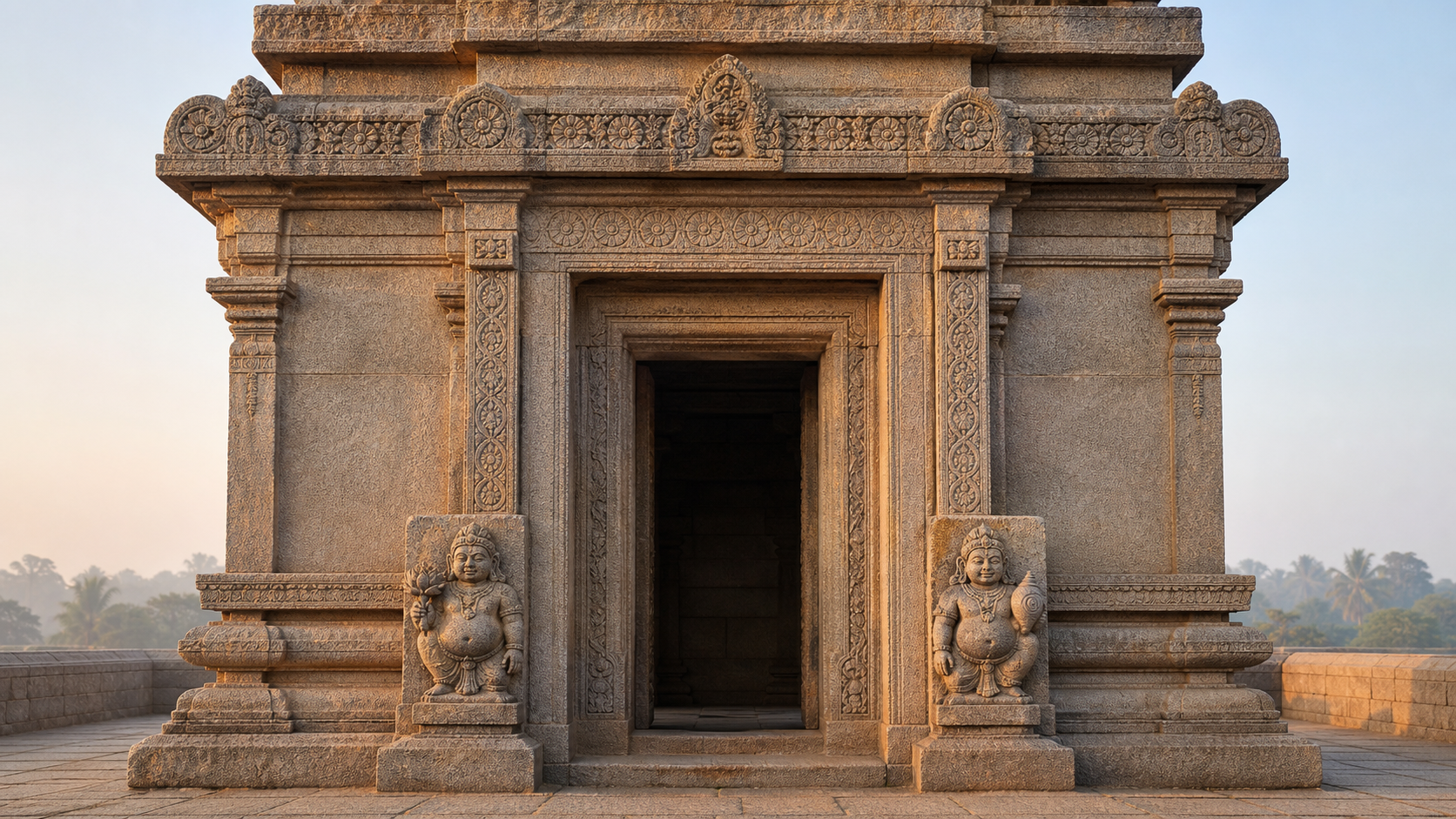
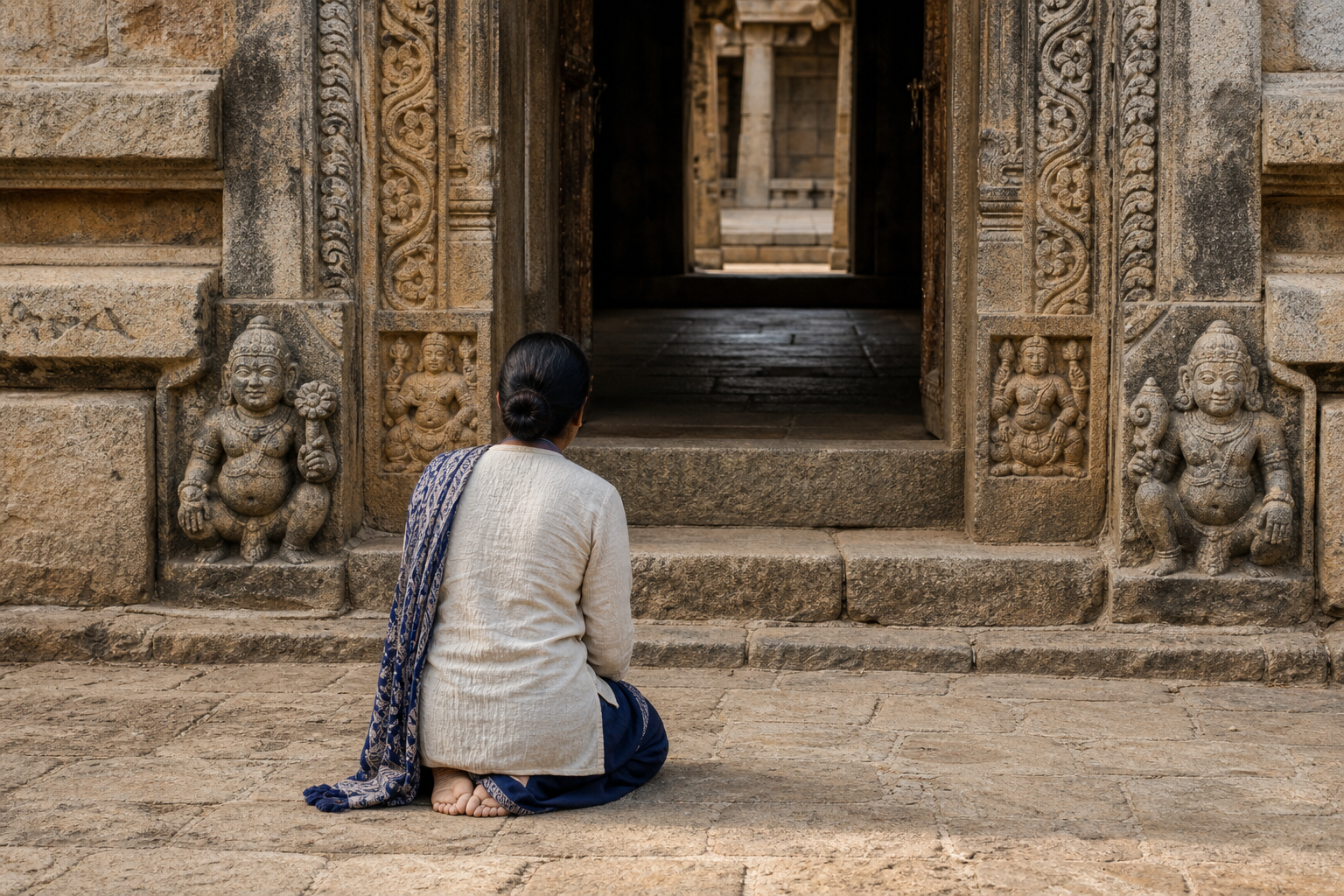
You are standing before a South Indian temple doorway and notice a small, pot-bellied figure near the base. It looks too gentle to be a door guardian and too deliberately placed to be incidental decoration. If a lotus appears in its hand or beside it, you may be looking at Padma Nidhi, the personified lotus treasure associated with Kubera.
The safest identification does not begin with the lotus alone. You need to read the figure, its companion, and the entire doorway together. Once you do that, an easily overlooked carving becomes a concise lesson about sacred entry, prosperity, and the dharmic use of wealth.
Find Padma Nidhi by reading the whole doorway
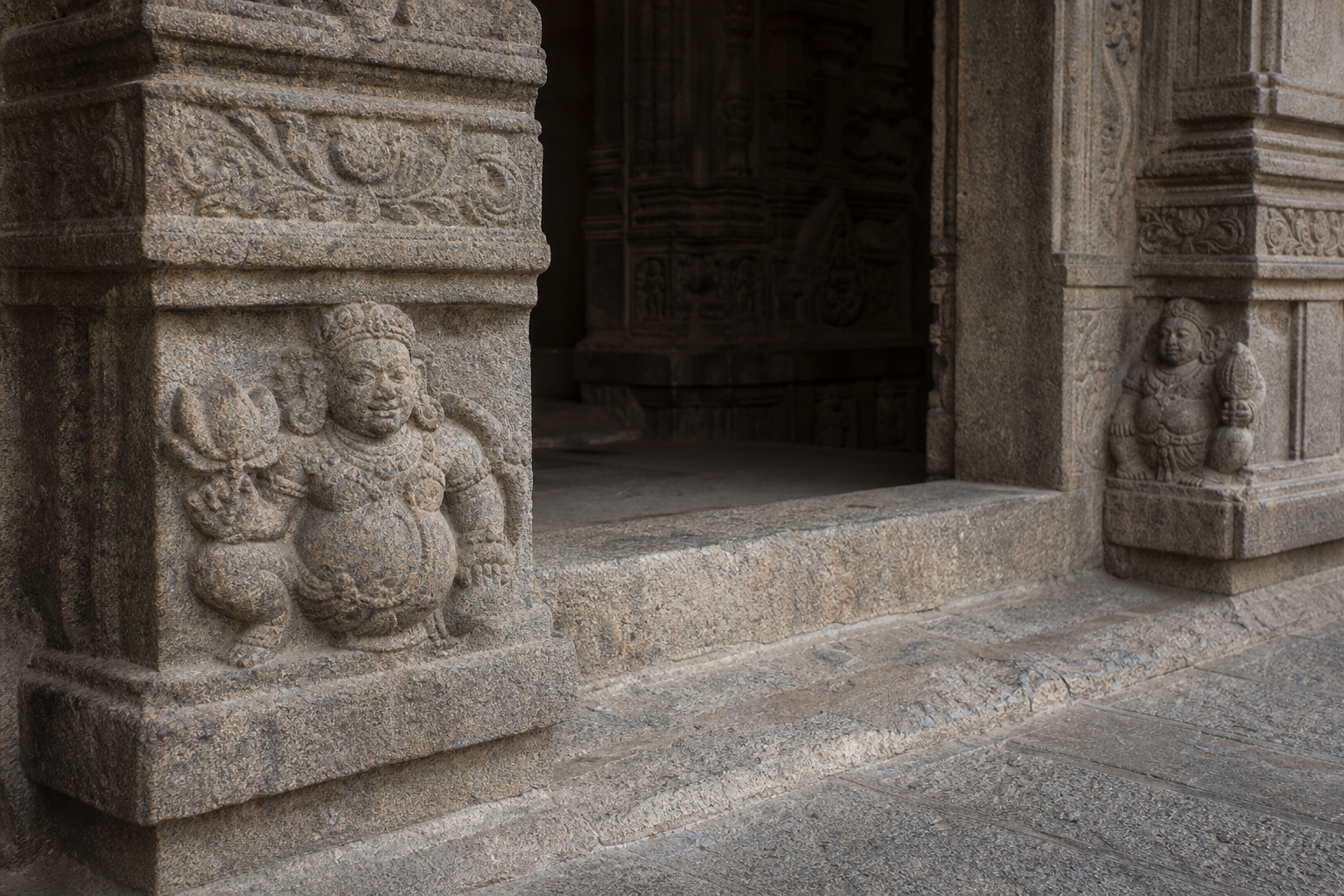
Begin with the architecture rather than the smallest carving. Padma Nidhi usually belongs to a coordinated threshold arrangement, so its position can tell you as much as the object it carries.
- Locate the principal doorway into the garbha-griha or mukha-mandapa. The pair is most meaningful at a transition into more sacred space, not beside an unrelated wall sculpture.
- Step back and examine the upper register. A lalata-bimba, often showing Gaja-Lakshmi, may occupy the area above the lintel.
- Look for the larger dvarapalas. Their scale, posture, and higher position usually make their protective role immediately visible.
- Now lower your gaze to the base of the jambs or adjoining plinth, roughly within the ankle-to-knee register. This is where the compact Nidhi figures are often placed.
- Search for a pair. One member should have a lotus-related attribute and the other a conch-related attribute. These are Padma Nidhi and Shankha Nidhi.
This vertical arrangement is not arbitrary. The dvarapalas establish vigilance, the image above the lintel announces divine grace, and the Nidhis stabilize the threshold with auspicious treasure. Together they form a program of protection, grace, and abundance.
Do not rely on a fixed left-or-right rule when the attributes are visible. Regional workshops and later alterations can vary the presentation. Identify the figures from their objects, bodily form, paired placement, and relationship to the doorway.
Distinguish the lotus treasure from a generic dwarf
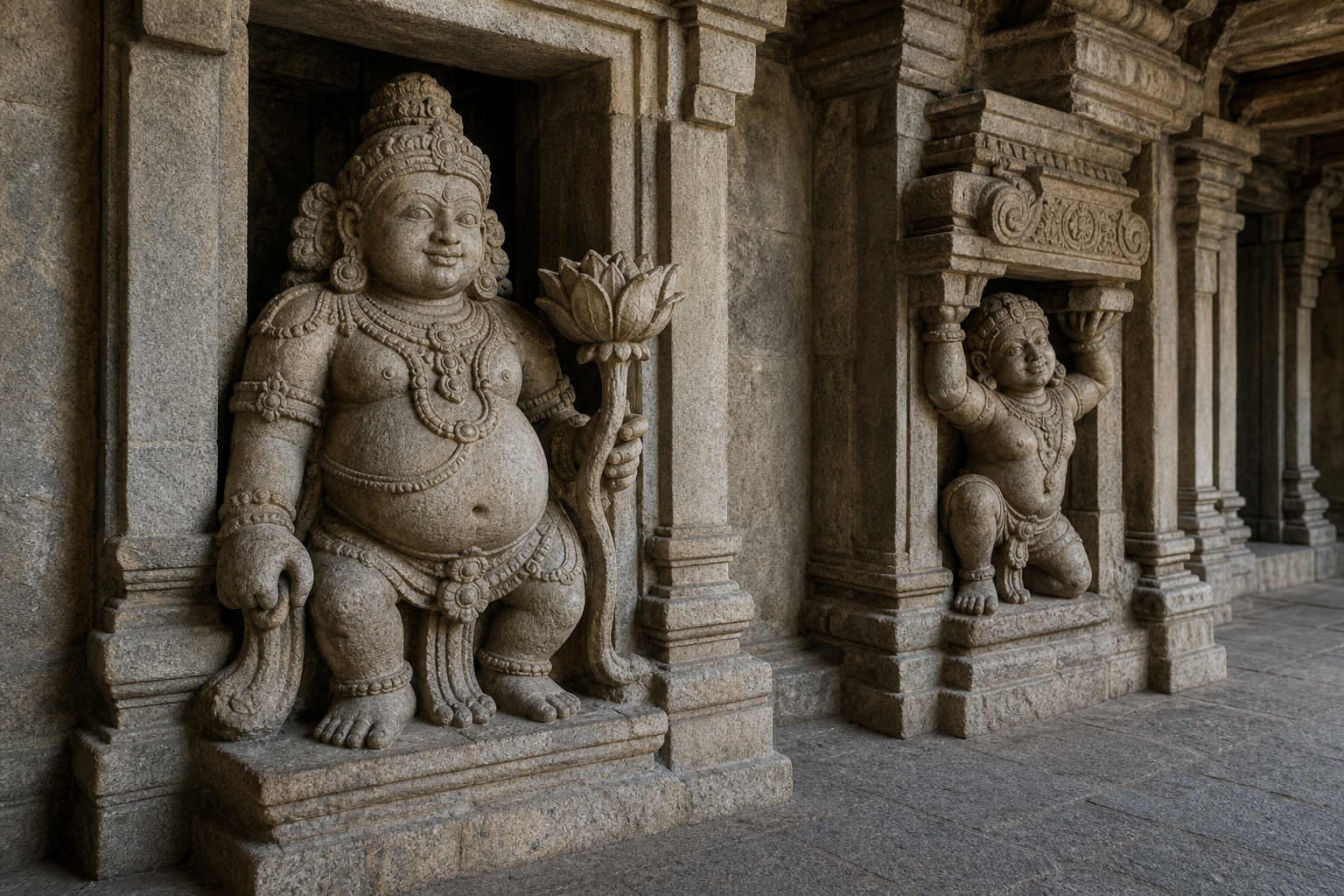
Padma Nidhi is a personified treasure, not simply a miniature image of Kubera. Nor is every small, pot-bellied temple figure automatically a Nidhi. Look for several clues working together.
- Body: The figure is commonly compact, youthful or dwarfish, and pot-bellied rather than tall and martial.
- Expression: The face is usually serene. Its composure contrasts with the more emphatic vigilance of a dvarapala.
- Ornament: Jewelry, anklets, and a waistband may be carved even when weathering has softened the smaller details.
- Padma attribute: A stylized lotus is the clearest sign. A purse-like bag, cornucopia, or treasure urn may also communicate stored abundance.
- Gesture: The hands may suggest a restrained boon-giving attitude, but a damaged or ambiguous hand should not outweigh the architectural context.
- Companion: Shankha Nidhi is associated with a conch. A recognizable conch-bearing partner substantially strengthens the identification of the lotus-bearing figure.
The lotus may be small, heavily stylized, or partly lost. Repainting can obscure the carving, while erosion and repairs can blur the object into a rounded mass. In those cases, use a three-part test: low threshold placement, the characteristic compact form, and a corresponding companion figure. A single clue is suggestive; all three are much more persuasive.
A practical confidence scale can keep you from over-identifying what you see:
- High confidence: Two compact figures occupy the lower doorway, and lotus and conch attributes remain legible.
- Moderate confidence: The paired placement and bodily type are clear, but one or both attributes are worn.
- Low confidence: A lone dwarfish figure appears outside a coherent doorway program and has no identifiable treasure attribute.
This is a field method, not a substitute for an inscription, an iconographic survey, or informed guidance from the temple tradition. Its purpose is to help you notice the right evidence before assigning a name.
Read the lotus as an ethic of prosperity
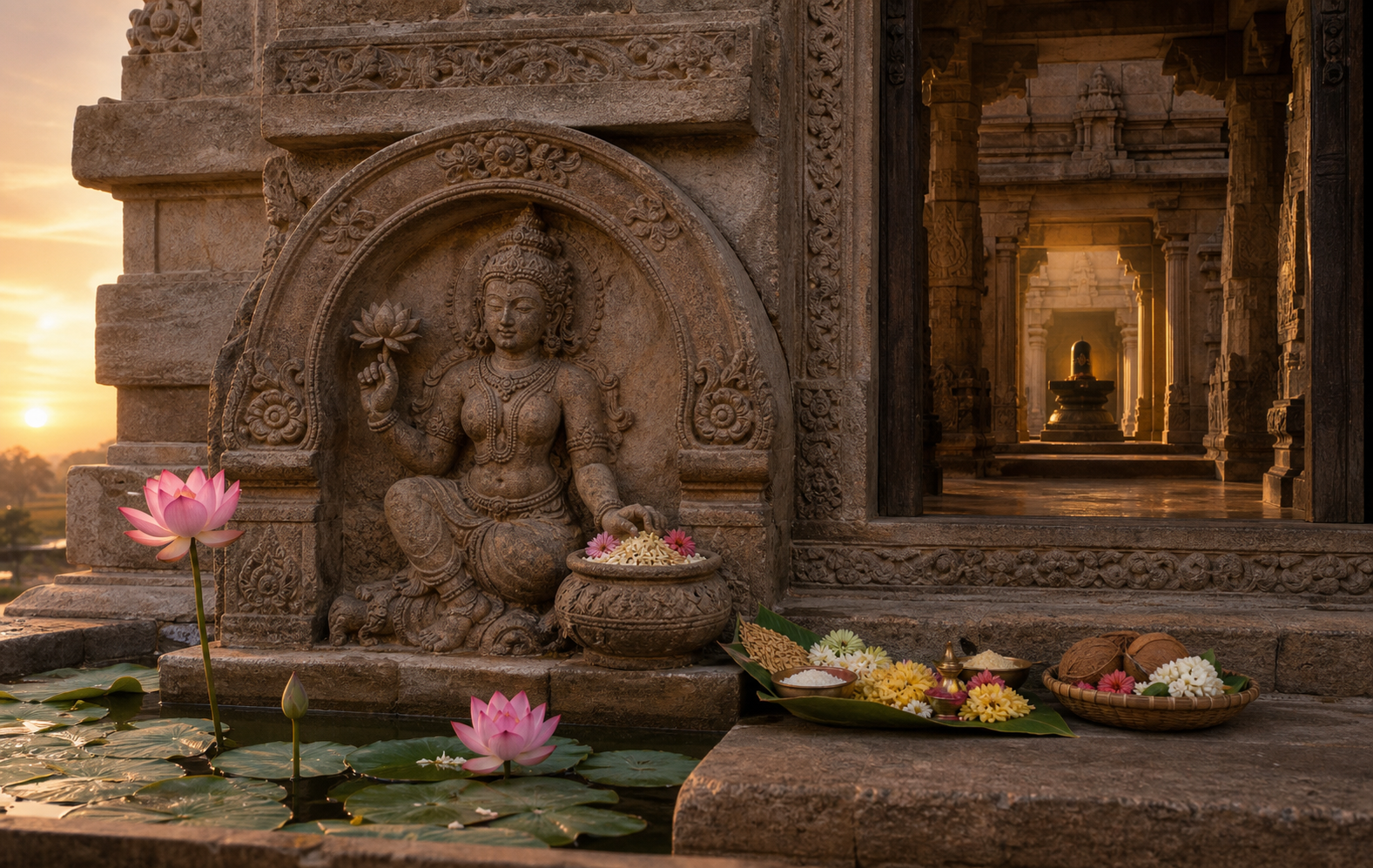
The Sanskrit word nidhi means a treasure or inexhaustible store. Padma and Shankha belong to the Ashta-Nidhi, the eight treasures associated with Kubera, also known as Vaishravana. Their personification converts an abstract treasury into figures that a devotee can recognize while crossing the threshold.
Padma, the lotus, brings together purity, fertility, and the unfolding of spiritual insight. Shankha, the conch, evokes primordial sound, victory, and protection. The pair therefore says more than “wealth is present.” It places abundance beside purity and protection, within an ordered sacred passage.
Kubera’s role clarifies the point. As the Dikpala of the north, he represents stewardship over wealth within the sacred geography of the Vastu Purusha Mandala. The Nidhis extend that stewardship to the doorway. They are generally not independent deities awaiting separate propitiation; they are auspicious presences within a larger architectural and theological statement.
This changes how you should interpret the image. Padma Nidhi is not a stone promise of private riches detached from conduct. Its position binds prosperity to entry into sacred order. Wealth should be preserved, directed, and circulated in the service of the deity, the community, and the care of the temple. Offerings and donations acquire their full meaning when they sustain worship, shared institutions, and inherited sacred places.
Traditional Indian numeration adds another layer: padma and shankha can also name very large numbers. At the threshold, the vocabulary of treasure can therefore move from a small carved body to abundance on a cosmic scale. Yet the figure remains near the devotee’s feet. The visual contrast is instructive: abundance may be vast, but its proper use begins with disciplined human action.
The same civilizational vocabulary crosses sectarian boundaries without erasing their differences. Vaishravana appears in Buddhism as the northern Lokapala and a guardian associated with monasteries. Jain art preserves analogous auspicious pairs at gateways and pillars. Hindu, Buddhist, and Jain canons do not make every figure identical, but they share a durable intuition: treasure belongs within ethical order, and a sacred threshold should prepare the person who crosses it.
When you next pause before such a doorway, ask a better question than “Will this bring me wealth?” Ask what kind of prosperity can cross this threshold without violating dharma, and what responsibility accompanies whatever you hope to receive.
Use dynasty and region as clues, not shortcuts
The Nidhi motif became established during the Pallava and early Chola phases, broadly within the seventh to twelfth centuries CE, and reached refined expression under the High Cholas. It continued through Pandya and Vijayanagara-Nayaka temple building and renovation. Examples survive across important temple landscapes associated with Kanchipuram, Thanjavur, Kumbakonam, and Srirangam, while related forms also entered the Dravidian temple traditions of Karnataka and Andhra.
Style can help orient your eye. Chola examples may favor rounded bodily modeling, while later figures can become more angular. Nayaka-period work may include stucco or polychrome treatment. These tendencies are useful clues, but they are not secure dates by themselves. A stone figure can retain an older core beneath later pigment, stucco, or repair.
The motif is not confined to one Hindu sectarian setting. Major Sri Vaishnava temples can integrate the Nidhis with Vaishnava emblems, while Shaiva temples retain the pair within Shaiva threshold programs. The local guardians and lintel imagery may change, but the lower register can still communicate auspicious treasure.
Material also affects what you can see. Many Tamil examples are carved in granite. Their compact mass gives them resilience near a vulnerable doorway base, while undercut ornaments and clearly separated attributes make the figures readable at human scale. Weathering, episodic repainting, and improvised repairs can nevertheless erase precisely the details needed for identification.
If you are documenting a possible Padma Nidhi, record context before chasing a close-up. Subject to the temple’s rules, a useful sequence is:
- Photograph the entire doorway so the lintel, dvarapalas, jambs, and lower figures remain in one frame.
- Take a middle-distance view showing the two possible Nidhis in relation to each other.
- Record the lotus, conch, urn, bag, jewelry, and hand positions that remain visible.
- Note the exact shrine or mandapa entrance and the side on which each figure appears as you face the doorway.
- Record whether the surface is exposed stone, painted, stuccoed, weathered, or visibly repaired.
That sequence preserves evidence that a tight portrait would lose. It also makes comparison across Pallava, Chola, Pandya, and Vijayanagara-Nayaka settings more reliable. Do not rub, scrape, wet, or clean a figure to expose an attribute. If damage worries you, bring it to the attention of the responsible temple authorities; conservation should retain both iconographic legibility and the traces of living worship, with appropriate Agamic and art-historical guidance.
Key takeaways for your next temple visit
- Start with the primary sacred doorway, then scan from the lintel and dvarapalas down to the base of the jambs.
- Identify Padma Nidhi through a combination of lotus imagery, compact pot-bellied form, low placement, and a conch-associated companion.
- Do not assume that every dwarfish figure is a Nidhi or that one fixed left-right arrangement applies everywhere.
- Read the pair as part of a threshold program: protection above and beside you, auspicious treasure below, and divine grace presiding over entry.
- Interpret prosperity as stewardship. The lotus treasure connects abundance with purity, ethical restraint, community, and sacred maintenance.
- Use dynastic style as supporting evidence only, because weathering, pigment, stucco, and renovation can alter an older carving.
At your next South Indian temple, give the doorway thirty quiet seconds before crossing it. Look high, look low, find the pair, and let the threshold set the terms of entry. Padma Nidhi is easiest to recognize when you see not just a lotus-bearing figure, but a dharmic instruction about how abundance should be held.
References
