
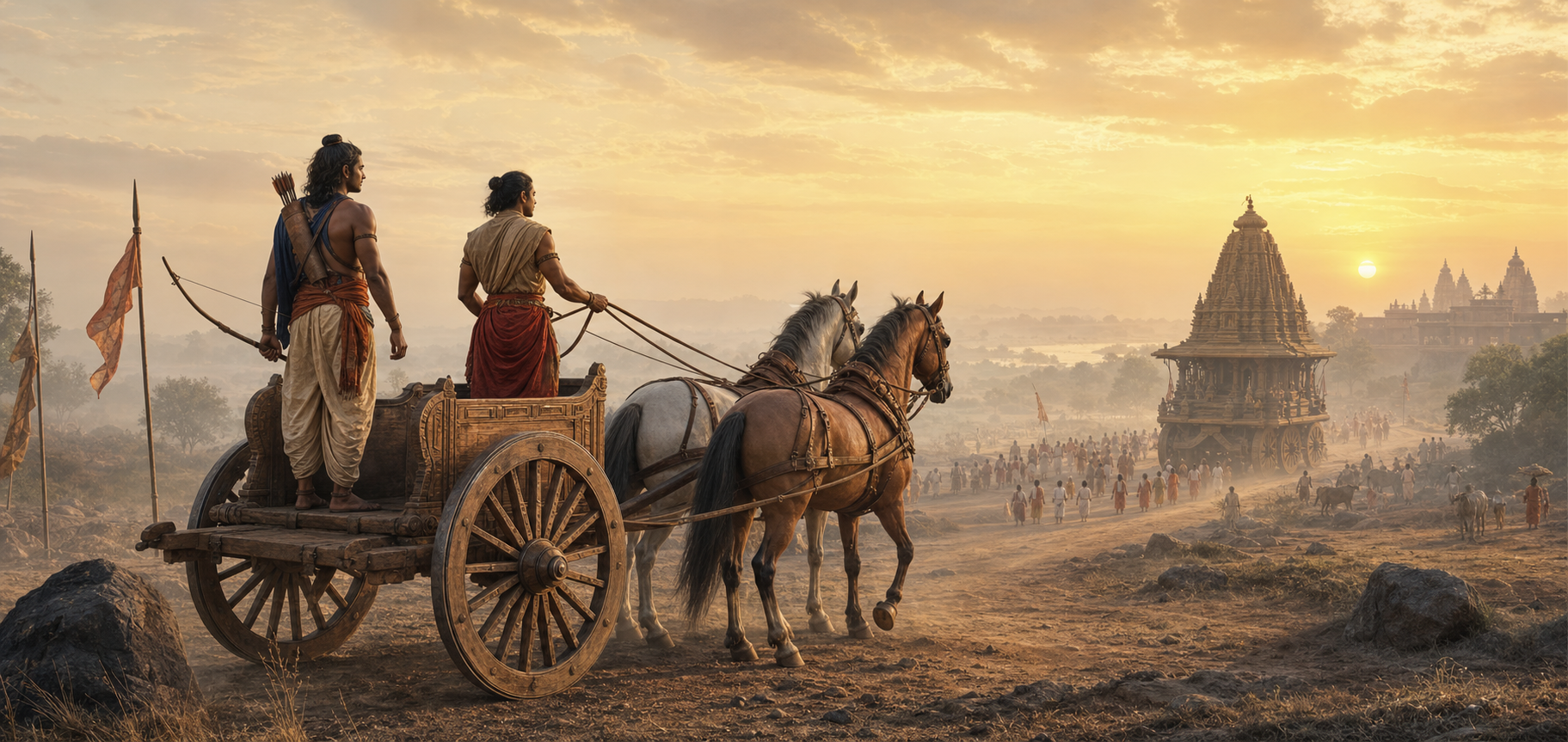
You may meet the ratha in a Bhagavad Gītā discourse, a temple procession, an account of ancient warfare, or a debate about archaeology. If you treat every appearance as a poetic symbol, you lose the machine that made the symbol intelligible. If you treat it only as a machine, you miss why it continued to move through Hindu life long after its battlefield importance declined.
A reliable way to read any chariot scene is to ask three questions in order: What can this vehicle physically do? Who directs its movement? What kind of movement is being staged: tactical, ritual, or inward? Those questions keep history, worship, and philosophy connected without collapsing them into one vague meaning.
Before it became a symbol, the ratha had to work
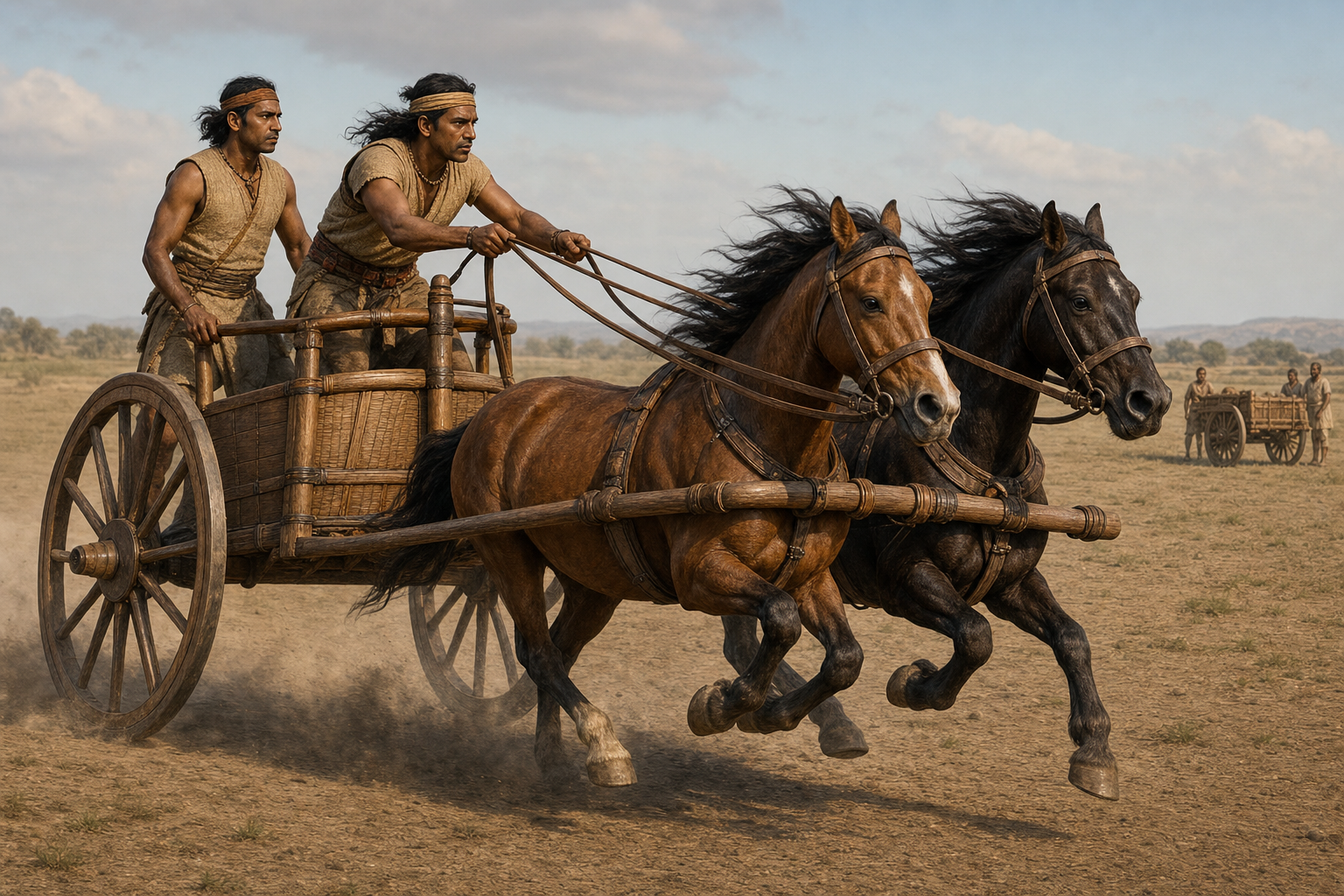
Begin with the vehicle. The early Hindu ratha was a light, two-wheeled platform built around a wooden chassis, spoked wheels, a yoke, and usually a pair of horses. Joinery, leather lashings, fibre ropes, and copper or bronze fittings gave the structure enough strength and flexibility to endure movement. This was not a heavy cart made to carry bulk goods. It was designed to place trained people and weapons where speed and manoeuvrability mattered.
Its crew reveals why chariot warfare was an institution rather than a single warrior’s accomplishment. The sārathi controlled the horses, read the ground, and coordinated the vehicle’s movement with the warrior’s timing. The dhanurdhara fought from the platform, while an attendant might manage shields or spare weapons. A celebrated archer therefore depended upon driving skill, animal conditioning, maintenance, and teamwork. When an epic gives the charioteer narrative importance, that is not an ornamental detail. The driver’s judgment could determine whether the warrior obtained a shot, escaped danger, or entered it.
On firm, level ground, the ratha could support rapid feints, withdrawals, flanking movement, and archery-based shock. Chariots could work with cavalry and elephants inside larger formations, or vyūhas, where lanes and coordinated movement mattered. Marshes, forests, and broken ground reduced that advantage. Such terrain favoured other forces, and cavalry gradually assumed more of the mobile battlefield role. The practical correction is simple: prominence in hymns and epics does not prove that chariots dominated every landscape or every period of Indian warfare.
The martial titles rathi, mahārathi, and atirathi should also be read as assessments of the warrior, not as three vehicle models. They expressed expectations involving skill, endurance, and command. Likewise, chariots presented as gifts in Rigvedic dānastuti hymns signalled prestige because a usable ratha represented horses, craftsmanship, training, and the social capacity to sustain them. A chariot was battlefield equipment, but it was also stored wealth and visible rank.
Handle archaeological claims with a vocabulary test
Material evidence requires more care than a dramatic label allows. The Painted Grey Ware horizon, conventionally dated to about 1200-600 BCE, belongs to a cultural setting in which horse-drawn vehicles likely had military and ceremonial uses. The ornate vehicles discovered at Sinauli have solid disc wheels and copper fittings, however, and specialists debate whether they were horse-drawn chariots or ox-drawn ceremonial wagons. A solid-wheel vehicle is not automatically the same thing as the light, spoked-wheel ratha described in Vedic and epic settings.
When you encounter a confident claim about an ancient Indian chariot, check four things: wheel type, probable draught animal, vehicle weight, and archaeological context. Ornament proves status more readily than it proves speed. A burial vehicle can establish the importance of wheeled transport without settling exactly how that vehicle moved in battle. This distinction protects the history of Bharat from both careless dismissal and careless exaggeration.
Kurukṣetra turns mobility into a moral problem
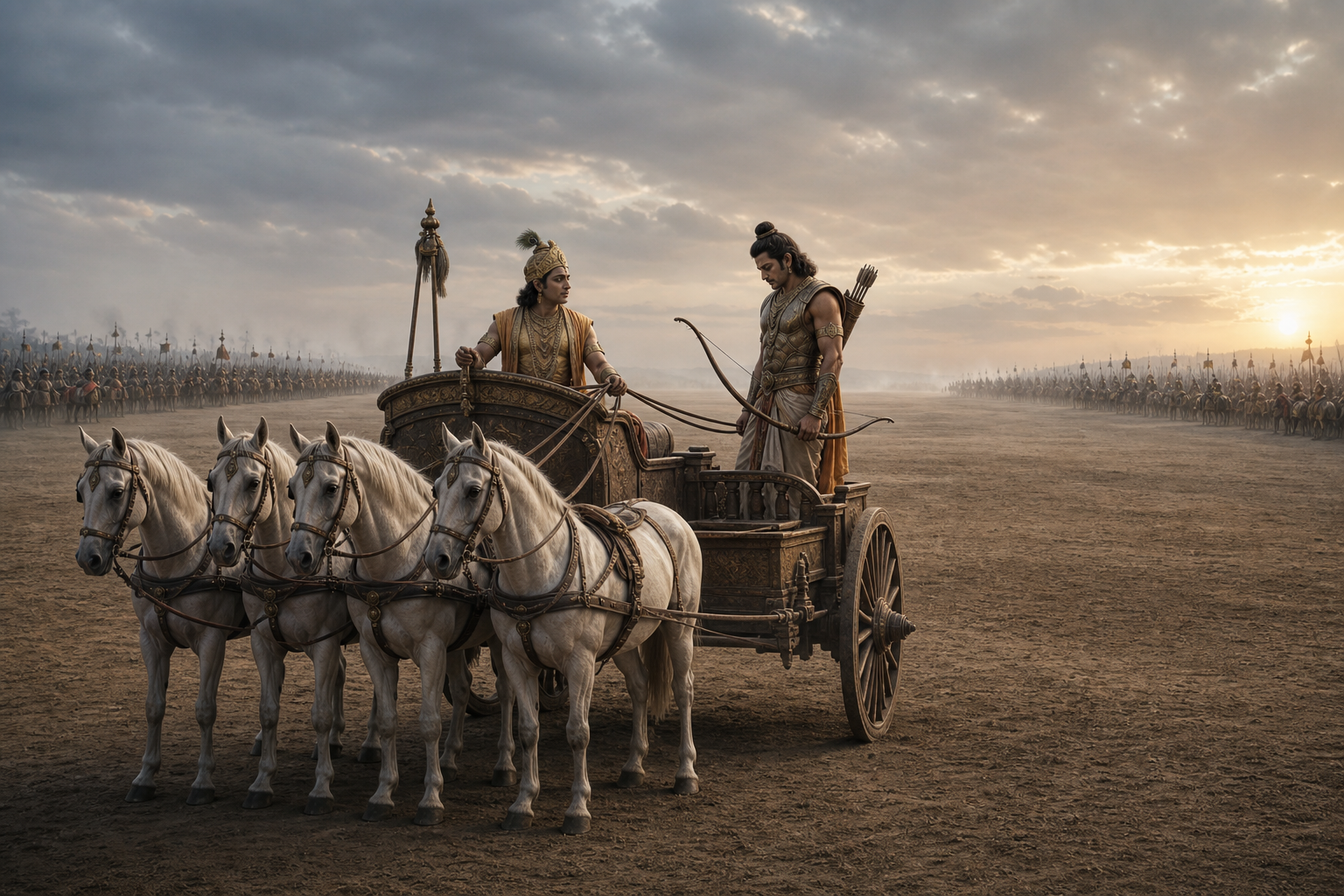
The Mahābhārata places the chariot inside a martial world of formations, matched opponents, projectile exchanges, and conventions associated with dharma-yuddha. Yet its most enduring chariot scene is not a manoeuvre. It is a halt. Arjuna’s vehicle stops between the armies, and a platform built for rapid action becomes the place where action can no longer be taken for granted.
That setting matters to the Bhagavad Gītā. Kṛṣṇa appears as Pārthasārathi, Arjuna’s charioteer, while Arjuna remains the warrior who must confront grief, duty, judgment, and action. The military role gives the relationship its texture. A sārathi does more than supply motion: he must govern powerful horses, recognise terrain, choose position, and coordinate timing. Kṛṣṇa’s counsel therefore comes from the place of guidance and disciplined direction, not from a distant spectator’s seat.
The ratha becomes an ethical chamber within a public war. Arjuna cannot escape the field merely by calling withdrawal spiritual, and he cannot act rightly merely by possessing weapons. His crisis concerns the alignment of capacity, responsibility, understanding, and purpose. This is why the chariot is a better frame for the Gītā than an isolated image of the heroic archer: power is present, but power requires right direction.
You can use that structure when assessing any interpretation of the Gītā. Ask whether it keeps Arjuna’s concrete duty in view, whether it distinguishes counsel from compulsion, and whether its promised clarity returns the person to responsible action. A reading that turns the Gītā into a slogan for aggression ignores Arjuna’s moral crisis. A reading that turns it into permission to avoid difficult action ignores the battlefield on which the teaching occurs. The chariot holds both realities together.
Ratha-yātrā makes divine presence public
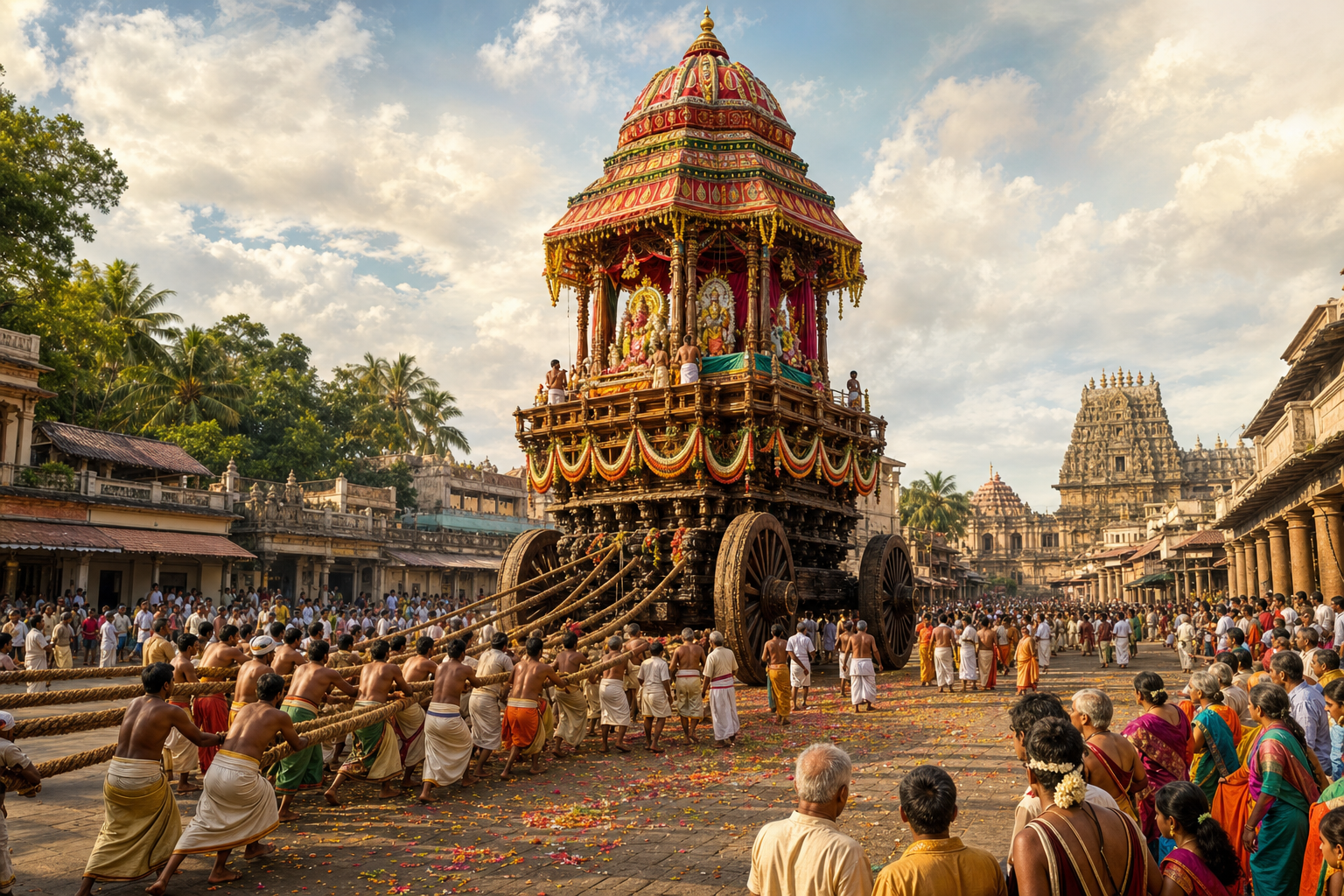
As the ratha lost its decisive military role, it gained an even larger ceremonial life. The basic transformation is easy to notice: a vehicle once associated with elite speed becomes a means through which divine presence enters the shared street. The movement is no longer designed to outflank an enemy. It brings the deity, devotees, artisans, music, and public space into one ritual action.
The clearest example is the Jagannath Ratha Yatra at Puri. Jagannath rides Nandighosha, Balabhadra rides Taladhwaja, and Subhadrā rides Darpadalana as the three chariots travel from the principal temple to the Gundicha temple. The chariots are distinguished by features including canopy colours and wheel counts, but their annual rebuilding is just as significant. Hereditary artisans rebuild these monumental wooden vehicles each year, renewing an inherited form through fresh material and living skill.
If you attend or study the festival, do not look only at the towering superstructures. Notice four relationships. The deity leaves the fixed sanctum and becomes publicly accessible. Craft knowledge passes through a community rather than residing in the finished object alone. A durable tradition is carried by a vehicle that must be remade. Devotees pulling the ropes become participants in the deity’s movement, not an audience watching a religious parade from outside.
The same ritual grammar appears in the great ther processions of Tamil Nadu, the rathotsavas of Karnataka, and the Brahmotsavam at Tirumala, where an utsava-mūrti moves among worshippers. Ratha Saptamī gives the image a cosmic register through Sūrya’s seven-horsed chariot and the renewal associated with light, health, and the agricultural year’s turning. The ratha can thus organise sacred movement at several scales: the deity through a town, the sun through the heavens, and the community through a ritual calendar.
Not every architectural ratha is a vehicle
Context becomes especially important in temple architecture. In the Nāgara vocabulary, ratha can mean a vertical projection or offset in a shrine’s plan. Terms such as triratha, pañcaratha, and saptaratha classify the pattern by the number of projections. These forms organise light, shadow, and sculptural rhythm, but they are not wheeled conveyances.
Other monuments translate the vehicle more directly into stone. Konark’s Sun Temple imagines Sūrya’s cosmic chariot on an architectural scale, including twenty-four elaborately carved wheels. Hampi’s celebrated stone chariot depicts a chariot within the Vijaya Vitthala temple complex. The Pancha Rathas at Mamallapuram, despite their popular association with the Pāṇḍavas, are not five literal vehicles. Before interpreting any temple ratha, decide whether the word names a moving ritual car, a stone representation of one, or a projection in the building plan.
Shared streets do not erase distinct traditions
Jain ratha-yātrās carry images of tīrthaṅkaras through public space in acts of devotion and service. Sikh Nagar Kīrtans are not properly called ratha-yātrās, but they share a broader Dharmic pattern of sacred mobility as the Guru Granth Sahib, song, and community enter the street together. The comparison is useful only when its boundary remains clear. Similar public forms can express civilizational kinship without making Jain, Sikh, and Hindu theology interchangeable.
The inner chariot is a diagnostic map, not decoration
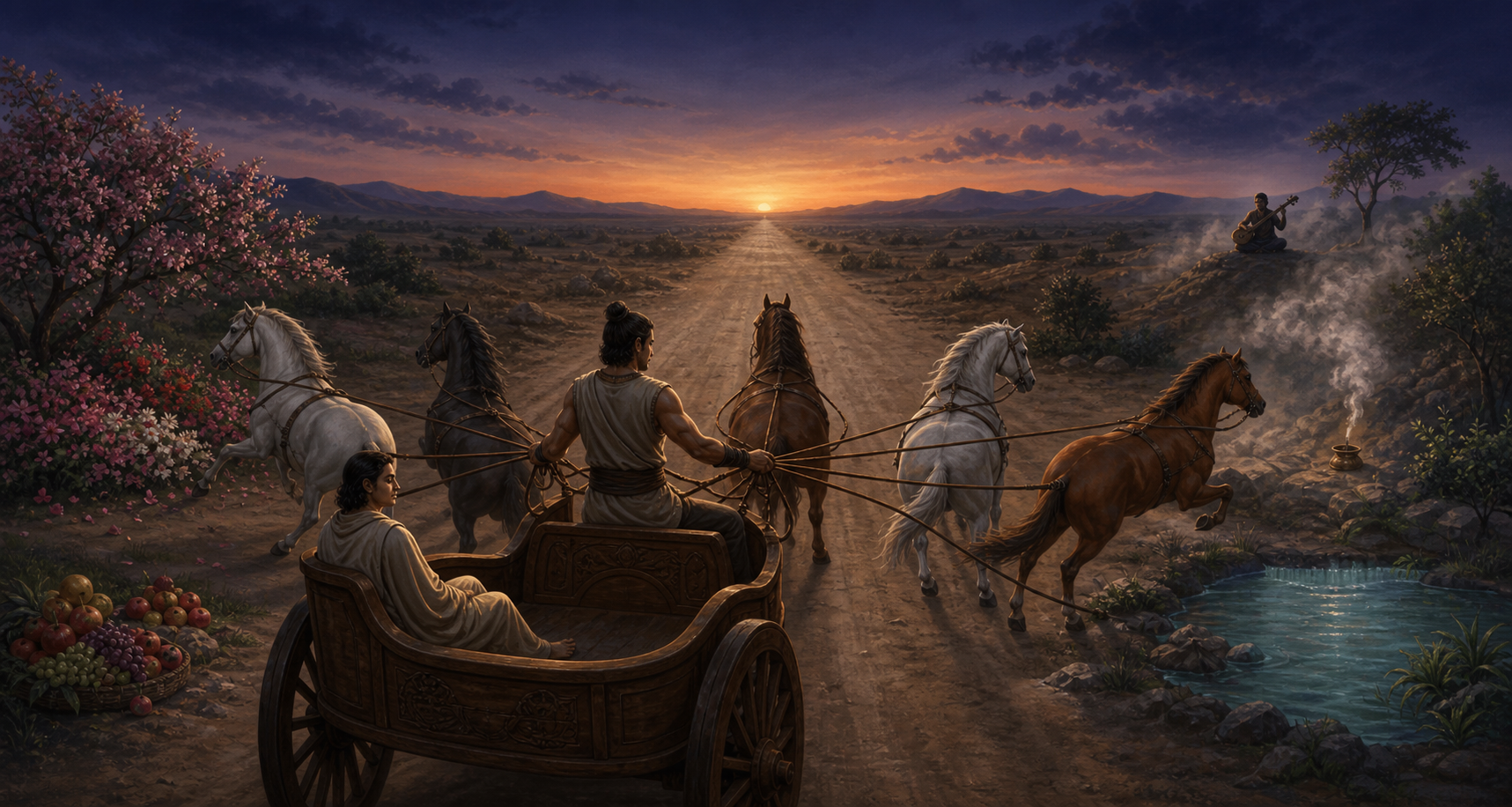
The Kaṭha Upaniṣad turns the technology of coordinated movement into a precise model of the person. Its correspondences should be kept intact, because the relationships among the parts carry the teaching:
| Element in the person | Element of the chariot |
|---|---|
| Ātman | Lord or owner of the chariot |
| Body | Chariot |
| Buddhi, discriminating intelligence | Charioteer |
| Manas, the mind | Reins |
| Indriyāḥ, the senses | Horses |
| Objects of the senses | Roads along which the horses travel |
The model does not demand destruction of the horses. A chariot without horses cannot move. Nor does it confuse the reins with the driver: mental activity and discriminating judgment perform different functions. Mastery comes from trained coordination. Good horses, reliable reins, an alert charioteer, and a clear relationship to the chariot’s lord must work together.
You can use the allegory as a short examination before a consequential action:
- Name the horses. Identify the immediate perceptions, attractions, aversions, or impulses pulling you toward action.
- Check the reins. Ask whether the mind can hold attention steadily enough to prevent one impulse from deciding everything.
- Consult the charioteer. Let buddhi distinguish what is merely urgent from what is right, proportionate, and consistent with your duty.
- Remember the owner. Do not reduce the whole self to the body’s discomfort, the mind’s agitation, or a single sensory demand.
- Examine the road. The objects and environments toward which you repeatedly direct the senses help determine whether disciplined movement is possible.
This sequence is more useful than telling yourself simply to exercise willpower. If the horses are untrained, tightening the reins once will not solve the problem. If the reins do not transmit direction, excellent judgment cannot govern movement. If buddhi is confused, mental concentration can make a mistaken course more efficient. The allegory asks you to locate the failed relationship before prescribing more force.
The same chariot can support a different metaphysics
The Buddhist Milindapañha uses a chariot in a sharply different way. A chariot is a conventional designation for an arrangement of parts; it cannot be found as an independent essence apart from those parts. The person is likewise discussed as a conventional designation for aggregates, illustrating anattā, or non-self. The Kaṭha Upaniṣad, by contrast, places the ātman as lord of the chariot. One image therefore serves two different philosophical arguments: coordinated governance in the Hindu allegory and analysis of constructed identity in the Buddhist simile.
That difference gives you a sound rule for reading Dharmic symbols. Never infer doctrine from the object alone. Ask what relationship the teaching establishes among the object’s parts. Is the chariot carrying a warrior, bearing a deity, representing the body, or demonstrating that a named whole depends upon components? Shared imagery is evidence of a common civilizational vocabulary, not proof of identical conclusions.
Key takeaways
- Read the ratha literally before reading it symbolically: wheel type, terrain, horses, crew, and formation explain what the image originally made possible.
- Treat the sārathi as essential. The chariot’s power depends upon judgment, coordination, and direction as much as the warrior’s weapons.
- At Kurukṣetra, the ratha holds martial capacity and ethical hesitation in the same space; the Gītā’s teaching returns clarity to responsible action.
- In ratha-yātrā, movement makes divine presence public and turns artisans, devotees, streets, and sacred images into one participatory rite.
- The Kaṭha Upaniṣad uses the chariot to diagnose coordination among body, mind, senses, intelligence, and ātman; the Milindapañha uses it for a distinct teaching about non-self.
- When you next encounter a ratha, ask what moves, who governs the movement, and where it is going. Those three questions usually reveal whether the scene concerns power, worship, or self-mastery.
The most useful next step is to choose one chariot scene you already know and read it again with those questions. A wheel, a set of reins, and a driver’s position may tell you more than a general appeal to symbolism ever could.