
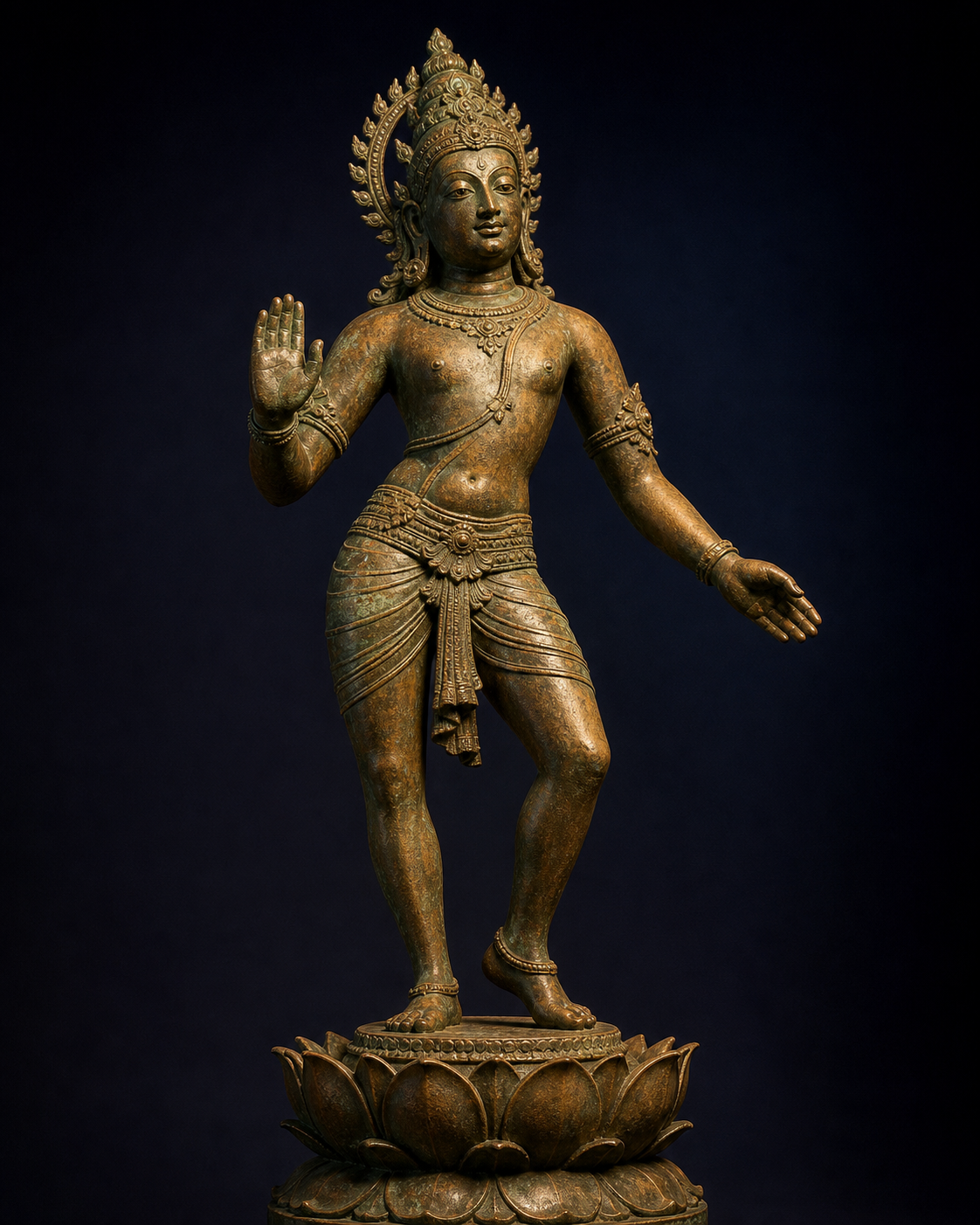
You are looking at a Hindu bronze whose lower garment seems almost too small to matter. The thighs remain visible, the cloth hugs the hips, and a belt or knot gathers the folds at the waist. That compact drape may be the ardhoruka, and identifying it can change how you read the figure’s movement, temperament, and sacred role.
The useful question is not simply, “Is the garment short?” You need to examine how it is secured, where its hem falls, what the pleats are doing, and why the sculptor wanted the legs to remain visually free. Follow those clues and the ardhoruka becomes part of the icon’s language rather than an obscure costume term.
Recognize the garment from structure, not exposed skin alone
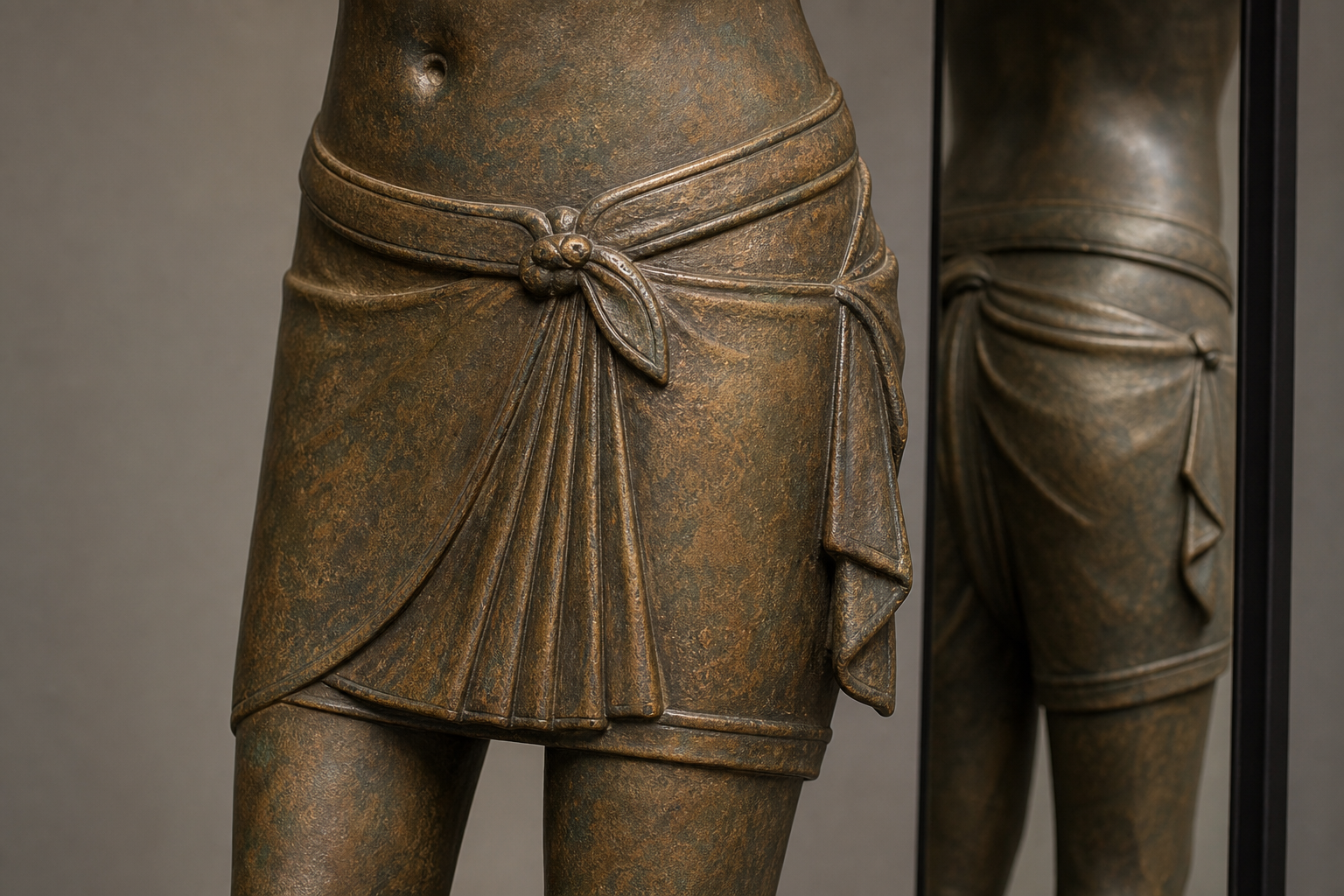
Start with the silhouette. An ardhoruka is a short, closely fitted lower garment that generally reaches from the waist to about mid-thigh. Unlike a long antariya, it does not send a large field of cloth cascading down the legs. Its compact outline keeps the hips, knees, and major changes of stance easy to see.
Shortness by itself is not enough. A broken hem, a simplified provincial treatment, an animal skin, or a compact garment from another regional tradition can produce a similar first impression. Look for a cluster of related features:
- A controlled waist: A mekhala, or girdle, usually establishes a firm horizontal boundary across the hips. It may be plain, beaded, or accompanied by cords identified as the kati-sutra or nivi.
- A compact pleating scheme: The cloth may form shallow ridges, small lateral falls, or a short central fan emerging from a tightly gathered knot.
- A definite hem: The lower edge is normally crisp rather than vague. Fine chasing or a serrated treatment may suggest woven texture.
- Tension over the body: The garment follows the pelvis closely. Subtle convex modeling over the hips and a taut transition beneath the abdomen make the cloth appear bound to an active body rather than suspended from it.
- Uninterrupted legs: The arrangement allows your eye to follow the planted thigh, bent knee, lifted foot, or rotation of the pelvis without long cloth concealing the action.
Keep the mekhala and udarabandha conceptually separate from the garment. The mekhala anchors the hips; the udarabandha crosses the stomach; the ardhoruka covers the lower body. On a small or heavily ornamented bronze, confusing one element for another can turn a sound visual description into a doubtful identification.
Pose also affects apparent length. A hem that terminates near mid-thigh on a resting leg will look shorter when the knee flexes or the pelvis tilts. Check the garment against the more extended leg and the waistline before deciding that its proportions are unusually abbreviated.
Read three meanings in the open line of the legs
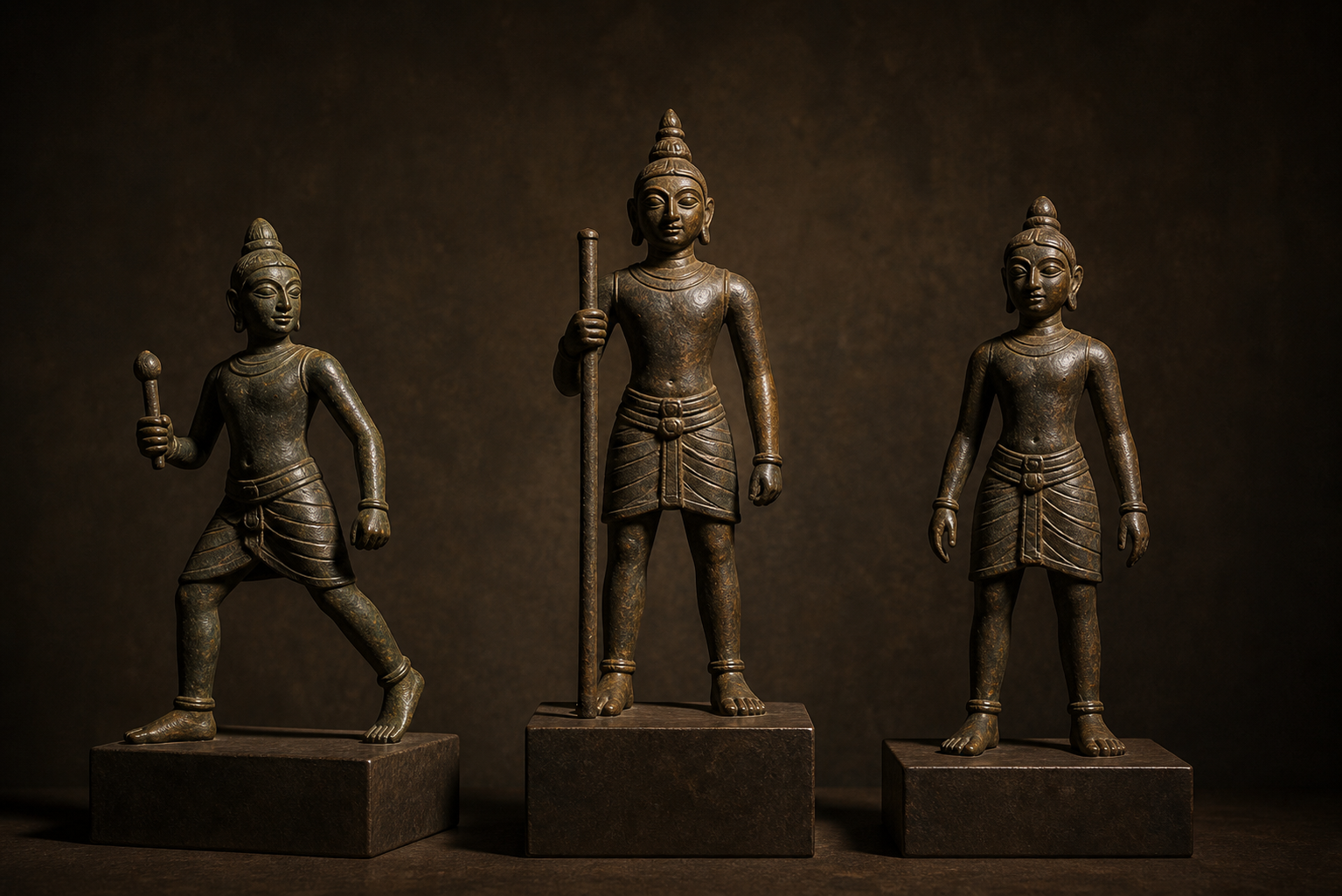
The ardhoruka is not merely an ancient version of convenient clothing. Its form helps communicate three qualities that often overlap in a vigorous divine image: kshatra, nrtta, and tapas.
Kshatra is martial capacity: readiness to protect, confront, and act. The thighs are central to stance, combat, leaping, and changes of direction. Exposing their structure gives the figure a grounded physical force. This is why an abbreviated, tightly organized drape suits guardians, warriors, and deities shown in formidable modes.
Nrtta is pure dance and rhythmic movement. A long garment can create grace through flowing lines, but the ardhoruka does something different. It reveals the mechanics of motion: the transfer of weight, the turn of the pelvis, the opposition between lifted and planted legs, and the curve connecting abdomen to thigh. In a dancing image, the garment functions almost like a frame around the body’s kinetic center.
Tapas is disciplined austerity or concentrated spiritual heat. The relative economy of cloth can signal restraint rather than poverty or incompleteness. The waist is tightly governed, the pleats are controlled, and nothing hangs low enough to diffuse the figure’s force. Ornament may remain abundant elsewhere, yet the lower garment still communicates compression and discipline.
Do not force a choice among these meanings too early. A Shaiva image can be martial, dancing, and ascetic at once. The ardhoruka is especially effective because one garment can hold those qualities together: the limbs are free for action, the waist disciplines the body, and the brevity concentrates attention.
Let the deity and pose refine the identification
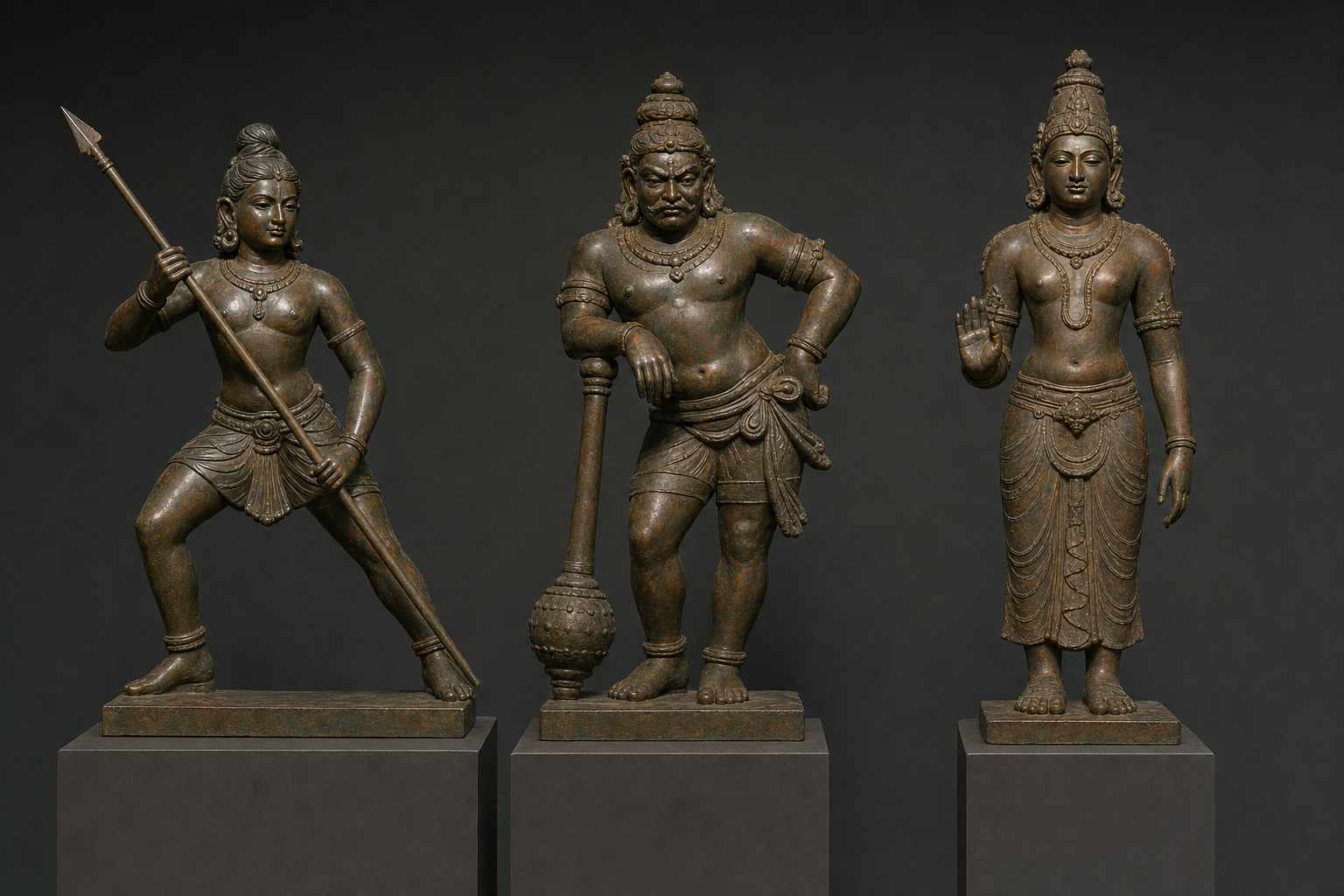
Once the garment’s structure is clear, test the reading against the icon as a whole. The same short drape does not communicate exactly the same emphasis on every figure.
- Shiva Nataraja: This is the clearest demonstration of the garment’s kinetic purpose. The short hem leaves visible the opposition between the planted and lifted legs, the torque of the pelvis, and the pulse of the abdomen beneath the stomach band. Where tiger-skin markings appear, the sculptor may combine the pelt with a structured short wrap. Read that hybrid as wild power brought under disciplined control, not as evidence that the garment has disappeared.
- Bhairava and Virabhadra: Tighter and more rugged treatments reinforce confrontation and readiness. The compact waist behaves like divine field gear, keeping the figure’s force concentrated around a broad stance.
- Skanda or Murugan: A comparably short garment can emphasize youthful martial vigor and immediate readiness. The identification still depends on the complete iconography; the drape supports the reading but does not establish the deity by itself.
- Ugra-Narasimha: Some regional forms use an abbreviated lower garment to intensify explosive energy. Because this is not a universal feature of every Narasimha image, describe it as a regional treatment rather than a fixed requirement.
- Dvarapalas, ganas, and heroic figures: A thigh-free wrap allows a wide gait, balances weapon-bearing arms, and signals an active protective function. On virakal, or hero stones, a related short kilt can serve the same visual logic even though the medium is stone rather than bronze.
Somaskanda ensembles require particular care. Longer antariyas are common, although some workshop traditions favor shorter variants. Do not rename every compact fold as an ardhoruka merely because a neighboring Shaiva figure wears one. Follow the actual hem, pleats, and waist attachments on each body.
The broader Dharmic context is also worth noticing without flattening distinct traditions. Vajrapani and certain Buddhist lokapalas may wear short, thigh-revealing wraps that express protective force. Jain yakshas and guardians associated with the Tirthankaras can use comparable abbreviated garments to convey vigor and stewardship. These parallels reveal a shared civilizational vocabulary of dynamic protection. They do not prove that every such garment was named ardhoruka in every community or period, so ardhoruka-like is often the more responsible description outside a securely identified Hindu iconographic setting.
Use workmanship and history without turning the drape into a date stamp
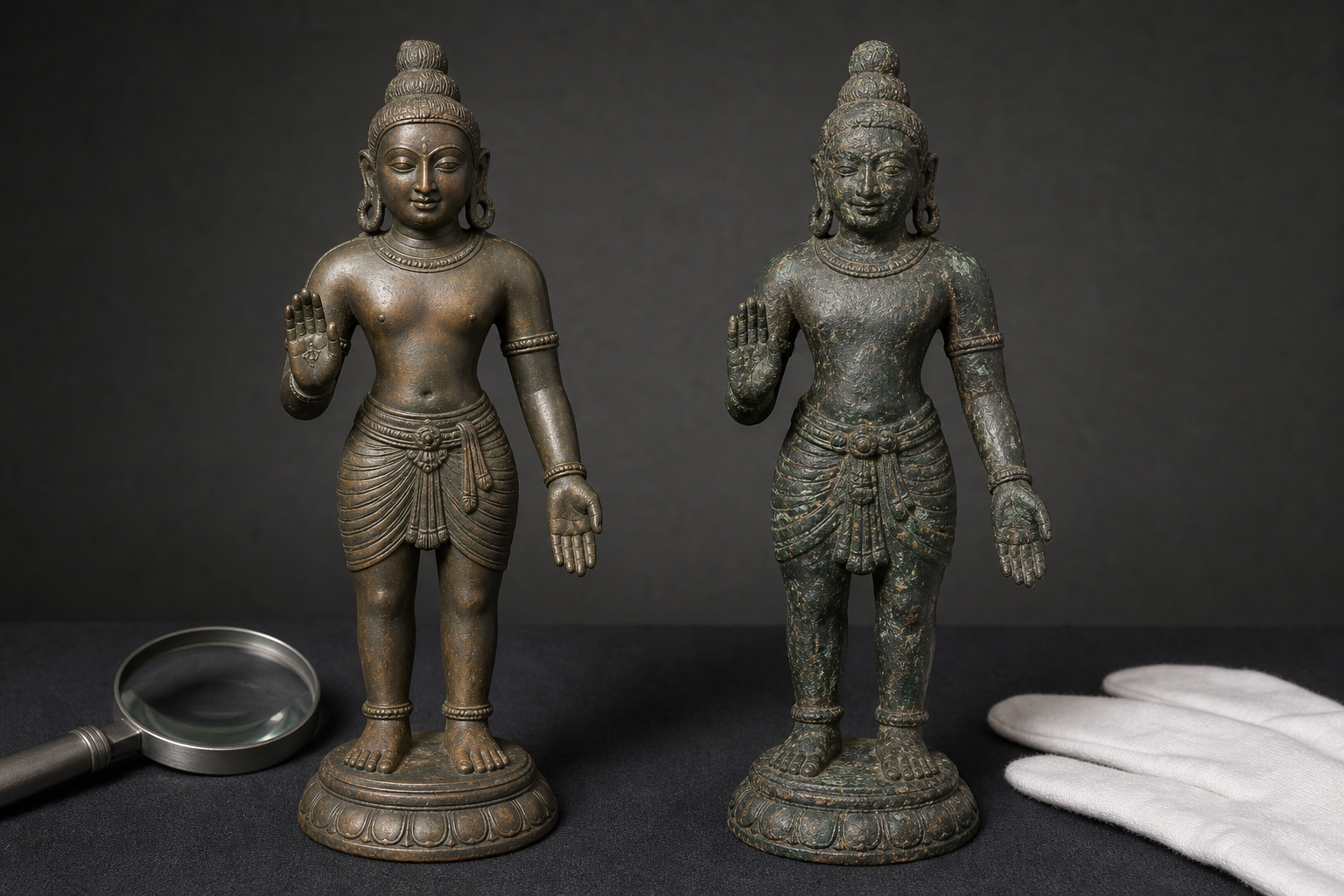
Short lower garments appear in Indian art well before the celebrated Chola bronzes. Early Mathura yakshas, dvarapalas, and later Deccan figures can display thigh-length wraps, while many Gupta-period divinities favor longer garments associated with courtly grace. Pallava and then Chola ateliers in South India gave the ardhoruka an especially stable and refined place among the costume options for vigorous and ascetic forms.
In Chola bronzes of the ninth through thirteenth centuries, the type reaches a notable formal maturity. Fine hems, tightly gathered sashes, small fan-shaped pleats, and belts that seem to press into the hips make the garment feel physically tense. That tension directs attention toward asymmetrical stance and poised movement.
The casting process helps explain the effect. In lost-wax work, the artisan can model the drape as a thin, tensioned membrane in wax, pinch its margins into clear hems, and define the major pleats before casting. Chasing after casting can add threadlike marks, pelt patterns, and sharper edges. A mekhala may be integral to the figure or separately added, but its horizontal line still counterbalances the spiraling torso and limbs.
This knowledge is useful for close looking, but it should not become an automatic attribution rule. An ardhoruka does not make every bronze Chola. Related short wraps occur across periods, regions, religions, and media. South Indian bronzes tend to prize compactness and tensile pleating; Hoysala stone carving can achieve comparable sharpness through deeply articulated hems and beaded girdles; Odisha may intensify surface pattern; Malla-period Nepalese bronzes may build compact garments beneath intricate layered belts. Khmer sculpture at Angkor adapts related short-wrap principles through its own garment forms and pleating conventions.
When cataloguing an object, separate observation from attribution. A defensible record can proceed in this order:
- Describe what is visible: Record the mid-thigh hem, fitted outline, central fan, lateral folds, belt, cords, and stomach band without assigning a name prematurely.
- Name the likely garment: Use ardhoruka when the structural features agree. Use ardhoruka-like short lower garment when damage, scale, or regional variation leaves uncertainty.
- Explain its visual work: State whether it exposes a dancing weight shift, reinforces a martial stance, or concentrates an ascetic form.
- Test the wider iconography: Check the deity, attributes, pose, accompanying figures, and treatment of animal skin before drawing conclusions from costume.
- Keep dating evidence separate: Let the garment support a regional or chronological attribution only alongside the bronze’s proportions, ornament, casting, and complete stylistic character.
Canonical proportion also helps you judge whether the drape is intentional rather than casually abbreviated. Iconographic systems organize the body through larger tala-based proportions and smaller angula-based modules. Within that geometry, the hem usually approaches mid-thigh when the leg is at rest, while the central fan relates to the hip span and navel zone. The result can look effortless, but its placement is carefully governed.
Key takeaways
- Identify the ardhoruka through a fitted mid-thigh outline, an anchored waist, controlled pleats, and a crisp hem rather than shortness alone.
- Distinguish the garment from the mekhala at the hips and the udarabandha across the stomach.
- Read the exposed legs as purposeful iconography: they can express martial capacity, dance movement, ascetic concentration, or a combination of all three.
- Use the figure’s pose and identity to refine the meaning, but never identify a deity from the garment alone.
- Treat tiger skin and structured cloth as potentially layered or hybrid features rather than mutually exclusive alternatives.
- Do not use the ardhoruka as a date stamp. Chola bronzes refine the form brilliantly, but related short wraps occur across periods and regional traditions.
- When certainty is limited, describe the visible construction first and use the qualified term ardhoruka-like.
The next time you encounter a vigorous Hindu bronze, begin at the waist and trace the cloth to its hem before studying the weapons or ornaments. If the belt, compact pleats, mid-thigh edge, and open line of the legs work together, you are not looking at incidental clothing. You are seeing how the sculptor made disciplined power visible.