
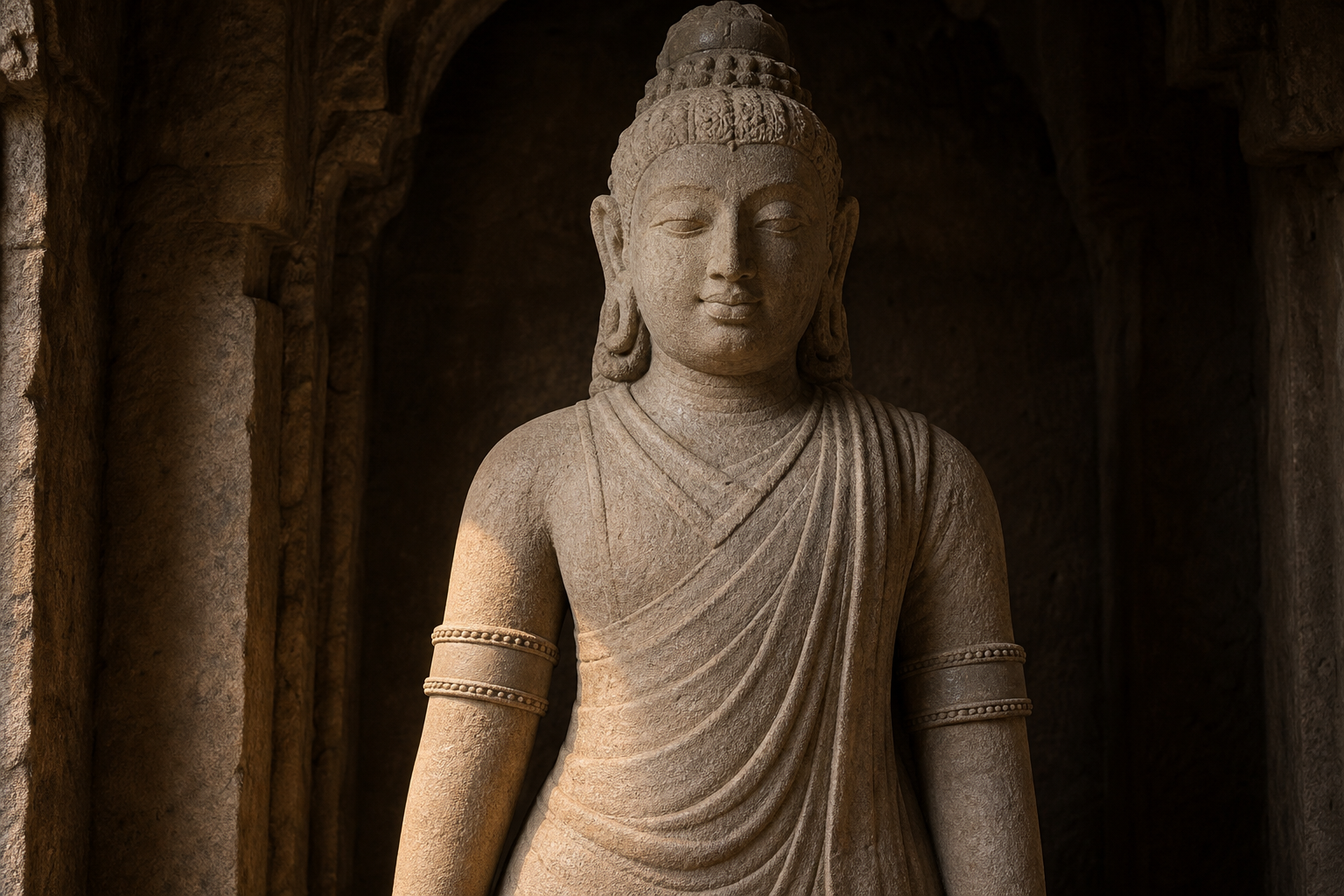
You are looking at a temple sculpture or bronze, and the ornament above the deity’s elbow seems too deliberate to be incidental. Is it simply an armlet, or does its shape contribute to the identity and mood of the sacred figure?
Start with the silhouette, not the decoration. A bahuka is recognizable because it concentrates visual weight around the upper arm. Once you learn to separate that compact cuff from rings, tied bands, and open armlets, you can also see how a sculptor used it to express controlled strength.
Key takeaways
- A bahuka sits on the upper arm, usually just above the elbow.
- Its defining form is a continuous, compact cylinder with visible mass, often finished with reinforced rims.
- A ring-like ornament is more likely a bahuvalaya; a tied band points toward a bahubandha; an open or highly articulated form may be a keyura.
- The bahuka can reinforce an image of divine protection, sovereignty, restraint, or martial readiness, but it does not identify a deity by itself.
- Surface ornament varies by region. The cylinder, proportions, and relationship to the arm are more dependable than any single decorative motif.
Identify the cylinder before studying the ornament
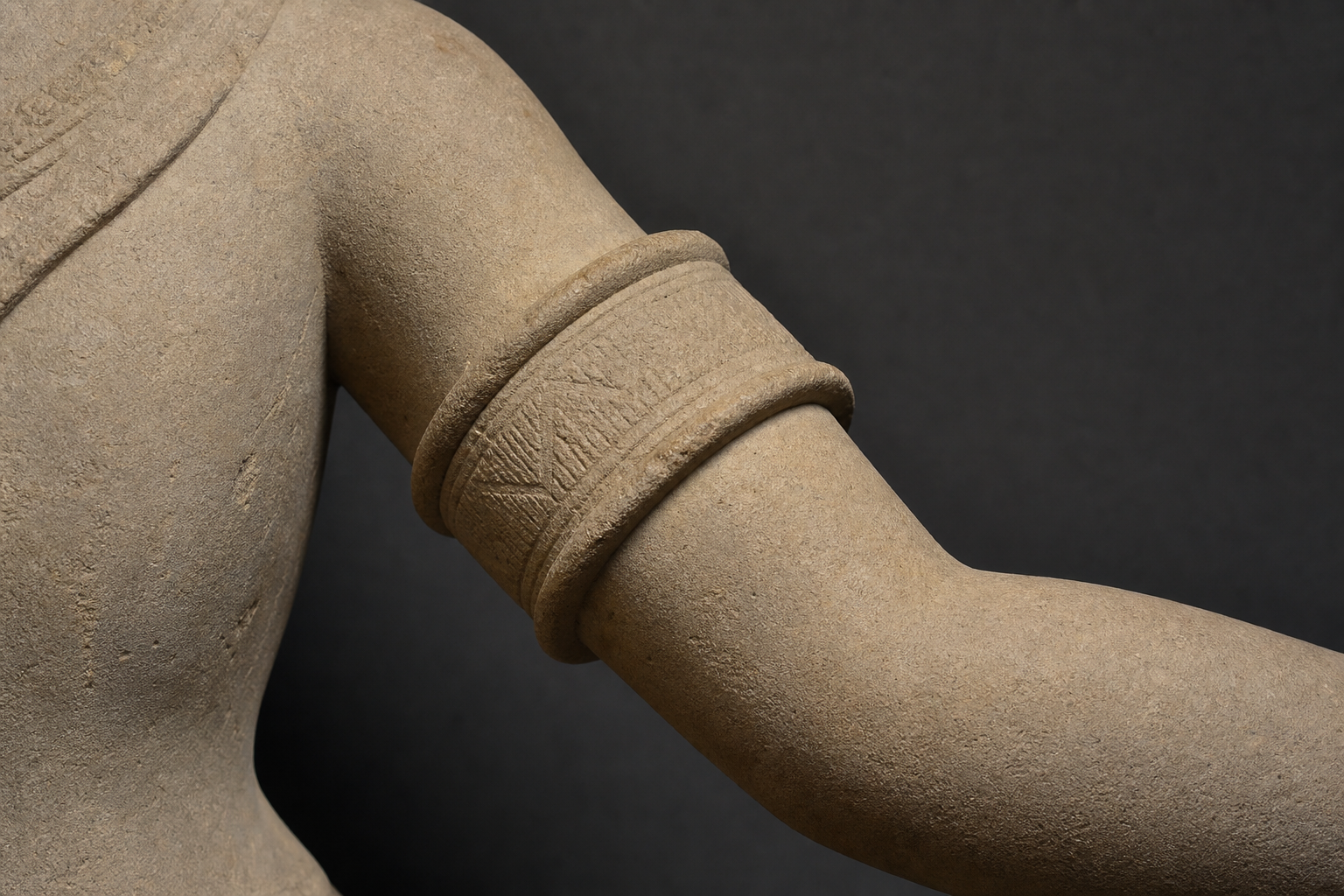
The easiest mistake is to begin with beads, incisions, or floral details. Those features attract the eye, but they are not the foundation of the classification. Erosion can erase them, local workshops can change them, and later repairs can confuse them. The profile of the ornament survives as the stronger clue.
- Locate the elbow. Confirm that the ornament encircles the upper arm rather than the wrist or forearm.
- Trace the outer silhouette. Look for a straight or slightly tapered cuff whose height is compact in relation to its diameter.
- Find the upper and lower edges. Bahukas often have pronounced rims that make the cuff look contained and structurally firm.
- Check for interruption. Visible ribbons, knots, tie-ends, open terminals, or a conspicuous central fastening weaken the identification as a bahuka.
- Study the surface last. Horizontal fluting, ribbing, chevrons, punctate borders, and beading can support the identification, but none is required on its own.
Light matters. On dark stone or a frontal photograph, a smooth cuff may merge visually with the arm. Look for narrow shadows beneath its rims or for a change in the contour where the cylinder meets the flesh. Oblique illumination is especially useful when documenting sculpture, provided the site’s rules allow photography and added lighting.
If damage has removed the rims and any evidence of ties, do not force a precise name. Record it as an upper-arm ornament with a possible bahuka form and state which features remain visible. A qualified identification is more useful than a confident label unsupported by the object.
For museum, archive, or field documentation, record the ornament’s position, profile, rim treatment, surface pattern, and relationship to the deity’s gesture. Macro-photography can preserve fine incisions that ordinary installation photographs miss. Three-dimensional scanning and reflectance-based imaging can add evidence where shallow ribbing has become difficult to see.
Separate the bahuka from neighboring armlet types
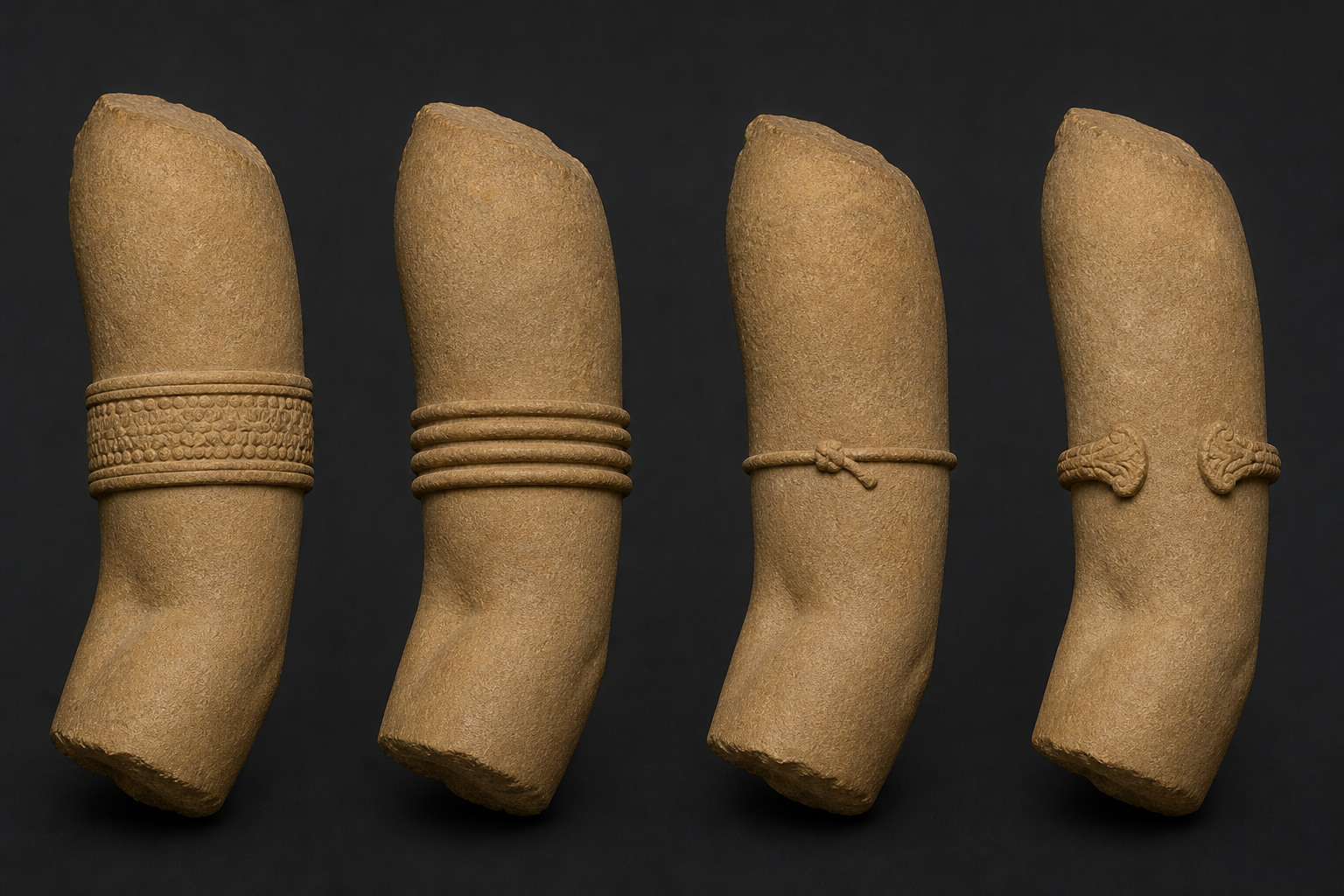
Words such as bahuka, bahuvalaya, bahubandha, and keyura belong to the same broad vocabulary of arm ornaments, but they do not describe the same visual construction. When you are identifying an image, ask how the ornament appears to hold itself together.
| Ornament | Visual construction | Most useful clue |
|---|---|---|
| Bahuka | Rigid, uninterrupted cylindrical cuff | Compact mass with firm upper and lower edges |
| Bahuvalaya | Light, ring-like ornament, sometimes repeated | Reads as a ring rather than a broad cuff |
| Bahubandha | Band or strap with tied construction | Ribboning, tie-ends, or a fastening boss |
| Keyura | More open, torc-like, or articulated armlet | Open terminals or elaborate modeled structure |
The distinction is clearest when you ignore ornamentation and imagine each object in plain metal. Would it remain a short, weighty tube? If so, bahuka is plausible. Would it become a thin hoop, a tied strap, or an open torc? One of the neighboring terms will usually fit better.
Do not treat the absence of a sculpted clasp as proof that an actual historical cuff was seamless. Within the image, an unbroken hoop is part of the bahuka’s visual logic. Metal prototypes could still have required an opening, hinge, or another practical means of fitting the arm. Sculpture tells you how the ornament was meant to read; it does not always reveal every detail of fabrication.
Read the bahuka as controlled force, not decorative bulk
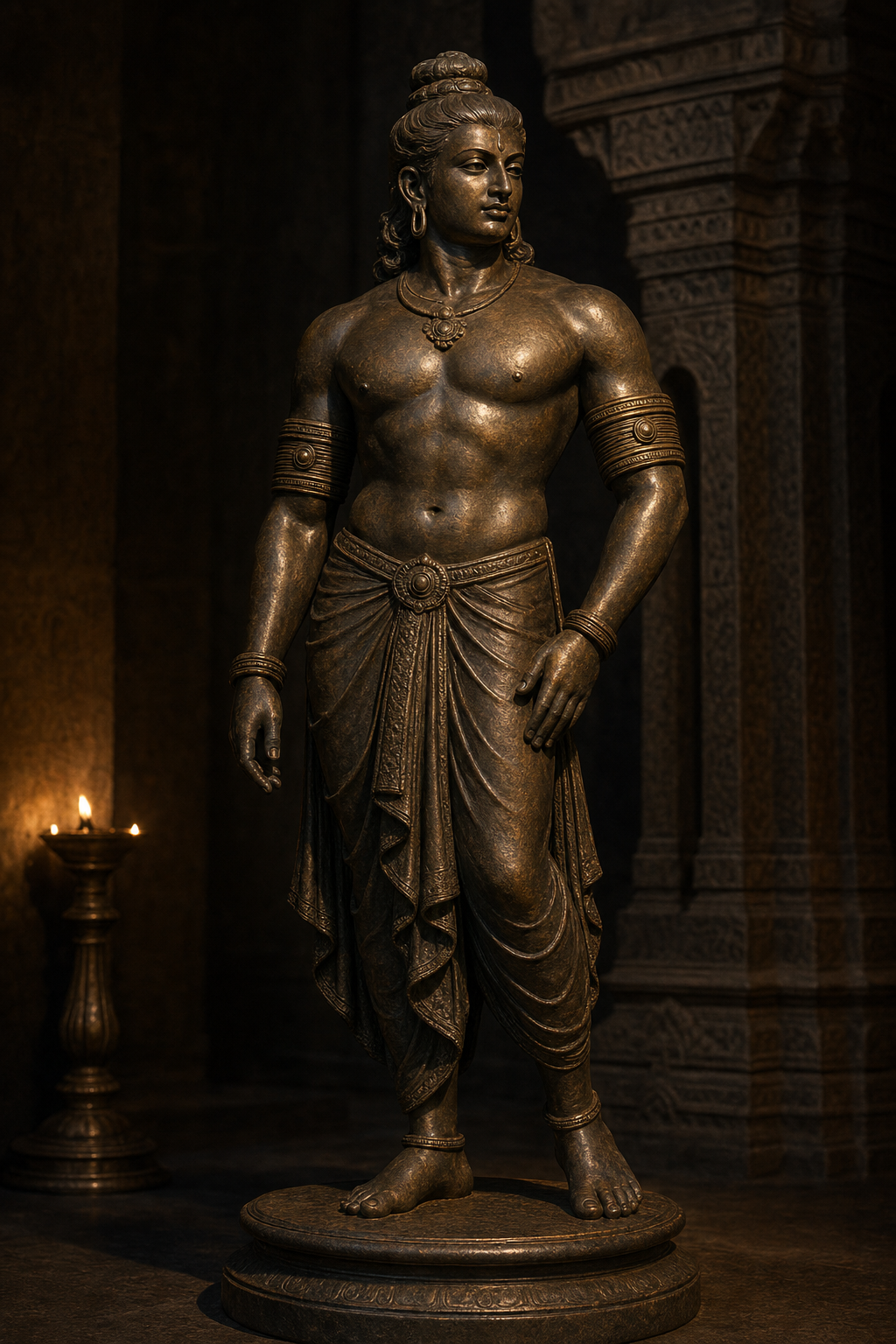
The bahuka occupies a strategically active place on the sacred body. Positioned just above the elbow, it interrupts the long curve of the arm and gives the limb a visual center. When a hand raises a conch, draws a bow, or brandishes a trident, the cuff appears to anchor that movement. The gesture still carries energy, but the energy looks governed.
This is why denser upper-arm ornaments work especially well with images of valor, guardianship, and divine sovereignty. Martial Shaiva and Shakta forms, including Bhairava and Durga, can use such weight to intensify their protective presence. Heroic Vaishnava imagery, including Narasimha and victorious forms of Vishnu, can employ the same device. The cuff complements the weapon, posture, vehicle, and expression; it does not replace them as iconographic evidence.
That last distinction prevents overreading. Finding a bahuka does not establish that an unidentified figure is Durga, Bhairava, Narasimha, or even a principal deity. First identify attributes such as weapons, hand gestures, vahana, crown, posture, and attendant figures. Then ask what the armlet adds to the completed reading.
In a battle or demon-subjugation scene, the bahuka can sharpen the impression of readiness. In a blessing-oriented image, the same cuff can place firmness behind a gentle gesture. Compassion is not presented as helplessness, and power is not presented as uncontrolled aggression. The visual ideal is disciplined capacity: strength held in service of protection and dharma.
The form recalls protective equipment, but it should not automatically be labeled armor. It remains an ornament. Its cylindrical mass borrows something from the visual logic of armor – enclosure, firmness, and bodily readiness – without necessarily serving the same physical function.
Material must also remain an inference unless the object itself survives. A sculpted bahuka can plausibly evoke a substantial cuff made from gold, silver, or a copper alloy. Casting, hammering, repoussé, and lathe-based shaping are credible ways to understand the represented form, while ivory or dense wood may also be possible in some settings. Crisp stone edges do not prove a particular metal, technique, or weight.
Social associations add another layer without turning the ornament into a fixed code. Upper-arm ornaments in courtly and martial cultures could carry meanings of rank, initiation, vows, or bonds of service. On a protective deity, the bahuka can therefore evoke something like an embodied pledge: power is present, contained, and ready to uphold an obligation.
Let regional style refine the reading, not control it
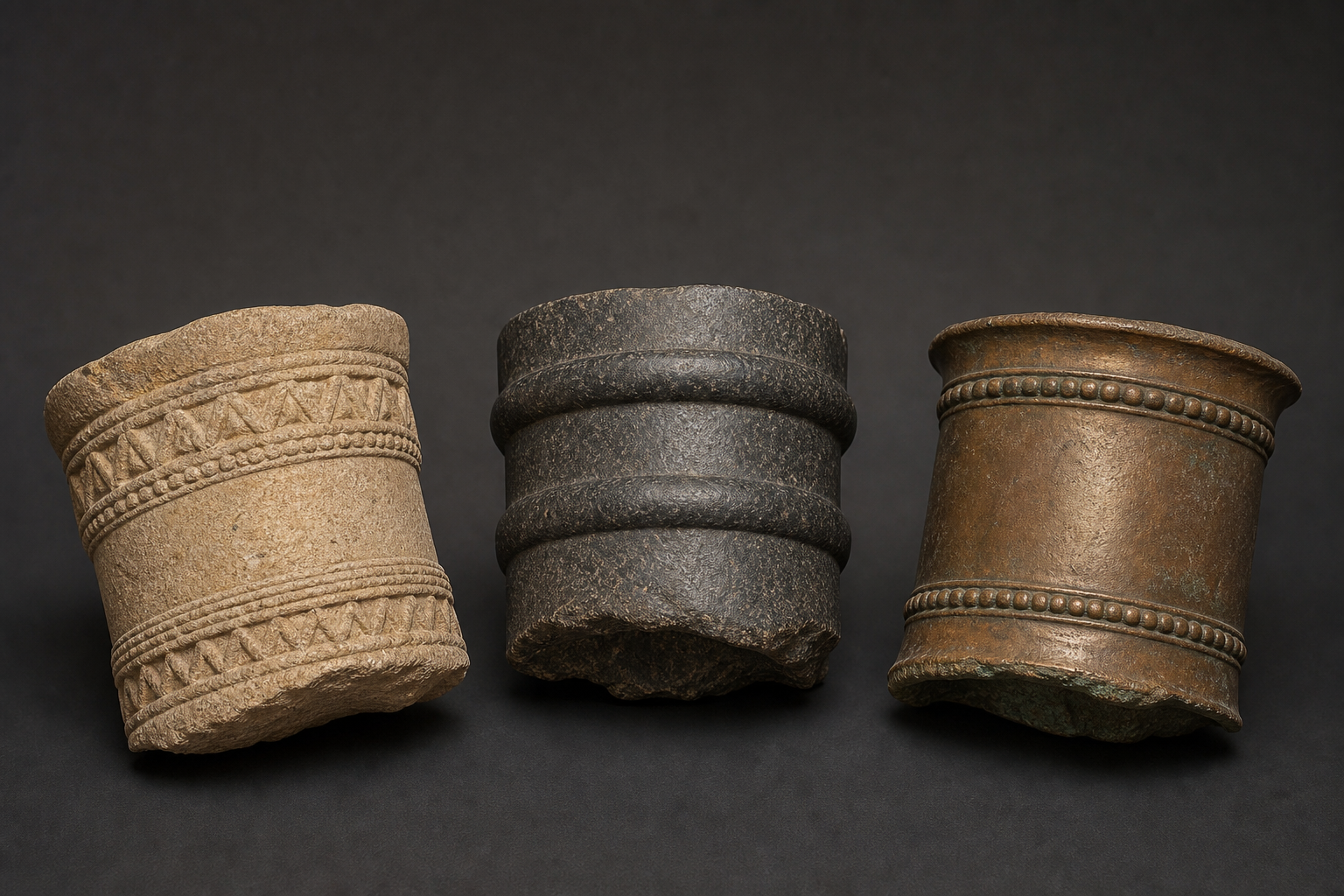
Robust upper-arm cuffs appear in pan-Indic imagery from at least the early historic period, continue through Gupta and post-Gupta production, and become particularly emphatic in early medieval and medieval art. That long history means there is no single decorative pattern that can stand for every bahuka.
South Indian bronzes associated with Chola and later Vijayanagara production often favor strong arm ornaments. A Chola example may present the bahuka as a smooth, lustrous cylinder with assertive rims. Hoysala stone carving can turn the same basic form into a finely worked surface of close ribbing and beads. Odisha’s Kalinga workshops may emphasize fluting and sharply cut borders, while western Deccan idioms can introduce alternating incised bands. Pala-Sena bronzes in eastern India also sustain the substantial cuff while adapting it to local systems of proportion.
Use those details to refine an attribution only after the basic form is secure. A fluted armlet is not automatically from Odisha, and a smooth cuff is not automatically Chola. Region, material, body proportion, hairstyle, drapery, pedestal, and the treatment of other ornaments must support one another. The bahuka is one piece of stylistic evidence, not a shortcut to provenance.
The form also belongs to a wider Dharmic artistic vocabulary. Cognate cuffs occur on Buddhist bodhisattvas and on Jain yaksha and yakshi figures, where dignity, agency, and protective presence remain relevant. Canonical images of Jain Tirthankaras are unornamented, so the cuff belongs instead to attendants, protective beings, or donor figures. This distribution helps you distinguish a shared South Asian language of sacred embodiment from an identical theological meaning.
When you next approach a murti, narrative panel, or processional bronze, pause at the upper arm before consulting the label. Locate the elbow, follow the silhouette, test for ties or open terminals, and then return to the whole figure. That small discipline will tell you whether you are seeing generic adornment or a compact visual statement about beauty, restraint, and strength placed in the service of dharma.