
You find two recordings of what appears to be the same Vedic passage. The words sound similar, but the melody, pauses or phrasing differ. Is one of them corrupted? Not necessarily. The useful first question is not, “Which version is authentic?” It is, “Which Veda, shakha, textual layer and recitation mode am I hearing?”
Those four labels turn a vague claim about “Vedic chanting” into something you can examine. They also reveal why the Vedas survived through living memory with such precision: preservation depended on lineage-specific rules, several ways of reciting the same material and a community trained to detect deviation.
Start by identifying four labels
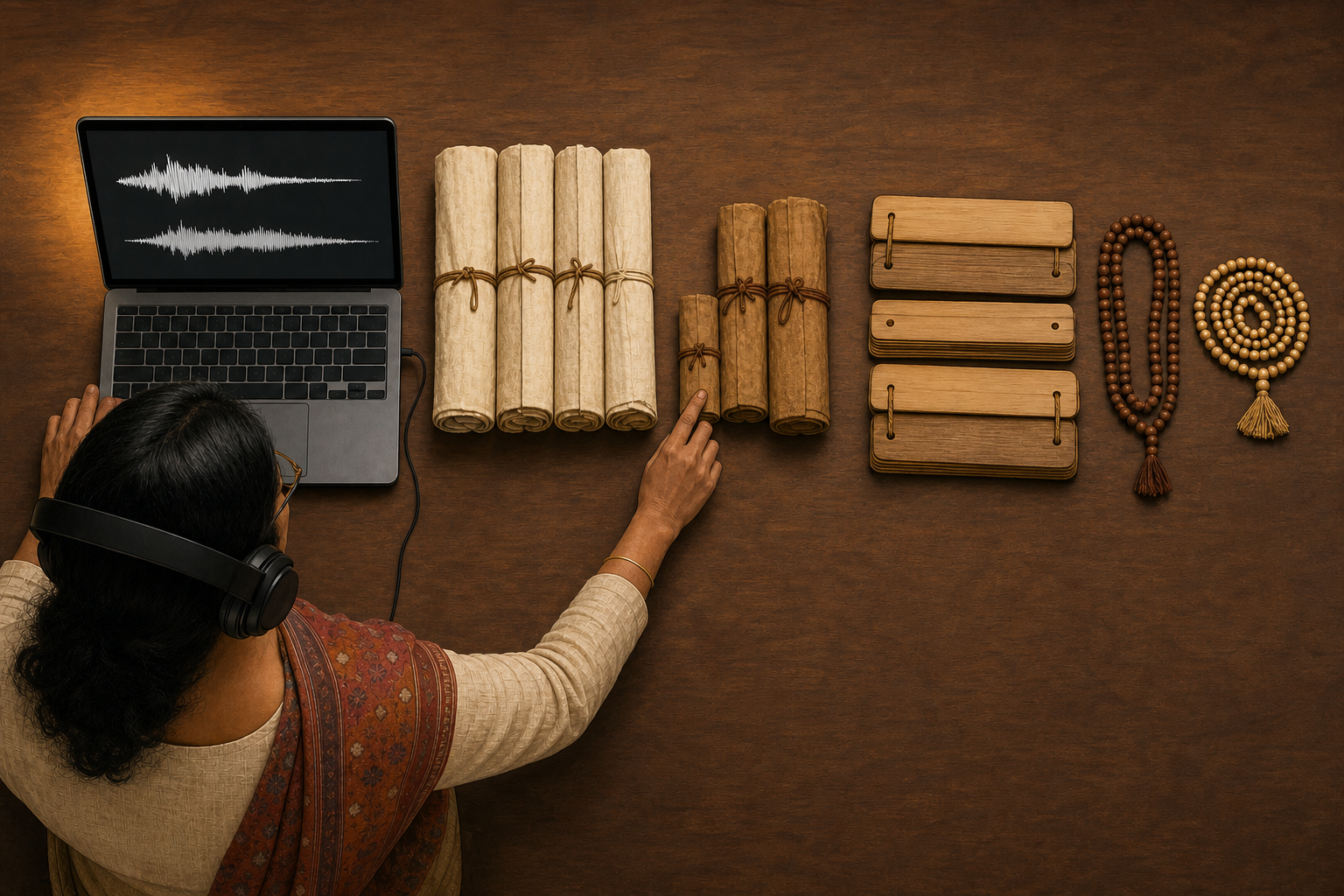
A shakha is more than a version of a book. It is a recension joined to a curriculum, a teacher-student lineage and rules governing sound, ritual and interpretation. It is therefore neither a translation nor an improvised regional accent. Its differences are inherited within a disciplined system.
- Name the Veda. Begin with Rigveda, Samaveda, Yajurveda or Atharvaveda. “Vedic” alone is too broad to identify what is being transmitted.
- Name the shakha or recensional family. A Yajurveda recording, for example, may belong to the Shukla or Krishna family and then to a particular recension such as Madhyandina, Kanva or Taittiriya.
- Name the textual layer. A Samhita supplies mantra collections, while a Brahmana treats ritual reasoning, an Aranyaka moves toward contemplative inquiry and an Upanishad develops philosophical teaching. These are related parts of a lineage’s corpus, not interchangeable labels.
- Name the patha, or recitation mode. A continuous liturgical rendering, a word-separated analysis and an elaborate mnemonic permutation are doing different jobs. They should not be compared as though one were merely a faster or more ornate rendition of another.
If a recording is titled only “Yajurveda chanting,” its identity is incomplete. Ask whether it is Shukla or Krishna Yajurveda, which shakha it follows, which work and passage it contains, and which patha is being used. If the person publishing it cannot supply those basics, you may still listen devotionally, but you should not treat the label as adequate evidence of textual provenance.
This distinction also resolves an apparent contradiction. The tradition could preserve several recensions without surrendering precision. Plurality existed between established branches; precision was maintained within each branch. A difference between Madhyandina and Kanva is therefore not automatically a copying mistake. The right comparison is recension against the standards of its own lineage.
Oral precision came from layered error correction

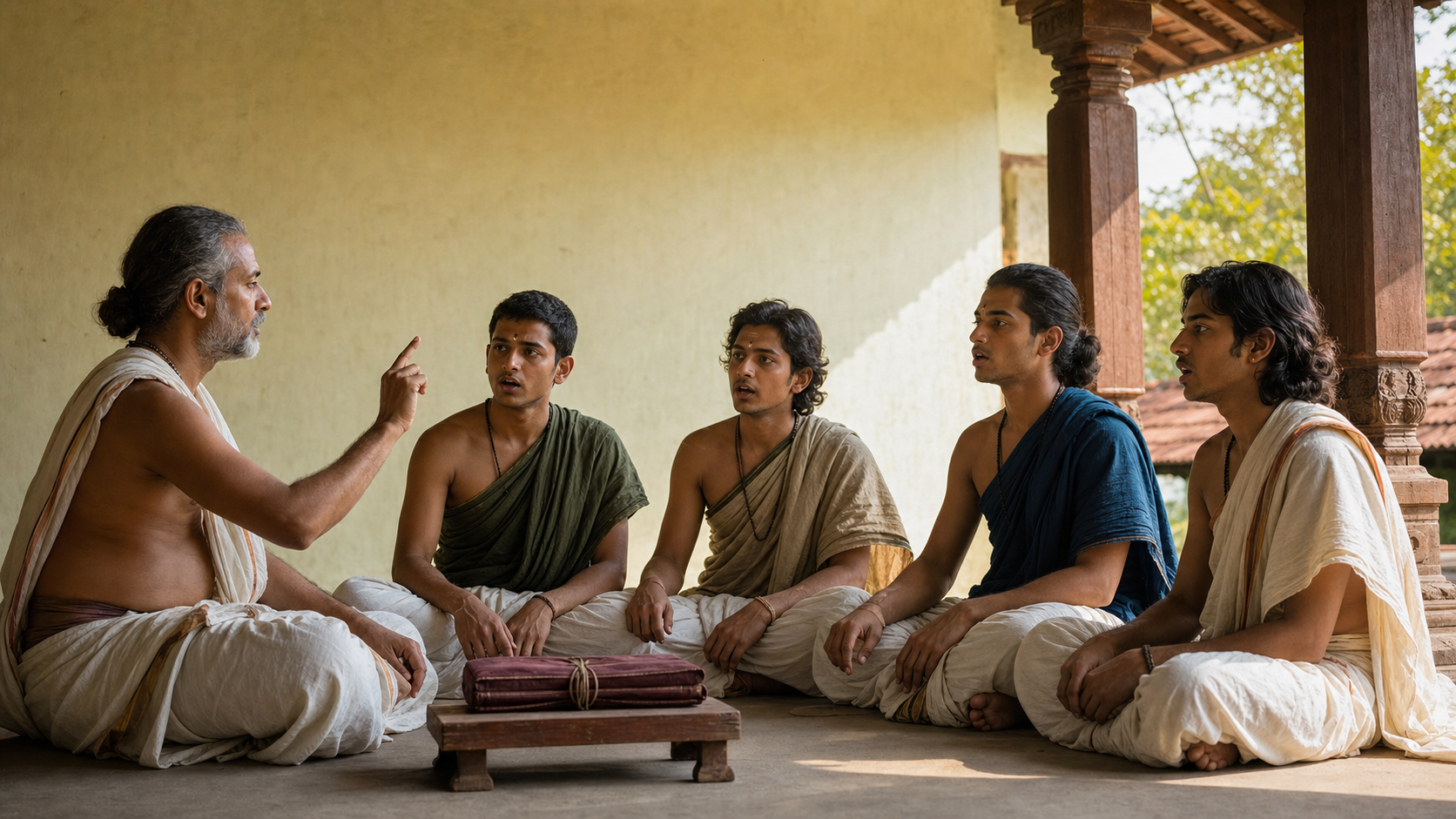
Calling the system “oral” can mislead a modern reader. It did not mean that a teacher recited freely while students tried to remember the general sense. The object of preservation included syllable, sequence, pitch, duration and the rules by which sounds meet. Meaning mattered, but a meaning-only paraphrase was not the Veda being transmitted.
The unit of preservation was sounded speech
Vedic recitation distinguishes the accents udatta, anudatta and svarita, described respectively as raised, unraised and falling. It also attends to temporal extension through pluta and to nasalization through anunasika. A plain transcript that preserves consonants and vowels but removes these features may be useful for reading; it is not a complete record of the recited form.
This is why a preservation project needs more than clean audio or a printed Sanskrit text. It should keep the recording and its accent-bearing textual reference together, identify the shakha and teacher lineage, and avoid silently normalizing one recension to match another. Without that metadata, future listeners may possess the sound file while losing the knowledge required to interpret it.
The wider curriculum supplied additional checks. Pratisakhyas regulated phonetics and accent. Anukramanis indexed hymns by rishi, devata and metre. The six Vedangas organized phonetics, metre, grammar, etymology, calendrical knowledge and ritual under the names Shiksha, Chhandas, Vyakarana, Nirukta, Jyotisha and Kalpa. Shrauta Sutras and Grihya Sutras connected recitation to public and domestic rites. Together, these disciplines made preservation an ecosystem rather than an isolated feat of memory.
Different pathas expose different kinds of error
The pada-patha separates words that connected recitation may join through sound rules. The krama-patha links them in overlapping pairs. In a purely schematic sequence A B C D, its checking logic would move through AB, BC and CD. More elaborate vikriti modes, including jata-patha and ghana-patha, weave the material through complex permutations. A missing, displaced or altered unit becomes harder to conceal because it must remain consistent across several recitational structures.
These modes are not decorative performances added after the “real” text. They are part of the checking architecture. At the same time, ghana-patha should not be treated as a universal authenticity badge. A lineage may preserve other modes, and a technically elaborate recital still needs the correct base text, accent and training. If you are learning, follow the order established by a qualified teacher rather than trying to reconstruct an advanced patha by imitating an online recording.
The system’s strength should also be stated carefully. Redundancy explains how a living lineage can resist drift; it does not prove that every historical branch survived. Many shakhas disappeared, while others remain known through manuscripts, associated works or partial continuity. Precision within surviving transmission and loss of entire lineages can both be true.
Use this map to place the major surviving lineages
The following map is a practical classifier, not a complete historical census. Traditional counts vary, and the surviving landscape is much smaller than the earlier plurality. Use it to ask better questions when you encounter a chant, an Upanishad, a ritual manual or a preservation campaign.
| Vedic family | Lineages or recensions to recognize | Associated corpus and identifying features | Regional clues |
|---|---|---|---|
| Rigveda | Shakala is the principal survivor in full oral form. Kausitaki, also called Sankhyayana in associated usage, preserves evidence of variant liturgical practice even where continuous recitation has lapsed. | Shakala is linked with the Aitareya Brahmana and Aitareya Upanishad. The Kausitaki Brahmana and Kausitaki Upanishad belong to the Kausitaki constellation. Asvalayana and Shankhayana ritual manuals are also important identifiers. | A generic “Rigveda” label is insufficient; verify the recension and associated teaching tradition. |
| Samaveda | Kauthuma and Ranayaniya remain widely represented. Jaiminiya, also called Talavakara, survives in select communities. | Melodic performance is integral rather than incidental. The Chandogya Upanishad is associated with Kauthuma, while the Kena Upanishad is traditionally tied to Talavakara. Gramageya and Aranyageya chant series, with derived forms, further distinguish the tradition. | Ranayaniya is prominent in western India. Jaiminiya survives in parts of Kerala and Tamil Nadu. |
| Shukla Yajurveda | Madhyandina and Kanva are the two principal shakhas of the Vajasaneyi Samhita. | Both are associated with the Shatapatha Brahmana and with the Isa and Brihadaranyaka Upanishads. The Katyayana Shrauta Sutra and Paraskara Grihya Sutra help identify the related ritual framework. | Madhyandina predominates across much of North India. Kanva remains in pockets extending from Central India toward the East. |
| Krishna Yajurveda | Taittiriya is the most prominent living shakha. Maitrayaniya and Katha are other important recensions; Kapisthala-Katha is known mainly through manuscripts and references. | Krishna Yajurveda characteristically interleaves mantra and explanatory prose. Taittiriya transmits its own Samhita, Brahmana and Aranyaka, including the Taittiriya Upanishad. Maitri and Katha Upanishads identify their respective traditions. Apastamba, Baudhayana and Bharadvaja supply major ritual frameworks. | Taittiriya is especially strong in South India. |
| Atharvaveda | Shaunaka and Paippalada are the two principal shakhas. Shaunaka has broader continuity; Paippalada gained renewed attention after important manuscripts were identified in eastern India. | The wider corpus includes the Gopatha Brahmana and the Prashna, Mundaka and Mandukya Upanishads. Its range extends across domestic rites, royal consecration, healing lore and philosophical inquiry. | Shaunaka spans Gujarat and Maharashtra, while Paippalada has re-emerged in Odisha. |
Geography is a clue, not a substitute for identification. If you hear a Samavedic chant from Kerala, Jaiminiya becomes a relevant possibility, but the location alone does not prove the shakha. Confirm the lineage, repertoire and teacher. Likewise, do not use the absence of a large present-day community to declare a recension imaginary: some are represented principally through manuscripts and related textual evidence rather than an unbroken public recitation practice.
The table also shows why an Upanishad should not always be detached from its recensional home. The Taittiriya Upanishad belongs within a Taittiriya textual world; the Brihadaranyaka stands within the Shukla Yajurvedic constellation; the Chandogya is connected with Samavedic transmission. You can certainly study an Upanishad philosophically on its own, but remembering its shakha restores the sound, ritual and pedagogical setting from which it emerged.
How to evaluate a recitation or preservation effort
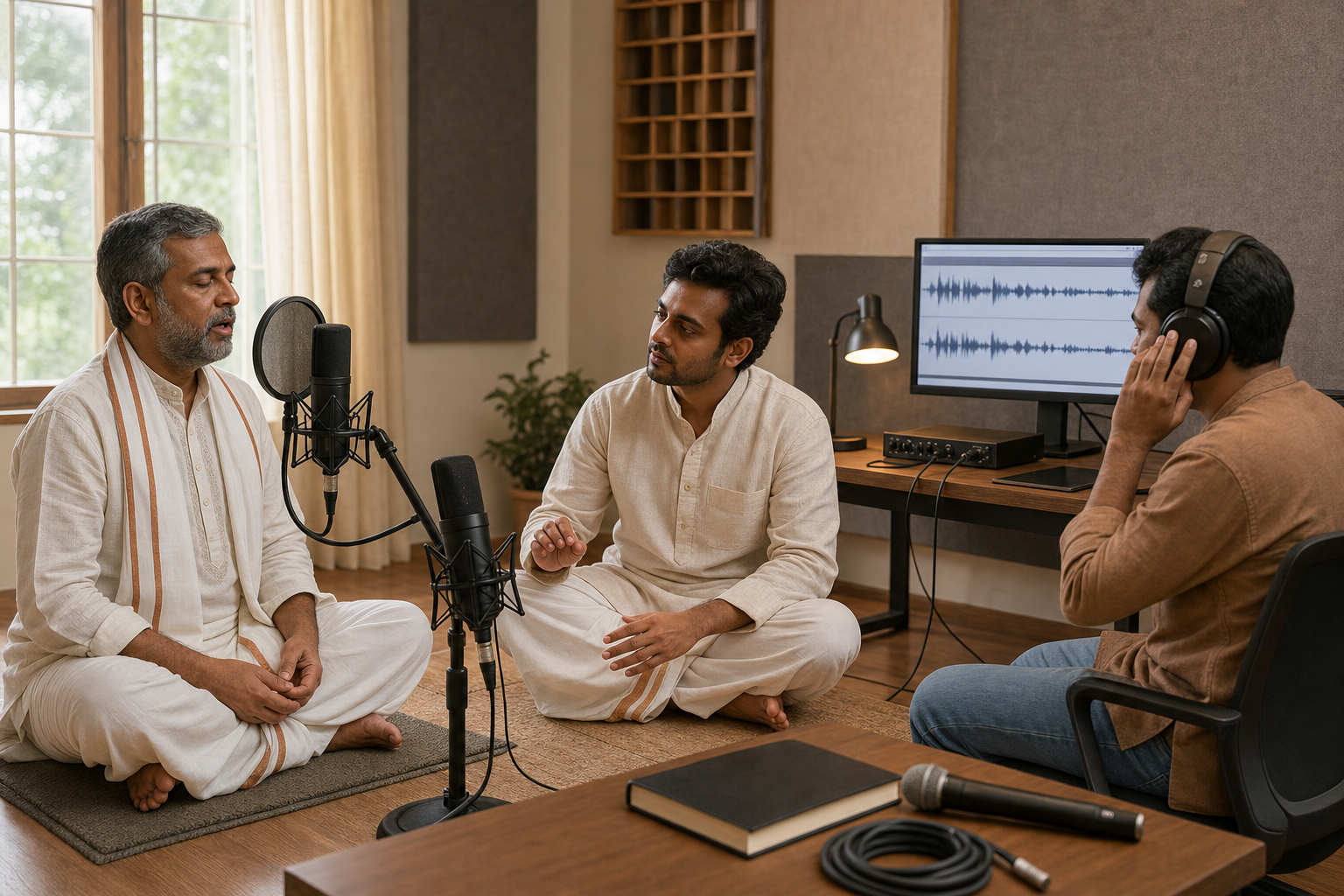
You do not need to be a Vedic specialist to ask responsible questions. Whether you are choosing a recording, supporting a pathashala, organizing an event or cataloguing family material, the following checks separate living preservation from a file that merely looks traditional.
- Demand a precise identity. Record the Veda, shakha, exact work, passage and patha. Add the ritual or teaching context when it is known. “Ancient Vedic mantra” is not enough.
- Preserve provenance. Note who taught the reciter, the lineage or institution in which the training occurred and the region associated with that training. This is not celebrity pedigree; it is the chain needed to interpret variant forms responsibly.
- Check whether accent is being preserved. Ordinary Sanskrit competence does not by itself establish command of Vedic accent. Ask whether the recital follows the udatta, anudatta and svarita rules of the named branch.
- Keep sound and text together. Pair recordings with the appropriate accent-marked text and, where available, the relevant phonetic or ritual manual. A normalized transcript can conceal precisely the distinctions the recording was meant to preserve.
- State the kind of survival honestly. Distinguish a living oral lineage from a recension known mainly through manuscripts, references or associated works. Kapisthala-Katha should not be presented as though its present condition were identical to Taittiriya, and Paippalada’s manuscript-supported revitalization should not be collapsed into Shaunaka’s broader continuity.
- Look for repeated teaching, not a single performance. Traditional pathashala formation relies on daily cycles of memorization, correction, chant and contemplation. A festival recital can display the result, but it cannot replace the sustained teacher-student work that produces another competent transmitter.
- Ask what will survive after the current expert. A credible preservation effort should be able to name the students being trained, the material they are learning and how correction will continue. Recording an elderly master is valuable; creating no succeeding learner leaves the lineage dependent on playback.
Choose the next step that matches your role
- If you are a listener or sharer, add the four identifying labels whenever you publish a recording. Do not rename a regional or recensional form as the universal version of a mantra.
- If you are a student, use recordings for review only in the manner your teacher permits. A video cannot hear your mistake, distinguish a stable lineage feature from a personal habit or correct your accent at the moment it begins to drift.
- If you manage an archive, store pronunciation notes, textual references and provenance beside the media. A filename and a generic description will not be enough for a future cataloguer to distinguish closely related traditions.
- If you support a pathashala or community program, ask how many portions are taught systematically, how correction is supervised and whether students have enough time for daily practice. Public events matter, but continuity is built in the less visible hours of repetition.
- If you organize ritual, verify the Grihya or Shrauta framework being followed instead of assembling mantras from unrelated recensions because their translations appear similar.
This standard also helps readers across the wider Dharmic family. Buddhism, Jainism and Sikhism have their own scriptures, doctrines and modes of transmission; they should not be relabelled as Vedic shakhas. What can be recognized across these traditions is the civilizational importance of disciplined orality, teacher-student formation and reverence for sacred sound. Compare the methods without erasing the boundaries.
Key takeaways
- A shakha is a living recensional curriculum, not merely a different edition of a book.
- A variation is not automatically an error. First identify the Veda, shakha, textual layer and patha.
- Vedic preservation carries pitch, duration, nasalization and sequence alongside verbal meaning.
- Pada, krama, jata and ghana recitations create overlapping checks that make unnoticed corruption harder.
- Survival is uneven: some shakhas retain strong oral continuity, while others are known chiefly through manuscripts or associated texts.
- The decisive unit of preservation is still the trained human relationship among teacher, student and community.
The next time you save or share a Vedic recital, begin with one small act: attach its Veda, shakha, text and patha. If you support preservation, go one step further and ask who is learning it next. Those questions move sacred sound from anonymous media back into the living chain that gives it form.