

You may be here because a death has unsettled your household, because someone you love is fragile, or because your own future suddenly feels less theoretical. You do not need a slogan about accepting impermanence. You need a way to decide what deserves your attention now.
The dharmic response is neither denial nor morbid fixation. It is to see the body’s vulnerability clearly, keep the differences among traditions honest, and make remembrance, restraint, duty, and service more dependable than your mood. Across Hindu, Buddhist, Jain, and Sikh paths, impermanence increases ethical responsibility; it does not cancel meaning.
Death changes the body, but conduct still carries forward
Funeral fire, burial earth, and biological decomposition all establish one limited fact: the material body returns to larger natural processes. That fact does not settle the nature of consciousness. Nor does it erase the choices, relationships, duties, and consequences through which a life has taken shape. Dharmic funerary practices honour bodily impermanence while treating death as a morally significant transition, not as the resurrection of the former body.
There is no single, interchangeable dharmic explanation of what continues. The differences matter, especially when you are caring for someone from a tradition other than your own.
| Path | What changes at death | How continuity is understood | Practice it calls for |
|---|---|---|---|
| Hindu | The gross body, or sthula sharira, perishes. | In many Vedic accounts, the jiva continues with subtle and causal conditions, bearing samskaras and the results of karma. | Dharma, japa, surrender, self-knowledge, and non-attachment. |
| Buddhist | All conditioned constituents are impermanent; anatta denies an unchanging personal self. | Causal continuity links lives without requiring a permanent soul. Abhidharma analysis describes rebirth-linking through patisandhi citta, shaped by intention. | Refuge, maranasati, ethical discipline, compassion, and non-grasping. |
| Jain | Paryaya, the modes or states of a substance, continually change. | The eternal jiva remains bound by karmic pudgala until liberation. | Ahimsa, aparigraha, samayik, right knowledge, and right conduct. |
| Sikh | Embodied life unfolds within janam-maran, the cycle of birth and death, under Hukam. | The cycle is transcended through Divine grace and union with Akal Purakh. | Naam Simran, truthful living, surrender to Hukam, and seva. |
These are convergences, not synonyms. Anatta should not be quietly translated into jiva. Jain karmic matter is not merely another name for a Hindu subtle body. Sikh surrender to Hukam has its own scriptural and communal grammar. Dharmic solidarity becomes stronger when it is built on precision rather than a claim that every tradition secretly teaches the same metaphysics.
For many Hindu readers, the Bhagavad Gita supplies the most familiar frame. Verses 2.13 and 2.22 present bodily transition through the experiences of aging and changing garments. The distinction among gross, subtle, and causal embodiment explains how samskaras and karma can outlast the visible organism. Bhagavad Gita 18.66 then turns metaphysics into a decision: surrender to Krishna while continuing to act, rather than using surrender as an excuse to abandon action.
This distinction should change how you speak around death. Use the language of the grieving person’s lineage. Do not tell a Buddhist that anatta secretly means an eternal soul, or tell a Vaishnava that Krishna is only a metaphor for an impersonal process. You can stand beside another person without annexing their path.
Let mortality create urgency rather than panic

In the Gaudiya Vaishnava setting, A.C. Bhaktivedanta Swami Prabhupada emphasized sharanagati because neither death nor the gradual erosion of faith waits for a convenient time. The classical image of a drop trembling on a lotus leaf carries two instructions. Life may slip away without notice, yet action can remain unwetted by possessiveness. Fragility and non-attachment belong in the same teaching.
Panic fixes attention on everything you cannot govern. Urgency identifies the truthful duty that remains possible. Panic says that every problem must be solved immediately. Urgency asks what must be done now, what can wait, and which result was never yours to guarantee.
The six movements of Vaishnava sharanagati provide a practical test for decisions made under the pressure of mortality:
- Anukulyasya sankalpa: choose what nourishes devotion and virtue. Give remembrance a stable place in the day instead of waiting to feel inspired.
- Pratikulyasya varjanam: refuse what corrodes attention or kindness. Remove the recurring input, habit, or relationship pattern that makes sacred commitments easier to neglect.
- Rakshishyati iti vishvasah: trust the Divine as protector. Name the outcome you cannot control and stop treating anxiety as if it could secure that outcome.
- Goptrtve varanam: accept divine guardianship. Continue to plan, but plan as a steward who can receive counsel and correction, not as an owner demanding certainty.
- Atma-niksepa: offer the self. Dedicate your work, abilities, family responsibilities, and temperament to sacred purpose rather than confining devotion to ritual time.
- Karpanya: remain humble. Admit where you need help, where you have caused harm, and where your understanding is incomplete.
If you are not a Vaishnava, you need not relabel your tradition. Buddhist refuge, Jain aparigraha and samayik, and Sikh remembrance under Hukam have their own integrity. The practical resemblance lies in moving from grasping to disciplined attention, not in pretending that the theological objects of refuge are identical.
Test mortality-inspired decisions against your actual dharma. If fear makes you neglect people who depend on you so that you can pursue a dramatic spiritual gesture, urgency has turned into escape. If awareness of death leads you to repair a relationship, simplify a compulsion, resume practice, or perform an overdue duty, it is producing clarity. Abhaya, or fearlessness, is not bravado. It is the capacity to act without demanding that circumstances first become safe.
Build a practice that still works when concentration fails

A crisis does not automatically produce a steady mind. The mind usually returns to the channels cut by repetition. A dawn, midday, and evening rhythm gives remembrance several ordinary places to re-enter your day.
- At dawn, establish refuge before distraction. Use the form authorized by your path: japa, Naam Simran, meditation, prayer, recitation, or quiet scriptural reflection. Then name one duty and one quality with which you intend to perform it. Keep the practice modest enough that you can retain it on a difficult morning.
- At midday, interrupt momentum. Stop long enough to steady the breath and recall a Divine Name, verse, refuge, or ethical precept. Ask whether the action occupying you is still service or has become compulsion, vanity, resentment, or avoidance. Make the smallest available correction before continuing.
- In the evening, review without attacking yourself. Notice what strengthened remembrance and what weakened it. Acknowledge harm plainly, identify any repair that belongs to you, and end with gratitude. The purpose is to learn while the day is still close enough to examine, not to conduct a private trial against yourself.
Protect this rhythm from gradual erosion. Maya rarely needs to persuade you to reject the sacred outright. It can make the sacred optional, then decorative, then absent. Endless stimuli, performative identity, consumer appetite, and algorithmic outrage are effective because they repeatedly occupy the moments in which remembrance might otherwise arise. If a feed consistently leaves you agitated, unkind, or unable to pray, change the feed. That is pratikulyasya varjanam applied to a device.
Make community operational as well as inspirational. Satsanga, sangha, and sangat should include people who practise, study, and serve together, not only people who exchange opinions. Know whom you would call after a death. Know who understands your family’s rites. Let those people know you before a crisis occurs. An isolated will is fragile; a living community can carry the rhythm of practice when your attention is overwhelmed.
When death enters the household, reduce the next step

Sudden news can make the mind rush toward impossible solutions or collapse before necessary tasks. You do not have to settle the entire meaning of death in that moment. Reduce the horizon to the next truthful, reversible duty.
- Address immediate reality. If a person may still be alive or in danger, contact emergency services and follow competent medical direction. Do not substitute a spiritual interpretation for urgent care.
- Steady attention. Take one conscious breath at a time and return to the Name, refuge, mantra, or precept you already practise. This is not a technique for suppressing grief. It is a way to remain present enough to act.
- Contact the people who share the duty. Call close family and an appropriate priest, granthi, monastic, teacher, or experienced community elder. Do not carry ritual and logistical responsibility alone merely to appear strong.
- Identify the deceased person’s tradition. If you are responsible for arrangements, follow the person’s sampradaya, lineage, expressed wishes, family practice, and applicable local requirements. Do not improvise a blended ceremony because several dharmic practices sound similar.
- Postpone metaphysical argument. This is not the time to prove one doctrine of rebirth or liberation. Use words that honour the deceased and are intelligible within the family’s path.
Hindu antyeshti and shraddha, Sikh antam sanskar with remembrance of Naam, Buddhist practices centred on impermanence and compassionate attention, and Jain observances shaped by ahimsa and detachment each require their own guidance. Their common seriousness does not make their ritual details interchangeable.
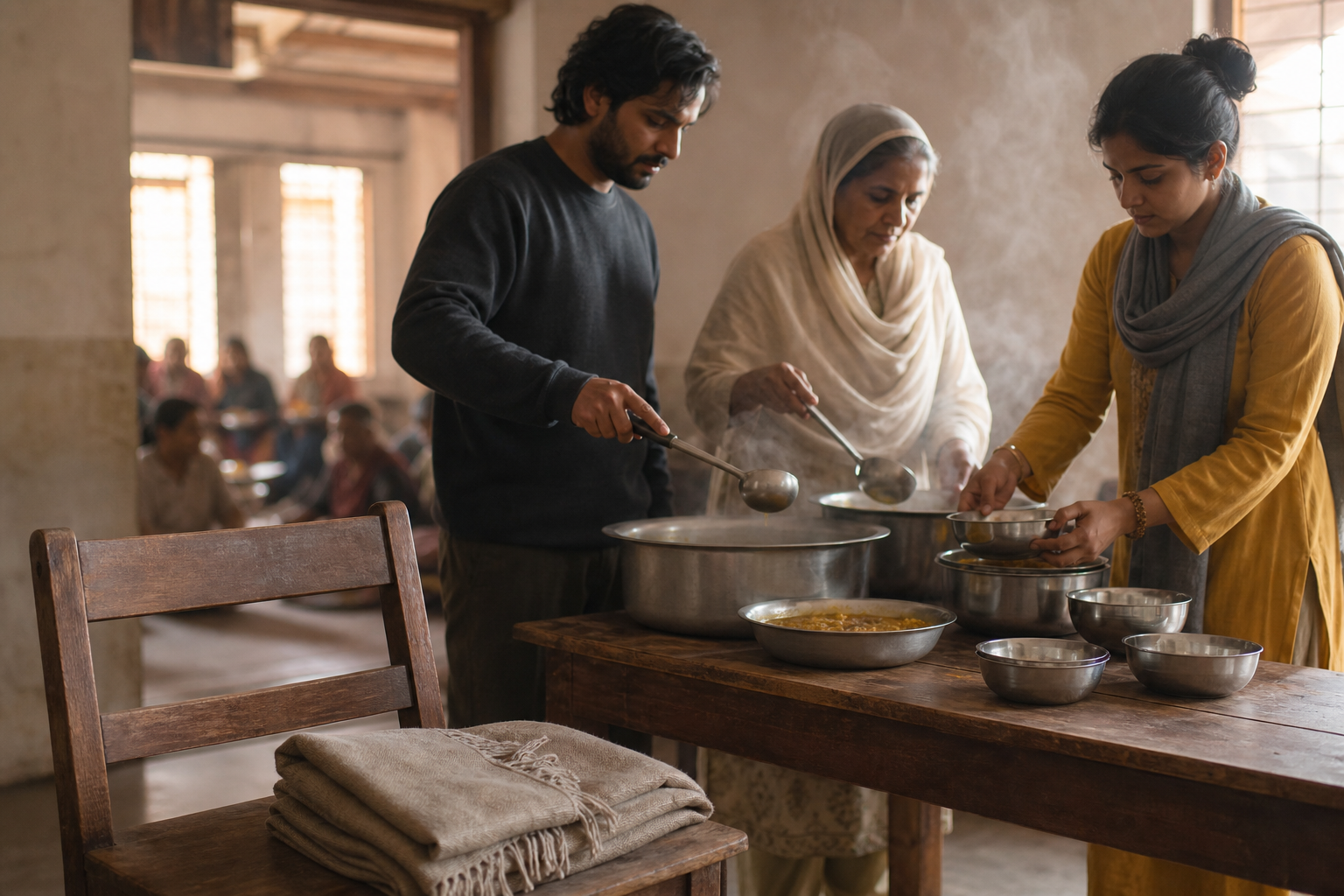
Non-attachment does not ask you to become emotionally unavailable. Aparigraha challenges possession; vairagya corrects the demand that changing forms provide permanent security. Neither principle requires you to love less. Bring food, make necessary calls, sit quietly, help with rites, and protect the bereaved from avoidable burdens. In a household touched by death, seva makes philosophy usable.
After the immediate rites, continuity becomes conduct. Fulfil a promise the deceased entrusted to you. Support someone they cared for. Offer dana or seva without turning generosity into a performance. Resume the prayer or discipline that grief has shown to be necessary. Choose one faithful act before attempting a grand memorial project.
Questions that become sharper when death feels close
Does impermanence mean that nothing is real or worth doing?
No. Impermanence means that conditioned states cannot be held in place. It does not mean actions are without consequence. Hindu karma, Buddhist causal continuity, Jain relations between jiva and karmic matter, and Sikh life under Hukam all make conduct significant. Because an opportunity to speak truth, prevent harm, or offer care will pass, timing matters.
Is surrender a form of fatalism?
No. Bhagavad Gita 18.66 does not license the abandonment of svadharma. Surrender relinquishes the fantasy of owning the result; it does not erase the obligation to act. Make the plan, seek sound counsel, protect those who depend on you, correct avoidable mistakes, and then release the demand for a guaranteed outcome.
Is non-attachment the same as feeling less?
No. Attachment tries to possess a person, role, body, or result and make it permanent. Love attends to the being in front of you. Grief and non-attachment can therefore coexist. If your practice makes you colder, less truthful, or less willing to serve, treat that effect as adverse to the path rather than as proof of spiritual advancement.
What if I am uncertain about rebirth?
You do not need to counterfeit certainty. The dharmic traditions offer serious but different accounts of continuity, and those differences deserve study through scripture, reasoning, practice, and qualified teachers. Meanwhile, uncertainty does not prevent you from practising ahimsa, truthfulness, restraint, generosity, meditation, remembrance, and service. Doubt is not a command to drift, just as faith is not permission to pretend that honest questions do not exist.
Before you leave this page, choose one act that mortality has made obviously overdue: resume remembrance at dawn, apologize without defending yourself, contact your spiritual community, remove one corrosive input, or complete a duty on which someone depends. Do that act before designing a larger programme.
Death becomes a dharmic teacher when it restores order to your loves. Let it move truth, devotion, and service from someday into the next available moment.
References
- Dandavats – Facing Impermanence Now: Urgent, Courageous Surrender to Krishna and Dharma’s Unifying Path
- Dandavats – Beyond Ashes: Dharmic Wisdom on Death, Rebirth, and Why Restraint Sustains Our World