
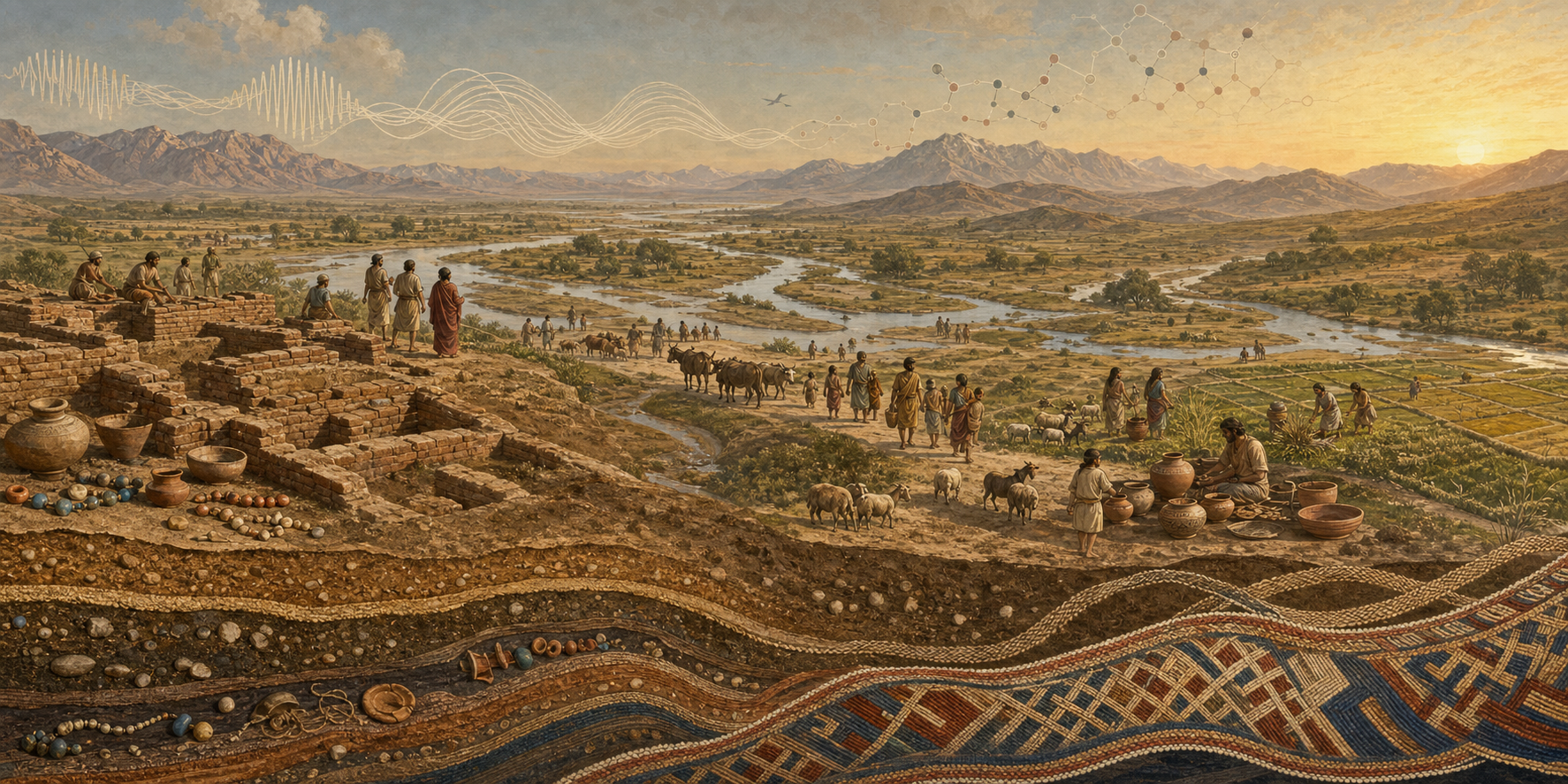
If you came here because someone told you that ancient DNA has either disproved India’s civilizational continuity or finally settled an Out of India origin, you are being offered more certainty than the evidence can carry. The useful question is not which slogan wins. It is how to separate claims about language, ancestry, archaeology, and heritage before one is made to stand in for all the others.
The most defensible answer is precise but not dramatic. Sanskrit belongs to the Indo-European language family. Ancient DNA supports steppe-related movement into South Asia after the mature Harappan phase. Neither fact, by itself, identifies a single invasion, dates the Vedas, reveals what migrants called themselves, or makes the Dharmic inheritance foreign to the land in which it developed. Once you understand those limits, you can defend South Asian heritage without making it depend on genetic isolation or an oversimplified migration story.
Separate the four kinds of evidence before judging a claim
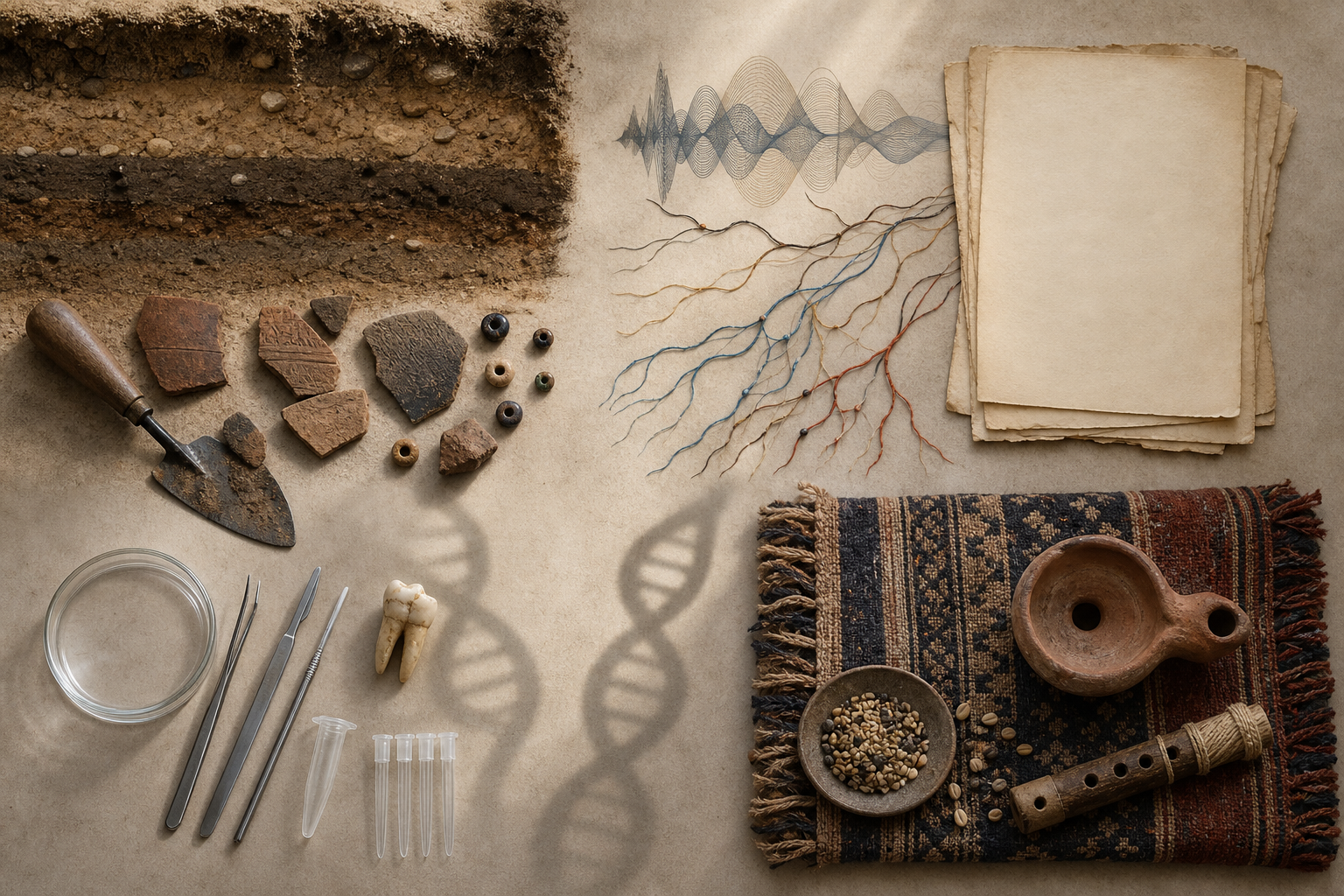
Most bad arguments about Indo-European origins begin with a category error. A linguistic relationship becomes a biological race. A genetic component becomes a language. A chariot becomes the identity of its driver. A later political label is projected backward onto people who never used it.
You can avoid that trap by sorting every claim into four columns. Each form of evidence answers a different question, and none can silently answer the other three.
| Evidence | What it can establish | What it cannot establish alone |
|---|---|---|
| Historical linguistics | Systematic relationships among languages through shared sounds, grammar, and vocabulary | Genes, skin colour, political identity, or a complete migration route |
| Ancient DNA | Biological relatedness, mixture, and population movement among sampled individuals | The language a person spoke, the scripture a person valued, or whether movement was peaceful or violent |
| Archaeology | Settlements, technologies, trade, subsistence, burial practices, and changes in material life | A spoken language when no readable linguistic record identifies it |
| Texts and living traditions | Concepts, ritual worlds, social memories, and the development of a civilization’s self-understanding | The genetic profile of a community or an exact prehistoric migration date |
Historical linguistics established the deep kinship between Sanskrit and numerous European languages after Sir William Jones drew sustained attention to it in the 18th century. That kinship is real. It does not mean that speakers formed one race, shared one political culture, or moved as a single army. Proto-Indo-European is a reconstructed linguistic ancestor, not the name of an excavated state or a genetically uniform nation.
The same discipline can reconstruct patterns of linguistic descent and contact, but the family tree does not come with a map attached. Languages move through many mechanisms: households relocate, communities intermarry, bilingual speakers shift toward a language of prestige, and neighbouring populations borrow from one another over generations. A linguistic expansion can accompany large population movement, small-scale infiltration, elite influence, or a mixture of these processes.
Genetics has a similarly firm boundary. Labels such as Steppe_EMBA and Steppe_MLBA describe ancestry profiles used for comparison. They are not the personal identities of ancient people. There is no Sanskrit gene, Vedic chromosome, or Aryan genome. When steppe-related ancestry appears in a sample, it tells you that biological ancestors connected to those populations entered the family history of the sampled person. Moving from that finding to a claim about language requires an additional argument.
Archaeology supplies another part of the bridge. A new vehicle, burial form, ceramic style, or settlement pattern can indicate contact and change. Yet an object does not speak. Spoked-wheel chariots may help reconstruct networks of technology and mobility, but a chariot alone cannot tell you which hymns its users knew or what language they used at home.
Use a simple reading habit whenever you encounter an origins claim. Mark each sentence L for language, G for genetics, A for archaeology, or T for textual tradition. If an argument moves from one letter to another, ask for the missing bridge. That one check catches much of the overstatement on both sides of the debate.
Read the chronology as evidence, not as a finished biography
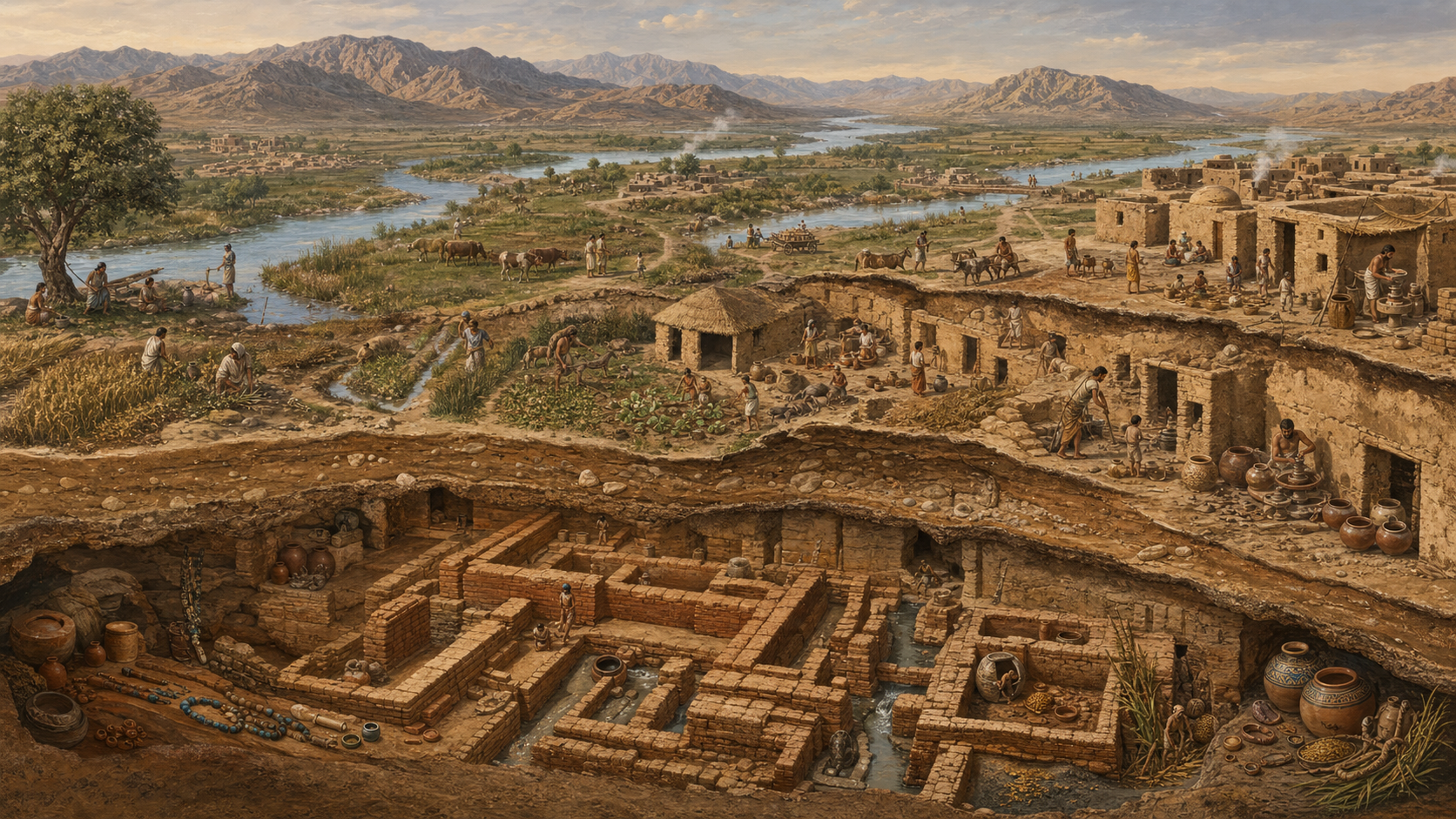
A homeland theory must explain more than linguistic resemblance. It must also fit the chronology of agriculture, mobility, technology, archaeological interaction, and population mixture. That is why the homeland has been placed in so many regions and why no single discovery should be treated as a complete solution.
A useful map of the modern debate contains three major model families that dominated discussion by 2013. The Anatolian-Neolithic model links language dispersal to the spread of agriculture from Anatolia. A South Caucasus model places an early homeland south of the Caucasus, followed by movements that include a staging area north of the Black and Caspian seas. The Pontic-Caspian model locates Proto-Indo-European between the Volga and Dnieper rivers around 4500-3000 BCE.
Each model must account for Anatolian as an early linguistic split and for the later distribution of the other branches. The Anatolian farming version also has to explain sweeping language changes across culturally varied territory between Anatolia and the Indus. Some computational reconstructions have depended on assumptions that are difficult to reconcile with real contact. One 2012 phylogeographic model effectively required separated populations to mirror linguistic change for about 2,500 years. A precise-looking output is only as persuasive as the historical assumptions built into it.
Ancient DNA has made one sequence more plausible, especially for later steppe movement, but it has not turned that sequence into a transcript of who spoke what. Keep these chronological anchors together:
- The Pontic-Caspian scenario places Proto-Indo-European in a broad window of approximately 4500-3000 BCE. This is a proposed linguistic homeland, not a directly observed language community.
- Yamnaya and related steppe populations are placed around 3300-2600 BCE.
- Ancient DNA recovered since 2015 shows substantial Steppe_EMBA, or Yamnaya-related, ancestry entering Central and Northern Europe in the third millennium BCE alongside Corded Ware horizons. This gives the steppe model strong support in Europe, though Europe and South Asia still require their own regional explanations.
- The analyzed Harappan individuals from Rakhigarhi carried no detectable steppe ancestry. The careful wording is important: it describes those individuals and supports a post-mature-Harappan arrival of the detected component. It does not turn a limited sample into a census of every Harappan settlement or every earlier contact.
- The Sintashta-Andronovo complexes are placed around 2100-1500 BCE and are associated with technological developments that include spoked-wheel chariots. Their position helps define a possible mobility corridor through South-Central Asian interaction zones, including BMAC.
- Individuals in the Swat region carried Steppe_MLBA ancestry in the second millennium BCE. Present-day South Asian groups contain variable proportions of related ancestry alongside deep components related to South Asian hunter-gatherers and Iranian agriculturalists.
The responsible inference is that ancestry connected to later Bronze Age steppe populations reached parts of South Asia after the mature Harappan phase and contributed, in varying degrees, to later populations. A possible connection with Indo-Aryan language dispersal becomes historically plausible because the genetic and archaeological chronologies can be aligned. It remains an inference rather than something DNA reads out directly.
Several further questions remain open. The samples do not specify the precise route followed by every group. They do not measure the full social scale of movement across the subcontinent. They do not tell us whether every encounter involved conflict, alliance, marriage, patronage, or gradual absorption. They also do not date the composition of a particular Vedic hymn. If a claim supplies those answers from ancestry alone, it has outrun the evidence.
Why the invasion-versus-Out-of-India binary fails
The public argument often gives you two packages. In one, invading Aryans enter India, defeat an indigenous population, and bring Vedic civilization with them. In the other, all relevant language and culture originate within India and move outward, with no significant later movement into the subcontinent. You do not have to buy either package whole.
The older invasion narrative did not emerge in an intellectually neutral environment. Early efforts to fit Indian antiquity into European sacred chronology worked within Bishop Ussher’s 4004 BCE creation date. Nineteenth-century racial theories later combined linguistic categories with physical stereotypes. The demonstration that Dravidian languages did not descend from Sanskrit was an important linguistic achievement, but it was drawn into racialized interpretations of Vedic conflicts between Aryas and dasas. Colonial rule could then be presented as another supposed Aryan wave over India.
This history matters because old language can continue to shape modern assumptions. It explains why many Indians hear invasion theory as more than a technical claim. But colonial misuse does not automatically make every later finding false. Rejecting a racial myth and evaluating ancient DNA are compatible acts. A bad political use of evidence is not a substitute for examining the evidence itself.
The word migration also needs discipline. It describes movement, not a single mechanism. It can cover a conquering army, but it can also describe repeated flows of families, pastoral groups, craftspeople, marriage partners, or small communities entering established networks. Indian historiography has largely moved away from one decisive Aryan invasion toward several waves of migration. That shift is not cosmetic. It changes the historical mechanism from sudden replacement to a process that may include admixture, bilingualism, competition, alliance, and gradual language change.
The archaeological difficulty remains real. There is no generally accepted archaeological demonstration of the exact elite-dominance or language-shift mechanism by which Indo-Aryan became established in India. Genetic mobility makes contact possible and population mixture demonstrable. It does not automatically fill that explanatory gap.
Gradual diffusion deserves serious attention for that reason. A language can spread through sustained interaction without the previous population vanishing. Agricultural and pastoral networks can bring communities into repeated contact. Children can grow up bilingual. A language associated with ritual, trade, power, or wider communication can be adopted beyond the ancestry group that first carried it. Late in his career, Max Muller himself questioned a rigidly monolithic Proto-Indo-European population and considered gradual infiltration by relatively small numbers more plausible than massive invasions.
Out of India is also a family of claims rather than one proposition. Evidence of later inward steppe ancestry challenges versions that deny meaningful post-Harappan movement into South Asia. It does not logically disprove every possibility of an earlier outward movement, nor does it settle the ultimate Proto-Indo-European homeland by itself. Conversely, linguistic or cultural continuity in India cannot erase a demonstrable genetic contribution merely because that contribution entered later.
So replace the binary question with four smaller ones: Where did the relevant ancestry form? When did it enter the sampled region? How might a language have spread? Where did the resulting tradition undergo its major development? Those answers need not point to the same place.
South Asian heritage does not require ancestral purity
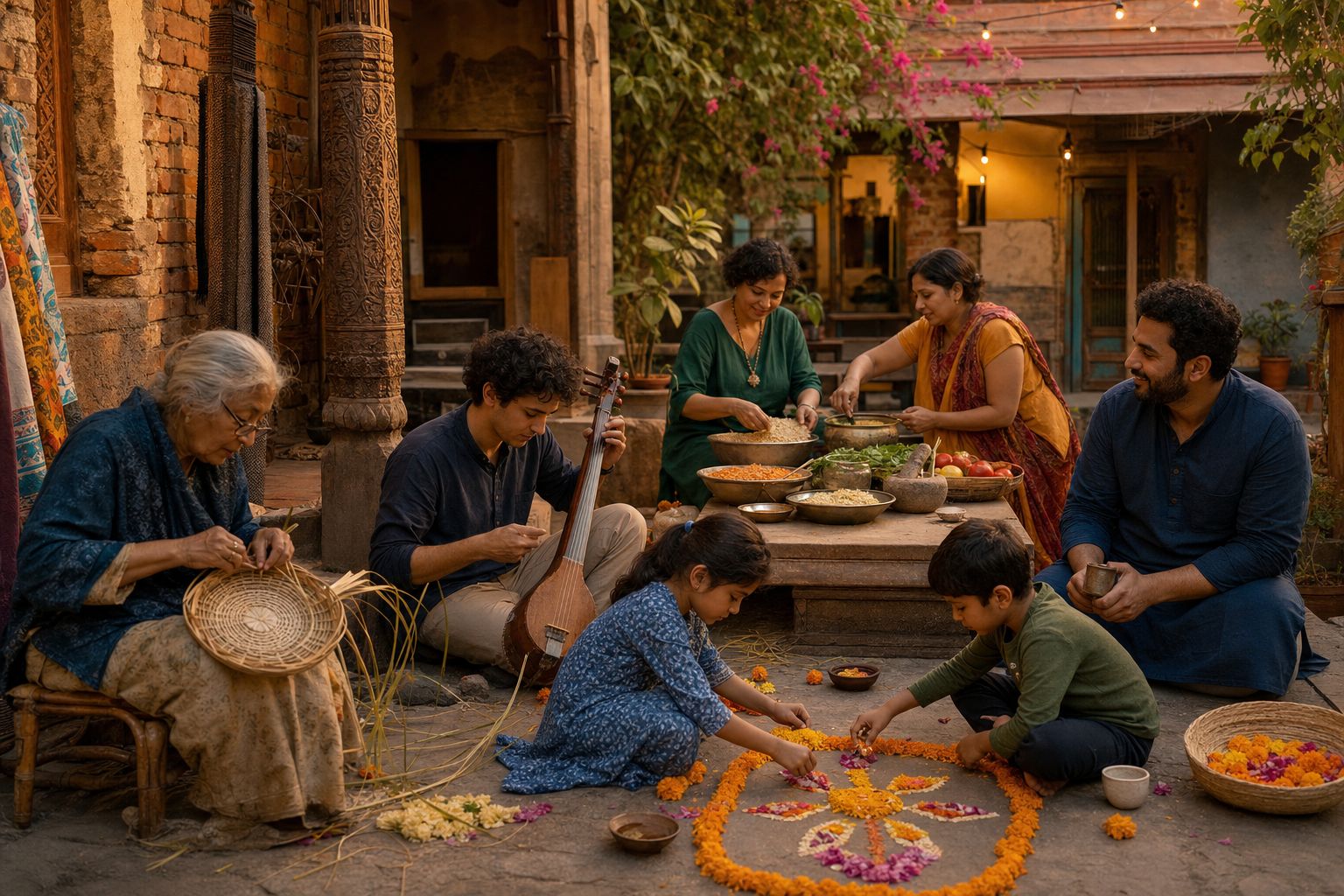
The emotional mistake at the centre of this debate is treating origin as ownership. If one ancestral component arrived from outside the modern borders of India, some conclude that the civilization it joined belongs elsewhere. If a tradition is unquestionably Indian, others conclude that every biological and linguistic precursor must also have originated inside India. Neither conclusion follows.
Heritage is not a title deed issued to the first population component. It is what generations create, preserve, debate, translate, reform, and transmit. Biological ancestors can move while their descendants become rooted in a new landscape. Languages can arrive through contact and then acquire their defining literature, philosophy, ritual vocabulary, and social range in that landscape. Existing communities can adopt a language while transforming it. None of these possibilities makes the resulting civilization counterfeit.
South Asian ancestry itself records depth and mixture. The available genome-wide picture includes components related to South Asian hunter-gatherers, Iranian agriculturalists, and later steppe populations in different proportions across present-day groups. That is a history of interaction, not a hierarchy of belonging. A later ancestry component is not more civilized because it is later, and a deeper component is not the sole owner of everything developed afterward.
The same reasoning protects the integrity of Sanskrit and the Vedic tradition. Even if some Indo-Aryan linguistic ancestors entered through migration, the language could develop locally through long contact with South Asian communities. The preservation, elaboration, and civilizational life of Sanskrit belong to South Asian history. An external contribution to ancestry or remote linguistic formation cannot transfer that inheritance to modern Europe, just as shared linguistic ancestry does not make European traditions branches of Hindu practice.
Nor should Indo-European become a synonym for Dharmic. Hindu, Buddhist, Jain, and Sikh traditions grew through distinctive South Asian debates, institutions, ethical disciplines, and spiritual vocabularies. They interacted with Sanskrit and other Indo-Aryan languages, but South Asia also contains Dravidian languages and many communities whose contributions cannot be compressed into an Aryan-versus-non-Aryan frame. The Dharmic civilizational space is wider than one reconstructed language family.
This gives you a firmer pro-heritage position than a purity claim can provide:
- You can affirm the antiquity and continuity of South Asian civilization without claiming that no population ever entered it.
- You can recognize steppe-related admixture without calling every movement an invasion or every migrant a civilizational founder.
- You can accept the Indo-European relationship of Sanskrit without turning a language family into a race.
- You can treat Harappan civilization as a foundational South Asian inheritance without pretending that every later tradition must be identical to Harappan life.
- You can defend the Indian character of Vedic and later Dharmic traditions because civilizations are formed through historical development, not awarded according to the oldest detectable gene.
When the discussion becomes personal, one concise answer is enough: ancient DNA supports post-Harappan steppe-related admixture in South Asia, but it does not demonstrate a single Aryan invasion or make Vedic civilization foreign. Language, genes, objects, and traditions can travel together, separately, or at different speeds. Each connection has to be demonstrated rather than assumed.