Hindu temples and mosques are not simply different-looking religious buildings. Each organizes space, movement, sound, time, and communal participation around a distinct understanding of worship. Reading those elements together reveals how architecture becomes a practiced theology rather than a decorative shell.
This comparison draws on the cited DharmaRenaissance overview. Because the supplied material contains one source article, the discussion reorganizes and contextualizes that account without presenting its details as independently corroborated.
Key takeaways
- A Hindu temple directs attention toward a consecrated presence, while a mosque directs a congregation toward the qibla for image-free prayer to the one God.
- Temple circulation commonly emphasizes approach, thresholds, and circumambulation; mosque planning emphasizes orientation, visible alignment, and synchronized rows.
- Figurative sculpture, offerings, lamps, incense, and instruments can participate in temple worship, whereas mosques characteristically foreground calligraphy, geometry, recitation, and the unaccompanied human voice.
- Priestly service has a central ritual role in temples. Mosque prayer is led by an imam but remains non-sacerdotal in structure.
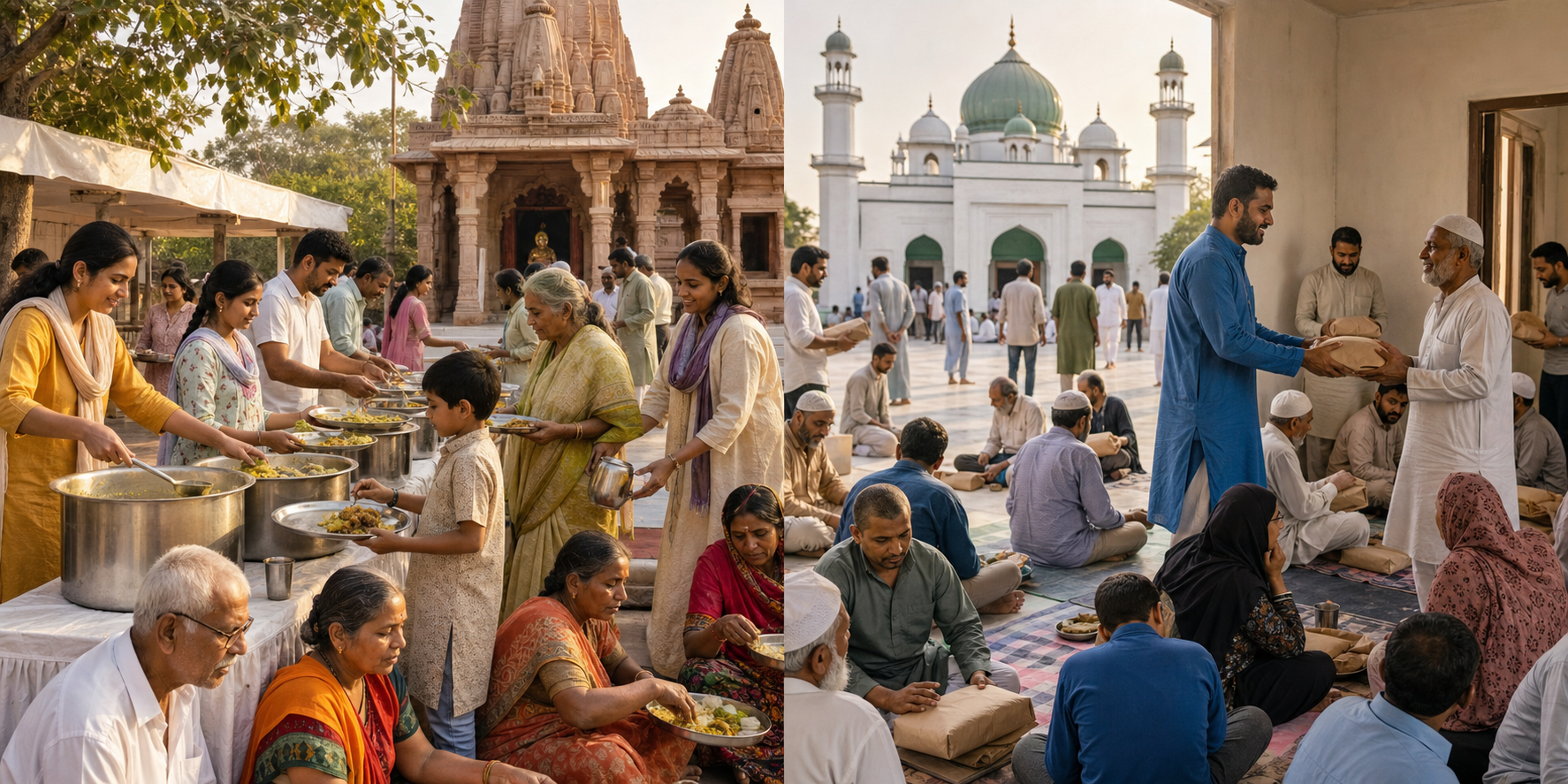
- Both institutions extend beyond formal worship through food, education, charity, accommodation, and other forms of community support.
Theology determines what sacred space must accomplish
The most useful comparison begins with religious purpose rather than domes, towers, or ornament. The source presents Hindu temple worship through the relationship between divine transcendence and immanence. Through prana pratishtha, a murti, linga, or other sacred form is consecrated as an active divine presence. Darshan consequently makes seeing central: the devotee approaches the deity not merely to inspect an image, but to enter a devotional encounter.
This principle explains why the garbhagriha carries such weight. The sanctum is the concentrated ritual center around which halls, vestibules, enclosures, gateways, and processional routes acquire meaning. Access to the innermost chamber may be restricted even when devotees can receive darshan from beyond it. The arrangement therefore distinguishes physical proximity from devotional participation.
The source interprets the mosque through tawhid, the absolute oneness of God. A mosque does not house an image of the Divine or establish a consecrated embodiment comparable to a temple murti. Its task is to support direct, image-free submission through salah. The qibla gives the community a shared direction, while the mihrab identifies that orientation in the prayer hall.
Aniconism should not be mistaken for an absence of visual meaning. According to the source, Quranic calligraphy, vegetal arabesques, and geometric tessellations make unity, continuity, and transcendence perceptible without depicting God. Hindu iconography and Islamic non-figurative ornament thus perform different theological work: one gives sacred form a focal presence, while the other disciplines attention without a divine image.
Movement turns architectural plans into religious practice
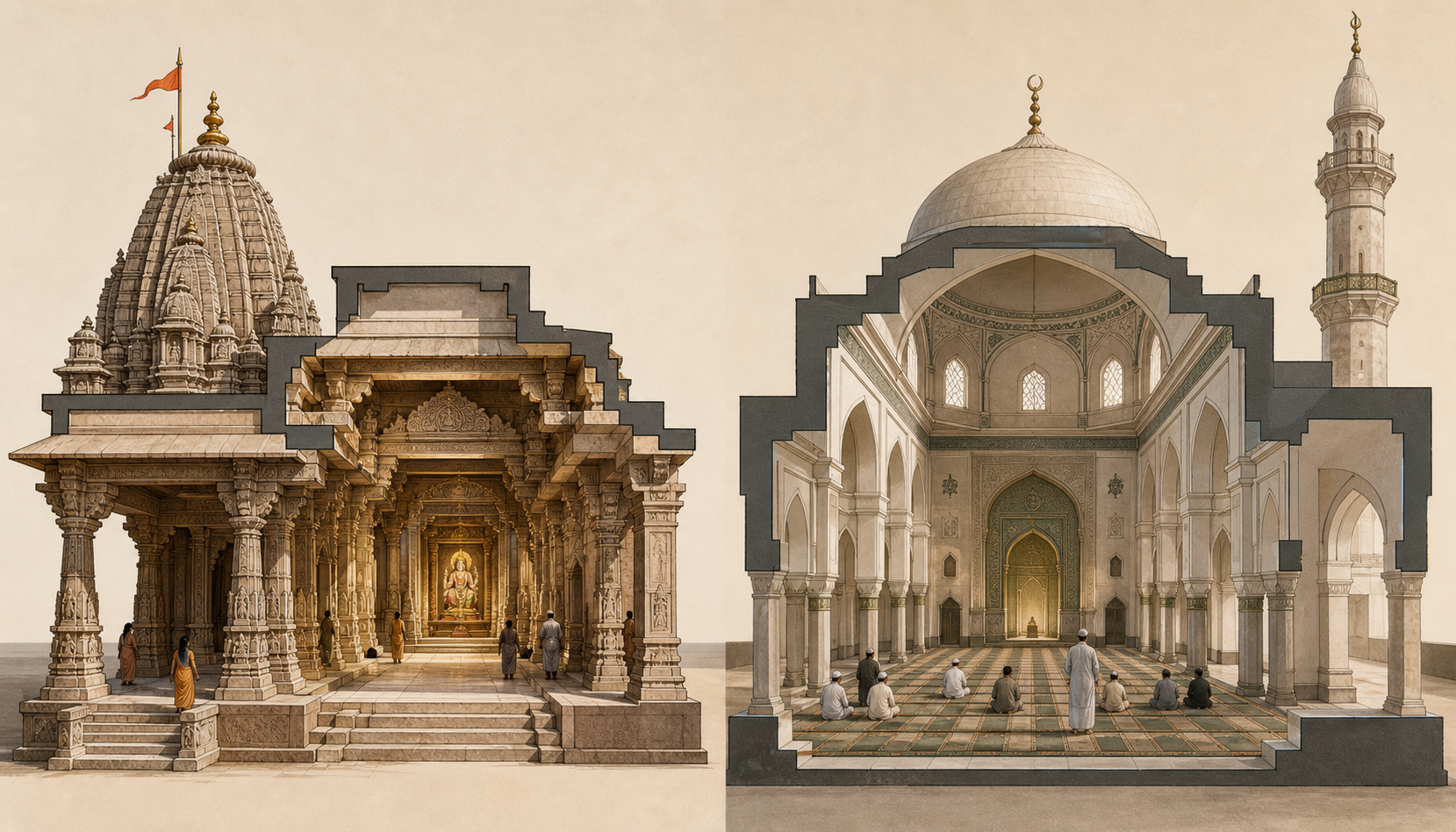
A plan becomes spiritually meaningful when people move through it. The source describes Hindu temple planning as a gradual passage from ordinary surroundings toward a concentrated center. Vastu Shastra and the Vastu Purusha Mandala may provide a cosmological framework, while the garbhagriha, antarala, mandapas, prakaras, and circumambulatory paths organize the devotee’s approach.
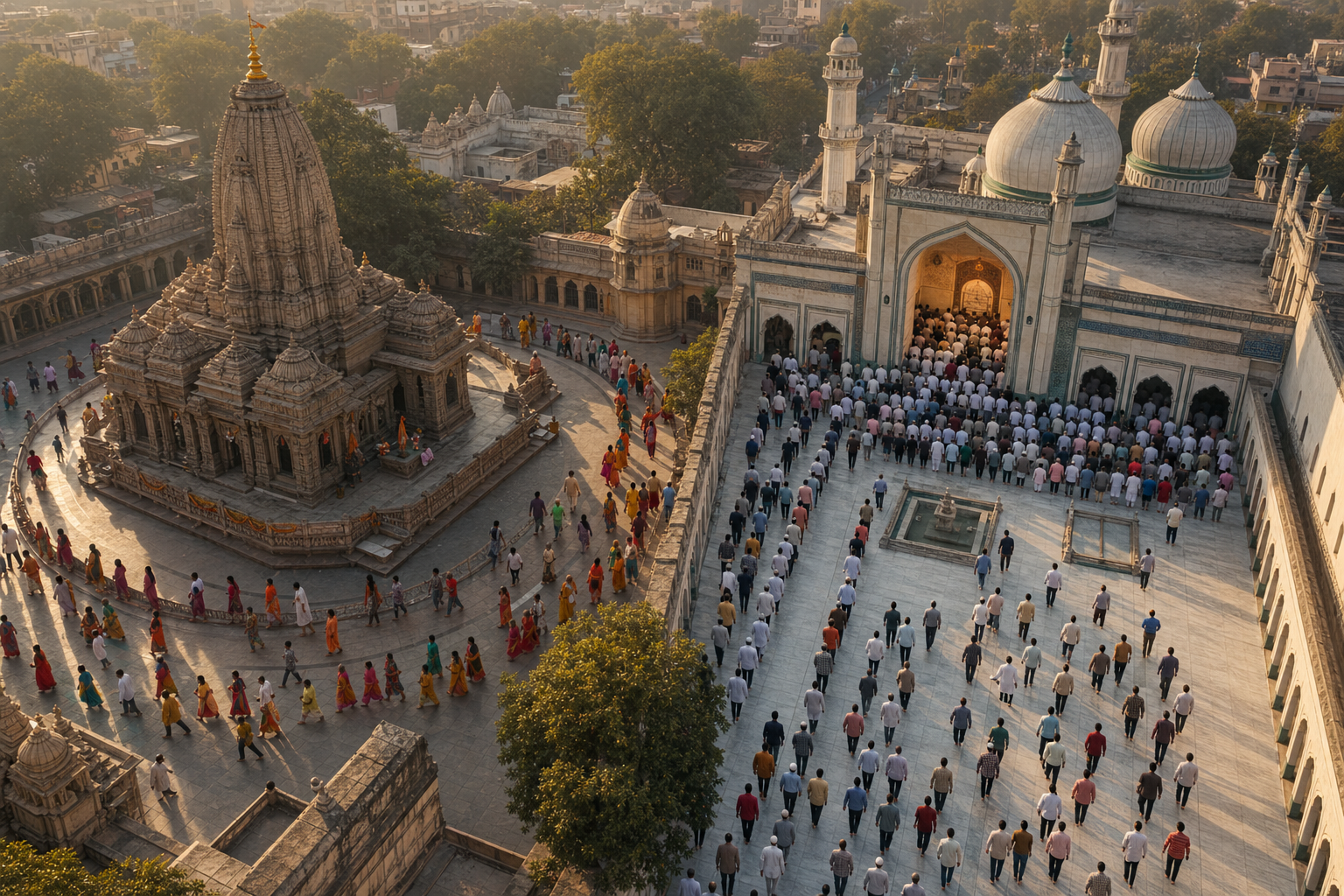
That movement is both inward and circular. Successive thresholds can reduce distraction as worshipers near the sanctum, while pradakshina places the sacred center at the heart of bodily movement. In southern temple complexes, monumental gopurams and enclosing walls can extend this sequence across multiple zones. In the source’s account, northern Nagara temples are associated with the shikhara and southern Dravida temples with the vimana, indicating that a shared centripetal logic can take regionally different architectural forms.
Mosque circulation answers another practical and theological need: many worshipers must assemble, face one direction, and pray together. The qibla wall and mihrab establish alignment; the minbar supports the Friday sermon; and a courtyard, shaded riwaqs, or a hypostyle or domed prayer hall may accommodate gathering. Ablution facilities integrate wudu into the transition toward prayer, while minarets historically supported the adhan.
The contrast is therefore more precise than “complex temple” versus “open mosque.” Temple space often intensifies approach to a localized sacred presence. Mosque space seeks clarity across a congregation so that parallel rows can bow and prostrate in coordination. One gives architectural form to proximity and circumambulation; the other gives form to common orientation and simultaneous action.
Materials reinforce these spatial aims without defining either tradition by themselves. The source associates many Hindu temples, particularly in Dravidian regions, with heavy stone, trabeated construction, corbelled towers, and extensive relief carving. It describes South Asian mosques as using combinations of brick and stone, arches, vaults, domes, stucco, lime plaster, and glazed tile according to local conditions and craft traditions. Both therefore depend on sophisticated systems of geometry, proportion, construction, and climate response, even when their structural vocabularies differ.
Ritual engages the senses, the calendar, and religious authority
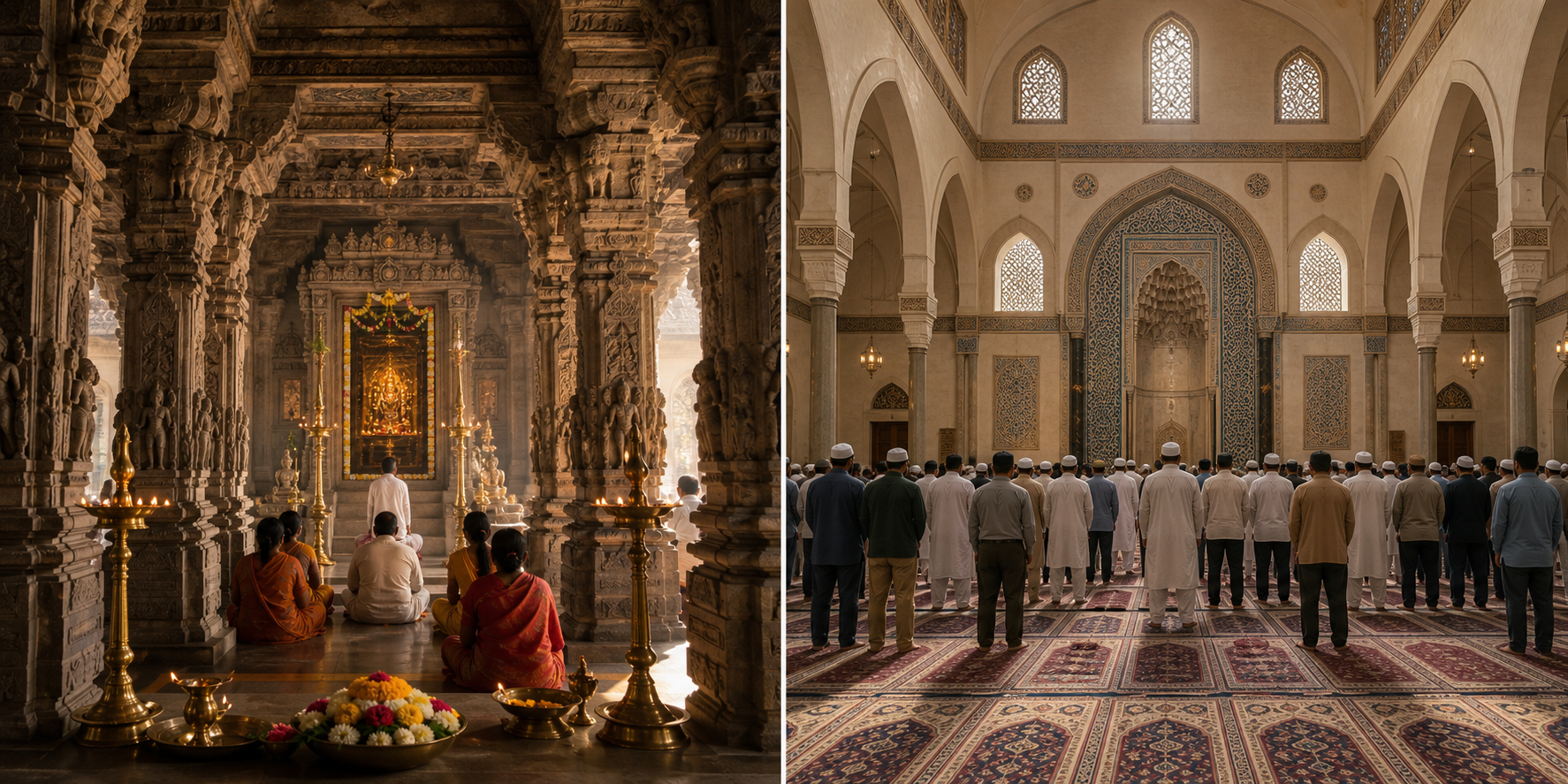
The different uses of space become clearest during worship. The source describes Hindu temple service as an agamic cycle in which trained archakas perform such acts as abhisheka, alankara, naivedya, and aarti. Sacred presence is served through bathing, adornment, food, light, and other upacharas. Prasad then connects an offering made at the shrine with the wider body of devotees.
Temple festivals enlarge this relationship beyond the sanctum. Rath yatras, Brahmotsavams, and processions of utsava murtis allow the deity’s festival form to move into public space. Pilgrimage likewise links individual temples with rivers, confluences, shrines, and other elements of sacred geography. Local worship and movement across a larger religious landscape are therefore mutually reinforcing.
Mosque ritual life, as presented by the source, is structured around the five daily prayers, the adhan, and the iqama. Friday brings Jumuah prayer and the khutbah, delivered from the minbar. Ramadan adds tarawih and the possibility of i’tikaf, while Eid prayers may require larger mosque grounds or an Eidgah. Quranic recitation and personal du’a sustain forms of remembrance that do not depend on a consecrated image or priestly intermediary.
These practices create distinctive sensory disciplines. Temple worship may combine the sight of an adorned deity with lamps, incense, bells, the conch, and live instruments such as nagaswaram and mridangam. The source characterizes mosque sound primarily through the adhan, Quranic recitation, and purposeful silence, with instruments typically absent. Neither environment is sensorially neutral: each selects and orders sensation according to its ritual purpose.
Time is similarly embodied. Temple observances may follow tithis, planetary transits, and traditional panchang calculations. Islamic prayer times track the sun, while the Hijri lunar calendar governs Ramadan, Hajj, and the Eids. Both traditions translate astronomical observation into recurring devotional obligations, although they do so through different calendars and ritual schedules.
Religious authority reflects the same divergence. Temple priests conduct rites under agamic or tantrasastra guidelines, sometimes within hereditary lineages and sometimes through newer training routes. An imam leads mosque prayer and a khatib delivers the sermon, but the source emphasizes that the mosque is non-sacerdotal: a qualified adult Muslim male may lead prayer, and worshipers stand as equals in the row. Leadership exists in both settings, but its theological basis and ritual function are not interchangeable.
Community institutions complicate any simple contrast
Theology distinguishes temples and mosques, but neither can be understood only through formal rites. The source reports that temples may operate annadanam kitchens, dharmashalas, clinics, and educational initiatives. Mosques may organize zakat and sadaqah distribution, madrasas, iftar gatherings, and funeral services. In both cases, the worship site can become neighborhood infrastructure through which devotion is translated into hospitality, learning, material support, and care.
Governance also extends sacred buildings into civic life. Temple administration may rest with a devasthanam or trust, while mosques may be managed through waqf boards and community committees. These arrangements affect maintenance, access, programming, and the preservation of inherited buildings and crafts.
Questions of access and gender resist universal claims. The source notes variation among temples in entry to the garbhagriha and describes changing efforts toward wider inclusion. It likewise reports that mosques may provide separate rooms or galleries for women, alongside efforts to improve access and safety. Such differences are better examined at the level of particular institutions and regions than converted into blanket judgments about either tradition.
The same caution applies to artisanship. Temple construction preserves bodies of knowledge associated with the shilpa shastras, Vastu Shastra, iconometry, carving, and sthapati lineages. Mosque craft draws on calligraphy, geometric design, brick bonding, stucco, and tilework. Treating these merely as competing styles would obscure their deeper parallel: both are intellectual and artisanal systems for making metaphysical commitments inhabitable.
A responsible comparison therefore preserves difference without turning difference into rank. Future interfaith and heritage work can begin with the practices each building is meant to sustain, then ask how conservation, access, and community service can protect those purposes without flattening them into a single model of sacred space.