Brihaspati Smriti is best approached not as a surviving code with a settled table of contents, but as a juristic voice reconstructed from quotations preserved by later authors. Its importance lies in what those fragments reveal about classical Hindu jurisprudence: law operating through courts, proofs, customs, commercial relationships, royal authority and ethical restraints.
The supplied source is a single DharmaRenaissance article rather than several independent studies. Accordingly, the historical and textual particulars below are attributed to that account, while the synthesis focuses on how its reported features fit together. No independent corroboration among multiple source publications is implied.
Reconstructing a legal classic from its later reception
The source reports that no complete manuscript of Brihaspati Smriti is extant. The work attributed to the sage Brihaspati is instead known through fragments quoted or paraphrased in medieval digests and commentaries. That mode of survival changes the central historical question. Rather than asking only what an original author wrote, readers must also ask which rules later jurists considered useful enough to preserve.
According to the article, several hundred verses were transmitted through works including Mitakshara, Dayabhaga, Smritichandrika, Apararka and Viramitrodaya. Modern scholarship, including work associated in the source with P. V. Kane, brought dispersed passages together to clarify the Smriti’s principal concerns. The result is a reconstruction rather than a recovered integral text.
The article situates the work after Manu and Yajnavalkya and alongside more specialized juristic authorities such as Narada and Katyayana. It reports a debated compositional or redactional range extending from the middle of the first millennium into the early second millennium CE, while also describing the work as composite and layered. These qualifications matter: variations among surviving passages need not represent defects in a single fixed code. They may reflect changing settings, regional practices, textual additions or the preferences of the later writers who selected the quotations.
A plural jurisprudence joining dharma, custom and governance
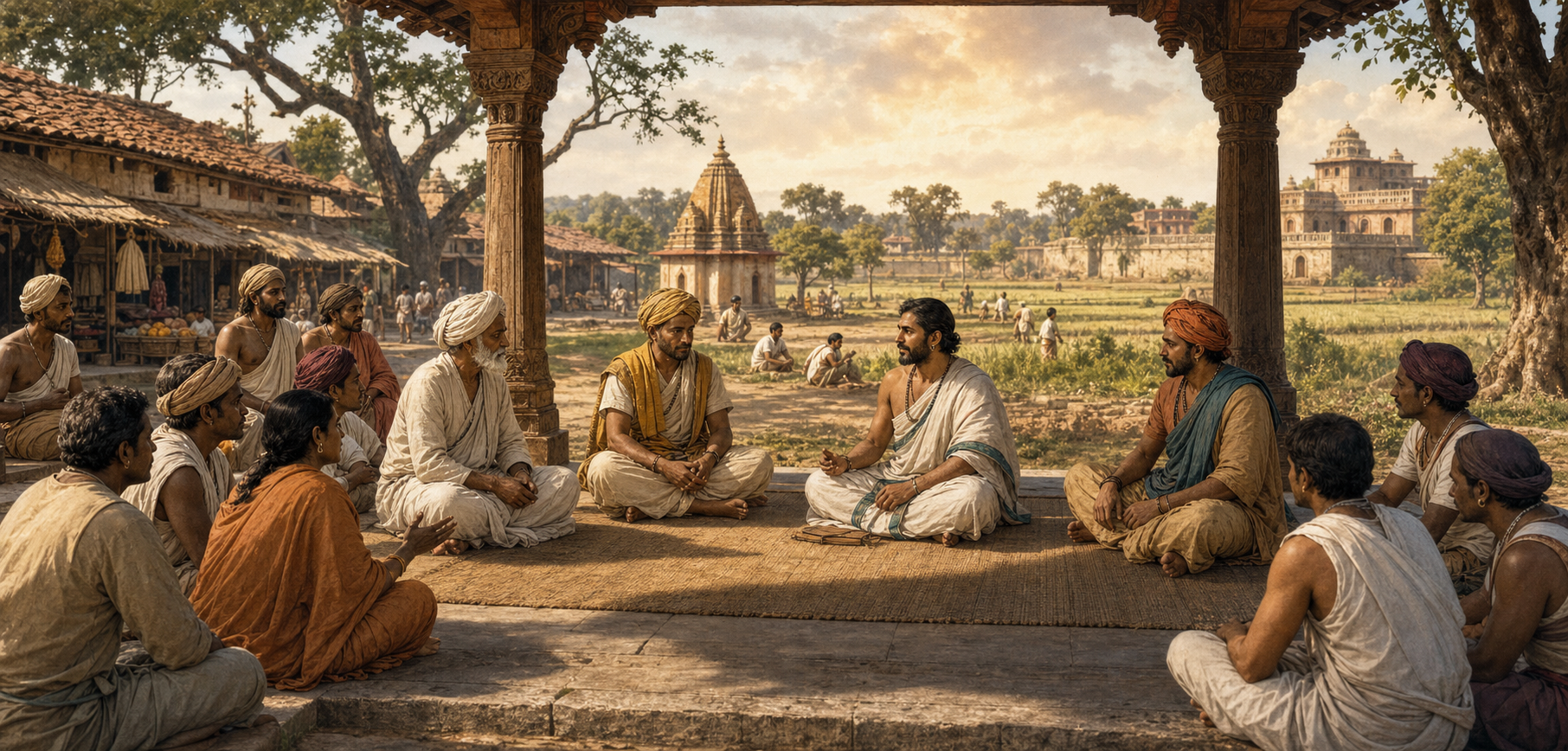
The reconstructed Smriti appears to place vyavahara, the field of adjudication and legal procedure, at the meeting point of several kinds of authority. The source identifies foundational scriptural and remembered tradition, the practices of regions, families and guilds, and royal commands as relevant components of the legal order. This is not a picture of law flowing from one document alone. It is a framework in which normative authority, established social practice and the requirements of government must be brought into a workable relationship.
That relationship also explains the reported proximity between Brihaspati’s jurisprudence and the concerns of artha and dandaniti. Dharma supplies ethical legitimacy; attention to material life addresses contracts, property and enterprise; governing authority protects order and enforces judgments. The distinctive feature is not the victory of one domain over the others, but an attempt to keep all three within the same field of reasoning.
Key takeaways
- The surviving Brihaspati Smriti is a reconstruction assembled from later citations, not an intact code.
- Its reported centre of gravity is practical adjudication: courts, pleadings, evidence, obligations and remedies.
- Custom and royal governance operate alongside inherited religious authority rather than outside the legal framework.
- Its commercial rules and preference for proportionate remedies connect moral responsibility with economic reality.
- Every reconstructed rule must be read with caution because its wording and context come through later transmitters.
Procedure and evidence as restraints on judgment
The clearest unifying idea in the source’s account is that a legitimate result depends on an ordered process. It describes litigation as moving from plaint and answer through the identification of issues, presentation of proofs and a reasoned finding. Burdens of proof are assigned with attention to which party is positioned to provide the relevant evidence. On this reading, procedure is not merely administrative machinery; it disciplines accusation, denial and the exercise of judicial power.
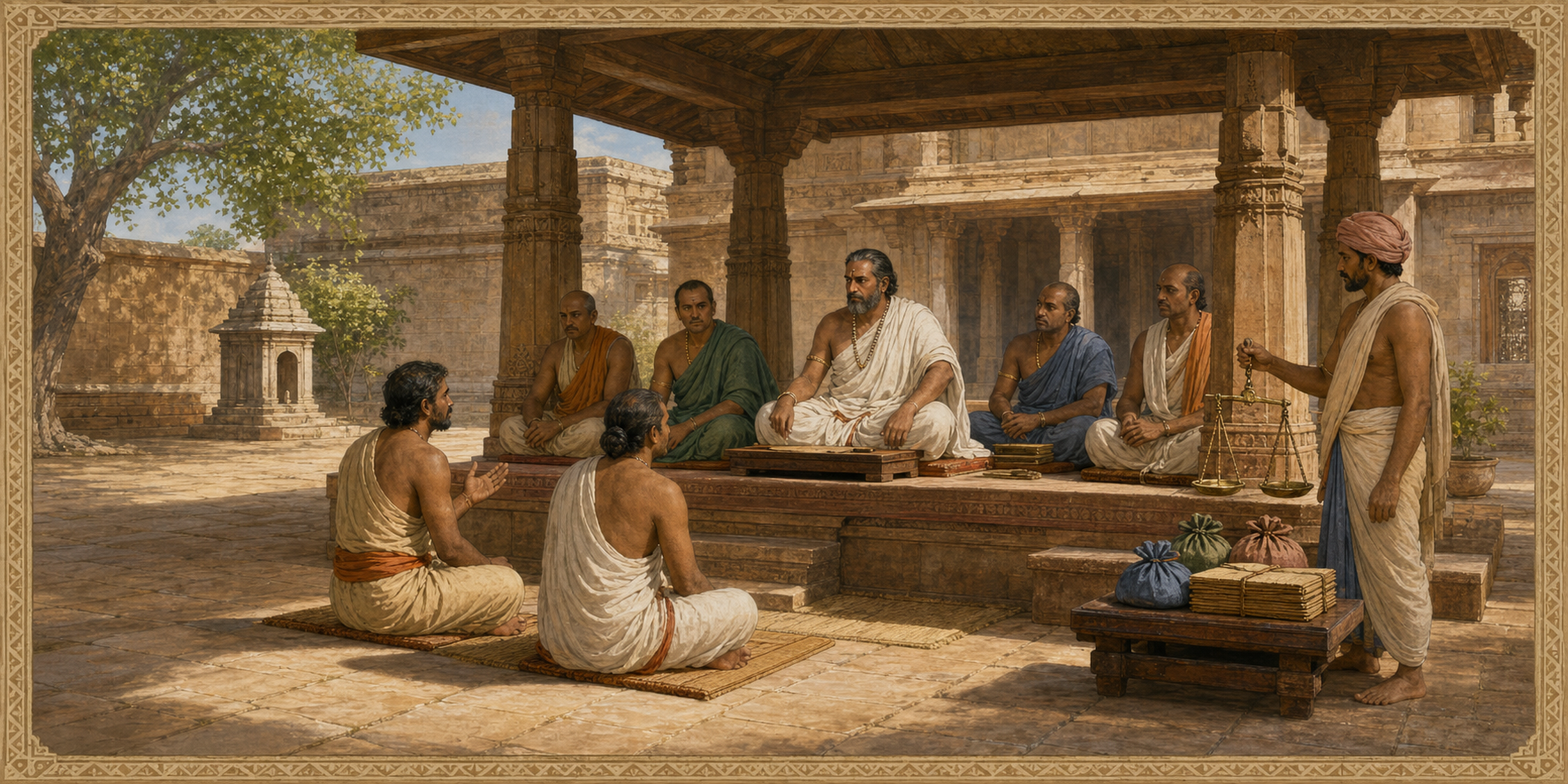
The court or sabha is correspondingly presented as a learned institution. The article reports expectations that judges, assessors and officers should be trained, impartial and attentive to both parties. Royal power therefore does not stand alone. It is mediated by juristic competence, deliberation and a duty to fit relief to the dispute.
The source identifies three prominent forms of proof: written instruments, witness testimony and possession. Documents receive substantial weight when their authenticity and integrity are established; witnesses are assessed for competence and credibility; and lengthy, uncontested possession can stabilize property relations. The larger significance is the interaction among transaction records, human testimony and observable control. None is merely symbolic: each connects a claim to evidence that a court can examine.
The article also reports that oaths, ordeals and other divine tests were recognized when ordinary proof failed, but it presents documents, witnesses and possession as the preferred evidentiary path. That distinction should not be exaggerated into a modern-versus-archaic contrast. More carefully understood, it shows a jurisprudence containing different modes of proof while giving structured human evaluation a central role.
From commercial risk to social repair
The range of disputes attributed to Brihaspati makes procedure concrete. The source connects the Smriti with the classical eighteen titles of law and reports treatment of debts, deposits, pledges, unauthorized sales, partnerships, gifts, boundaries, contracts, employment, property, assault, theft, defamation, adultery, inheritance, partition, gambling and related wrongs. This catalogue is most useful as a map of recurring conflict, not as proof that every surviving fragment formed part of one immutable statutory scheme.
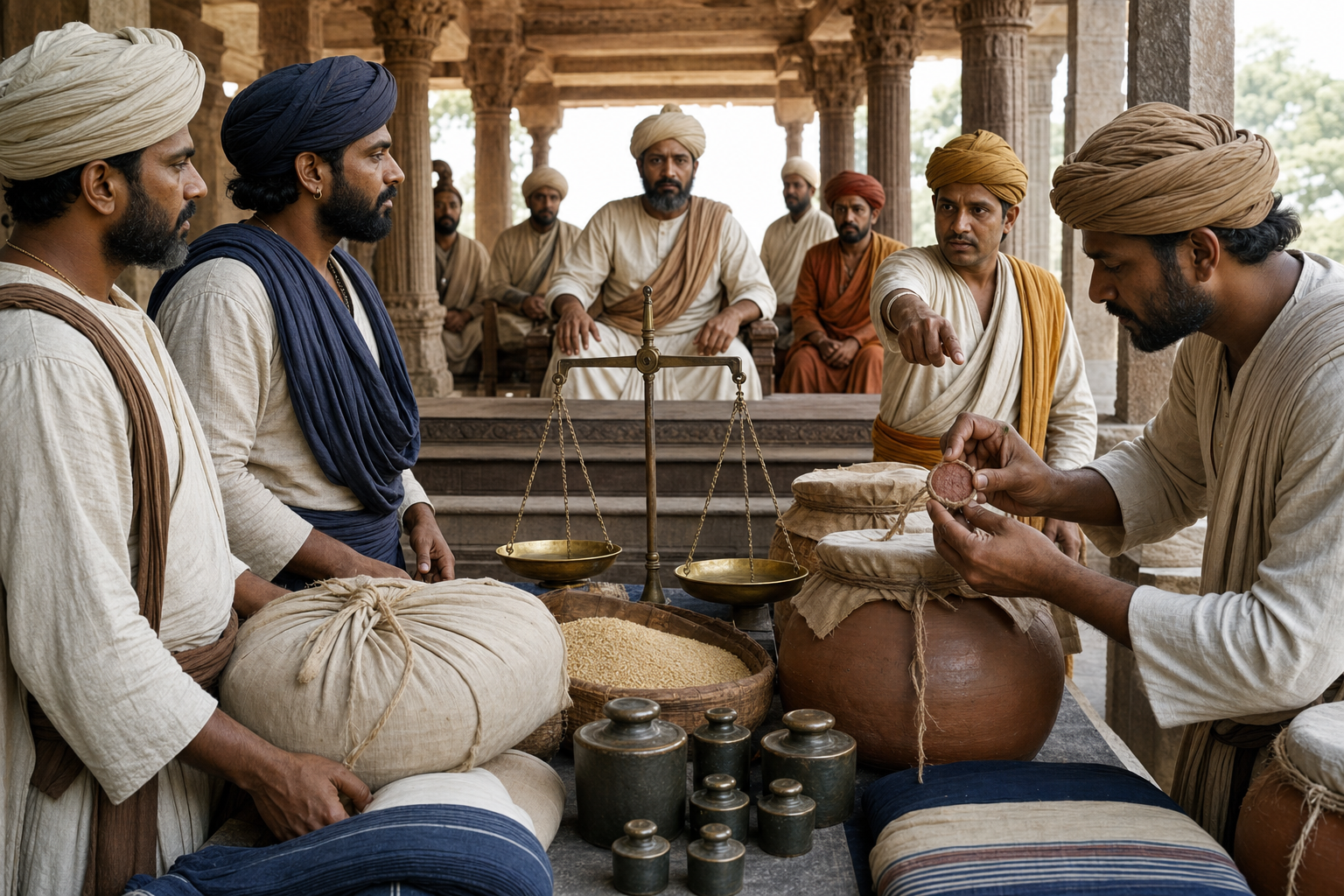
Commercial relationships receive particular emphasis in the account. Rules on debt, interest, suretyship, pledge, mortgage, agency, partnership, profit and loss are described as protecting legitimate exchange while limiting opportunism. The source also reports scope for remission or rescheduling when famine, flood or unforeseen calamity undermined performance. The underlying logic is significant: obligations support trust, yet enforcement that ignores genuine incapacity can damage the social and economic order that contract law is meant to sustain.
The same concern with calibrated response appears in the treatment of public wrongs. According to the article, theft, assault and defamation attract restitution, fines or graded sanctions directed toward deterrence, reform and restoration of equilibrium. Punishment is therefore framed as purposeful rather than simply retaliatory. Truthfulness remains essential because both testimony and commerce depend on reliable representations.
Family property occupies a smaller share of the fragments as presented by the source, but inheritance, partition, succession and joint holdings remain part of the legal horizon. Their inclusion reinforces the breadth of vyavahara: the court must handle disputes arising from households as well as markets and public harms. The reported preference for settlement and conciliation adds another dimension, seeking to reduce needless cost and lasting hostility without abandoning enforceable standards.
Textual limits, historical influence and responsible comparison
The source credits Brihaspati’s fragments with a long afterlife in medieval legal writing and community practice. It reports their use alongside Manu, Yajnavalkya, Narada and Katyayana, followed by later encounters with the material through digest literature during the colonial period. It also associates this reception with settings in which documentary transactions, guild customs and arbitration were important. These claims describe influence through citation and adaptation, not the continuous application of a single, unchanged book.
The article further draws affinities with Buddhist concern for communal procedure, Jain commitments to non-harm and fair confession, and Sikh ideals of justice, service and collective welfare. Such comparisons are most defensible at the level of ethical themes. They can illuminate shared concern for truth, fairness and humane judgment, but they should not erase the distinct institutions, vocabularies or historical development of those traditions.
Fragmentary transmission ultimately requires disciplined modesty. A quotation selected by a later jurist may preserve an older rule, reinterpret it or detach it from its original setting. The strongest account of Brihaspati Smriti therefore combines appreciation with source criticism: it recognizes a practical jurisprudence of fair hearing, proof, custom and proportionate remedy while keeping every reconstructed doctrine open to philological and historical review.
Future study can make this legal inheritance more intelligible by tracing each fragment to its transmitting work and comparing how different jurists deployed it. That approach would reveal not only what Brihaspati was believed to have said, but how classical Hindu law continued to reason through changing disputes.