
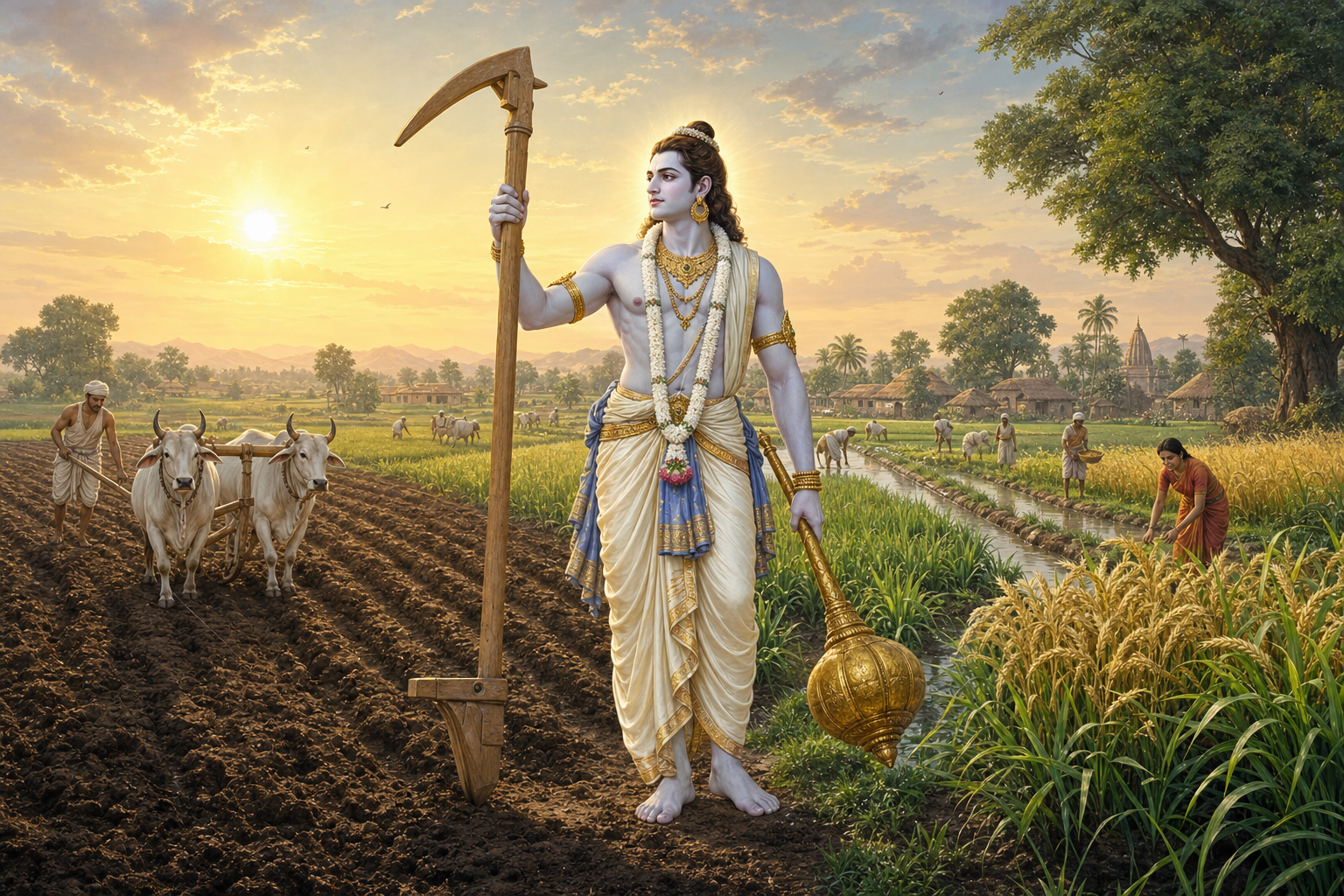
Balarama’s plough is easy to recognize as an agricultural implement, but its iconographic work is much broader. It connects the preparation of soil with divine authority, nourishment with protection, and physical strength with disciplined responsibility.
Read in this wider frame, the Langala or Hala does more than identify Balarama in Hindu sculpture. It presents cultivation as part of sacred order and asks viewers to see land, labor, food, and power as morally connected.
Key takeaways
- The plough identifies Balarama, especially through the name Halayudha, the bearer of the plough as a weapon or defining implement.
- Its symbolism begins with cultivation: opening the earth, preparing it for seed, and supporting the production of food.
- In divine hands, the same implement can express protection, authority, and the restraint of disorder without losing its generative meaning.
- The frequent pairing of the plough with the musala, or pestle, evokes an agrarian sequence extending from preparing soil to processing a harvest.
- Variations in stone, bronze, relief, and regional workmanship show how a stable attribute can remain recognizable while taking different artistic forms.
The plough identifies Balarama and interprets his strength
Attributes in Hindu sculpture serve at least two purposes. They help identify a figure, and they indicate how that figure’s nature should be understood. The source article places Balarama’s Langala within the same visual grammar as the conch, chakra, lotus, mace, bow, book, rosary, trident, and water pot. Yet the plough carries a distinctive association: unlike insignia rooted primarily in sovereignty or combat, it comes from the cultivated field.
This agricultural origin is essential to its theological force. The article identifies Balarama as the elder brother of Krishna and notes names including Baladeva, Balabhadra, Sankarshana, and Halayudha. Halayudha is particularly revealing because it joins Hala, the plough, with the idea of an implement borne as a weapon. The name does not erase the object’s ordinary function. Instead, it allows cultivation and protective force to occupy the same symbol.
The result is a particular model of strength. Balarama’s power is not represented only as the capacity to defeat an adversary. It is also the capacity to prepare, support, stabilize, and sustain. This reading accords with the source’s description of him as a figure associated with immense strength, ethical complexity, elder kinship, pilgrimage, instruction in mace warfare, and guardianship of dharma. The plough gathers these dimensions into a single visible sign: force becomes meaningful when directed toward order and life.
Cultivation and protection belong to one symbolic cycle
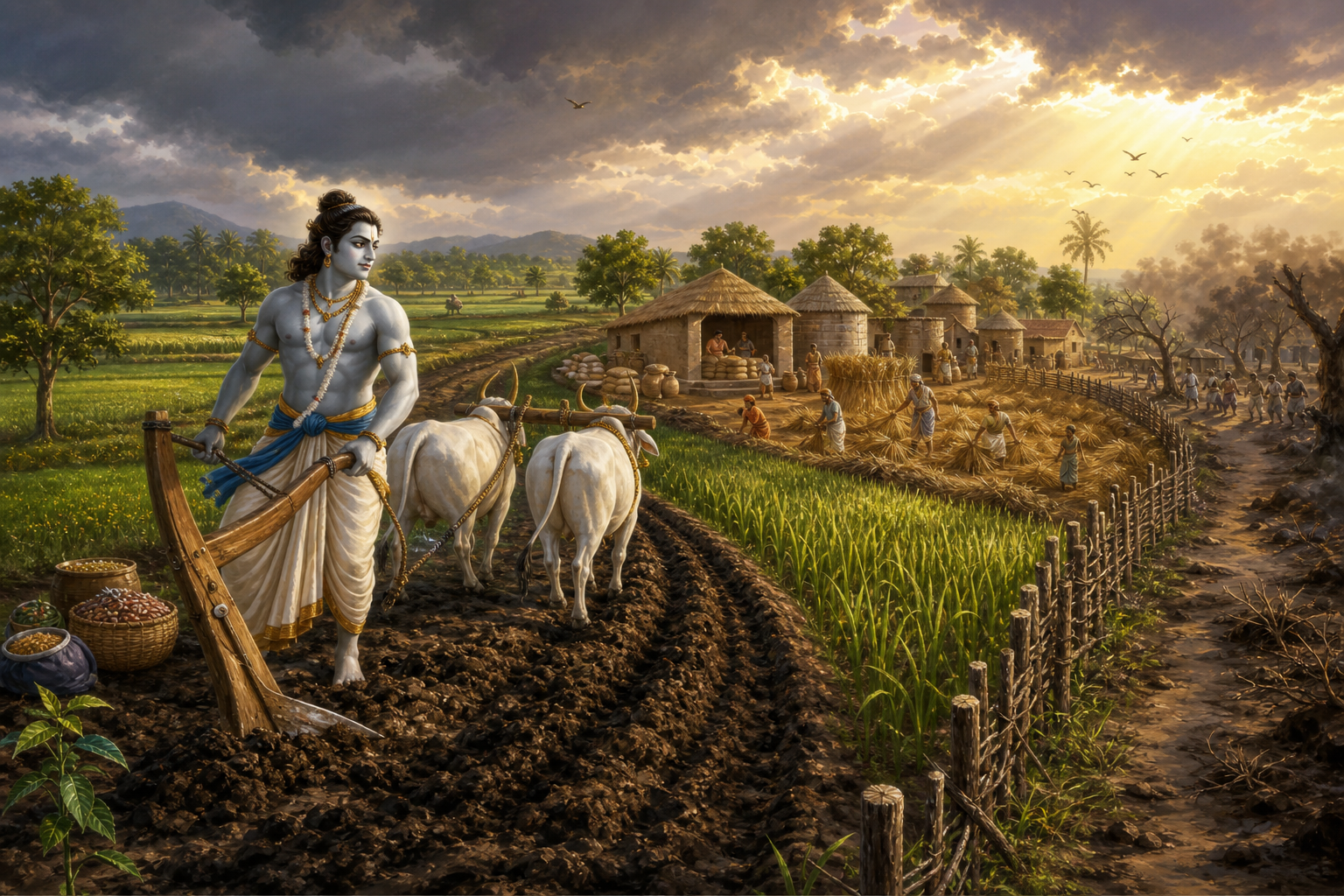
A plough changes the surface of the earth. It cuts, turns, draws, and forms a furrow, but the disruption is undertaken so that growth can follow. That sequence explains how the Langala can signify intervention without becoming an emblem of destruction. Its force is purposeful, bounded, and generative.
The source article reports that epic and Puranic traditions remember Balarama’s plough as capable of drawing, redirecting, or commanding the landscape. It associates those motifs with the disciplining of pride and the exercise of divine will through the earth. Without reducing these narratives to agricultural allegory, the connection clarifies the attribute’s internal logic: the implement that directs soil can also signify the restoration of direction when human or natural order has been disturbed.
This makes the plough an unusual divine weapon. Its primary social value is not injury but sustenance. It can symbolize defence because cultivation preserves the material conditions on which households and communities depend. Food-producing land, cattle care, seasonal labor, irrigation, and the hope invested in rain form the practical horizon behind the image. Protection, in this symbolic vocabulary, includes safeguarding the processes that allow life to continue.
The musala, or pestle, strengthens that interpretation. The article notes that Balarama is frequently represented with both implements. The plough prepares the field; the pestle suggests strength, processing, and the transformation of harvested produce into nourishment. Together they evoke more than two isolated tools. They frame an agrarian continuum from opening the soil to making its yield usable as food.
The pairing also helps distinguish Balarama’s visual world from Krishna’s familiar flute. As presented by the source, the flute evokes pastoral sweetness, devotional attraction, and divine play, while the plough directs attention toward cultivated ground and disciplined labor. These are complementary emphases rather than competing ones: one draws through beauty and intimacy, while the other grounds sacred power in work, provision, and stability.
Sculpture turns an everyday tool into theological language
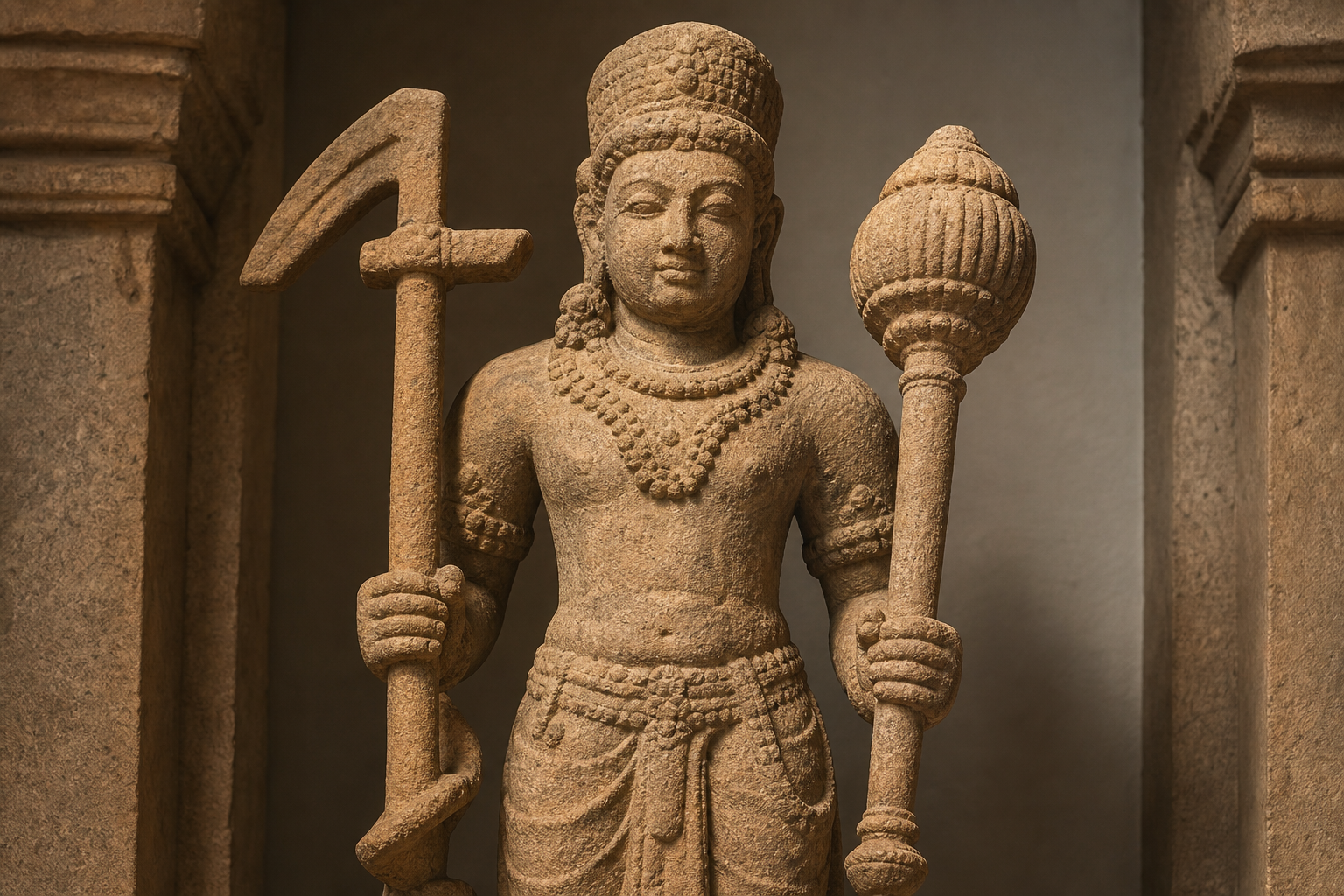
For a sculpted attribute to function, it must remain recognizable even when scale, material, or composition requires simplification. According to the source article, the Langala may appear as a curved or hooked ploughshare, held upright, placed across a shoulder, or compressed into a compact form. Its curve is especially expressive because it suggests drawing and furrowing rather than the static authority of a straight staff.
The attribute is therefore both a label and a gesture. In an independent image, it can establish Balarama’s identity. In a crowded temple program or narrative relief, it can distinguish him from other heroic or divine male figures. Its shape simultaneously recalls an action: contact with the ground, resistance from the soil, and directed movement through it.
The article describes material and regional variation without treating iconography as arbitrary. Stone versions may be compact and sturdy, reflecting the demands of carving and durability. Bronze can permit a more elongated or refined curve. Relief sculpture may preserve only the essential outline. These differences demonstrate how iconographic continuity works: the concept remains legible even as artists adjust proportions and details to a medium, workshop tradition, patron, and ritual setting.
Other features may contribute to recognition, including a powerful physique, a composed or majestic expression, and associations with Shesha or Sankarshana theology. The plough, however, condenses the figure’s agrarian and protective dimensions with unusual economy. A viewer does not need a detailed scene of cultivation to encounter the meaning of cultivation; the implement carries the field into the sacred image.
A symbol of land ethics rather than unlimited mastery
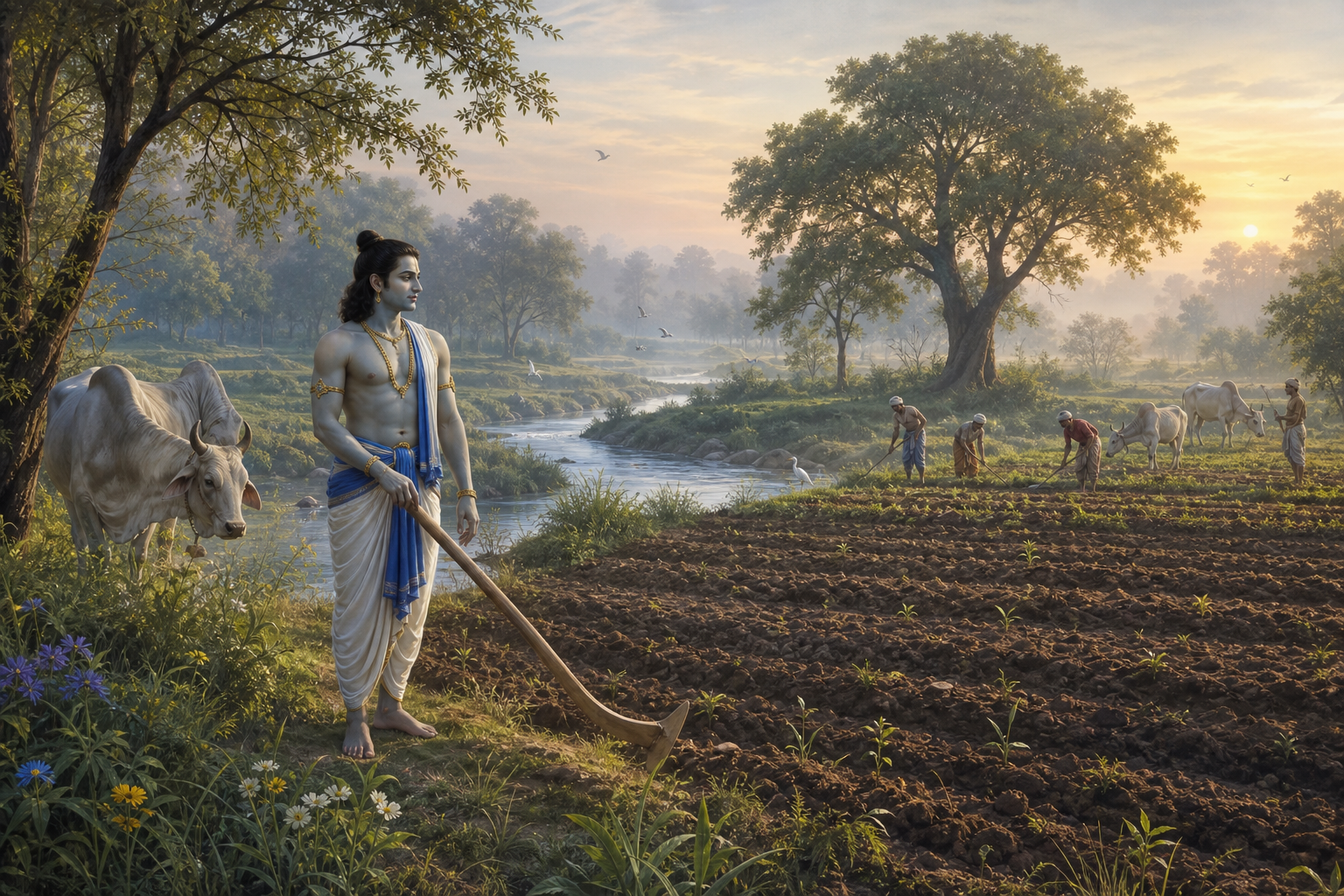
The Langala can be read ecologically, but the reading requires care. The source article does not present the plough as a call to leave land untouched. Its symbolism assumes active human engagement with the earth. At the same time, that engagement is directed toward fertility, nourishment, seasonal continuity, and communal stability rather than extraction without obligation.
The relevant ethical idea is disciplined intervention. A furrow is an alteration, but it is an alteration ordered toward growth. In this framework, human effort should cooperate with larger rhythms represented by soil, water, rain, crops, cattle, and seasons. Sacredness does not eliminate labor; it changes the moral terms under which labor and land are understood.
The connection with food deepens this interpretation. The source places the plough within a Hindu understanding that links food, rain, sacrifice, living beings, and dharma. Preparing land for grain is consequently more than an economic act. It supports nourishment, household life, ritual offerings, and the social capacity to perform duties. The plough becomes a bridge between material dependence and metaphysical order because it makes their relationship visible.
This perspective also dignifies rural work without romanticizing the tool as merely decorative. The sacred attribute retains the weight of effort: earth must be opened, seasons observed, animals cared for, and produce processed. Balarama’s strength belongs to that demanding world. Its religious significance arises partly from recognizing that ordinary acts of sustenance can bear civilizational and spiritual meaning.
Future study of Balarama images can build on this layered reading by attending closely to material, posture, accompanying attributes, and placement within a sculptural program. The Langala is most illuminating when neither its agricultural function nor its divine force is isolated from the other.