

Kalapurusha is most useful not as a fixed divine portrait but as a way Hindu thought makes time conceivable. The source article presents Kalapurusha as time given a cosmic body: a symbol joining mortality, recurring cosmological rhythms, karmic consequence, and the opportunity to live according to dharma.
This framework clarifies several questions at once: what the name signifies, how Kalapurusha differs from Yama and Mahakala, why fierce imagery surrounds the concept, and how the human body can represent celestial order. Together, these dimensions form a meditation on change rather than a simple image of death.
From measured time to a sacred presence

The term brings together two conceptually dense words. As the DharmaRenaissance article explains, kala denotes time while also carrying the resonance of death. Purusha can mean person, cosmic being, or a principle of consciousness. Kalapurusha therefore makes an otherwise invisible force present as a cosmic person.
The relationship between time and death is not treated as a contradiction. Birth, growth, decline, and dissolution all become visible through time. Death is consequently understood not as an event outside the temporal order but as one of its most decisive expressions. Giving this order a body allows philosophy, religious imagination, ritual, and visual culture to approach the same problem through different languages.
The source places this symbolism within the wider history of Purusha. It refers to the cosmic being of the Purusha Sukta, the witness-consciousness associated with Sankhya, and the supreme cosmic person found in Vaishnava theology. These meanings should not be merged into one technical definition. Their importance lies in establishing a broad symbolic vocabulary through which the universe, consciousness, and embodiment can be related.
Kalapurusha uses that vocabulary to portray time as something more comprehensive than a sequence of intervals. Its body symbolically contains manifestation, continuity, decay, and dissolution. An image of Kalapurusha can therefore function as a philosophical proposition in visual form, even where no single, universally standardized icon exists.
The many scales of time contained in one figure

The article distinguishes cosmic time from ordinary clock time by gathering several scales into one idea. Time governs celestial movement, the maturation of karma, the succession of yugas, bodily aging, ritual calendars, and the rise and fall of civilizations. It also determines the limited span in which spiritual discipline and ethical action remain possible.
This layered model joins measurement with meaning. Biological time is experienced as growth and aging; ritual time identifies significant occasions; karmic time concerns the ripening of actions; and cosmological time encompasses immense cycles of manifestation. These are not presented as unrelated systems. Kalapurusha supplies the symbolic unity connecting them.
Cyclical cosmology further changes the significance of destruction. The source situates Kalapurusha within recurring patterns of creation, preservation, dissolution, and renewed manifestation, referring to such frameworks as kalpas, manvantaras, and yugas. Dissolution in this setting is a transition within a larger rhythm, not merely an isolated termination.
Time is also moral in this interpretation. Actions mature into consequences, attachments bind people to changing conditions, and dharma must be practiced within circumstances that do not remain fixed. Kalapurusha consequently represents both inevitability and opportunity: no embodied condition can be retained forever, yet impermanence gives ethical choices their urgency.
FAQ: related deities, fierce symbols, and the cosmic body
Is Kalapurusha another name for Yama or Mahakala?
The source explicitly advises against treating the three as interchangeable without context. Yama is associated with death, judgment, moral order, and the destiny of beings after bodily life. Mahakala expresses the overwhelming or transcendent power of time, particularly in Shaiva and Shakta settings. Kalapurusha more broadly embodies cosmic time itself.
The concepts can overlap because each concerns mortality and temporal power. Kalapurusha may absorb meanings associated with Yama or Mahakala in particular textual, regional, astrological, or temple traditions. Conceptual proximity, however, does not establish a single identity. The immediate context of an image or teaching remains essential.
Do fierce attributes define one standard Kalapurusha image?
No uniform iconographic formula is established by the source. Dark coloration, flames, weapons, a noose, skulls, serpents, a trident, or a drum may occur in imagery associated with Kala, Mahakala, or other time-related forms. Such attributes should not automatically be assigned to every representation labeled Kalapurusha.
Within the article’s symbolic reading, fierceness expresses the impartiality of time rather than simple malevolence. A noose can signify bondage through karma, attachment, and mortality. Skulls expose the fragility of social distinctions and bodily pride. Fire communicates both consumption and transformation, drawing together the sacrificial fire, bodily digestion, material change, and cremation.
This approach treats frightening imagery as a discipline of attention. Status, beauty, strength, possessions, and intellectual pride all pass away. The image confronts the viewer with that fact so that appearance is not mistaken for enduring identity.
How does Jyotisha connect Kalapurusha with the zodiac?
The article reports that astrological symbolism maps the zodiac onto the body of Kalapurusha. The correspondences presented in the source are:
| Zodiac sign | Region of the Kalapurusha body |
|---|---|
| Aries | Head |
| Taurus | Face or neck |
| Gemini | Arms |
| Cancer | Chest |
| Leo | Heart |
| Virgo | Abdomen |
| Libra | Lower abdomen or bodily balance |
| Scorpio | Hidden organs |
| Sagittarius | Thighs |
| Capricorn | Knees |
| Aquarius | Calves |
| Pisces | Feet |
The table should be understood as symbolic cosmology rather than anatomy alone. It expresses the microcosm-macrocosm relationship: the human form mirrors a larger celestial order. Under this model, planetary movement and embodied processes belong to one temporal field, connecting astrology with the same cosmic-body symbolism found in philosophy and iconography.
Mortality as an ethical and spiritual lens
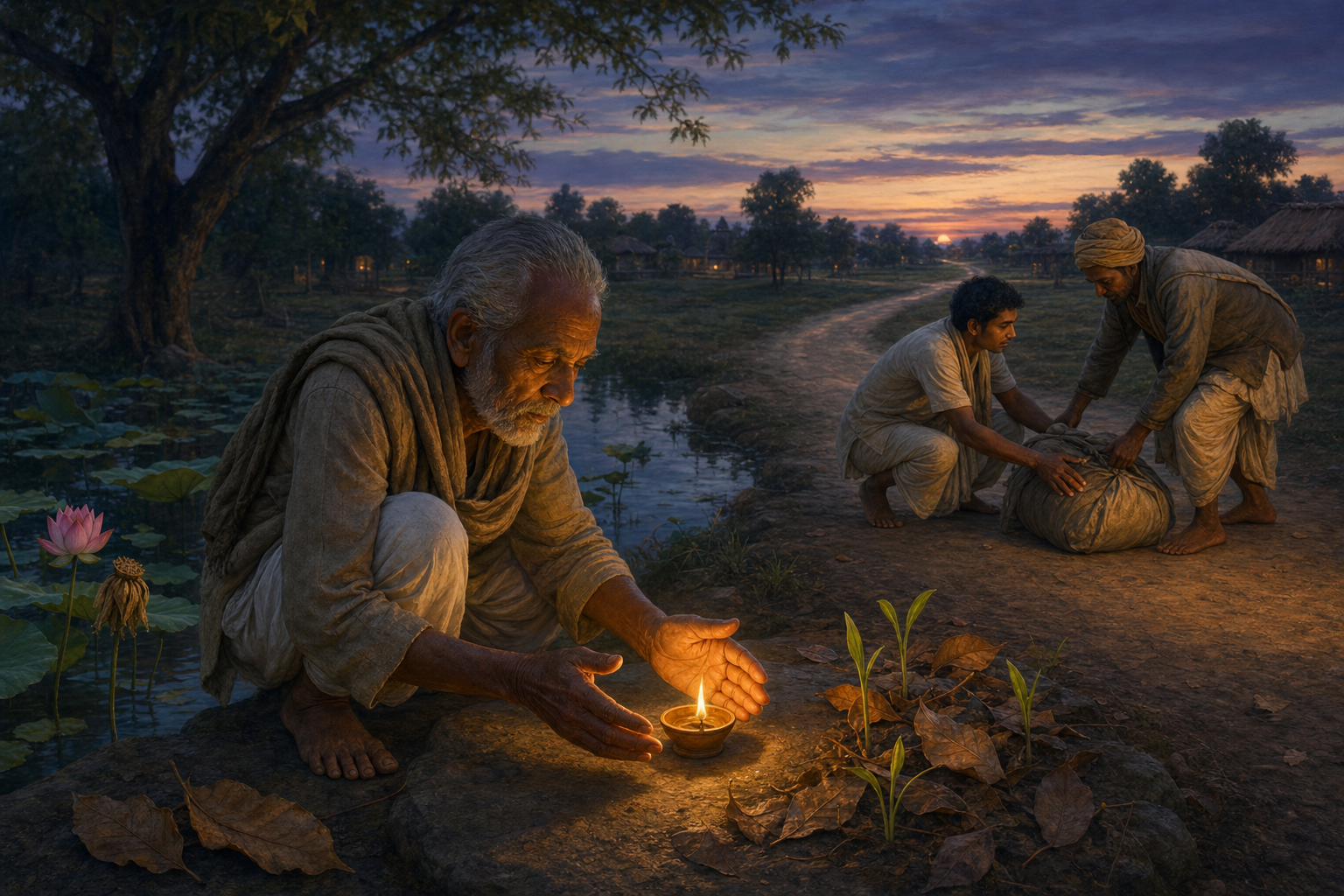
The central ethical significance of Kalapurusha emerges from a simple tension. Human beings act as though possessions and identities can be secured, while time continually reveals their impermanence. The figure redirects attention from what can be accumulated to what can be meaningfully practiced.
The source names dharma, self-discipline, compassion, truthfulness, study, devotion, and service as responses to this recognition. Mortality is therefore not presented merely as a pessimistic subject. Awareness of death becomes a method of moral clarification because limited time makes priorities unavoidable.
The same symbolism can be read spiritually. According to the article, a person identified only with the perishable body experiences time principally as terror. Recognition of Atman, or of a deeper divine ground of existence, allows time to be encountered as a teacher. Change then exposes mistaken attachments while directing attention toward liberation.
Further study of Kalapurusha will be most productive when each image, astrological scheme, or theological claim is located in its own textual, ritual, and regional setting. That contextual care can preserve the concept’s unifying insight without erasing the diversity of Hindu traditions through which it is expressed.