
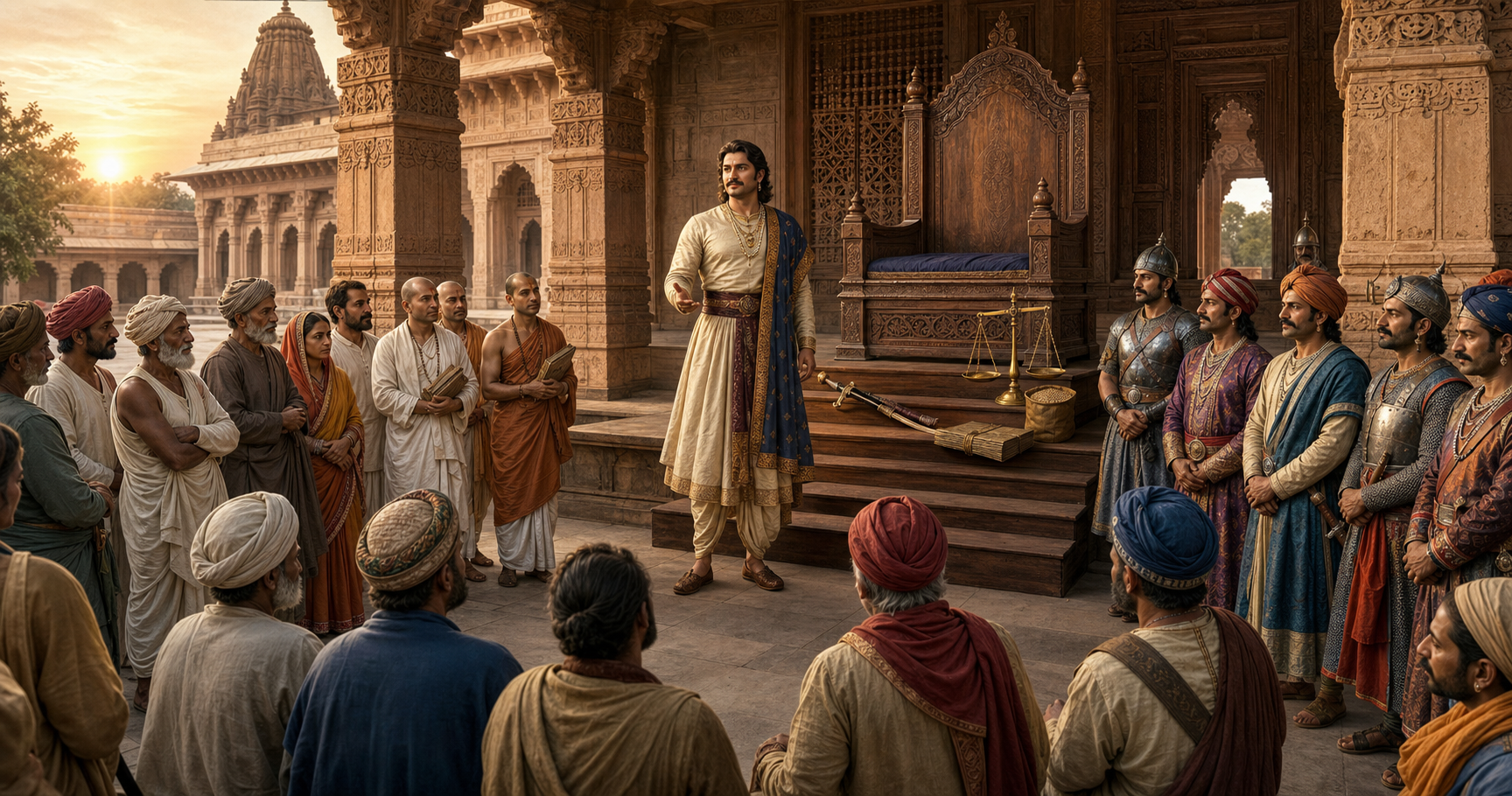
Vikramaditya becomes clearer when three questions are kept separate: which rulers bore the title, how Paramara and wider Rajput traditions claimed its legacy, and why literature made his throne an examination of public duty. The four source articles connect these questions, but they do not make them interchangeable.
The resulting picture is more useful than either uncritical celebration or summary dismissal. Vikramaditya emerges as a layered historical memory; Agnivamsa as an account of political incorporation and responsibility; and Rajadharma as the standard by which lineage, victory, learning, and institutional power must all be judged.
A royal name at the intersection of three archives
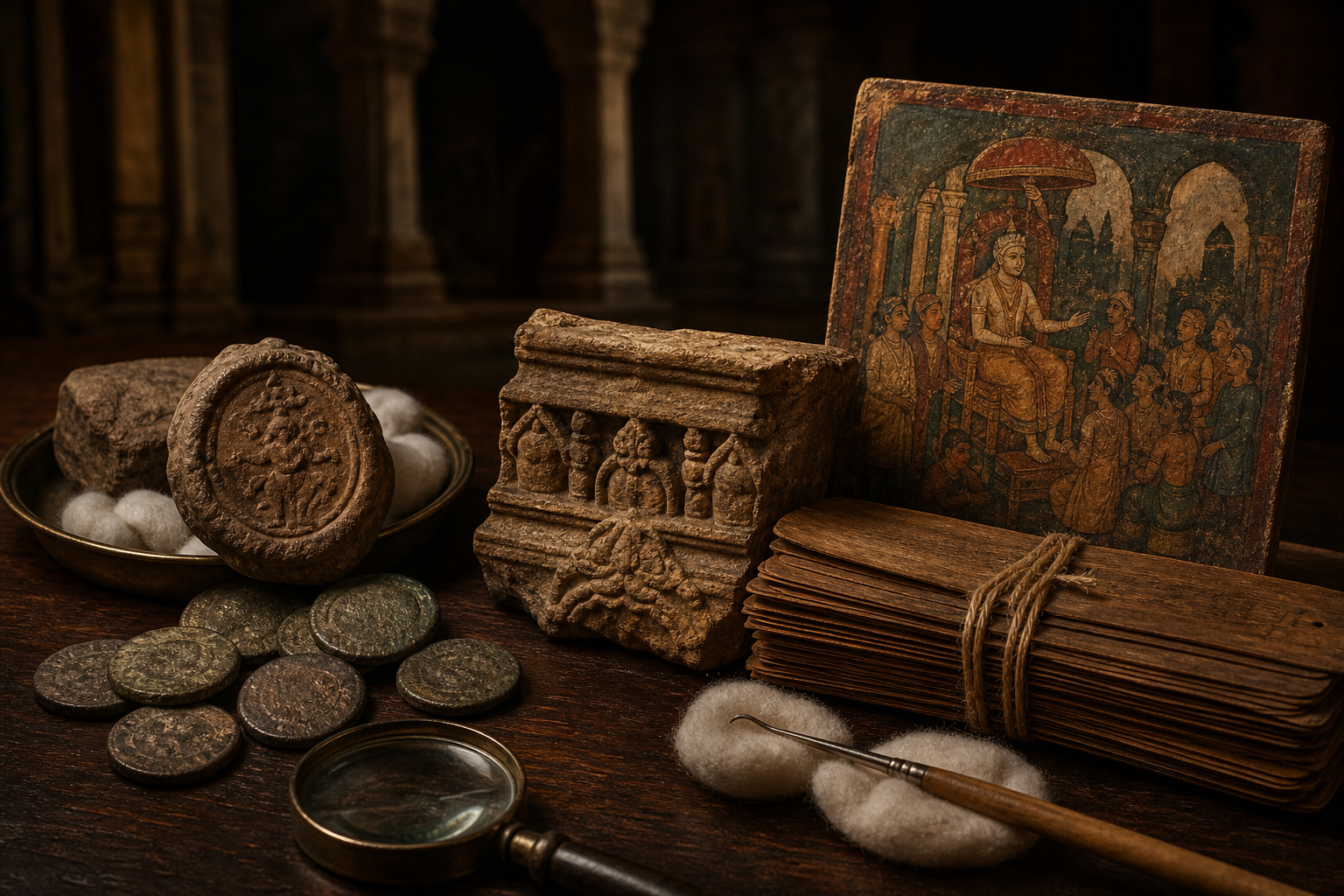
The Agnivamsa reassessment and the Vikramaditya profile agree on a basic methodological caution: Vikramaditya was a title associated with more than one ruler. Both discuss Chandragupta II, Sriharsa Vikramaditya, and a celebrated Vikramaditya connected by one traditional stream to the Paramaras of Ujjain. The sources therefore counsel separating title, individual ruler, dynasty, and calendar era before attempting a single biography.
That distinction matters because the available forms of evidence answer different questions. Inscriptions can help establish names, titles, patrons, and chronological limits. Dynastic genealogies, Puranic materials, Jain narratives, and regional traditions can preserve claims about ancestry, conflict, and legitimate rule. Literary cycles reveal the virtues later communities expected a king to embody. None of these bodies of material should automatically be made to perform the work of all the others.
The Vikramaditya profile reports that modern academic historiography generally places the documented Paramara dynasty of Malwa from the early medieval period into the early fourteenth century. Traditional accounts described in that article extend Paramara memory much further back. The Agnivamsa article, meanwhile, presents a chronology influenced by Pandit Kota Venkatachalam and explicitly acknowledges that this reconstruction differs from mainstream Indological timelines and remains debated.
The disagreement should be stated rather than smoothed away. The documented dates of a dynasty do not, by themselves, verify every earlier genealogical claim; equally, a late or layered tradition is not devoid of historical value merely because it cannot be read as a contemporary chronicle. It may preserve geography, political ideals, remembered adversaries, or a later dynasty’s understanding of its place in civilizational history. The disciplined question is not simply whether a tradition is history or legend, but what kind of information it can responsibly support.
Agnivamsa makes lineage a claim about public duty
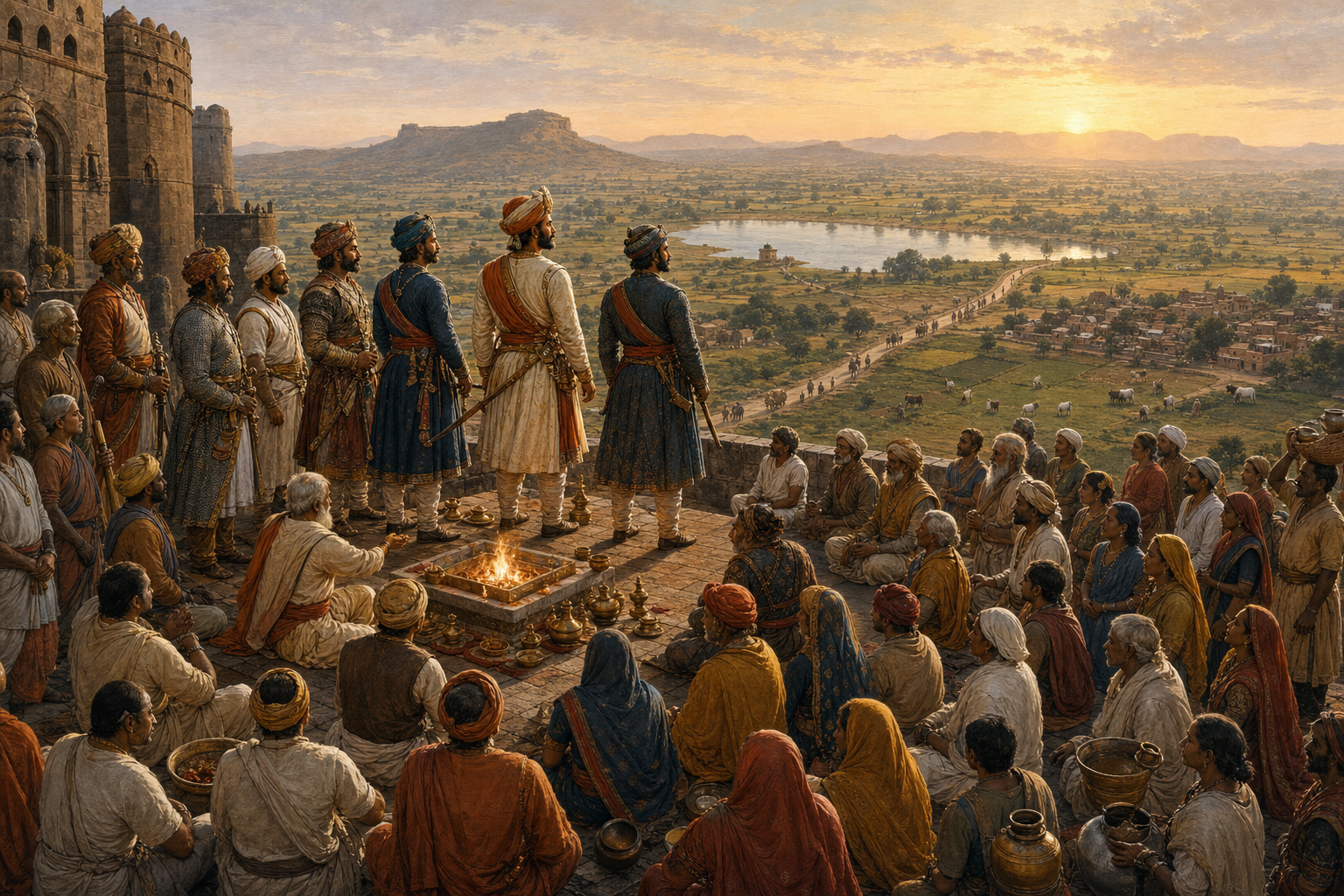
The Agnivamsa article places the Paramaras among four principal fire-lineages, alongside the Pratiharas, Chahamanas, and Chalukyas. It reports the tradition that these houses were ritually associated with a yajna at Mount Arbuda, identified with Mount Abu. The article also describes them as integrated into the Dharmic order through Brahma-Kshatra and Vedic associations, while cautioning that every reported affiliation is not necessarily confirmed by inscriptional evidence.
Read politically, the fire-lineage account does more than propose a biological pedigree. It presents Kshatriya standing as a consecrated obligation to protect society, govern, and restore order during upheaval. The article invokes the traditional example of Vishvamitra, whose status changed through tapas and recognition, to illustrate that Indian accounts of social function could include more than one historical pathway. Within this interpretive framework, Agnivamsa signifies an authorization to carry Kshatra Dharma as much as a claim about descent.
This reading also helps avoid the two reductions identified by the Agnivamsa source. One explains Rajput houses principally through foreign-origin theories; the other treats every important house as an uncomplicated continuation of the oldest Solar or Lunar dynasties. The source instead proposes a layered account in which indigenous political communities, ritual standing, regional power, sacred geography, and inherited memory interact. That approach does not settle every genealogy, but it better explains why lineage narratives speak simultaneously about ancestry and fitness to rule.
The Paramara connection gives this principle a particular landscape. Both historical articles associate the lineage with Malwa, Ujjain, and Avanti, while the Vikramaditya profile reports the martial interpretation of Paramara as enemy-slayer. The Agnivamsa article emphasizes Ujjain’s associations with pilgrimage, astronomy, Sanskrit literature, temple culture, Kalidasa, and Vikramaditya. In the combined tradition, royal identity is therefore anchored not only in a family tree but also in stewardship of a major sacred and intellectual center.
The Shaka narrative turns victory into restoration
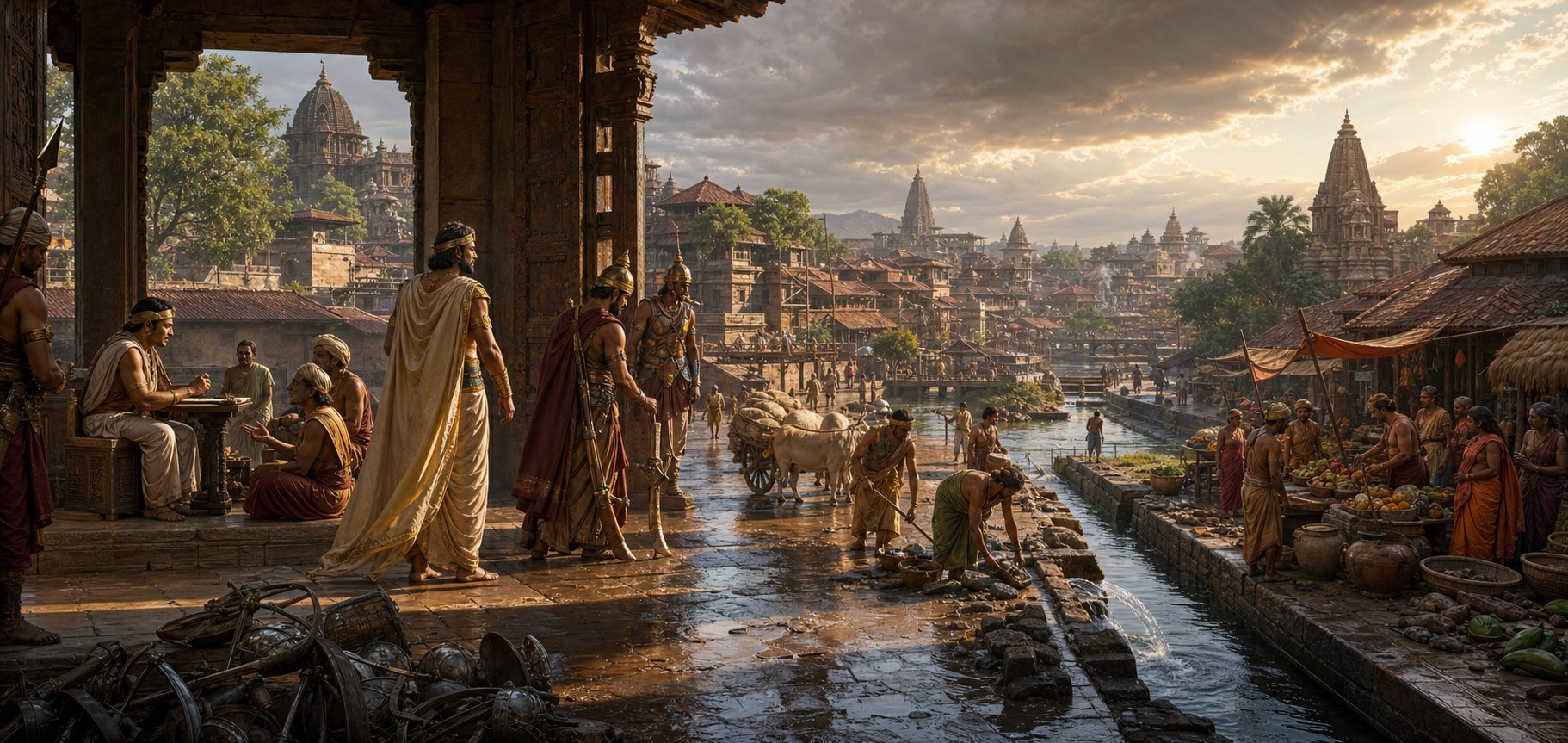
The Vikramaditya profile presents a traditional narrative in which Gandharvasena, also called Mahendraditya, was Vikramaditya’s father and a Shaka incursion disrupted Ujjain. It reports the prince’s exile, preparation, and return, as well as the traditional claims that he was born in 101 BCE and expelled the Shakas from Ujjain at seventeen. The same article describes the Battle of Korur and a defeated Shaka ruler named Roomaka. These particulars belong to the source’s account and should not be mistaken for independently verified conclusions.
A related chronological problem concerns the era beginning in 57 BCE. The profile notes both the deep traditional association of this era with Vikramaditya and the observation by modern epigraphists that the name Vikrama Samvat appears in inscriptions later than the era’s starting point. The Agnivamsa article likewise treats the era as part of the civilizational memory of resistance to Shaka power. The careful position is therefore to distinguish the commencement of the reckoning, its later recorded name, and the heroic ruler subsequently attached to it.
Even with those qualifications, the narrative’s political meaning is plain. Vikramaditya is remembered not merely as a conqueror collecting territory but as a ruler who recovers a disturbed realm, restores security, and makes victory serve a renewed moral order. The profile also reports expansive claims about a Samrajya of tributaries, allies, and vassal rulers across Bharatavarsha and beyond. It advises caution about their scale while drawing attention to the underlying political imagination: diverse regions could be envisioned within a larger civilizational order without requiring the uniform centralization of a modern state.
This is where the lineage and liberation traditions meet Rajadharma. Martial success supplies an opportunity to rule, but it does not by itself legitimate rule. The memory becomes exemplary only because victory is represented as protection, recovery, and the re-establishment of conditions in which social and intellectual life can continue. The ethical sequence is crucial: danger calls forth Kshatra, Kshatra restores order, and restored order remains answerable to Dharma.
The throne tests character while institutions test power
Simhasana Dvatrimsika converts this political memory into a demanding examination. As described in the literary source, King Bhoja approaches Vikramaditya’s throne but is confronted by thirty-two speaking statuettes. Each recounts an episode and tests whether Bhoja possesses the courage, generosity, discernment, justice, learning, and self-command required to occupy the seat. In this frame, descent and inherited prestige cannot substitute for demonstrated worthiness.
The throne is consequently less a prize than an audit. Its stories ask whether bravery is governed by judgment, whether generosity remains responsible, whether punishment serves justice, and whether learning has produced humility rather than vanity. The literary article reports that the cycle circulated in Jain, Bengali, and Southern recensional streams and across Sanskrit, Prakrit, and regional settings. That breadth of transmission suggests that Vikramaditya’s remembered kingship became a shared medium for debating authority across distinct Indic communities.
The Rajadharma article broadens this moral test beyond the personality of one king. It argues that ancient Indian governance included monarchies, gana polities, sangha or confederate formations, assemblies, councils, village institutions, and other local or corporate bodies. It also cautions that ancient republics were often aristocratic or clan-based and should not be equated with modern systems of universal suffrage. The common standard was not one immutable constitutional design, but the obligation to direct authority toward order, justice, welfare, and protection.
Within monarchy itself, that source describes the ruler as the bearer of a trust rather than the private owner of the state. Dharma stood above the king, while the Manthri Parishad, Raaja Sabha, officials, provincial authorities, and local bodies gave counsel and administrative form to rule. Some traditions described in the article even allowed public recognition or selection when succession failed. Bloodline could place a claimant near the throne; consecration, competence, counsel, acceptance, and protection of the realm helped make kingship legitimate.
Together, the throne tales and the governance typology identify two safeguards that should not be separated. Character restrains abuses that rules alone cannot anticipate, while institutions restrain the vanity of leaders who regard personal virtue as sufficient. Rajadharma requires both an inward discipline over anger, pleasure, flattery, and faction, and an outward order of advice, procedure, accountability, and public duty.
Key takeaways
- Vikramaditya should be studied by distinguishing the royal title, possible historical rulers, Paramara memory, literary archetype, and later association with the Vikrama era.
- The Agnivamsa tradition is most informative when read as a claim about ritual integration and the assumption of protective duty, not as self-sufficient proof of every genealogical detail.
- The Shaka narratives make resistance meaningful by presenting victory as the recovery of a disrupted realm rather than conquest for its own sake.
- Simhasana Dvatrimsika and the wider Rajadharma tradition agree that inherited authority must be earned through character, while councils, assemblies, procedures, and public expectations help keep power answerable.
Future study can sharpen this synthesis by comparing inscriptions, genealogies, Puranic and Jain narratives, manuscript recensions, and political vocabulary without forcing them into a single evidentiary category. For contemporary public life, the durable challenge is not to recreate Vikramaditya’s throne, but to recover its question: what must authority prove before it becomes worthy of obedience?
References
- DharmaRenaissance Blog — Agnivamsa Rajput Origins: A Powerful Reassessment of Fire-Lineage History
- DharmaRenaissance Blog — Vikramaditya Paramara: Powerful Legacy of the Legendary Emperor of Ujjain
- DharmaRenaissance Blog — Simhasana Dvatrimsika: Powerful Lessons from Vikramaditya’s Legendary Throne
- DharmaRenaissance Blog — Rajadharma and Government Types: Essential Lessons for Dharmic Governance