
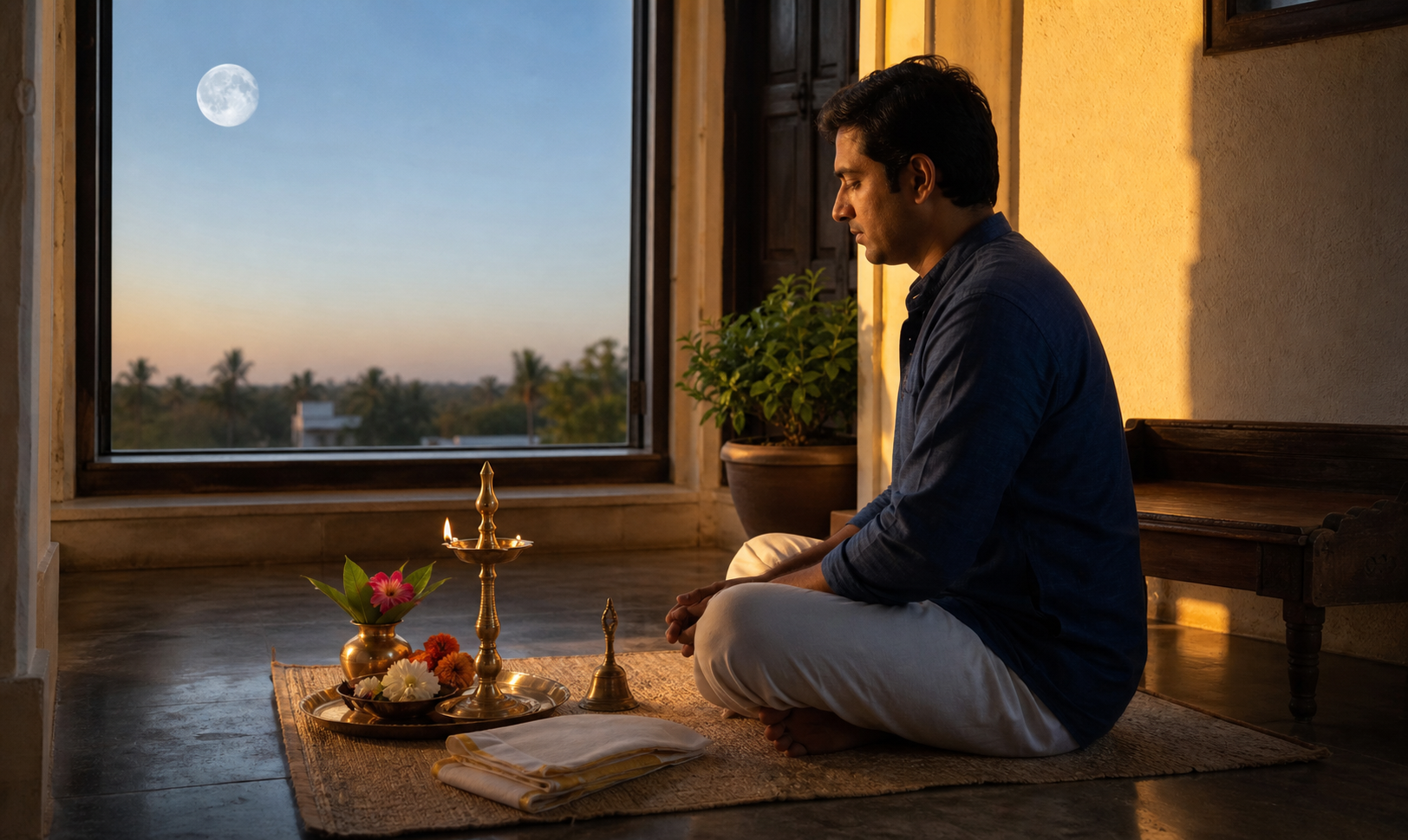
A daily Panchang becomes useful when it is read as a guide to changing ritual time, not as a fixed verdict on whether an entire date is auspicious. The central practical question is often simple: which tithi is present when a particular observance is performed?
The supplied DharmaRenaissance Blog entry offers a useful case study because it reports a tithi transition during the morning of July 5, 2026. From that example, readers can develop a more careful method for connecting lunar-calendar information with worship, family custom, and ordinary responsibilities. Because the source packet contains only that one entry, its date-specific details are treated here as single-source reporting rather than independently corroborated calendar data.
Tithi changes within the civil day
A civil date begins at midnight and lasts for a fixed number of hours. A tithi follows a different logic. As the source explains, it is determined by the angular relationship between the Sun and Moon, with each tithi corresponding to 12 degrees of separation. Its beginning or ending therefore need not coincide with midnight, sunrise, or the start of a conventional workday.
This distinction explains why one calendar date can contain portions of two tithis. A person who reads only the tithi listed beside the date may miss a morning or evening transition that matters for a time-bound vrata or ritual. The ending time is therefore part of the entry’s meaning, not a minor technical detail.
The July 5 entry concerns Krishna Paksha, the waning fortnight between Purnima and Amavasya. The source associates this phase with inward attention, restraint, completion, purification, and remembrance. Such associations can help establish the tone of a personal practice, but they should not be turned into universal prohibitions. A lunar phase supplies context; it does not eliminate the role of lineage, region, temple practice, or the purpose of an activity.
A practical hierarchy for reading the Panchang
The first step is to use a Panchang calculated for the practitioner’s location. The source cautions that sunrise, local time, and geography affect the practical application of a tithi. A time copied from a listing prepared for another country or time zone should not automatically be transferred to a household elsewhere.
The second step is to determine the rule relevant to the observance. Some traditions give importance to the tithi prevailing at sunrise, while others require the desired tithi during a particular ritual window. A published ending time cannot settle that question by itself; family convention, vrata instructions, or temple guidance must identify which rule applies.
The third step is to distinguish daily devotion from formal muhurta selection. The source emphasizes that a tithi alone does not establish a universally “good time.” A fuller assessment may consider nakshatra, yoga, karana, weekday, sunrise and sunset, lunar month, location, and the activity being planned. A period suitable for routine puja is not necessarily sufficient for marriage, housewarming, travel, or another major undertaking.
This hierarchy prevents two common errors: ignoring a tithi transition altogether and treating that transition as the only calendar factor that matters. The Panchang is most useful when its elements are read together and at a level of detail proportionate to the decision.
July 5, 2026 as a worked example
The DharmaRenaissance Blog source reports that Krishna Paksha Panchami continues until 9:49 AM on Sunday, July 5, 2026, after which Krishna Paksha Sashti begins. On the source’s stated schedule, the civil morning is therefore divided into two ritual segments:
| Period reported by the source | Prevailing tithi | Practical reading |
|---|---|---|
| Until 9:49 AM | Krishna Paksha Panchami | A Panchami-specific practice would ordinarily need attention during this earlier period, subject to the applicable tradition. |
| After 9:49 AM | Krishna Paksha Sashti | Later worship occurs under Sashti, while routine devotion may continue without interruption. |
The source connects Panchami broadly with learning, healing, reverence, and disciplined worship. It associates Sashti with protection, strength, continuity, and, in some regional traditions, devotion to Skanda or Subramanya. These descriptions offer interpretive context rather than a complete prescription for every household.
The example also shows what cannot safely be inferred from a tithi line. The supplied entry does not preserve the day’s location-specific nakshatra or rashi details, and it advises readers to check a local Panchang for such factors as Rahu Kaal and exact auspicious periods. The reported 9:49 AM transition is therefore useful as an illustration, but it is not a portable muhurta for every location or purpose.
From calendar information to sustainable practice
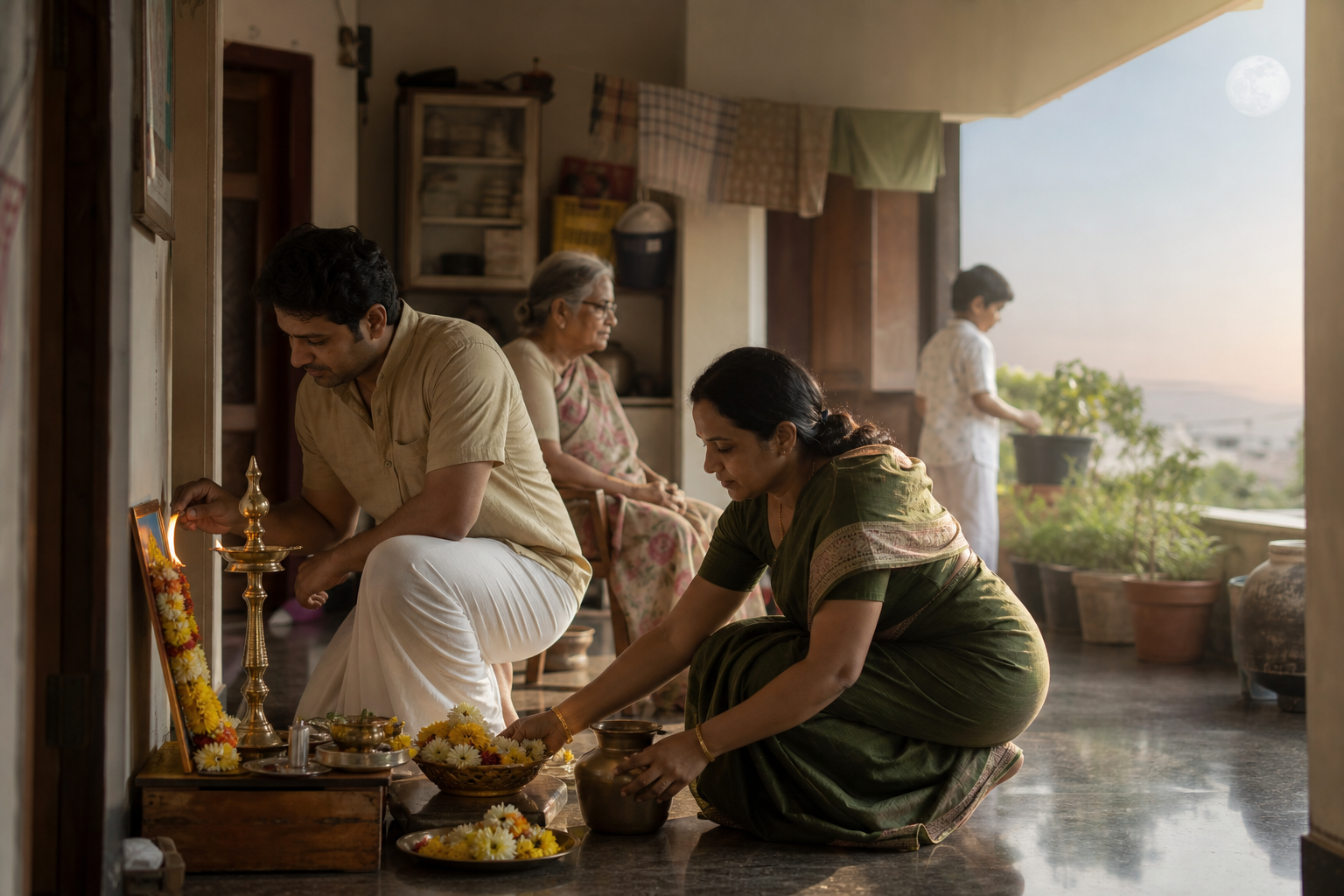
For ordinary daily worship, the source suggests modest and repeatable practices: lighting a lamp, offering water, performing japa, reading scripture, meditating, or undertaking quiet seva. If a practitioner wishes to acknowledge the reported Panchami-to-Sashti transition, a Panchami-oriented observance can be placed before the stated ending time and later worship can proceed under Sashti.
Formal observances require greater precision. A practitioner planning a vrata, samskara, temple rite, or consequential journey should verify the local calendar and consult the relevant customary authority. This is especially important in diaspora settings, where a date circulated by relatives or institutions abroad may correspond to different local clock times.
The deeper value of this approach is disciplined attention. Panchang practice can connect astronomical movement, inherited ritual memory, and the shape of an ordinary day without turning every calendar entry into an inflexible command. It supports continuity while leaving room for legitimate regional and family differences.
Key takeaways
- A tithi can change during a civil date, so its ending time matters.
- The relevant timing rule depends on the observance; sunrise-based and time-window-based practices are not interchangeable.
- Tithi is only one part of muhurta assessment and should be read with local Panchang factors.
- The source reports Panchami until 9:49 AM on July 5, 2026, followed by Sashti, but that timing should not be exported to another location without verification.
Used with local accuracy and respect for living tradition, the daily Panchang can become a steady framework for future practice rather than a collection of isolated dates and deadlines.