
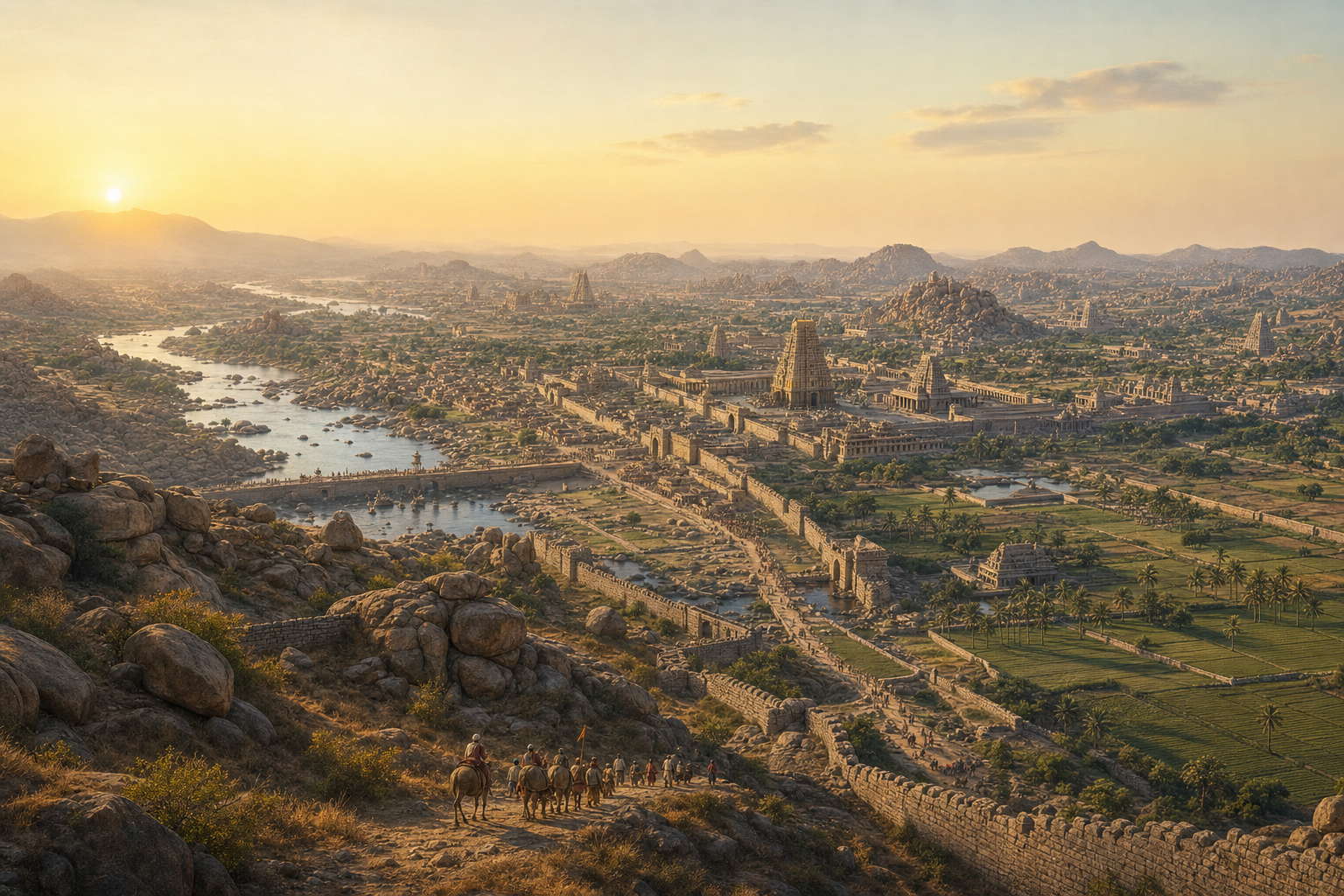
Vijayanagara is often introduced through a founding date, a celebrated ruler, or the monuments of Hampi. Read together, the three source accounts suggest a more useful interpretation: the empire emerged within a wider search for political recovery, fashioned a capital from a strategically and religiously meaningful landscape, and sustained authority through institutions of learning as well as armies and architecture.
This combined view connects developments that are easily separated in conventional narratives. Regional resistance explains the problem Vijayanagara had to answer; Hampi shows how that answer was expressed in space; and the career of Annambhaṭṭa reveals how scholarly patronage continued to give the imperial order intellectual reach beyond the capital.
Formation was a regional process, not a single date
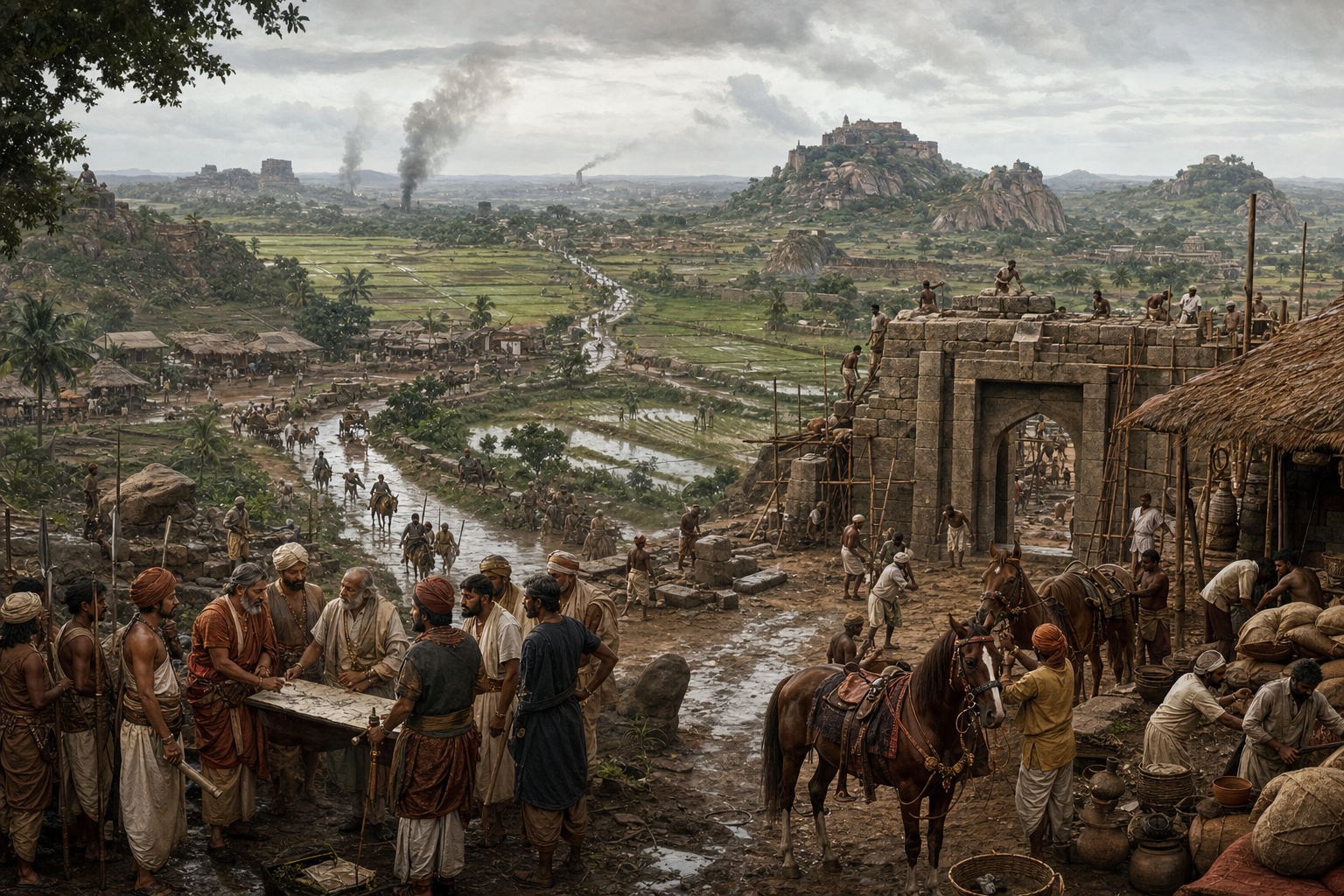
Pragyata places the political background in the crisis that followed the early fourteenth-century fall of the Kakatiya kingdom. Its account describes the loss of Orugallu, pressure on other Telugu forts and administrative centres, disruption to temples and agrarian settlements, and the dispersal of military leaders who had served within the Kakatiya Nayaka system. The Musunuri movement arose in this unsettled environment as an attempt to restore local authority and coordinate chiefs whose loyalties had become fragmented.
The Musunuri account is valuable to Vijayanagara history primarily as regional context. It does not, in the material supplied here, demonstrate a simple institutional succession from the Musunuri coalition to the Vijayanagara state. It instead identifies the political questions confronting much of the southern peninsula: how could dispersed commanders be reunited, sacred and economic institutions protected, and legitimate authority reconstructed after an established centre had fallen?
The Nayaka system illustrates both the resources and the dangers of that environment. Pragyata describes commanders whose strength rested on local knowledge, fighting forces, territorial revenues, and relationships with agrarian and frontier communities. Such decentralisation could support resistance, but rivalry among the same leaders could also dissolve collective action. The experience helps explain why durable recovery required more than battlefield success: it required institutions capable of binding regional power to a larger political purpose.
Indic Portal supplies the more specific foundation tradition. It associates the conventional date of 1336 CE with Harihara I and Bukka I of the Sangama line and notes the place of Vidyaranya Svaami in the intellectual and spiritual memory of the city’s beginnings. These elements should be kept analytically distinct. The date and founders provide a dynastic point of reference, while the post-Kakatiya setting reveals the broader process of reorganisation within which a new imperial centre became meaningful.
Hampi converted terrain, memory, and water into power
Vijayanagara’s capital was not established on an empty landscape. Indic Portal locates it on the southern bank of the Tungabhadra, opposite the older settlement of Anegondi, in a region remembered as Pampakshetra and associated with Kishkindha traditions. Earlier shrines, settlements, tanks, and sacred memories gave the site an inherited significance that the rulers enlarged rather than created from nothing.
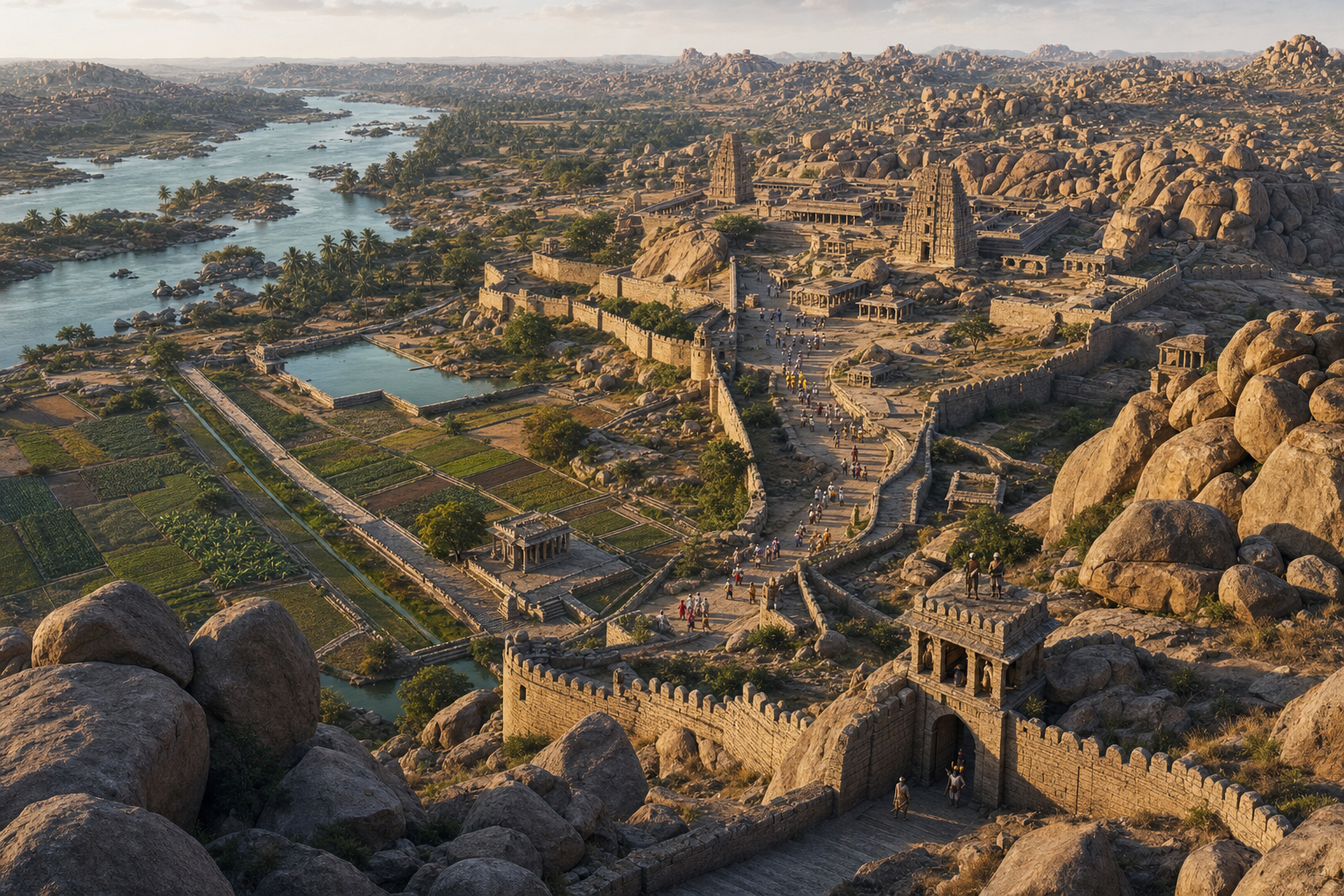
The physical setting also offered strategic advantages. Granite formations, ridges, river edges, open ground, and restricted passages could be incorporated into layered defences. According to Indic Portal, the city’s protection depended not on one enclosing wall but on successive defensive lines that integrated roads, gateways, watch points, settlement clusters, and agricultural areas. The capital therefore joined sacred geography to military planning without treating them as separate urban domains.
Water management made this imposing landscape habitable at metropolitan scale. The same source reports a network of tanks, canals, aqueducts, anicuts, wells, reservoirs, channels, and stepped tanks serving agriculture, households, gardens, rituals, and royal activity. Waterworks were thus not decorative additions to monumental architecture. They were part of the capital’s productive base and helped connect ceremonial spaces with the daily requirements of a large population.
Indic Portal’s account of more than 1,600 surviving remains, drawing on UNESCO’s description of the site, reinforces this urban breadth. Temples and shrines existed alongside royal compounds, stables, gateways, defensive works, memorials, water features, and fragments of ordinary settlement. Archaeological finds mentioned by the article, including coins, ceramics, utensils, terracotta objects, and sculptural pieces, likewise place administrators, artisans, merchants, soldiers, agricultural workers, priests, and visitors within the monumental landscape.
The city’s art gave visible form to this integration. Temple axes opened onto bazaars and processional streets; narrative sculpture and painting joined theology to public memory; and royal platforms staged political ceremony. Indic Portal presents the Vitthala complex, the monumental Narasimha, the Mahanavami Dibba, and the wider hydraulic and defensive systems as parts of one urban language. The result was neither merely a temple town nor merely a fortified seat of government, but a capital in which devotion, commerce, security, and sovereignty reinforced one another.
Scholarship extended the imperial order beyond the capital
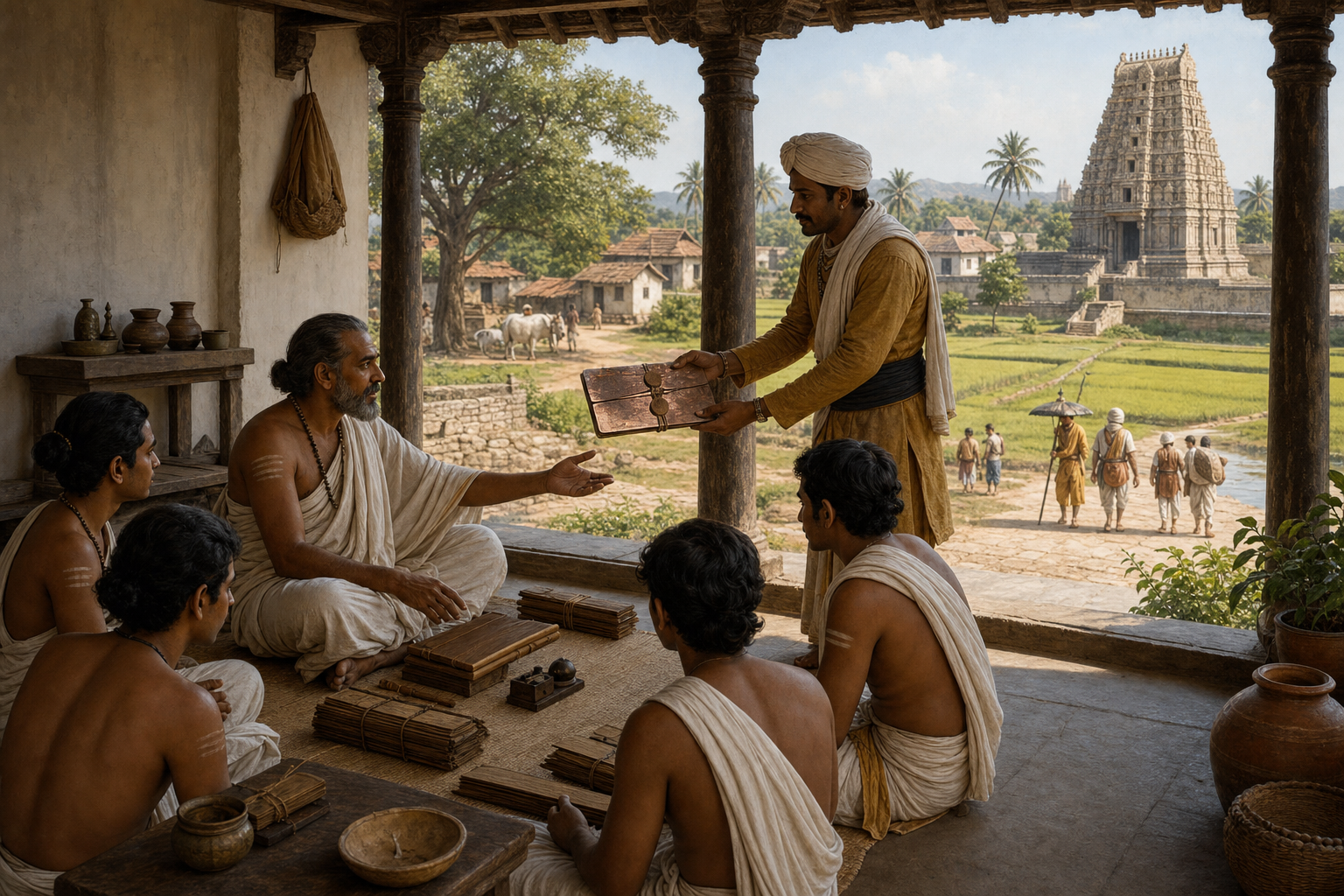
The article on Garikapati Annam Bhaṭṭu shifts attention from Hampi’s visible monuments to the empire’s intellectual infrastructure. It identifies him with the Tarka Saṅgraha and its companion Dīpikā, works valued for presenting Nyāya reasoning with compactness and pedagogical clarity. More importantly for his historical setting, the article reports that a copper-plate inscription issued by Sadāśiva Rāya in 1560 CE granted the Garikapāḍu agrahāra to Annambhaṭṭa.
That record links scholarship to governance in several ways. As described by the source, the plate invoked religious authority, specified the grant’s boundaries, and established its legal and ritual standing. The agrahāra was consequently more than personal compensation. It supplied a durable setting for teaching, study, ritual practice, and community leadership, translating royal recognition into a locally rooted institution.
The same account describes learned assemblies under Sadāśiva Rāya in which specialists in Vedic learning, logic, Mīmāṃsā, and Dharma examined questions through organised debate. It reports that these pariṣats generally lasted three days, arranged participants according to fields of learning, and conferred graded titles and material support. Whether expressed through land or gold, patronage carried an expectation that recipients would sustain study and instruction. Knowledge was therefore treated as a public responsibility, not simply an individual accomplishment.
Annambhaṭṭa’s reported educational journey adds a geographical dimension. The source traces his movement from a Telugu scholarly lineage to advanced grammatical study in Kāśī under Śeṣa Vīreśvara Paṇḍita, followed by his return south. It presents this as part of a larger circulation of southern scholars through centres of Sanskrit learning. Grammar, logic, Vedānta, manuscripts, teaching lineages, and debate travelled across regions even when patronage was anchored in a particular village or court.
This evidence changes the scale at which the imperial capital should be understood. Hampi concentrated ceremony, defence, exchange, and administration, but Vijayanagara’s cultural reach depended on a distributed network of scholars, temples, agrahāras, and regional communities. The grant to Annambhaṭṭa shows the court supporting intellectual continuity away from the monumental centre. The capital’s importance lay partly in its ability to authorise and resource institutions elsewhere.
Reading Vijayanagara as a system of connected institutions
The three accounts use different kinds of evidence and should not be collapsed into a single seamless story. The Musunuri narrative foregrounds political memory and coalition-building; the Hampi account emphasises archaeology, architecture, and landscape; and the Annambhaṭṭa study relies on inscriptional, textual, and lineage evidence. Their value in combination is that each corrects the limitations of viewing the empire through only one archive.
Key takeaways
- Vijayanagara’s conventional foundation in 1336 CE is best read within a broader regional struggle to rebuild authority after major political disruption.
- Hampi worked as an integrated capital because inherited sacred associations, defensible terrain, water engineering, markets, agriculture, and ceremonial architecture were planned together.
- Royal support for scholars and agrahāras extended imperial influence through teaching, ritual, debate, and locally embedded institutions beyond Hampi.
- The empire’s durability cannot be explained by military power, monumental art, or religious patronage alone; it rested on the interaction among all three.
This interpretation also guards against two reductions: treating Vijayanagara as an instantaneous reaction to conquest, or treating Hampi’s monuments as self-explanatory achievements. Political recovery had to be organised, an imperial landscape had to be maintained, and knowledge had to be transmitted. Each activity relied on people and institutions operating at different distances from the throne.
Future study can deepen this connected history by reading inscriptions, settlement patterns, water systems, scholarly texts, and regional memories alongside one another. Such an approach can show more precisely how authority moved between the capital and the communities that gave the empire its practical and intellectual life.
References
- Indica Today — Garikapati Annam Bhaṭṭu: The Powerful Copper-Plate Legacy of Nyāya
- Pragyata — Musunuri Nayakas: The Fierce Telugu Resistance That Forged Vijayanagara
- Indic Portal — Vijayanagara’s Enduring Splendor: Hampi’s Art, Architecture, and Sacred Power