

Hindu sacred sculpture does not present authority as a simple measure of rank or force. It makes authority visible through relationships: between a weapon and its bearer, a protector and what is protected, a teacher and a disciple, or status and realized knowledge.
The khetaka shield and Shishyabhava Murti, in which Shiva adopts the disposition of a student before Skanda, illuminate complementary dimensions of this visual theology. One expresses the disciplined defense of sacred order; the other shows supreme status becoming receptive before wisdom. Read together, they offer a practical framework for interpreting how Hindu iconography distinguishes power from legitimate spiritual authority.
Two images place power under discipline
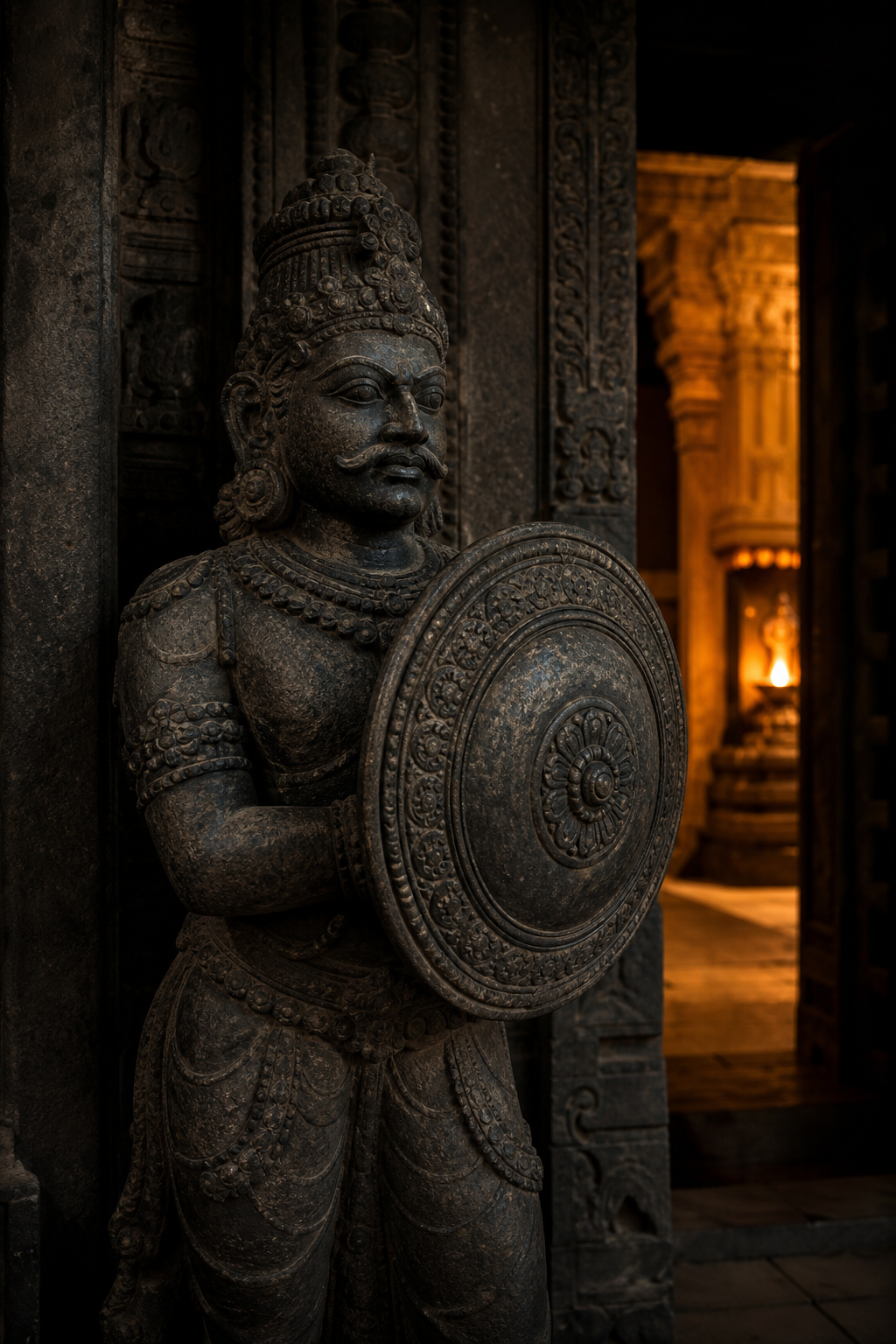
The DharmaRenaissance study of the khetaka identifies it as the shield carried by deities, guardians, and attendants. As an āyudha, or divine implement, it can help identify a manifestation or protective office. Its significance nevertheless depends on the complete image rather than on the object alone.
A sword projects force, while a shield receives and resists it. Their frequent pairing as khaḍga and khetaka consequently gives sacred power two coordinated movements: intervention against a threat and preservation of what must endure. The shield does not imply timidity. It requires alertness, endurance, positioning, and the restraint to place force in the service of protection.
The account of Shishyabhava Murti places discipline in a different register. Shiva, elsewhere represented as a divine teacher and formidable deity, receives instruction concerning the Pranava, Om, from his son Skanda. The reversal does not strip Shiva of greatness. It locates greatness in the ability to listen when knowledge appears through an unexpected teacher.
These forms therefore correct opposite misunderstandings of authority. The shield challenges the idea that power consists only in striking, while Shiva’s discipleship challenges the idea that elevated status eliminates the need to learn. In both cases, capacity becomes authoritative only after it has accepted a governing discipline.
Meaning arises from relationships, not isolated symbols

Across both source studies, iconography is presented as a structured visual language. A hand-held object, gesture, bodily orientation, companion figure, vehicle, or position acquires meaning through its relationship to the rest of the composition. Neither a shield nor a bowed or seated posture functions as a universal caption.
For the khetaka, the identity of the bearer is decisive. In a martial form of Devī, it participates in divine resistance to destructive forces. With Vīrabhadra, it contributes to formidable Śaiva authority. In a multi-armed Viṣṇu image, it can form part of sovereign equipment; with an attendant or guardian, it can mark a delegated protective role. Its pairing with a sword, its position among other attributes, and the narrative represented all refine its significance.
Shishyabhava Murti is equally relational. Shiva’s conduct becomes intelligible through Skanda’s position as teacher, the subject of the Pranava, and the contrast between divine or parental seniority and the discipline of discipleship. Related accounts vary in whether Shiva sits below Skanda, kneels, bows, or receives private instruction, but the source identifies a shared center: knowledge, rather than age or genealogy, determines the teaching role.
This relational approach prevents two common errors. The first is to assign every attribute one fixed allegorical meaning, such as treating every sword solely as knowledge or every shield solely as dharma. The second is to read hierarchy as a static ladder. Hindu sacred images can instead show roles becoming responsive to circumstance: the powerful protects, the senior listens, and the one conventionally understood as a son becomes a guru.
Key takeaways
- Sacred authority appears as both protective strength and receptivity to instruction.
- The khetaka gains meaning from its bearer, companion attributes, narrative setting, and regional convention.
- Shiva’s student-form presents listening as a discipline of greatness rather than a loss of status.
- The sword-and-shield pair joins necessary intervention to preservation and restraint.
- Sound interpretation considers the whole image alongside textual, ritual, and artistic context.
Texts authorize forms without exhausting their meaning
The sources also clarify how textual authority should be used. The khetaka article distinguishes a broad Vedic and epic environment of protection, armor, kingship, and victory over disorder from later, more detailed systems of image-making. It associates specific visual programs with Purāṇic, Āgamic, Tantric, and Śilpaśāstra traditions rather than treating the Vedas as direct manuals for every surviving sculpture.
As one reported example, the Agni Purāṇa describes an eight-armed form of Viṣṇu whose implements include a khetaka. The source also notes that Śaiva and Śākta traditions preserve configurations in which shields accompany swords, bows, tridents, axes, nooses, or other attributes. Such prescriptions help identify forms, but they are not identical across texts, recensions, and regions.
The Shishyabhava article supplies a parallel case. Citing T. A. Gopinatha Rao’s discussion of material drawn from the Mānasāra, it reports a formally conceived Sishya-bhava-murti and a corresponding teaching form of Subrahmanya. The transmitted description includes Shiva seated cross-legged before Subrahmanya, with gestures that turn restraint of speech and attentiveness into visible features. Subrahmanya appears as Desika-Subrahmanya, the preceptor, with teaching and divine attributes.
Neither study treats a textual description as a mechanical template that cancels the evidence of actual images. Scale can require omissions; objects can be damaged; attributes can be rearranged; workshops can inherit regional conventions; and ritual or narrative priorities can shape the finished form. Texts establish a field of authorized possibilities, while sculptures show how particular communities and artists realized those possibilities.
Protection and humility form a composite ethic
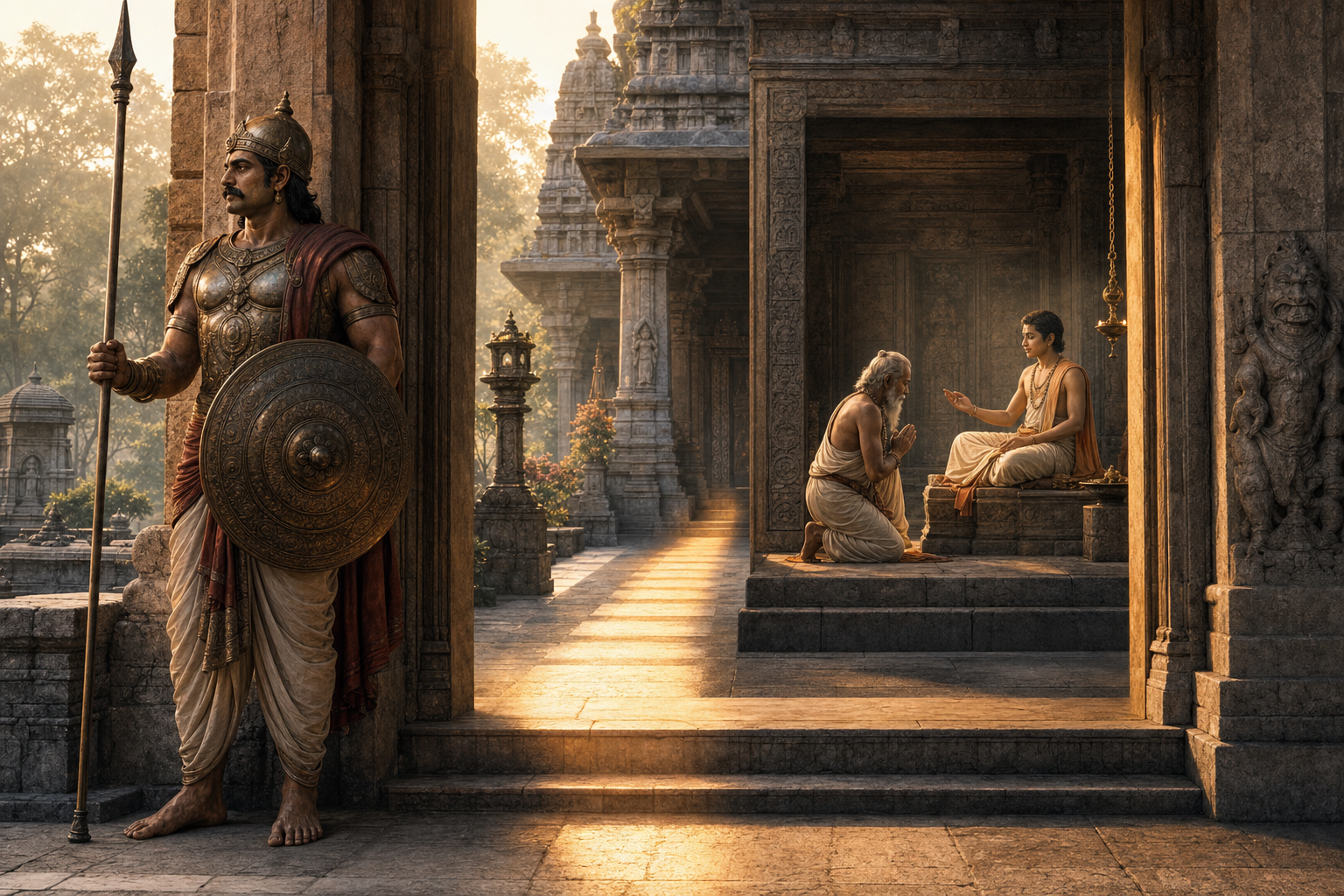
The contrast between the two forms reveals that sacred authority operates both outwardly and inwardly. The khetaka faces outward, establishing a boundary between danger and something worthy of preservation. Shishyabhava turns inward, establishing the receptive condition through which information can become transformative knowledge. One governs the use of force; the other governs the claims of status.
The two images also complicate the opposition between preserving tradition and correcting it. The shield preserves sacred order, yet it may operate beside a sword that removes an obstruction. Shiva preserves the dignity of sacred learning precisely by allowing an expected hierarchy to be reversed. Continuity, in this combined view, is not mere immobility. It can require defense, correction, and renewed understanding.
This synthesis should not be turned into a claim that every Hindu image encodes one theory of leadership. The sources repeatedly emphasize variation by deity, manifestation, text, region, workshop, and narrative. It is more useful as an interpretive lens: authority becomes spiritually credible when strength is restrained by responsibility and status remains answerable to truth.
Future encounters with sacred sculpture can therefore begin with three connected questions: what is being protected, what disciplines the figure’s power, and what relationship makes the depicted authority meaningful? Those questions keep interpretation attentive to both the visible form and the spiritual work it asks the viewer to contemplate.
References
- DharmaRenaissance Blog — Khetaka Revealed: The Shield’s Powerful Meaning in Hindu Sacred Sculpture
- DharmaRenaissance Blog — When Shiva Became the Disciple: Shishyabhava Murti and the Transforming Wisdom of Om