
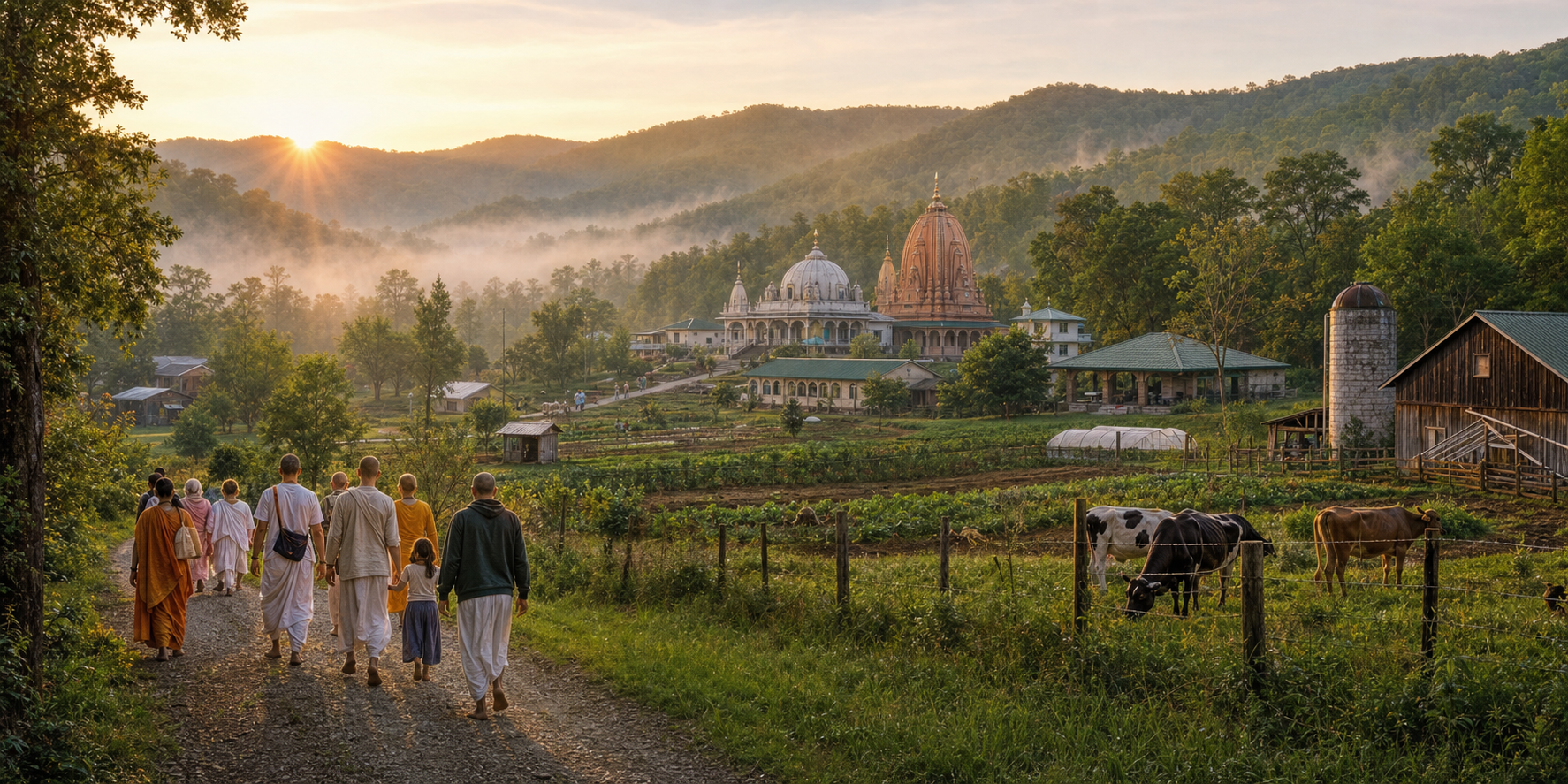
New Vrindaban is best understood not simply as a temple complex in West Virginia, but as an attempt to make Krishna-bhakti the organizing principle of a whole community. Its significance lies in the connections among worship, work, food, landscape, agriculture, animal care, and shared discipline.
The supplied DharmaRenaissance account brings those dimensions together. Read as a whole, it shows that New Vrindaban’s central experiment is practical: whether a devotional tradition rooted in India can shape daily life in an Appalachian setting without being reduced to architecture, private belief, or cultural display.
A community built around a devotional method
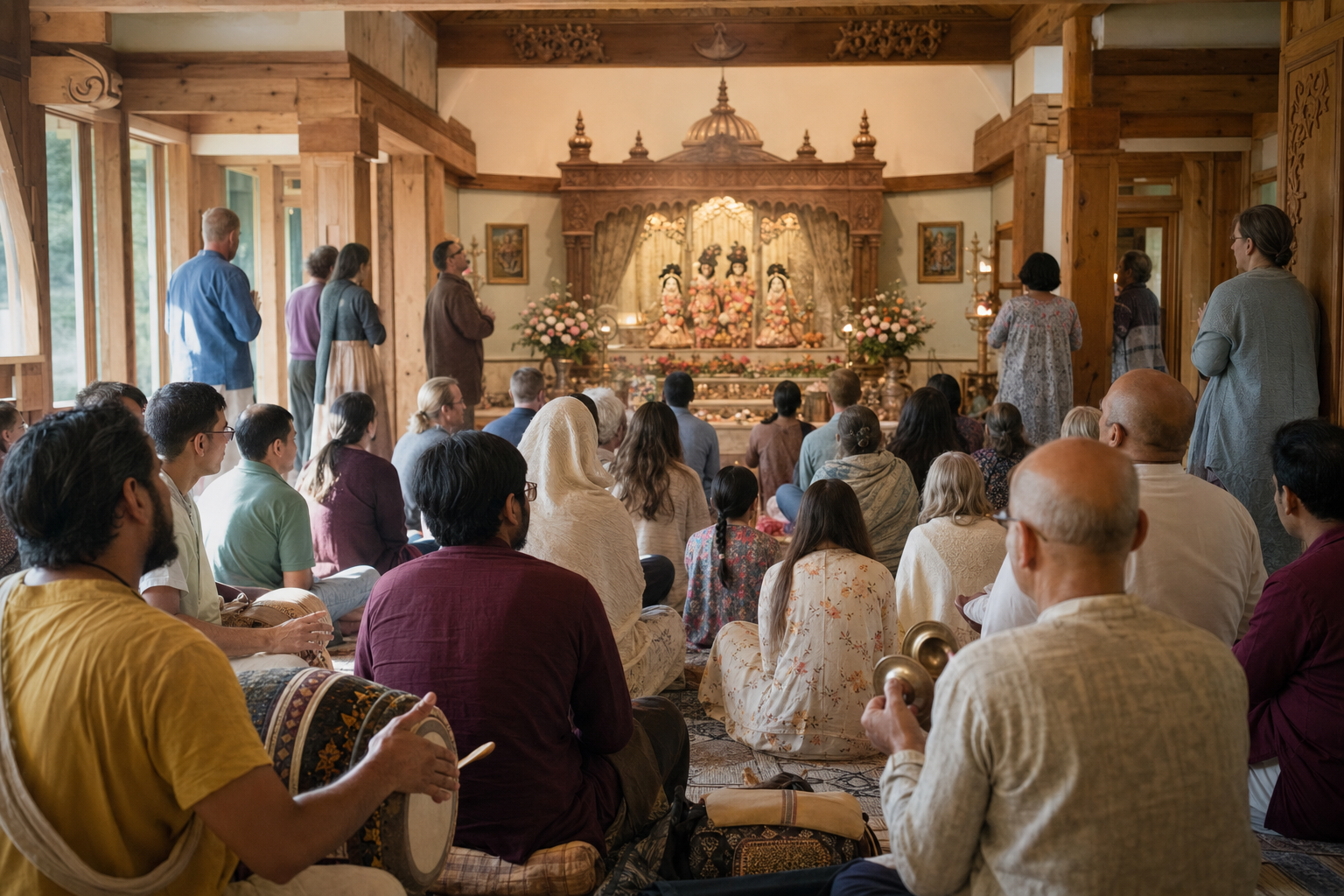
In the Gaudiya Vaishnava understanding presented by DharmaRenaissance, bhakti is disciplined loving service directed toward Krishna. It includes remembrance, prayer, temple worship, scriptural study, chanting, preparing sanctified food, maintaining sacred places, serving others, and cultivating humility. Community life therefore becomes part of the spiritual method rather than a backdrop for it.
This helps explain why New Vrindaban was conceived as more than a rural retreat. The source reports that it began in 1968 as ISKCON’s first rural farm community and took its name from Vrindavan in northern India, the region associated with Krishna’s childhood pastimes. The name expressed an aspiration to create surroundings that continually encouraged remembrance of Krishna; it did not make the two places historically identical.
The project also belonged to the wider transmission of Gaudiya Vaishnavism associated with A. C. Bhaktivedanta Swami Prabhupada. The account reports that Prabhupada arrived in New York in 1965, established ISKCON there in 1966, and first visited the developing West Virginia settlement in 1969. New Vrindaban gave rural form to a movement otherwise widely encountered through urban temples, public chanting, shared meals, and scriptural teaching.
An Indian sacred geography translated into Appalachia
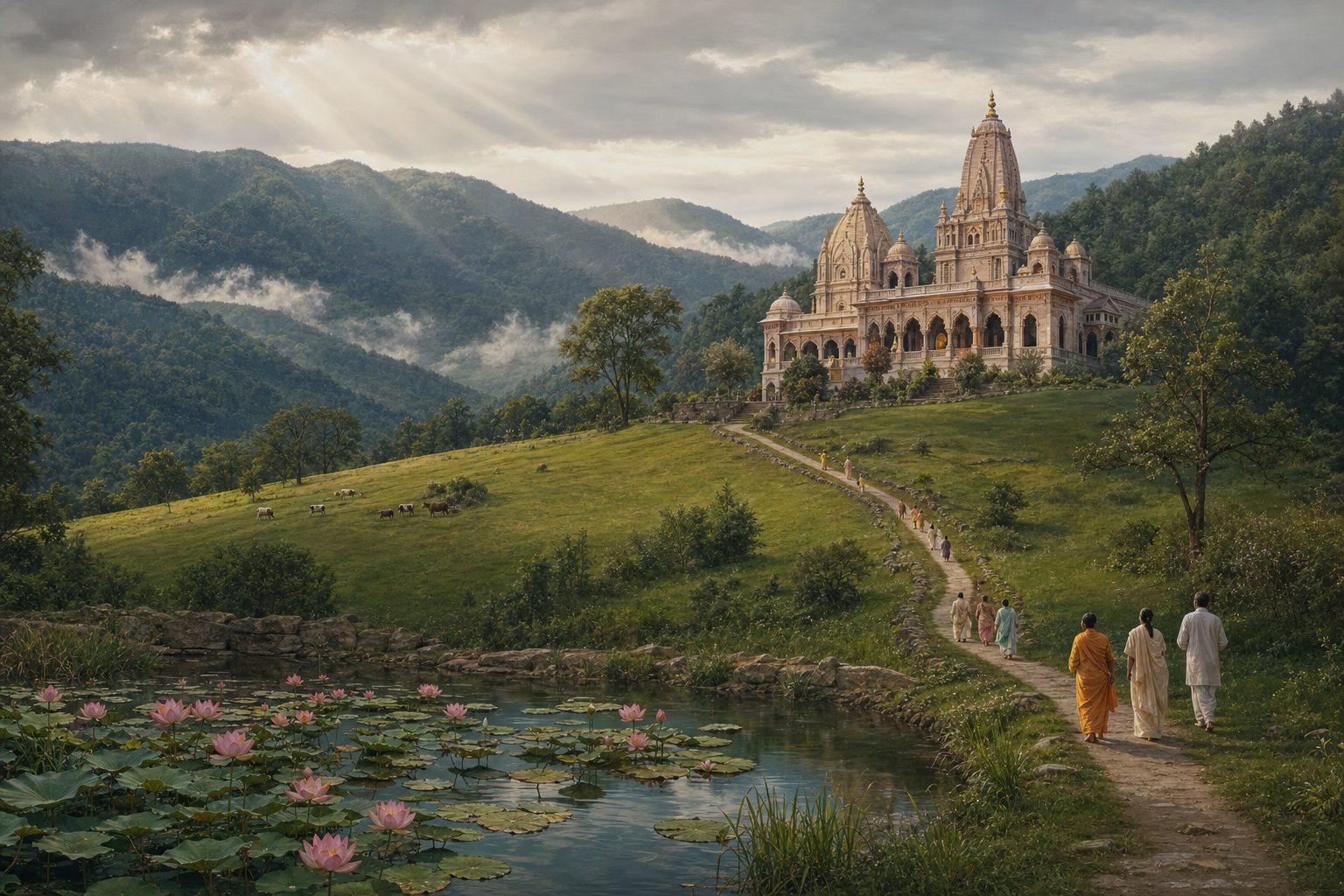
New Vrindaban demonstrates that sacred geography can be carried through memory and practice without treating geography as interchangeable. According to the source, hills, ponds, paths, and places of worship in the West Virginia settlement received names associated with Krishna’s pastimes. The resulting landscape functioned as a mnemonic map: movement through the community could also become an occasion for theological recollection.
This form of place-making depends on repetition. Walking, chanting, hearing sacred narratives, observing festivals, honoring prasadam, and returning to particular worship sites gradually join story to terrain. Buildings contribute to that environment, but they do not create it by themselves. A devotional landscape remains alive only when people repeatedly use it for devotion.
Translation also imposes limits. The account emphasizes that West Virginia’s climate, vegetation, regulations, labor conditions, and surrounding culture differ markedly from those of northern India. The community consequently had to interpret a devotional vision within Appalachian realities. Fidelity was expressed through purpose and practice, not through a literal duplication of the Indian landscape.
Worship, food, land, and animals form one system
The source’s descriptions of chanting and temple worship reveal how communal devotion is sustained. The maha-mantra may be repeated individually as japa or collectively through call-and-response kirtan. In the latter, voices, drums, hand cymbals, attention, and movement create a participatory practice in which the usual division between performer and audience becomes less important.
Formal deity worship supplies another rhythm. DharmaRenaissance identifies Sri Sri Radha Vrindaban Chandra as central to worship at New Vrindaban and explains that the consecrated deity is approached as a focus of divine presence. Scheduled offerings, cleanliness, food preparation, clothing, ornamentation, lamps, incense, flowers, prayers, and music turn time and sensory attention toward service.
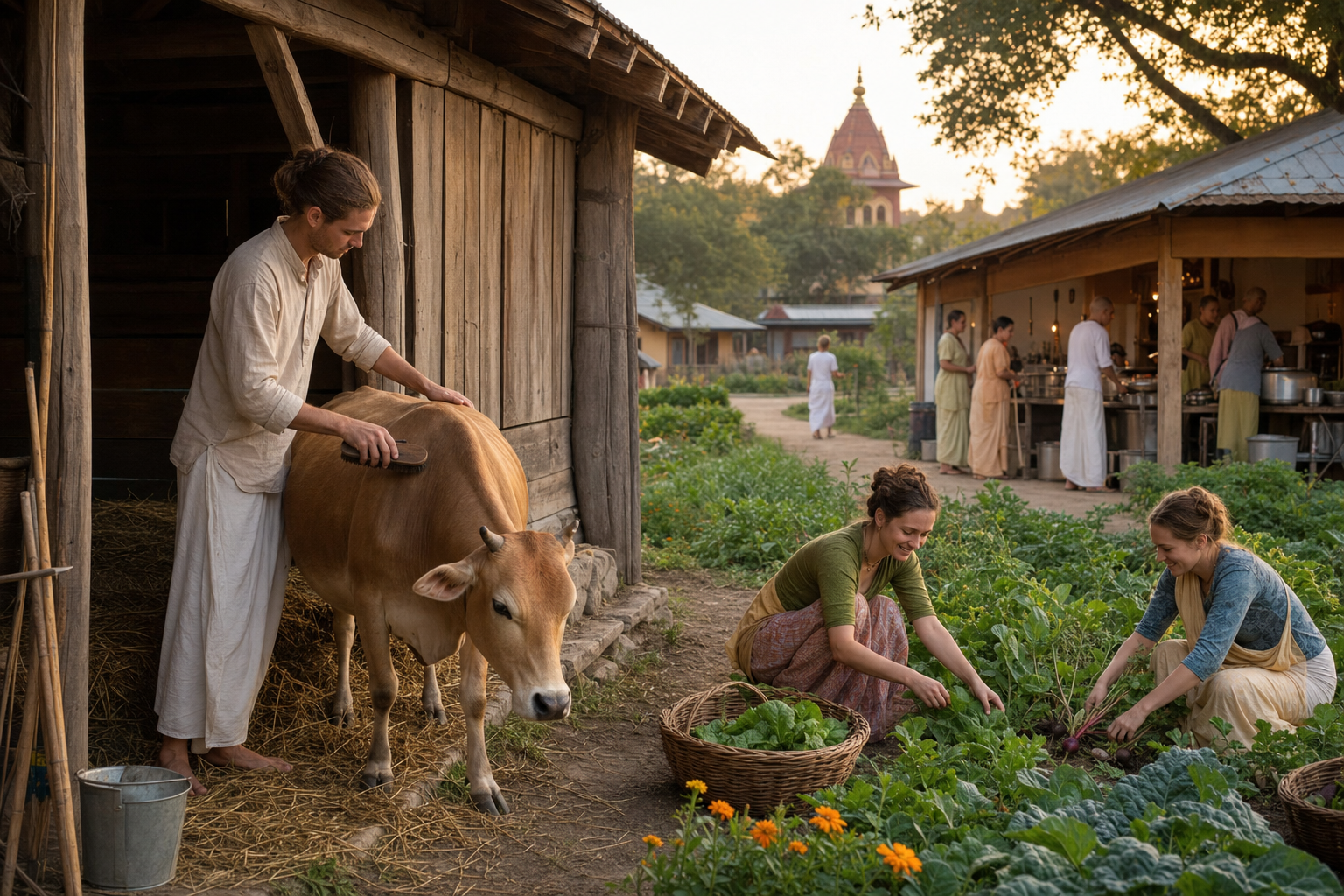
A rural community expands that discipline beyond the shrine. Meals must be prepared, buildings maintained, roads negotiated, fields tended, and animals cared for. When food is prepared as an offering and shared as prasadam, cooking connects agriculture, hospitality, theology, and fellowship. Cow protection similarly connects ahimsa and gratitude with the demanding routines of animal husbandry. The source presents these activities as interdependent expressions of Krishna consciousness, not as unrelated departments.
Key takeaways
- New Vrindaban treats community life itself as a field of bhakti, joining contemplation to work and responsibility.
- Its Appalachian sacred geography depends on names, narratives, pilgrimage habits, and recurring worship rather than architectural resemblance alone.
- Chanting, deity worship, prasadam, farming, and animal care reinforce one another within the community’s devotional ideal.
- The project’s meaning is clearest when spiritual intention and material difficulty are considered together.
The founding ideal meets material limits
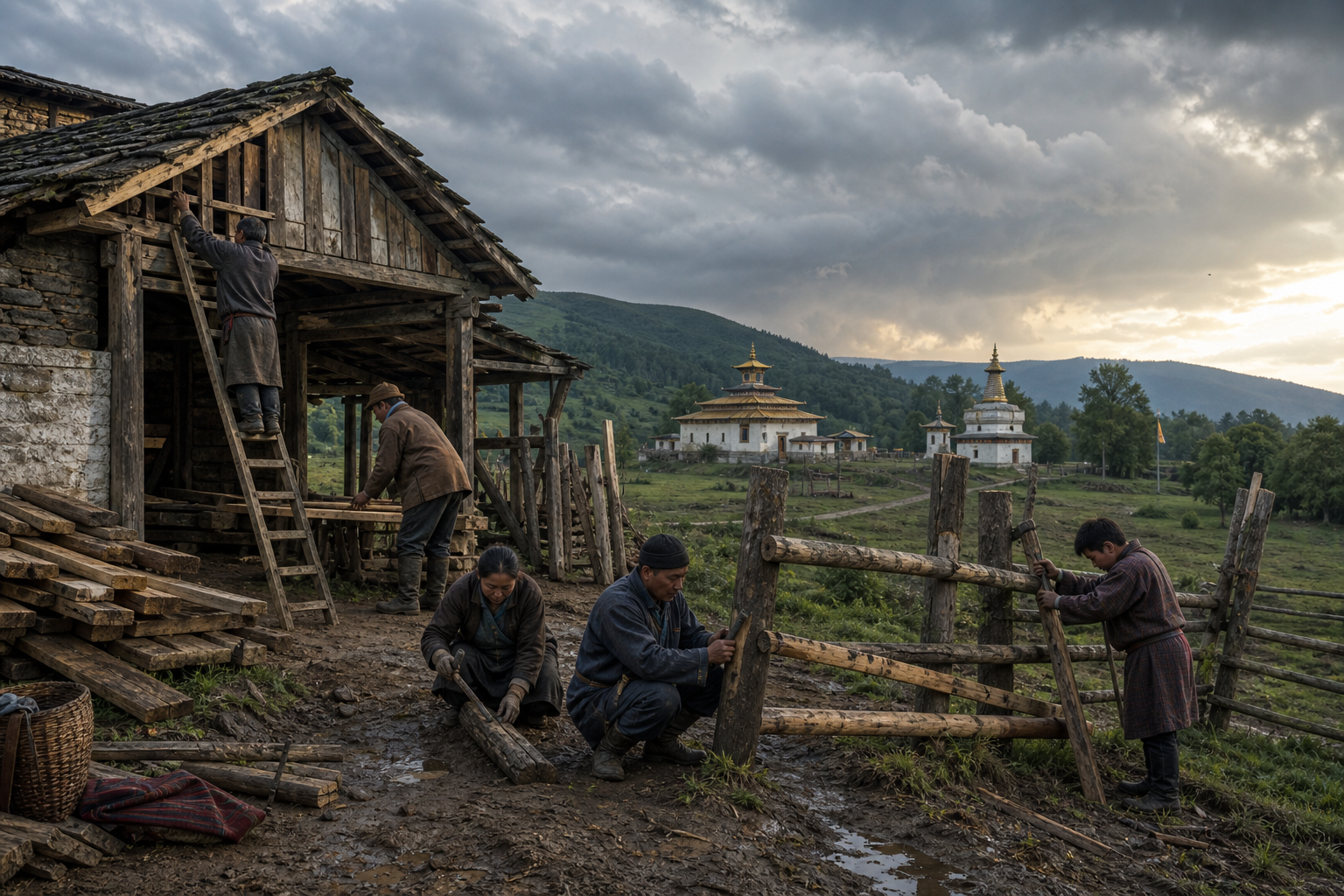
The early settlement’s austerity is essential to evaluating the experiment. The DharmaRenaissance article reports that the original property lacked electricity and running water, had difficult access, and included only a deteriorated building. Devotional aspirations therefore had to contend with cold, mud, transportation, sanitation, food production, limited resources, and physical exhaustion.
Those conditions expose an important distinction between an ideal and its implementation. Prabhupada’s rural vision, summarized in the account as “simple living and high thinking,” placed economic activity in the service of spiritual, ethical, and ecological ends. Agriculture was meant to reduce dependence on industrial arrangements; cow protection was meant to embody nonviolence and gratitude; and worship was meant to restrain consumption by orienting life toward service.
The source also acknowledges that this model was difficult to realize consistently. That qualification matters. A living community cannot be assessed solely by its stated theology or its most visible monuments. The more revealing questions concern how reliably its values shape labor, resource use, relationships, hospitality, and treatment of animals under ordinary pressure.
New Vrindaban’s continuing relevance will therefore depend on whether inherited devotional forms remain connected to competent stewardship and humane communal practice. If that connection is maintained, the settlement can remain a working inquiry into how Krishna-bhakti inhabits a place, rather than merely a place where bhakti is occasionally performed.