
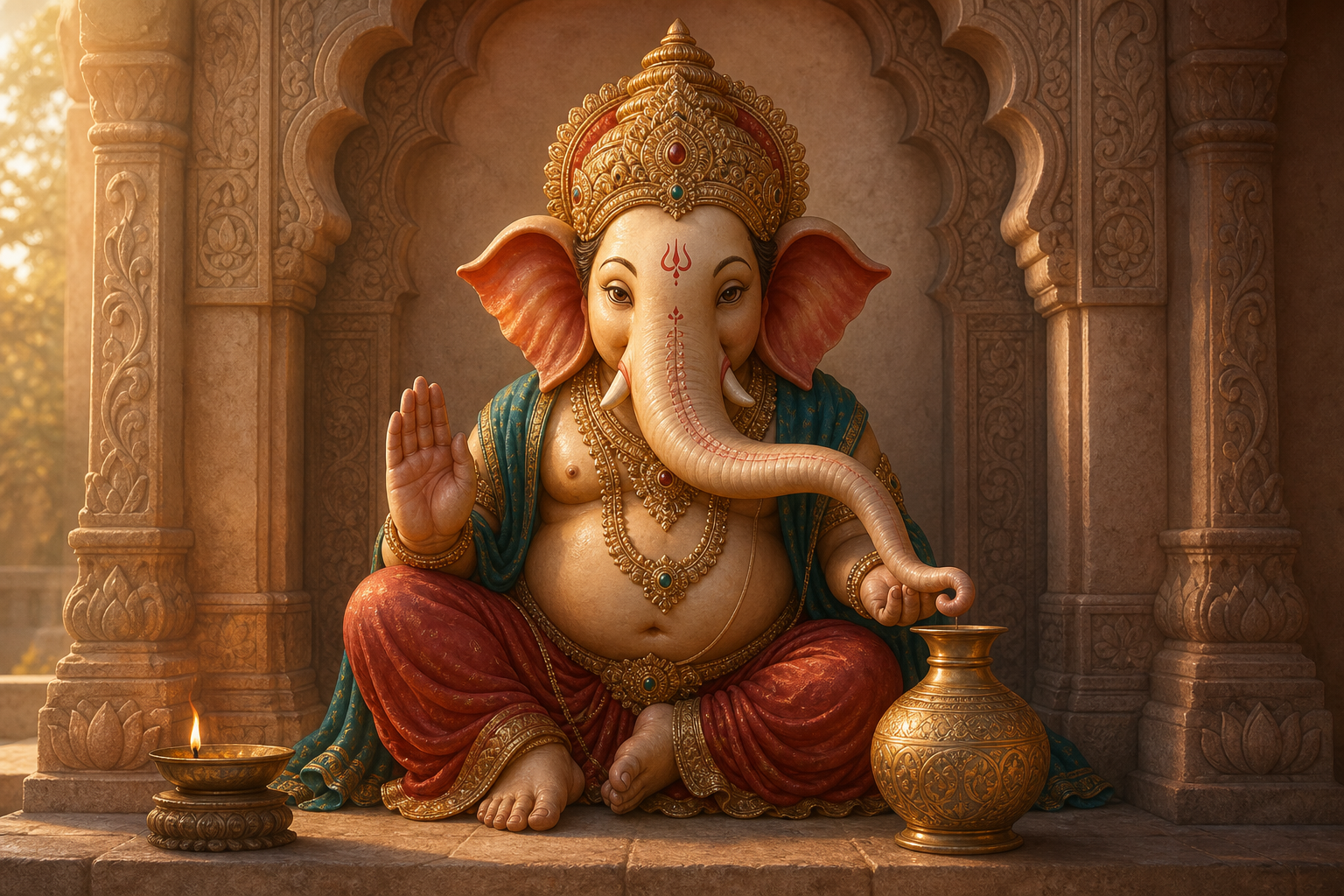
A vessel poised at the tip of Ganesha’s trunk can alter the meaning of the entire image. It brings together the ritual symbolism of the kalasha and the trunk’s distinctive combination of strength, precision, and controlled movement.
Reading this feature responsibly requires two kinds of attention: first identifying what the object actually is, and then interpreting it alongside Ganesha’s other attributes. The supplied DharmaRenaissance account provides both an iconographic vocabulary and a practical method for avoiding overly confident conclusions.
What the name reveals, and what it does not
The expression commonly written as sundagra patra, and more precisely transliterated as shundagra-patra, identifies a receptacle at the extremity of an elephant’s trunk. In that compound, shunda denotes the trunk, agra its point or extremity, and patra a vessel or receptacle. It is therefore primarily a positional description.
Kalasha, by contrast, identifies a more specific ritual and visual vessel type. This distinction prevents a technical label from being mistaken for the name of an independent mythic object. It also guards against assuming that every cup, bowl, or pot near Ganesha’s trunk must be a ceremonial kalasha.
The source also cautions against treating one spelling as universally authoritative. Sanskrit treatises, regional languages, inscriptions, workshop usage, museum catalogues, and living oral traditions can preserve parallel names and variant forms. Terminology assists identification, but the visible object must still support the proposed reading.
How to distinguish a kalasha from sweets, fruit, and other vessels
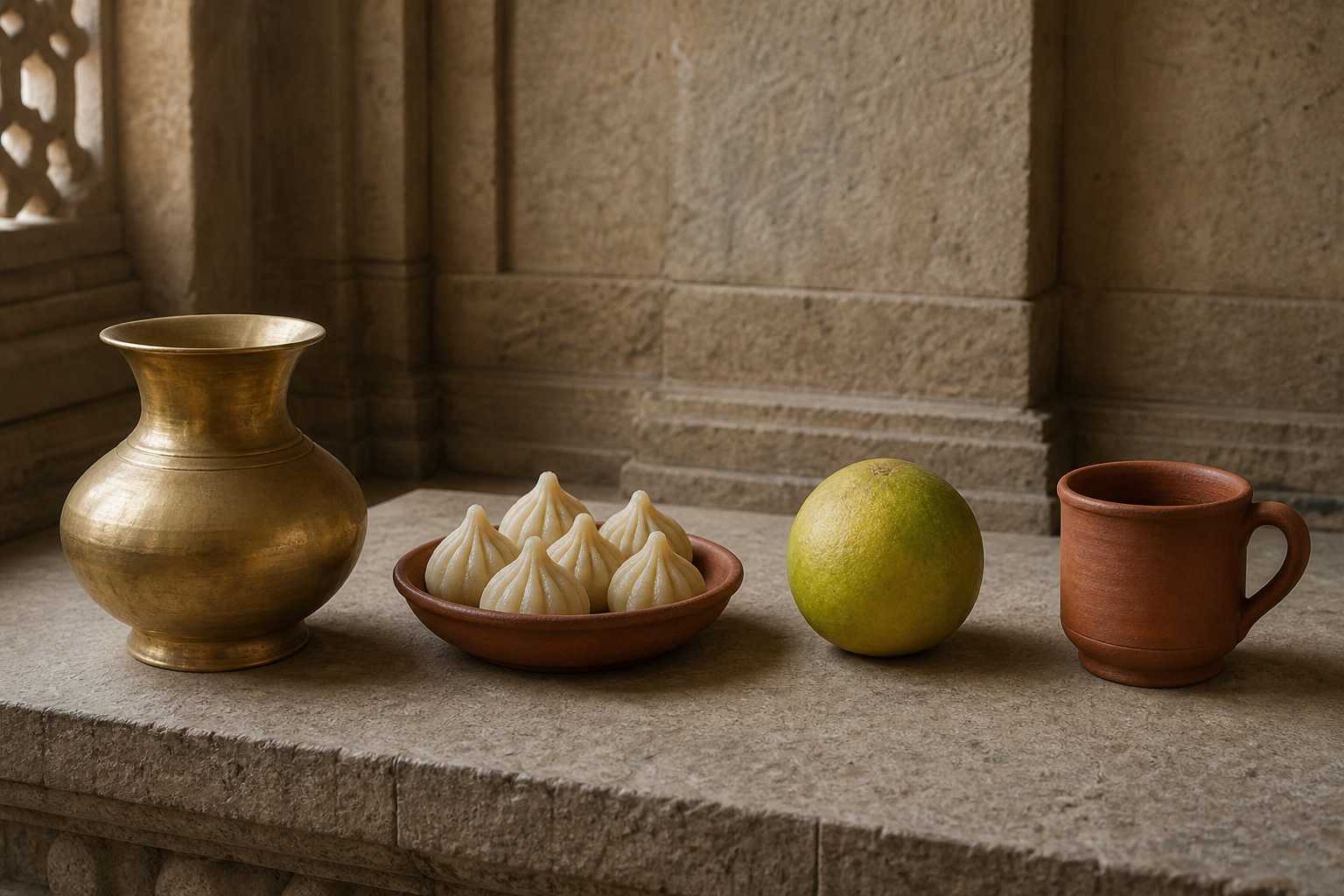
A kalasha is generally recognized by a swelling or globular body, a narrower neck, and a defined mouth or rim. A sculpted cluster of leaves, a pointed cap, or a coconut-like crown can strengthen identification as a full vessel, often described as a purna-kalasha or purna-kumbha. The trunk may curl around the neck, touch the rim, or support the vessel’s body.
Material conditions complicate the reading. Small scale can compress the vessel’s features, while age, wear, and breakage can remove the rim or crowning elements. Projecting parts in stone or metal are vulnerable, so sculptors may join the trunk and vessel to each other or to Ganesha’s torso for support. Structural attachment should not automatically be interpreted as a symbolic feature.
The closest visual alternatives require careful comparison. A modaka is usually a compact rounded or pointed sweet without a neck and rim. A fruit is likewise solid rather than architecturally shaped. A bowl of sweets is normally shallower and visibly open, whereas a kalasha tends to have greater depth and a distinct profile. A kamandalu may also contain water, but can differ through its handle, spout, or proportions.
No single contour settles every damaged or simplified example. Secure identification depends on several clues agreeing: outline, placement, the way the trunk touches the object, Ganesha’s other attributes, regional parallels, date, and ritual context. Where those clues remain incomplete, a cautious description such as “vessel at the trunk’s tip” is more defensible than a precise symbolic claim.
Why the trunk changes the vessel’s symbolic force
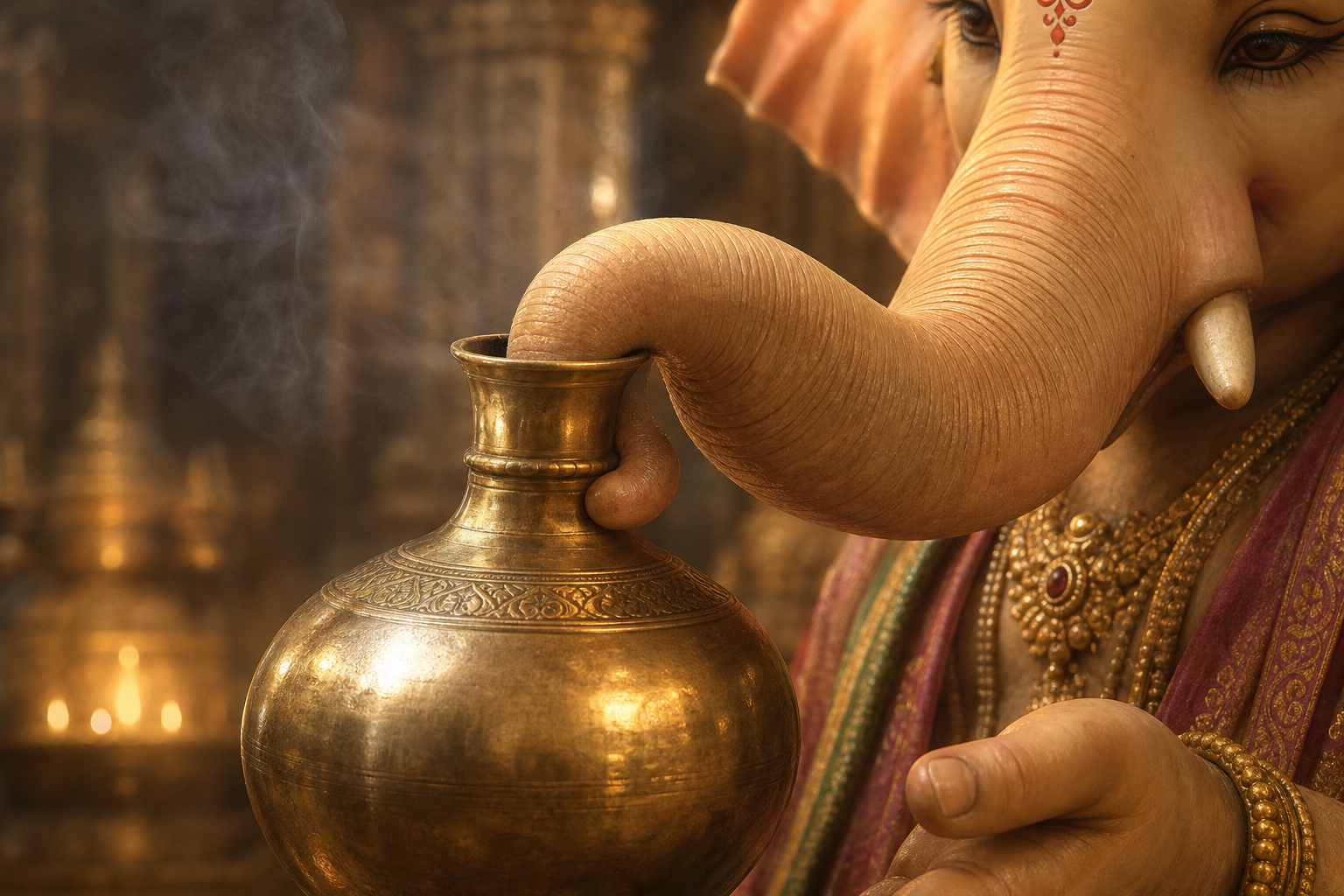
Ganesha’s trunk functions visually almost like an additional hand while remaining the defining feature of his elephant form. Its curve can connect the head to a lower attribute, direct the viewer’s gaze, and complete a compositional movement across the body. A vessel held there is consequently not an isolated accessory.
The source proposes an interpretive connection between the natural versatility of an elephant’s trunk and the theological character of Ganesha. The same organ can manage weight and perform delicate acts of grasping. In sacred imagery, that combination can suggest intelligent power: strength governed by discrimination, timing, and care. This is a persuasive reading rather than a mandatory doctrine for every image.
The kalasha intensifies that idea. Ganesha is associated with beginnings, transitions, learning, and the removal or placement of obstacles, while the full vessel signifies auspicious fullness and beneficial potential held in readiness. Their conjunction can therefore signify more than possession or material gain. It evokes the ability to receive, preserve, direct, and distribute what sustains life.
The surrounding attributes refine this interpretation. The noose can suggest restraint or the gathering of what has strayed; the goad can convey guidance and directed force; the broken tusk carries associations including sacrifice, resolve, authorship, or victory in different narrative settings; and sweets or fruits express nourishment and fulfillment. The kalasha belongs to this larger visual grammar rather than replacing it.
One vessel across ritual, sculpture, and temple architecture
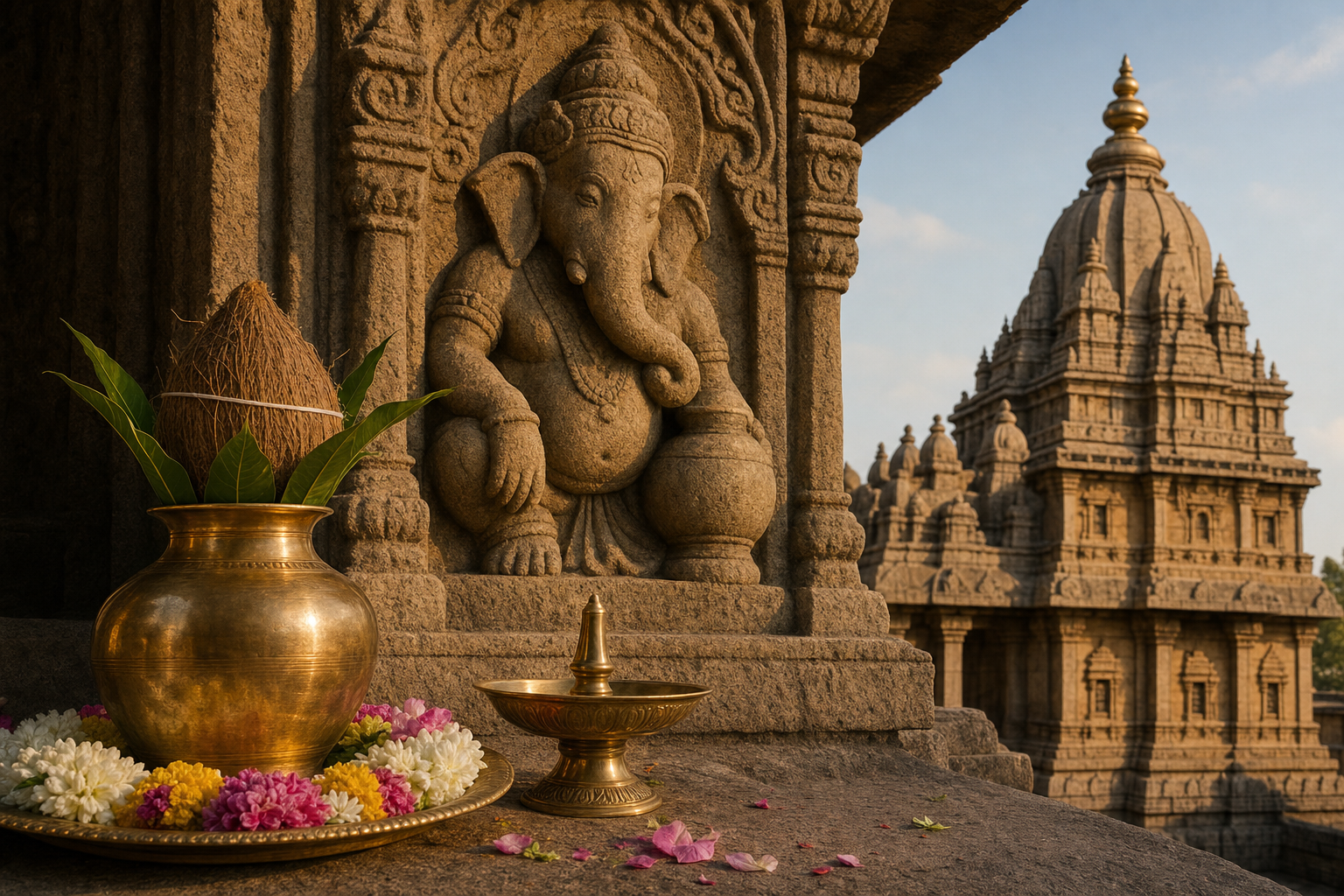
The force of the sculpted kalasha depends partly on its life beyond sculpture. In Hindu ritual settings, a material pot may be filled with sanctified water and furnished with leaves, coconut, flowers, grains, thread, cloth, or other auspicious materials according to the rite and region. It may serve as a temporary seat of invoked divine presence, a sign of welcome, or a reservoir from which consecrated water is poured.
Its meaning is produced through more than shape. Contents, mantra, placement, and ritual action help transform an ordinary container into a prepared sacred vessel. The word purna, meaning full or complete, consequently refers to more than physical volume. In the account supplied, fullness encompasses fertility, nourishment, prosperity, continuity, and the possibility of growth. Vegetation emerging from the pot makes that progression visible: contained water supports manifest life.
The same vessel form also appears on a larger architectural scale. Pot-shaped finials crown temple superstructures, while full-vessel motifs can ornament bases, thresholds, pillars, and decorative bands. The source further connects crowning finials with kumbhabhisheka, during which sanctified water is poured over them. A kalasha at Ganesha’s trunk thus participates in a wider continuum linking a handheld ritual object, a divine attribute, and the auspicious crowning of sacred architecture.
Key takeaways
- Sundagra patra describes a vessel at the trunk’s tip; kalasha names a more specific pot form.
- A rounded body, constricted neck, visible rim, and possible vegetal or coconut-like crown support identification as a kalasha.
- Modakas, fruits, sweet bowls, and other water vessels should be excluded through comparison rather than assumption.
- The trunk lends the vessel a theme of controlled power, joining physical strength with precision and discernment.
- Ritual use and architectural placement explain why the full vessel can signify prepared abundance, sacred presence, continuity, and life-giving potential.
Future documentation of individual sculptures can deepen this reading by recording the vessel’s profile, condition, regional setting, companion attributes, and ritual environment. Such close observation allows a small iconographic detail to remain both symbolically meaningful and materially precise.