
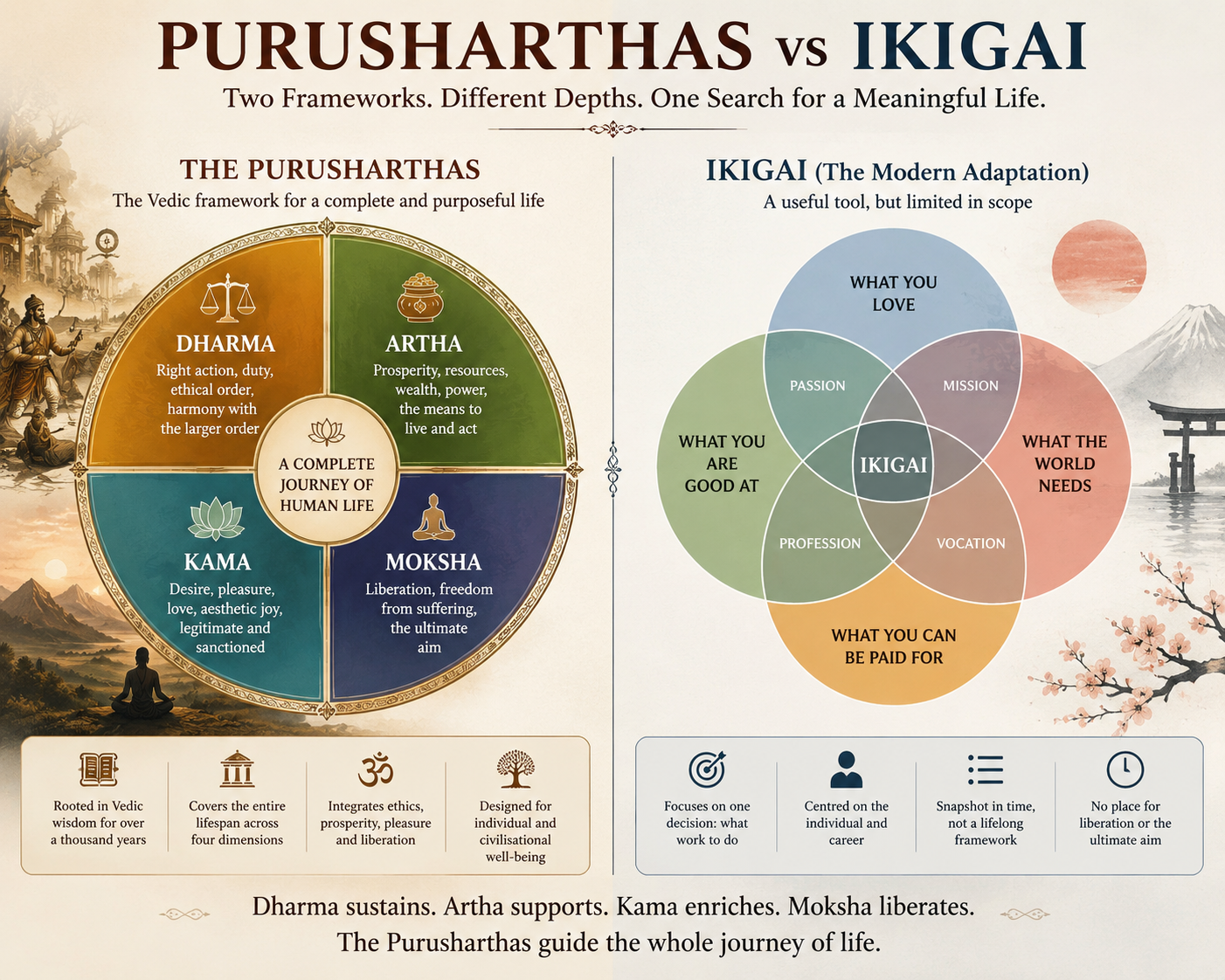
A successful professional can possess an impressive title, financial security, valued skills, and social recognition while still sensing that something essential is missing. Contemporary purpose culture often answers that discomfort with a familiar image: four overlapping circles representing what a person loves, does well, can be paid for, and believes the world needs. The intersection is labelled Ikigai, and the resulting diagram promises to turn an existential problem into a manageable exercise.
The appeal is understandable. A compact visual offers clarity in a culture of fractured attention, unstable careers, and relentless self-optimization. It can help someone compare talent, enjoyment, social contribution, and economic viability. Yet its simplicity also conceals an important historical distinction: the four-circle model is not a traditional Japanese account of Ikigai, and it is not equivalent to the classical Hindu framework of the four Purusharthas—Dharma, Artha, Kama, and Moksha.
Three different ideas therefore require separation. Japanese ikigai concerns the sources and felt experience of a life worth living. The popular Western diagram is primarily a model of vocational alignment. The Purusharthas constitute a much broader normative and philosophical architecture concerned with ethical conduct, material capacity, pleasure, and liberation. Treating these ideas as interchangeable diminishes all three.
This distinction need not become a contest between Japanese and Indian civilization. Traditional ikigai possesses a humane subtlety that the exported diagram frequently loses. The Purusharthas address questions that the Japanese concept was never designed to organize. A fair comparison respects the cultural integrity of Ikigai while recovering the extraordinary range of the Purushartha framework.
The existential problem hidden inside a career question
Questions about purpose rarely arise from work alone. They can emerge after bereavement, retirement, illness, migration, parenthood, moral injury, or the achievement of a long-desired goal that proves emotionally insufficient. A person may ask what work to pursue when the deeper concern involves mortality, belonging, responsibility, or freedom from compulsive striving. A framework that interprets every crisis as a career-design problem can therefore misdiagnose the nature of the distress.
The modern labor market intensifies this confusion by encouraging personal identity to merge with occupation. Work is expected to provide income, status, community, creativity, moral significance, psychological fulfilment, and a coherent life story. Few institutions can bear that burden. When employment fails to supply every form of meaning, individuals may blame themselves for not locating the perfect intersection rather than questioning an unrealistic cultural expectation.
The Purusharthas begin from a different premise. Human life contains several legitimate aims that cannot be compressed into a single vocation. Ethical responsibility is not identical to earning. Pleasure is not merely a sign of professional fit. Material security is not spiritual liberation. The central task is not to force all value into one occupational sweet spot but to understand how distinct aims can support, limit, and sometimes challenge one another.
Ikigai before the four-circle infographic
The Japanese word ikigai is often glossed as a reason for living, that which makes life worthwhile, or a source of meaning in life. No single English expression captures its complete range. A Japanese gerontological study led by Akihiro Hasegawa notes that specialists use related translations such as meaning in life, purpose in life, self-actualization, and reasons for living. The study operationalized ikigai as both the feeling of being alive in the present and an individual motivation for living. This definitional breadth is important because it resists reduction to one career formula. The research is available through J-STAGE.
Japanese discussions also distinguish a source of ikigai from ikigai-kan, the felt sense that life has value or meaning. A grandchild, a garden, a craft, religious practice, friendship, public service, artistic creation, or ordinary participation in community life can become a source. Its significance does not depend upon market demand, professional distinction, or payment. Some sources are enduring; others change as health, relationships, and social roles change.
Psychiatrist Mieko Kamiya gave the subject sustained attention in her 1966 work on ikigai. Her reflections were shaped partly by encounters with people living under severe conditions, including patients affected by leprosy. Recent scholarship emphasizes that Kamiya treated meaning as a fundamental human concern rather than an exotic secret unique to Japan. That interpretation complicates both romantic accounts of Ikigai and attempts to package it as a culturally exclusive productivity method. A 2025 scholarly reassessment appears in the Japanese Journal for the Psychology of Religion and Spirituality.
Traditional ikigai can therefore be modest without being trivial. Preparing food for a family, caring for a neighborhood shrine, meeting friends, tending plants, or improving a practiced skill may provide a recurring experience of value. Such activities do not need to represent a singular cosmic mission. Their power often lies in continuity, relationship, and attentive participation.
Research has associated a reported sense of ikigai with several measures of health and social well-being among Japanese adults. Longitudinal and cohort studies have examined mortality, functional health, psychological distress, social participation, and prosocial behavior. These findings deserve careful interpretation. They identify associations rather than proving that ikigai by itself causes longevity. Health, mobility, family structure, economic conditions, and social roles can influence both a person’s sense of meaning and subsequent outcomes. The evidence supports the importance of purpose, but it does not justify a monocausal claim that one cultural concept explains Japanese or Okinawan longevity. Relevant studies include the Japan Collaborative Cohort Study and a national longitudinal analysis of older Japanese adults.
How the Western Ikigai diagram emerged
The widely circulated diagram has a traceable modern genealogy. Andrés Zuzunaga developed a four-part purpose diagram that appeared in a Spanish publication in 2012. It addressed passions, talents, social contribution, and livelihood. Marc Winn later associated a version of that diagram with the word ikigai in 2014. An interview with Zuzunaga confirms that his original model was not created as an exposition of Japanese philosophy and that he did not possess detailed knowledge of ikigai when designing it. The history is documented in the interview on the diagram’s development.
The diagram is not useless simply because it is modern. It asks four practical questions that can improve career reflection. Work based only on enthusiasm may be financially fragile. Work based only on competence may feel empty. Work based only on payment may produce alienation. Work based only on perceived social need may become unsustainable if the individual lacks ability, support, or genuine commitment. Considering all four variables can expose imbalances.
The error begins when this vocational heuristic is presented as the authentic and exhaustive meaning of Ikigai. Its payment circle makes economic viability appear constitutive of a worthwhile life. That assumption marginalizes unpaid caregiving, friendship, contemplation, household labor, volunteer service, artistic practice, and the everyday sources of meaning frequently included in Japanese usage. It can also imply that a person whose job is merely necessary has failed to discover a proper life purpose.
For conceptual clarity, the diagram is best described as the popular Western Ikigai model or, more precisely, a purpose-and-career Venn diagram. Traditional Japanese ikigai should remain available for the broader and more personal experience it names.
The Purusharthas: a framework formed through long intellectual development
Puruṣārtha combines terms commonly understood as person or human being and aim, object, or purpose. In classical Hindu thought, it names the legitimate aims of human pursuit. The familiar four are Dharma, Artha, Kama, and Moksha. They are not four personality traits, four job criteria, or four identical circles. They identify distinguishable domains of human concern and place them within ethical, social, and soteriological reflection.
Historical precision strengthens rather than weakens the framework. The complete system did not appear as a finished chart in a single Vedic passage. Ideas related to duty, prosperity, desire, knowledge, and release developed across Vedic literature, the Upanishads, the epics, Dharma literature, political thought, philosophical schools, and specialized śāstras. Early formulations often emphasized the trivarga—Dharma, Artha, and Kama—while Moksha gained recognition as a fourth and transcendent aim through a gradual process. The history of that acceptance is discussed in the Oxford study Classical Hindu Thought: An Introduction.
The Mahabharata examines tensions among ethical obligation, power, desire, renunciation, and liberation rather than offering a simplistic hierarchy. Dharmaśāstra literature analyzes norms, institutions, duties, inheritance, household life, and governance. The Kamasutra (Kāmasūtra) treats Kama within the larger trivarga. The Arthaśāstra tradition takes material gain, administration, law, diplomacy, political order, and state capacity seriously. Upanishadic and later philosophical traditions investigate knowledge, selfhood, bondage, and release.
Dates and authorship must also be handled responsibly. The extant Kauṭilīya Arthaśāstra is traditionally linked with Kautilya or Chanakya, but modern textual scholarship debates its layers, composition, and redaction. It should not be assigned casually to one year or treated as the unaltered product of a single historical moment. Its significance remains considerable: it preserves a highly developed discourse about the material and institutional conditions of collective life. Oxford’s overview of Artha and Arthaśāstra explains the breadth of the term artha and the associated science of statecraft.
The antiquity of the Purusharthas is relevant, but age alone does not prove philosophical superiority. Their enduring importance lies in analytical scope. The framework acknowledges that human beings seek security and pleasure, inhabit relationships and institutions, face ethical constraints, and may pursue freedom beyond conditioned satisfaction. It refuses both material reductionism and a spirituality that denies ordinary life.
Dharma: the ordering and ethical dimension of life
Dharma is difficult to translate because its meanings vary by text, context, and philosophical tradition. It can refer to ethical conduct, duty, law, teaching, virtue, social responsibility, sustaining order, or the characteristic nature of something. Reducing Dharma to “what the world needs” removes precisely the dimensions that make it philosophically demanding.
Within the Purushartha framework, Dharma gives moral form to the pursuit of Artha and Kama. Wealth acquired through deception, coercion, ecological destruction, or exploitation cannot be justified merely because it creates prosperity. Desire that destroys health, dignity, trust, or another being’s freedom cannot be defended merely because it produces pleasure. Dharma asks whether conduct sustains rather than corrodes the conditions of shared life.
Dharma also exceeds private morality. It concerns the quality of institutions, the responsibilities attached to power, the treatment of vulnerable beings, intergenerational obligations, and the maintenance of social and ecological order. A corporate decision, public policy, family obligation, or use of technology can therefore become a Dharmic question even when no immediate personal benefit is involved.
Yet Dharma should not be interpreted as blind obedience to inherited roles. Historical societies have contained unequal practices, and appeals to duty can be used to silence conscience. Responsible interpretation requires attention to truthfulness, non-harm, justice, compassion, reciprocity, context, and the welfare of affected beings. The framework becomes ethically valuable when Dharma disciplines power, including the power of custom, rather than merely sanctifying whatever already exists.
For a modern professional, Dharma might concern honesty in research, fairness in hiring, protection of user privacy, environmental responsibility, or care for family members. For a citizen, it may involve public reason, service, and resistance to corruption. For a community, it includes preserving knowledge while allowing principled reform. Dharma converts purpose from a question of personal preference into a question of accountable participation.
Artha: the material means that make responsible action possible
Artha includes wealth but is not exhausted by salary. Its semantic range includes aim, object, means, advantage, material gain, and practical purpose. Within the Purusharthas, it encompasses the resources and capacities required to function in the world: food, shelter, health, education, tools, property, savings, institutional stability, political power, and administrative competence.
This recognition prevents spirituality from romanticizing deprivation. Financial insecurity can restrict freedom, damage health, intensify conflict, and make sustained ethical or contemplative practice more difficult. Households require resources. Educational and charitable institutions require sound administration. A state unable to maintain law, infrastructure, or economic stability cannot protect the conditions under which citizens pursue other aims.
Artha nevertheless remains morally ambiguous. The capacity to produce, organize, govern, and accumulate can serve welfare or domination. Dharma must therefore guide the methods and purposes of acquisition, while Artha gives Dharma practical force. Ethical intention without material capacity can remain ineffective; material capacity without ethical direction can become predatory.
A contemporary Artha assessment asks more than whether work pays well. It considers debt, savings, resilience, employable knowledge, health, ownership, time, and dependence upon fragile institutions. It also asks what social and ecological costs support an income. Such questions make Artha more rigorous than the diagram’s circle labelled “what you can be paid for.”
Kama: desire, relationship, beauty, and embodied joy
Kama includes sensory pleasure, affection, love, aesthetic enjoyment, emotional fulfilment, intimacy, play, and the movement of desire toward valued experience. It should not be reduced either to sexual technique or to the career question “what do you love?” A person can love music, food, landscape, poetry, companionship, ritual, craftsmanship, conversation, and countless forms of embodied or imaginative life.
The recognition of Kama as a legitimate aim challenges both puritanism and spiritual bypassing. Human beings are not treated as disembodied economic agents or as failed renunciants. Pleasure, attraction, and beauty belong to a full life. The Kamasutra is relevant here because it situates Kama within a wider field of cultured life and within the trivarga rather than isolating sexuality from ethics and material circumstances.
Legitimacy, however, is not limitlessness. Classical reflection repeatedly considers how the three worldly aims affect one another. Scholarship on the Kāmasūtra notes its insistence that Dharma, Artha, and Kama remain interconnected and that one aim should not damage the others. That structural principle is summarized in a Cambridge-hosted study of Vātsyāyana’s treatment of the trivarga.
The distinction is especially important in an attention economy. Digital platforms can convert desire into a continuously measurable commodity. Pleasure becomes compulsive scrolling, comparison, consumption, or validation seeking. A Purushartha analysis does not condemn enjoyment; it asks whether a desire enlarges life, damages another aim, or gradually turns agency into dependence.
Moksha: the horizon that career frameworks cannot contain
Moksha means liberation or release, but Hindu traditions explain bondage and freedom in different ways. Advaita Vedanta emphasizes liberating knowledge of non-duality. Other Vedantic traditions articulate liberation through distinct relationships among the self, the Divine, knowledge, devotion, and grace. Yoga traditions analyze the cessation of mental affliction and disentanglement of consciousness from misidentification. The term therefore names a shared soteriological horizon without erasing philosophical diversity.
Moksha is not another form of success, emotional comfort, or permanent positive feeling. It questions the ignorance, attachment, misidentification, and karmic conditioning through which suffering is reproduced. Whereas a career model asks how a person can find satisfying work, Moksha asks who or what is seeking satisfaction, why conditioned achievements fail to provide final freedom, and whether the structure of craving itself can be understood and transformed.
This horizon does not necessarily require contempt for worldly life. Hindu traditions contain renunciant paths, householder paths, paths of action, paths of devotion, paths of knowledge, and combinations among them. The Bhagavad Gita, for example, places spiritual realization within a profound argument about action, duty, knowledge, devotion, and non-attachment. Liberation can alter the manner of participation rather than merely demanding physical withdrawal.
Moksha also gives the framework resources for confronting grief, aging, failure, and death. Professional identity may collapse at retirement. Wealth may disappear. Pleasure changes with health. Social roles end. A philosophy concerned only with optimal work has little to say when these supports dissolve. A liberation tradition deliberately investigates impermanence, fear, suffering, selfhood, and what—if anything—remains fundamentally free.
The absence of a single canonical book titled “Moksha Shastra” does not indicate an absence of systematic thought. The Upanishads, Bhagavad Gita, Brahma Sutras, Yoga literature, the Mokshadharma section of the Mahabharata, Vedantic commentaries, devotional works, and many other traditions contain extensive accounts of liberation. Historical scholarship also cautions that early Upanishadic ideas developed over time and should not be forced into one later doctrinal formula. The Internet Encyclopedia of Philosophy’s study of the Upanishads provides a useful academic overview of this development.
Why the Purusharthas form an architecture rather than a checklist
The four aims are often presented as a static list, but their real sophistication lies in their relationships. Dharma constrains and directs Artha and Kama. Artha supplies the material conditions through which responsibilities can be fulfilled and healthy pleasures sustained. Kama gives warmth, affection, beauty, and motivation to a life that might otherwise become merely dutiful. Moksha prevents every finite achievement from being mistaken for final freedom.
The relationship is not a simple ladder on which every person completes one aim before beginning the next. A student needs material support, ethical discipline, friendship, and some awareness of deeper values. A householder may pursue livelihood, intimacy, service, and contemplative practice simultaneously. A renunciant still requires ethical conduct and basic material conditions even when wealth and pleasure no longer occupy the same place.
The Purusharthas are frequently associated with the āśrama system of life stages—student, householder, forest-dweller, and renunciant—but the relationship should not be converted into a rigid four-by-four chart. Texts and traditions differ, historical practice was varied, and human lives rarely unfold according to an ideal sequence. The useful insight is developmental: priorities can change as responsibilities, capacities, and insight change.
Conflict among the aims is expected rather than denied. A lucrative opportunity may violate Dharma. A demanding duty may damage health or intimacy. A cherished pleasure may undermine long-term Artha. A premature claim to detachment may conceal fear, irresponsibility, or economic dependence upon others. The framework does not mechanically solve these conflicts; it makes them visible and supplies a disciplined vocabulary for judgment.
That feature distinguishes a philosophical architecture from a motivational slogan. A slogan promises a central answer. An architecture reveals load-bearing relationships, constraints, trade-offs, and horizons. The Purusharthas do not guarantee an effortless life. They clarify why a meaningful life requires more than the maximization of one preferred variable.
Ikigai and the Purusharthas: a structural comparison
Different objects of analysis: Traditional ikigai identifies sources and experiences that make life feel worth living. The Western diagram assesses alignment among enjoyment, skill, social usefulness, and payment. The Purusharthas classify broad aims of human pursuit and place worldly life within an ethical and liberative horizon.
Different units of value: Ikigai can be personal and ordinary. A small ritual or relationship may be sufficient. The diagram privileges an integrated role, usually professional. The Purusharthas examine persons, households, institutions, political orders, and spiritual paths.
Different treatment of economics: Traditional ikigai does not require monetization. The diagram includes payment as one of four defining circles. The Purusharthas grant material security an independent legitimacy through Artha but subject its acquisition and use to Dharma.
Different ethical depth: The diagram’s phrase “what the world needs” can encourage service, but it does not provide a developed account of truth, non-harm, justice, obligation, legitimate power, or competing duties. Dharma opens that field of inquiry, even though its interpretation remains contested and context-sensitive.
Different time horizons: A purpose diagram often evaluates a present career decision. Ikigai can evolve through daily life and changing relationships. The Purusharthas address changing priorities across an entire life, including prosperity, family, pleasure, ethical conflict, aging, renunciation, and death.
Different ultimate horizons: Neither traditional ikigai nor the four-circle diagram contains an exact equivalent of Moksha. That absence is not a defect in Japanese culture; it indicates that the concepts answer different questions. The mistake lies in treating a framework without a doctrine of liberation as a complete substitute for one organized partly around liberation.
Why the familiar one-to-one mapping fails
A common comparison equates Kama with “what a person loves,” Artha with “what a person can be paid for,” and Dharma with “what the world needs.” The resemblance makes the mapping memorable, but each equation removes substantial content.
Kama includes love and enjoyment, yet it extends far beyond vocational passion. Artha includes income, yet it also encompasses assets, security, practical capacity, governance, and the preservation of resources. Dharma includes responsiveness to genuine need, yet it also concerns the moral quality of actions, relationships, institutions, and obligations. “What a person is good at” has no single Purushartha equivalent; competence can contribute to Artha, support Dharma, enrich Kama, or become part of a spiritual discipline depending on its use.
Moksha remains unmatched. Adding it as a fifth circle would not solve the problem because liberation is not merely another preference competing for space beside salary and talent. It changes the interpretation of all finite pursuits. Wealth, pleasure, status, and even moral identity are no longer asked to provide an ultimate fulfilment they cannot securely deliver.
The mapping is therefore useful only as an introductory analogy. It can help a reader recognize that Hindu thought did not reject desire or material life. It cannot establish conceptual equivalence. A career dashboard and a philosophy of human ends may contain similar words while operating at different levels.
A more productive synthesis gives each framework its proper task. The career diagram can test vocational fit. Japanese ikigai can help identify ordinary sources of vitality and meaning. The Purusharthas can examine whether the whole pattern of life is ethical, materially viable, emotionally alive, and oriented toward genuine freedom.
A respectful Dharmic conversation about liberation
The Purushartha framework belongs specifically to Hindu intellectual history, but its deepest questions participate in a wider Dharmic conversation. Hinduism, Buddhism, Jainism, and Sikhism should not be collapsed into one doctrine. They disagree about selfhood, metaphysics, divine reality, karma, authoritative texts, and the precise character of liberation. Unity becomes intellectually credible only when those differences are respected.
Buddhist traditions analyze suffering, craving, impermanence, ethical conduct, and nirvāṇa without simply reproducing Hindu accounts of Atman or Brahman. Early Buddhist texts connect ethical training, knowledge, dispassion, liberation, and nirvāṇa in a distinctive causal and practical path. An accessible primary-text example is the discourse on nirvāṇa preserved by SuttaCentral.
Jain philosophy articulates mokṣa through the liberation of the jīva from karmic bondage and gives exceptional importance to ahiṃsā, self-discipline, right knowledge, and careful conduct. Its account of karma and self differs from both Buddhist and Hindu systems even where the vocabulary overlaps. The Stanford Encyclopedia of Philosophy’s account of Jaina philosophy explains the close relation between non-violence, knowledge, conduct, and liberation.
Sikh tradition speaks of mukti and jīvan-mukti within a life of devotion, remembrance, truthful conduct, humility, grace, and service rather than requiring a withdrawal from social responsibility. The language of being liberated while alive appears in the Sri Guru Granth Sahib. These traditions do not become interchangeable, but together they demonstrate that Dharmic civilization preserved sustained inquiry into ethical action, attachment, suffering, self-transformation, and freedom.
Such comparison promotes unity without appropriation. It allows each tradition to contribute its own grammar of liberation and responsibility while resisting the commercial pressure to reduce all spiritual ideas to interchangeable wellness techniques.
Why modern culture favors the smaller model
The popularity of the four-circle diagram does not prove intellectual decline. It reveals an environment optimized for compression. A diagram can circulate through presentations, coaching sessions, social media posts, and corporate workshops within seconds. A śāstra tradition requires language, commentary, historical context, disciplined study, and sustained conversation. The distribution advantage belongs to the image even when the deeper analytical advantage belongs to the texts.
Modern attention is also economically contested. Notifications, advertising systems, algorithmic feeds, and performance metrics reward rapid recognition rather than contemplative depth. Philosophical traditions are consequently reformatted into portable quotations, productivity techniques, and branded habits. Stoicism, Zen, Yoga, mindfulness, Ikigai, and Vedanta have all been subjected to this process. The problem is not cross-cultural learning; it is decontextualization followed by commercial certainty.
The weakened public visibility of Indian knowledge traditions has additional historical causes. Colonial education and knowledge classification altered institutions, languages of prestige, and assumptions about what counted as universal or rational. Indian reformers, translators, monastics, and scholars also actively reinterpreted inherited traditions rather than merely abandoning them. Postcolonial curricula, urbanization, linguistic change, caste and sectarian debates, and the demands of modern employment further transformed access. No single narrative of civilizational forgetfulness can explain this complex history.
Imported concepts often become attractive because they arrive already translated into modern psychological vocabulary. Indigenous concepts may remain enclosed in technical Sanskrit, sectarian institutions, poorly edited translations, or politicized debate. A reader encountering Ikigai through an elegant graphic and the Purusharthas through a dense or moralizing summary will naturally prefer the graphic. The remedy is not cultural resentment but better scholarship, translation, teaching, and application.
Japanese, Buddhist, Jain, Sikh, Greek, Chinese, and modern Western traditions need not be portrayed as competitors crowding an intellectual marketplace. Genuine comparative study can illuminate different dimensions of human flourishing. The necessary discipline is to learn each concept at its native scale before combining it with another.
A practical Purushartha audit for modern life
The Purusharthas become useful when they guide inquiry rather than decorate a poster. A careful audit can be applied to a career, household, institution, public policy, or technological system. Its purpose is not to generate a single numerical score but to reveal neglected aims, hidden costs, and false substitutions.
The Dharma inquiry
The Dharma inquiry asks which responsibilities are real, who is affected by a decision, and whether the means are truthful and non-exploitative. It examines duties to family, colleagues, community, future generations, non-human life, and the integrity of a profession. It also asks whether an inherited obligation remains just or has become an excuse for avoidable harm.
Warning signs include success purchased through deception, institutional cultures that normalize humiliation, environmental costs displaced onto others, and moral language used to protect power from scrutiny. A healthy Dharma orientation creates accountability rather than self-righteousness.
The Artha inquiry
The Artha inquiry asks what resources make the life or project viable. It includes income, savings, debt, insurance, health, knowledge, tools, legal protection, networks, organizational capacity, and time. It distinguishes genuine security from status consumption and durable capacity from impressive but fragile appearances.
Warning signs include chronic financial precarity hidden beneath prestige, dependence upon exploitative income, neglect of health, and spiritual ideals used to avoid practical responsibility. Healthy Artha provides enough stability for generosity, ethical choice, learning, and resilience.
The Kama inquiry
The Kama inquiry asks whether life contains affection, beauty, rest, play, intimacy, friendship, creativity, and embodied joy. It distinguishes nourishing pleasure from compulsion and chosen desire from preferences manufactured by comparison or advertising.
Warning signs include pleasure that repeatedly damages trust, health, financial stability, or attention. Another warning is the opposite extreme: a life so dominated by duty and productivity that tenderness and delight appear morally suspicious. Healthy Kama renews rather than consumes the person and surrounding relationships.
The Moksha inquiry
The Moksha inquiry asks what forms of attachment, fear, ignorance, and identity produce bondage. It examines whether status, wealth, ideology, resentment, or even the image of being virtuous has become indispensable to the sense of self. It also asks which contemplative, devotional, philosophical, or ethical disciplines genuinely loosen that dependence.
Warning signs include using spirituality to avoid grief, responsibility, mental-health care, or material obligations. Another is turning liberation into a competitive identity. Healthy orientation toward Moksha tends to deepen clarity, humility, equanimity, compassion, and freedom from compulsive self-display.
The ikigai inquiry
After the fourfold audit, traditional ikigai contributes a valuable additional question: which concrete experiences make daily life feel worth inhabiting? The answer may be smaller than a mission statement. Morning prayer, a shared meal, tending a balcony garden, teaching a child, practicing music, walking with an elder, or completing careful work can provide continuity between abstract values and lived experience.
This daily inquiry protects the Purusharthas from becoming purely theoretical, while the Purusharthas protect purpose reflection from becoming merely pleasant or vocational. Together they connect ordinary vitality with ethical, material, relational, and liberative depth.
A case study: success without integration
Consider a technology executive who enjoys solving complex problems, performs the work well, earns a substantial salary, and develops products used by millions. The four-circle diagram may indicate strong alignment: love, competence, payment, and social demand all appear present. Persistent exhaustion and unease nevertheless remain.
The Dharma inquiry may reveal that the product increases compulsive engagement, extracts personal data without meaningful consent, or exposes vulnerable workers to unreasonable pressure. The discomfort is not evidence that the executive selected the wrong passion. It may be a morally intelligent response to misaligned consequences.
The Artha inquiry may show considerable income but little resilience because consumption, debt, and status obligations have expanded alongside earnings. It may also reveal that the executive’s material success depends entirely upon one institution, leaving little practical freedom to dissent.
The Kama inquiry may reveal that a loved occupation has displaced sleep, friendship, family intimacy, art, and unstructured pleasure. Enjoyment concentrated in achievement has gradually impoverished other forms of delight.
The Moksha inquiry may expose an identity organized around being indispensable, admired, and intellectually exceptional. Even ethically improved work would not by itself dissolve that dependency. Contemplative discipline, service without recognition, or serious philosophical study might address a level of bondage that career redesign cannot reach.
Traditional ikigai may then reintroduce small sources of meaning: preparing breakfast for a parent, practicing an instrument, mentoring without publicity, or walking without a device. None needs to become a new income stream. Their value lies partly in remaining outside professional optimization.
The integrated response might involve redesigning the product, setting ethical limits, reducing financial dependence, restoring relationships, and developing a liberative practice. It need not require an impulsive resignation or the discovery of one perfect occupation. The problem was never a missing circle; it was a life in which several legitimate aims had ceased to correct one another.
A framework for grief, aging, failure, and changing roles
One of the Purusharthas’ greatest advantages is their capacity to survive changing circumstances. A young adult may emphasize education and livelihood. A parent or caregiver may encounter Dharma through sustained responsibility. A person recovering from illness may need to rebuild Artha as bodily and practical capacity. Someone emerging from emotional numbness may need to reclaim healthy Kama.
Later life can transform rather than terminate purpose. Retirement may reduce occupational Artha while expanding service, study, devotion, family presence, and contemplation. Traditional ikigai can remain grounded in daily practices even when professional identity disappears. Moksha places the loss of role within a larger inquiry into identity and impermanence.
Grief exposes the limits of optimization most sharply. No Venn diagram can make bereavement efficient. Dharma may express itself as care for the living and fidelity to the dead. Artha may involve the practical work of sustaining a household. Kama may survive as love, memory, music, or shared ritual. Moksha traditions can provide disciplined reflection on attachment, mortality, and the nature of the self without requiring grief to be suppressed.
Failure can likewise be interpreted without reducing a person to professional outcome. A failed enterprise may damage Artha but clarify Dharma. A lost role may reveal neglected relationships. An unwanted transition may expose how thoroughly identity depended upon recognition. The framework does not make suffering desirable; it prevents one loss from becoming a total verdict on the worth of a life.
The Purusharthas in the twenty-first century
Recovering the Purusharthas does not mean treating ancient texts as ready-made policy manuals. Contemporary conditions require interpretation. Artificial intelligence, climate change, biotechnology, mass surveillance, platform economies, and planetary supply chains create circumstances that classical thinkers did not encounter in their present form. The framework contributes durable questions rather than automatic technical answers.
Dharma asks how technological power should be governed, which harms are unacceptable, and what obligations exist toward displaced workers, future generations, and ecosystems. It challenges claims that innovation is self-justifying merely because markets reward it.
Artha asks who owns data, infrastructure, models, energy systems, and productive assets. It considers whether prosperity is resilient and broadly enabling or concentrated through dependency. It also recognizes that ethical transitions require capital, institutions, expertise, and competent administration.
Kama asks how desire is engineered. Recommendation systems, advertising platforms, immersive media, and status metrics can influence attention before reflective choice begins. A modern philosophy of pleasure must therefore examine not only what people desire but how environments manufacture and monetize those desires.
Moksha asks whether digital identity intensifies attachment to image, reaction, comparison, and ideological certainty. It also raises a question that productivity culture avoids: whether greater efficiency liberates anyone when the underlying structure of craving remains unchanged.
These applications show why the Purusharthas remain intellectually fertile. Their value is not nostalgia for an untouched past. It is their ability to organize ethical, economic, affective, and spiritual analysis without pretending that one domain can replace the others.
Important cautions against a new simplification
The Purusharthas should not become another four-part corporate graphic. Each term belongs to long and internally diverse traditions. Serious use requires texts, teachers, languages, historical scholarship, philosophical debate, and attention to lived communities. A mnemonic can begin inquiry but cannot substitute for it.
The framework is also not a clinical instrument. Depression, anxiety, trauma, burnout, and suicidal thinking can involve medical, psychological, social, and economic causes. Philosophical reflection may support care, but it should not be used to blame a suffering person for lacking purpose or to replace qualified professional help when such help is needed.
Dharma must remain open to ethical examination. Historical authority alone cannot settle every modern question, and inherited hierarchy should not be insulated from critique. Artha must not be confused with greed, Kama with indulgence, or Moksha with withdrawal from responsibility. Each distortion breaks the relationships that give the framework coherence.
Ikigai should likewise not be dismissed. Its traditional breadth offers an important correction to cultures that demand a monetized mission from every individual. Small, recurring sources of meaning can sustain a person through seasons in which grand purpose is unavailable or unnecessary.
The most defensible conclusion is therefore comparative rather than triumphalist. Popular Western Ikigai is a useful but limited career heuristic. Japanese ikigai is a richer account of lived meaning than the diagram suggests. The Purusharthas provide a more comprehensive architecture for evaluating the aims and ultimate horizon of a human life.
Beyond the sweet spot
A meaningful life cannot always be located at the center of four circles. At times, Dharma demands work that is difficult rather than enjoyable. Artha requires practical labor that is not a calling. Kama restores delight outside employment. Moksha questions the identity that insists every action must confirm a personal brand. Ikigai may quietly appear in a morning routine that no market recognizes.
The Purusharthas remain powerful because they neither shame ordinary human aims nor mistake them for final liberation. Wealth matters, but it is not the whole. Pleasure matters, but it requires discernment. Duty matters, but it must answer to ethical scrutiny. Liberation matters because every finite arrangement remains vulnerable to change.
Recovering this framework does not require rejecting modern psychology, Japanese wisdom, or cross-cultural exchange. It requires enough intellectual patience to resist false equivalence. Once Ikigai, the career diagram, and the Purusharthas are restored to their proper scales, each becomes more useful.
The result is not a single formula for purpose but a more mature set of questions: Is conduct ethical? Are material foundations sound? Is life capable of love and beauty? Does identity remain trapped by what it possesses and performs? Which daily experiences make existence feel worth living? A philosophy adequate to human life must be able to hold all of these questions at once.
Inspired by this post on Pragyata.
