
Place names are more than coordinates. They are compact public archives, repeated on railway tickets, school forms, postal addresses, maps and everyday journeys until a particular account of the past begins to feel natural. A person asking for Laxmi Chowk in Lahore or GB Road in Delhi may discover that popular memory has preserved a name discarded by the state decades earlier. This tension between administrative nomenclature and lived memory explains why disputes over renaming can evoke pride, grief, anger and belonging far beyond the apparent importance of a street sign. The United Nations Group of Experts on Geographical Names accordingly treats geographical names as elements of culture, heritage and identity, not merely technical labels.
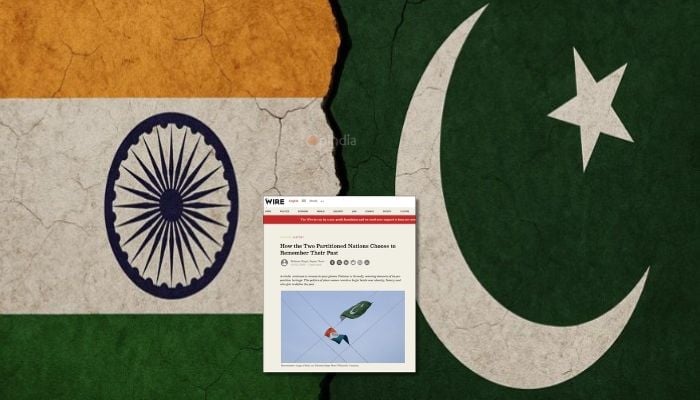
The immediate controversy arose from two sharply different interpretations of the same subject. On 4 July 2026, The Wire published “How the Two Partitioned Nations Choose to Remember Their Past”, comparing recent Indian renaming with Lahore’s proposed restoration of pre-Partition names. On 6 July, OpIndia challenged that comparison, arguing that the same process had been described as cultural redefinition in Bharat but as maturity in Pakistan. Evidence available through 15 July 2026 shows that the criticism identifies a significant asymmetry, although some of its rhetorical conclusions extend further than the documented facts permit.
Two textual distinctions are essential at the outset. The expression “Hindu majoritarianism” does not appear in The Wire article; it belongs to the critical interpretation placed upon the article by OpIndia’s headline. The description “maturity” does appear, but as the assessment of Delhi-based conservationist Sohail Hashmi rather than as an unattributed declaration by The Wire. Nevertheless, editorial framing is shaped not only by direct assertions but also by the examples selected, voices included, qualifications omitted and conclusions allowed to stand without challenge. Attribution therefore limits what can fairly be charged to a publication, but it does not eliminate responsibility for an unbalanced comparison.
The Wire’s central proposition is intuitively appealing: governments use maps, monuments and names to privilege particular memories, while residents often preserve older names through habit. The article acknowledges that Pakistan experienced extensive Islamisation of public space during the periods associated with Zulfikar Ali Bhutto and General Zia-ul-Haq. It then presents contemporary Lahore as moving in an opposite direction by recovering Hindu, Jain, Sikh and colonial-era names. India, by contrast, is described as replacing Islamic and colonial references with Hindu, indigenous or nationalist ones. This produces a moral arc in which Pakistan appears to be broadening its memory while India appears to be narrowing its own.
OpIndia’s strongest objection is not that Lahore’s older names lack value. Restoring Krishan Nagar, Jain Mandir Road, Ram Gali or other historically grounded names would be a welcome acknowledgement of communities whose presence shaped the city. The stronger objection concerns comparative method: implemented Indian decisions were placed beside an unsettled Pakistani proposal, Pakistan’s earlier erasures were acknowledged but not incorporated into the final evaluation, and broader evidence about heritage conservation and minority rights was excluded from the claim of national maturity. Those questions can be examined without the insulting labels, speculative motives or communal generalisations that weaken otherwise testable criticism.
The technical problem is one of critical toponymy. Toponymy is the study of place names, while critical toponymy examines who possesses the authority to name space and which political order that naming legitimises. Research on commemorative street names shows that renaming ordinarily performs two acts at once: it removes or reduces an earlier commemoration and installs another subject in the public landscape. The result may be decolonisation, democratic correction, partisan canonisation, recovery of an indigenous language, religious assertion or several of these processes simultaneously. No moral conclusion follows from the bare fact that a name changed; the old subject, new subject, procedure, historical setting and treatment of the displaced record must all be examined.
The stories of Laxmi Chowk and GB Road demonstrate a further distinction between official and vernacular toponymy. A government controls gazette notifications and signs, but residents control much of the spoken city. A name survives when it remains useful, emotionally resonant or embedded in commercial and family networks. The Wire is persuasive on this point. Yet popular survival does not by itself prove that an official restoration has occurred, that the governing ideology has changed or that the same openness extends to living minority communities. Collective memory can resist bureaucracy even while state policy remains unchanged.
A valid India–Pakistan comparison would therefore require matched units and matched time periods. A national programme should be compared with another national programme, or a municipal decision with another municipal decision. Completed changes should be compared with completed changes, not with proposals. Hindu, Jain or Sikh names should not be grouped indiscriminately with British imperial names, and architectural demolition should not be treated as identical to street renaming. Most importantly, the current flow of new decisions must be distinguished from the accumulated stock of names produced by earlier regimes. The Wire’s comparison does not consistently satisfy these conditions.
The status of the Lahore initiative is the decisive factual issue. A March 2026 meeting under the Lahore Heritage Areas Revival project approved, in principle, the recovery of original names for roads, streets and historic colleges alongside extensive urban restoration. The programme also contemplated museums, pedestrian routes and conservation work at Lahore Fort. However, Pakistani reporting on 31 May described the street changes as proposals still under discussion, noted scarce documentation for many lanes and stated that places such as Islampura might revert to Krishan Nagar. That language indicated research and consultation, not completed renaming.
More importantly, Dawn reported on 26 May 2026 that the Punjab government had deferred the plan amid opposition and that Lahore’s deputy commissioner said no final decision had been taken. A subsequent Pakistani fact-check found no formal notification, changed official signage or documentary proof that the proposed names had taken legal effect. These reports predated The Wire’s 4 July publication. Describing Pakistan as “formally restoring” its pre-Partition inheritance consequently overstated the policy’s legal and administrative status, even though the article sometimes used future-oriented language such as “set to revert.”
This is an outcome-status mismatch. India’s selected examples had already been notified, inaugurated or physically executed. Lahore’s proposal had been approved at one level, subjected to consultation, publicly contested and then deferred without final notification. The distinction matters because political courage is tested at implementation, especially after opposition arises. A proposal to recover minority-associated names is encouraging; a government’s retreat when those names become controversial reveals the limits of that encouragement. Treating aspiration as accomplished reform supplied Pakistan with credit for an outcome that had not occurred.
The comparison also contains a stock-flow problem. Lahore’s proposed restorations respond to decades in which Hindu-, Jain-, Sikh- and colonial-associated names were replaced by Islamic, Pakistani or post-Partition commemorations. Looking only at the attempted reversal captures a small positive flow while ignoring the much larger inherited stock created by earlier erasure. Conversely, beginning India’s timeline after 2014 isolates the latest flow without systematically examining colonial and post-Independence naming under previous governments. A balanced audit would record every relevant layer, the authority responsible, the date, the official rationale, popular usage and present legal status in both countries.
The Indian examples also require individual classification. Aurangzeb Road’s 2015 replacement by Dr A.P.J. Abdul Kalam Road cannot be described simply as an Islamic name being replaced by a Hindu one. The New Delhi Municipal Council resolution states that the purpose was to honour the recently deceased former president, scientist and educator. Dr Kalam was himself Muslim, and the proposal documented requests from elected representatives as well as an AAP trade-wing office-bearer. The decision certainly removed a Mughal imperial commemoration, but its replacement complicates any thesis based solely on religious substitution.
The Aurangzeb–Kalam change is better analysed as a conflict between two forms of Muslim representation: a medieval emperor whose legacy is deeply contested and a modern constitutional figure admired for science, public service and national integration. Supporters interpret the decision as replacing imperial power with civic achievement. Critics may still argue that deleting the road name reduces the visible complexity of Mughal history. Both positions are analytically possible, but neither justifies collapsing the case into a binary contest between Hindu and Muslim identity.
Mughalsarai Junction’s renaming as Pandit Deen Dayal Upadhyaya Junction belongs to a different category. Indian Railways records the renamed junction and division, while also noting the town’s varied historical names. Deen Dayal Upadhyaya was a major ideological figure in the political tradition from which the Bharatiya Janata Party emerged. This change is therefore more plausibly read as contemporary political commemoration than as the recovery of one uncontested ancient name. It provides genuine support for The Wire’s proposition that governments elevate figures useful to their present political narratives, although that observation alone does not establish illegitimacy.
Rajpath’s transformation into Kartavya Path is different again. The ceremonial avenue was originally Kingsway under British rule, became Rajpath after Independence and was renamed in 2022. The official explanation presented the change as a shift from an avenue symbolising imperial power to one emphasising public duty. That rationale may be debated as political symbolism, but the new name neither commemorates a Hindu deity nor substitutes one religious personality for another. It is a decolonial and civic-semantic intervention, with the concept of kartavya—duty—placed at the centre of the republic’s ceremonial landscape.
The Hall of Nations introduces yet another category. Its 2017 demolition was a serious controversy over modern architectural heritage, not a place-name change. Conservationists regarded the reinforced-concrete structure as a landmark of post-Independence design, while the government treated Pragati Maidan’s facilities as outdated and approved a new exhibition and convention complex. Bharat Mandapam was inaugurated in 2023 as part of that redevelopment, with an official design narrative rooted in Indian architectural and cultural motifs. The loss of the Hall of Nations deserves independent scrutiny, but placing physical demolition in a list of renamed roads mixes two different policy instruments and makes the comparison methodologically unstable.
These four cases consequently form no single homogeneous series. One replaced a contested Muslim emperor with a celebrated Muslim constitutional figure; one installed a modern party ideologue; one reinterpreted a colonial ceremonial avenue through a civic concept; and one involved redevelopment that erased a modernist building. Some reflect decolonisation, some partisan memory, some civilisational symbolism and some contested urban planning. A conclusion about Bharat’s entire historical policy cannot be inferred reliably from such a small, mixed sample without a transparent selection rule and an appropriate control set.
The Pakistani examples are similarly heterogeneous. Krishan Nagar, Sant Nagar, Dharampura, Jain Mandir Road and Ram Gali carry Hindu, Sikh or Jain associations, while Queen’s Road belongs to British colonial nomenclature. “Pre-Partition” and “pre-Islamic” are therefore not interchangeable. The first category may include Hindu, Muslim, Sikh, Jain and British layers immediately preceding 1947; the second refers to periods before Islam’s arrival in the region. Treating every older Lahore name as evidence of Pakistan embracing its pre-Islamic past exaggerates the scope of the proposal and obscures the distinct communities represented by each name.
The word “original” also requires caution. Cities such as Lahore are historical palimpsests: the same road may have a craft-based vernacular name, a colonial administrative name, a post-Partition official name and a popular name that never disappeared. Officials working on the Lahore project acknowledged that many supposed changes lacked formal notification and that archival evidence was incomplete. A name selected from one earlier period is not automatically the city’s first or only authentic name. Historical restoration becomes more credible when it documents every recoverable layer rather than declaring one politically preferred layer to be timeless.
The debate over “ancient Pakistan” benefits from another three-part distinction. Territorial inheritance concerns sites and artefacts now located within Pakistan’s borders; Pakistan unquestionably has both the right and duty to conserve them. Civilisational affiliation concerns the languages, philosophies and religious traditions to which those sites belonged, many of which extended across the subcontinent. Political nationality concerns membership in a modern state. Calling Pāṇini, Chanakya or ancient Takshashila “Pakistani” in the modern national sense is anachronistic because Pakistan did not exist in those periods. Yet excluding Pakistan from stewardship of heritage located within its territory would be equally mistaken.
Bharat’s civilisational continuity is real, but it is not reducible to the boundaries of the present Republic of India or to one party’s programme. Sanskrit learning, Hindu sacred geography, Buddhist monastic networks, Jain communities and Sikh history developed across regions now divided among several states. Taxila’s Buddhist complexes, Lahore’s Jain and Hindu toponyms and the Sikh inheritance of Punjab are parts of a connected civilisational field while remaining distinct traditions in their own right. Responsible historical reclamation should preserve this Dharmic plurality rather than absorbing Buddhism, Jainism or Sikhism into a flattened political identity.
Street names cannot serve as a substitute for institutional evidence. Pakistan’s constitutional architecture contains both minority protections and explicit Islamic preference. Article 2 establishes Islam as the state religion; Article 20 protects the right to profess, practise and propagate religion; Article 36 directs the state to safeguard minority interests; Article 41 requires the president to be Muslim; and Article 91 provides for the prime minister to be elected from the National Assembly’s Muslim members. These provisions can be examined directly in the official Constitution of Pakistan. This mixed structure is more probative of state identity than a proposed municipal signboard.
Contemporary rights evidence also complicates the language of national maturity. In its 2026 concluding observations, the United Nations Committee on the Rights of the Child recorded concerns about discrimination, intimidation and violence affecting Christian, Ahmadi, Hindu, Shia and Sikh children, as well as forced conversions through marriages involving girls from religious minorities. The Human Rights Commission of Pakistan’s report on 2025 likewise documented reported conversion disputes, attacks and other pressures while noting that some individuals stated before courts that their conversions and marriages were voluntary. That qualification matters: allegations require case-specific adjudication, but the recurring institutional concern cannot be erased by symbolic heritage policy.
Material conservation offers another test. Taxila is a UNESCO World Heritage property containing settlement layers and major Buddhist monasteries, including Mohra Moradu and the ancient city of Sirkap. Pakistani parliamentary material records UNESCO concern that recent interventions risked authenticity, including allegations that old walls had been demolished or replaced by new construction. By July 2026, a Pakistani Senate committee had sought a briefing and UNESCO had requested impact assessments, drawings and before-and-after documentation. This does not prove hostility toward Buddhist heritage, but it shows why conservation standards, professional capacity and accountability are better measures than branding.
Fairness also requires recognising positive evidence. The Lahore Heritage Areas Revival programme is broader than street names and includes restoration, pedestrianisation, museums and interpretation of Chinese and Sikh heritage. Its use of historians, architects and archival review is preferable to arbitrary renaming. Pakistan’s custodianship of Gandharan, Hindu, Jain and Sikh sites can generate scholarship, pilgrimage, tourism and cross-border cultural understanding. The appropriate conclusion is therefore conditional rather than dismissive: the initiative deserves support where it follows rigorous conservation and inclusive history, but it should not be inflated into proof that long-standing ideological and rights problems have already been resolved.
Basant illustrates the danger of exclusive narratives on both sides. Punjab’s government officially revived the Lahore festival in February 2026 as a regulated celebration of spring and kite-flying, describing it on the Punjab government portal as centuries-old cultural heritage. Vasant or Basant also carries well-established Hindu-Dharmic associations, including Vasant Panchami and reverence for Maa Saraswati, while Punjabi practice has developed regional and civic forms across religious communities. Presenting the festival as wholly detached from Dharmic history is incomplete; presenting every contemporary Punjabi celebration as exclusively liturgical is also incomplete. Layered provenance offers a more accurate and unifying account.
India’s constitutional setting must be treated with the same care. The Constitution of India defines the republic as secular and protects freedom of conscience and religious practice, alongside cultural and educational rights. Formal guarantees do not settle every dispute in social practice, just as Pakistan’s Article 20 does not settle conditions there. They do establish, however, that recovery of Hindu or wider Dharmic heritage need not logically entail exclusion of Muslims, Christians or other communities. Civilisational memory and equal citizenship can coexist when public policy distinguishes historical criticism of rulers from hostility toward present-day citizens.
That principle does not place every Indian renaming beyond criticism. Replacing the commemoration of an invader or colonial official may constitute legitimate decolonisation, but replacing a neutral or locally rooted name with a contemporary party figure may constitute partisan capture. Recovering Prayagraj or another historically attested name raises different questions from naming infrastructure after a recent politician. A government committed to historical correction should be willing to publish evidence, invite local consultation, preserve superseded names in archives and apply the same standard even when the politically useful conclusion is inconvenient.
The Wire’s asymmetry appears most clearly in its narrative verbs. Pakistan is portrayed as rediscovering, reclaiming and maturing; India is portrayed as redefining, curating and selecting. Yet both governments are selecting from history, and both selections serve contemporary objectives. Pakistan’s desire to broaden tourism and international cultural appeal does not invalidate restoration, just as India’s desire to decolonise public symbols does not invalidate reclamation. The same neutral vocabulary should precede evaluation in both cases. Motive should be demonstrated through records, budgets, speeches and implementation rather than inferred selectively from the identity of the state undertaking the change.
The Wire does acknowledge Pakistan’s earlier Islamisation and the universal political character of naming. The weakness lies in failing to carry those acknowledgements into the final comparison. No Pakistani critic of the deferred Lahore plan is heard, the absence of a final notification is not disclosed, and no evidence about minority rights or Taxila’s conservation controversy tests the expansive language of maturity. The result is not necessarily fabricated reporting; it is a selectively bounded account whose optimistic interpretation receives more evidentiary protection than its critical interpretation of India.
OpIndia’s response is most persuasive when it identifies those omissions, distinguishes implementation from publicity and asks whether identical standards are being applied. It is less persuasive when it attributes hidden motives as established fact, treats all Pakistani heritage engagement as inherently fraudulent or relies on pejoratives in place of analysis. Pakistan may pursue soft power, tourism and national rebranding while also undertaking conservation with genuine local support; mixed motives are normal in public policy. A rigorous rebuttal should expose weak evidence without denying every possibility of constructive change.
The reference to Aman ki Asha and Rohinee Singh’s participation in India–Pakistan Track II initiatives is contextual information, not proof of error. Peace advocacy may influence which developments appear hopeful, just as nationalist commitments may influence which omissions appear threatening. Neither affiliation establishes the truth or falsity of a historical proposition. The relevant questions remain whether Lahore’s names were legally restored, whether matched Indian cases were chosen, whether contradictory evidence was disclosed and whether evaluative language was applied consistently. Criticism grounded in those questions is stronger than guilt by association.
A consistent evaluation framework can reduce this ideological distortion. First, every case should be classified as restoration, replacement, new commemoration, translation, administrative standardisation or physical redevelopment. Second, the legal stage should be recorded as proposal, committee approval, gazette notification, signage installation or completed construction. Third, the historical layers should be documented, including vernacular usage and the communities connected to each name. These steps would have prevented an unsettled Lahore proposal from being treated as equivalent to completed Indian changes.
Fourth, the moral basis for removing a name should be stated explicitly: colonial domination, mass violence, local displacement, linguistic recovery, political commemoration or practical clarity. Fifth, the new name should be assessed independently rather than assumed legitimate because the old one was objectionable. Sixth, the process should include residents, historians, archivists and affected religious or linguistic communities. A name associated with Hindu, Buddhist, Jain, Sikh, Muslim or Christian history should not be adjudicated solely by a political majority unfamiliar with its local meaning.
Seventh, symbolic change should be compared with substantive outcomes: conservation budgets, professional restoration, curriculum accuracy, access to worship, minority representation, prosecution of heritage vandalism and protection from coercion. Eighth, superseded names should remain accessible through plaques, museum displays, digital maps and municipal archives. Ninth, media accounts should disclose adverse evidence and label interpretation as interpretation. Under these standards, restoring Jain Mandir Road could be commended while Pakistan’s broader record remained under scrutiny; Kartavya Path could be recognised as decolonial symbolism while the political messaging surrounding it remained open to debate.
Applied to Lahore, the framework produces a measured result. The stated goal of recovering neglected Hindu, Sikh, Jain and other historical layers is valuable. Archival uncertainty and the absence of notification require caution. The reported deferral after opposition raises questions about political commitment. The wider programme’s museums and conservation projects deserve project-specific assessment, while Taxila’s disputed interventions demand corrective professional review. None of these facts supports either extreme claim that Pakistan has achieved comprehensive civilisational maturity or that every heritage initiative there is necessarily counterfeit.
Applied to India, the same framework rejects a single verdict for every post-2014 change. Dr A.P.J. Abdul Kalam Road is a civic substitution that complicates a religious-erasure thesis. Pandit Deen Dayal Upadhyaya Junction is a clearer instance of present-day political canonisation. Kartavya Path is an explicitly decolonial reinterpretation of a former imperial avenue. The Hall of Nations concerns architectural preservation and redevelopment, not toponymy. Other cases would need the same individual examination before conclusions about cultural restoration, Hindu nationalism or historical erasure could be justified.
A constructive heritage policy need not force citizens to choose between memory and change. Dual signage can display a current official name alongside historically attested names. Explanatory plaques can identify who imposed each name and why. QR-linked municipal archives can preserve maps, oral histories and inscriptions. Public hearings can reveal whether residents actually use the proposed name. Independent heritage-impact statements can assess whether a symbolic project is displacing a structure, community or older cultural layer. Such measures transform renaming from a victory ritual into an educational encounter with the full past.
The emotional value of this approach is considerable. For a family whose ancestors left Lahore, seeing Krishan Nagar or Jain Mandir Road acknowledged may restore a fragment of belonging that Partition could not completely extinguish. For a community in Bharat, recovering a name suppressed under colonial or imperial rule may offer comparable dignity. Those emotions are not mutually exclusive. Historical recognition becomes dangerous only when one community’s recovered memory is used to deny another community’s equal place in the present.
Dharmic unity also depends upon precision. Hindu, Buddhist, Jain and Sikh traditions share geography, concepts, artistic forms and centuries of interaction, yet each possesses its own institutions, sacred memories and historical experiences. Protecting a Buddhist monastery at Taxila, a Jain-associated road in Lahore, a Sikh gurdwara in Punjab or a Hindu sacred name in Bharat should not require erasing those distinctions. A plural civilisational account is stronger than either Islamic exclusivism or a homogenising response to it.
The central lesson is therefore not that Pakistan must be denied credit or that India must be exempted from scrutiny. It is that credit and scrutiny must rest on the same evidentiary threshold. A proposed signboard cannot prove national transformation, and a renamed avenue cannot by itself prove majoritarian erasure. Maturity is demonstrated through transparent law, conservation competence, historical honesty, protection of minorities and willingness to preserve uncomfortable layers of the past. By those measures, both celebratory journalism and combative rebuttal require more discipline than their most emphatic headlines suggest.
The controversy ultimately reveals how media bias often operates: not through one demonstrably false sentence, but through mismatched timelines, uneven verbs, selective context and different burdens of proof. Bharat’s reclamation and Pakistan’s heritage revival should each be evaluated case by case, with Dharmic history neither erased nor converted into a weapon against living communities. Equal standards produce a conclusion more durable than Aman ki Asha romanticism or partisan outrage: shared heritage deserves preservation, but historical credibility must be earned through evidence and action.
Inspired by this post on Hindu Post.
