
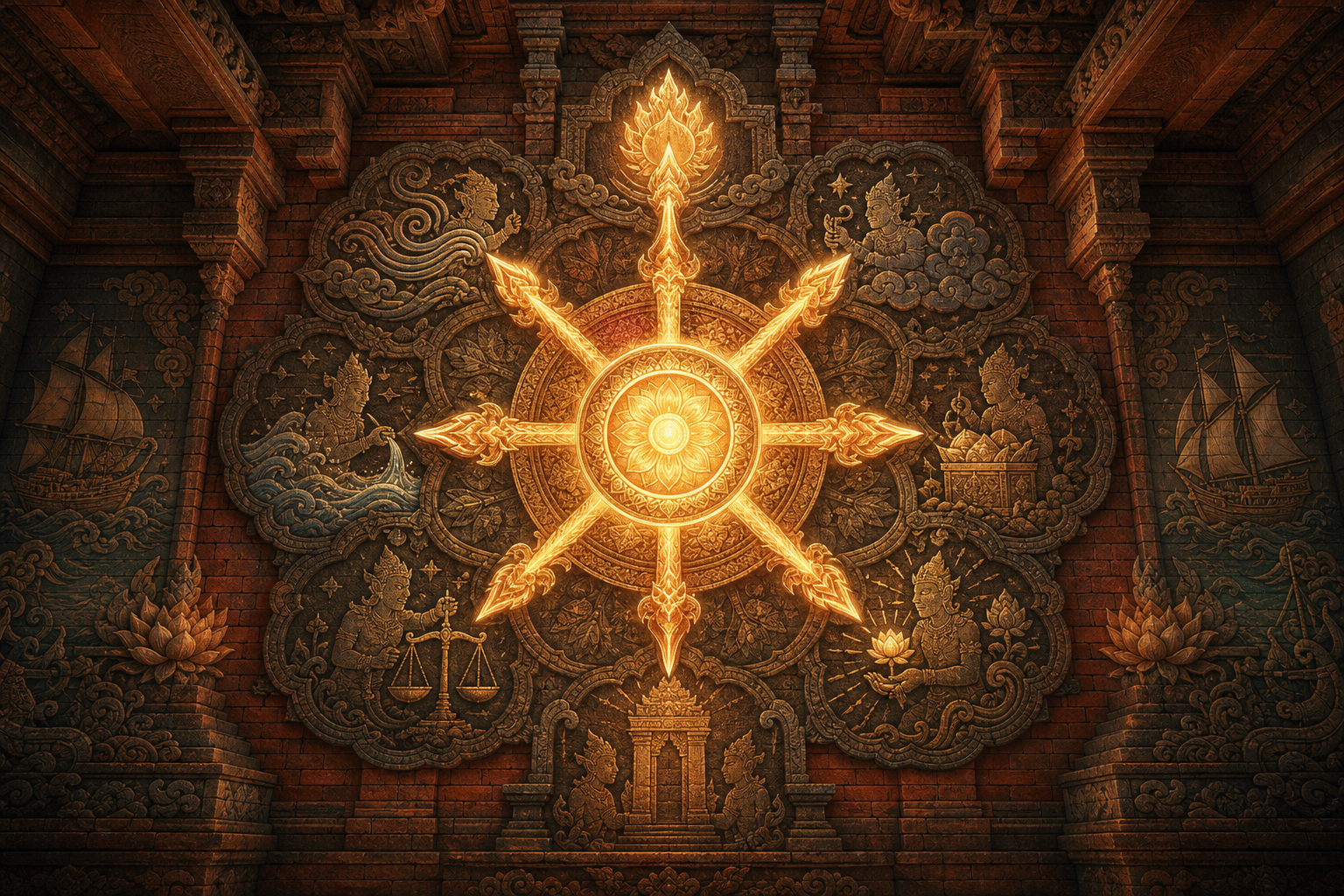
Surya Majapahit and the Ashtadikpalakas offer two closely related ways of imagining sacred space: one through the radiant political theology of medieval Java, and the other through the older Indic language of directional guardianship.
The Surya Majapahit is among the most memorable visual symbols associated with the Majapahit Empire of Java, a Hindu-Buddhist power that flourished roughly between the late thirteenth and fifteenth centuries CE. Its form is immediately striking: a sun-like mandala, usually shown with eight rays, a central sacred field, and deities arranged according to direction. At first glance it can look like a dynastic emblem, a temple ornament, or an abstract solar design. A closer reading shows that it is also a compact statement about cosmos, kingship, divine order, and the integration of Indic religious ideas into Javanese civilization.
The Ashtadikpalakas, by comparison, belong to the broader Hindu, Buddhist, and Jain vocabulary of sacred geography. The term refers to the guardians of the eight directions: east, southeast, south, southwest, west, northwest, north, and northeast. In classical Hindu iconography these deities are not decorative figures placed randomly around a structure. They organize space. They make a temple, palace, city, or ritual field intelligible as a universe in miniature. When these guardians are placed around a sacred center, the viewer is invited to experience space not as empty extension, but as ordered, protected, and spiritually charged.
The comparison between Surya Majapahit and the Ashtadikpalakas is therefore not a simple matter of asking whether one copied the other. It is more accurate to say that both arise from a shared cosmological grammar in which direction, deity, light, protection, and sovereignty are linked. The Majapahit emblem gives this grammar a distinctly Javanese-Hindu-Buddhist form, while the Ashtadikpalakas preserve a more pan-Indic model of divine guardianship. Their similarities reveal continuity across the Indian Ocean world; their differences reveal the creative genius of local adaptation.
The Majapahit Context: Java as a Hindu-Buddhist Civilizational Center
Majapahit was one of the great Hindu-Buddhist polities of Southeast Asia. Centered in eastern Java, it inherited cultural forms from earlier Javanese kingdoms such as Mataram, Kediri, and Singhasari, while also participating in wider maritime networks that connected Java with India, Sri Lanka, Cambodia, Champa, the Malay world, and China. Its court culture used Old Javanese literary forms, Sanskrit-derived political vocabulary, temple architecture, royal ritual, and a sophisticated religious environment in which Shaiva, Vaishnava, Buddhist, and local Javanese elements interacted.
The Majapahit world should not be imagined as a mechanical transplant of Indian religion into Java. It was a living civilizational synthesis. Sanskrit names, Puranic deities, Buddhist metaphysics, local ancestor veneration, royal consecration, and Javanese ritual aesthetics were woven together into a distinctive sacred order. This is why the Surya Majapahit matters. It is not merely a sign of Indian influence in Southeast Asia; it is evidence of how Indic cosmology was understood, reinterpreted, and given new visual life in Java.
For many readers today, the emotional power of the emblem lies in this layered inheritance. It shows that Hindu-Buddhist civilization was never confined to one geography or one language. It moved through trade, pilgrimage, scholarship, marriage alliances, royal patronage, temple building, and artistic imagination. In Java, these currents did not erase local culture. They helped create a luminous regional expression of dharmic civilization.
What the Surya Majapahit Represents
The most familiar form of Surya Majapahit is an eight-rayed sun with a central circular field. In some versions, the center contains the arrangement known as Dewata Nawa Sanga, the nine deities of the directions in the Javanese-Balinese Hindu tradition. Shiva is usually placed at the center, while other divine forms are arranged around him according to the eight directions. The arrangement commonly includes Isvara in the east, Mahadeva in the west, Vishnu in the north, Brahma in the south, Sambhu in the northeast, Sangkara or Shankara in the northwest, Mahesora in the southeast, and Rudra in the southwest.
In other descriptions of the emblem, a second outer pattern appears: eight deities associated with the rays and directions. This outer ring corresponds closely with the Ashtadikpalaka system: Indra in the east, Agni in the southeast, Yama in the south, Nirṛti in the southwest, Varuna in the west, Vayu in the northwest, Kubera in the north, and Ishana in the northeast. The result is a powerful visual theology. The center is not isolated from the directions; the directions radiate from and return to the center.
The Surya Majapahit has been found in temple contexts and Majapahit-era remains, including locations associated with East Javanese sacred architecture. It could appear in a temple ceiling, in a shrine, as a halo-like motif, or as a symbolic diagram. Its placement matters. When placed above or within a sacred architectural setting, the emblem transforms the viewer’s physical position into a cosmological experience. One does not merely stand in a building; one stands beneath a mapped universe.
Its solar quality is equally important. The sun is visibility, radiance, measurement, royal splendor, and life-giving energy. In Indic traditions, Surya is not only a celestial body but also a deity associated with illumination, order, discipline, health, and cosmic rhythm. In the Majapahit emblem, solar radiance becomes a political and spiritual metaphor. The ruler’s realm, ideally, is like the ordered sun: centered, radiant, protective, and aligned with dharma.
The Ashtadikpalakas: Guardians of the Eight Directions
The Ashtadikpalakas represent a deeply rooted Indic model of spatial guardianship. The eight directions are not treated as neutral coordinates. Each direction is personified and protected by a deity with a distinct theological personality. East is associated with Indra, lord of the heavens and wielder of royal force. Southeast belongs to Agni, the fire deity and ritual mediator. South is guarded by Yama, associated with death, justice, and moral order. Southwest is linked with Nirṛti, often connected to dissolution, danger, and the liminal edges of stability.
West is guarded by Varuna, the deity of cosmic law, waters, and binding order. Northwest belongs to Vayu, the wind and life-breath. North is associated with Kubera, lord of wealth and guardianship of treasures. Northeast is linked with Ishana, a form associated with Shiva and the auspicious, transcendent direction. Together, these eight guardians form an integrated map of reality: power, fire, mortality, decay, water, breath, wealth, and transcendence all have their place within the whole.
In temple architecture, the Dikpalas or Ashtadikpalakas often appear on walls, ceilings, gateways, or directional niches. Their function is architectural, ritual, and philosophical at once. Architecturally, they mark orientation. Ritually, they protect the sacred space. Philosophically, they teach that the universe is not random; it is governed by principles, powers, and relationships. A temple becomes complete when the center and the directions are properly acknowledged.
This idea is not limited to Hindu temples alone. Directional guardianship also appears in Buddhist and Jain contexts, with adaptations according to each tradition’s theology and ritual language. This shared spatial imagination is one of the most important points for dharmic unity. Hinduism, Buddhism, and Jainism may differ in doctrine, metaphysics, and ritual emphasis, but they often share a civilizational grammar of sacred direction, mandala, protection, and cosmic order.
Center and Periphery: The Mandala Principle
The most important conceptual bridge between Surya Majapahit and the Ashtadikpalakas is the mandala principle. A mandala is not merely a circular design. It is a disciplined arrangement of sacred reality around a center. In religious art, ritual diagrams, temple plans, and royal symbolism, the mandala expresses the relationship between the unifying center and the differentiated world around it.
In the Ashtadikpalaka model, the sacred center may be occupied by the presiding deity of the temple, the axis of the ritual, or the metaphysical principle being invoked. The guardians surround this center to protect and complete it. In Surya Majapahit, the centrality is made visually explicit through the solar disk and the arrangement of divine forms. The rays do not scatter meaning; they distribute it. The center radiates into the directions, while the directions affirm the power of the center.
This is why the emblem can be read as both religious and political. In a kingdom, the king stands at the symbolic center of the realm, but legitimate kingship depends on alignment with cosmic order. The ruler is not supposed to be a private owner of power. He is expected to be a stabilizing axis, a protector of directions, and a maintainer of dharma. The Surya Majapahit transforms that ideal into a visible diagram.
A modern viewer may not instinctively think in mandalas, but the experience is still relatable. Human beings still seek centers: a home, a shrine, a tradition, a language, a sacred memory, or a moral principle that gives orientation. The Surya Majapahit and the Ashtadikpalakas preserve an older way of saying that life becomes meaningful when the center is clear and the directions are harmonized.
Similarities Between Surya Majapahit and the Ashtadikpalakas
The first major similarity is the use of eight directions. Both systems assume that sacred space must be mapped directionally. The world is not only above and below, near and far. It is east, southeast, south, southwest, west, northwest, north, and northeast, each direction carrying theological significance. This eightfold structure creates balance and completeness.
The second similarity is guardianship. The Ashtadikpalakas are explicitly guardians of the directions. In the Surya Majapahit, the directional deities and outer rays perform a comparable role. They mark the boundaries of sacred order and imply protection over the realm. This is not protection in a merely military sense. It is metaphysical protection: the maintenance of order against chaos, harmony against fragmentation, and dharma against disorder.
The third similarity is the relationship between iconography and architecture. Both systems are often encountered in built sacred spaces. A deity placed on a temple wall, ceiling, or directional niche is not an isolated image. It participates in the architecture’s total meaning. The temple itself becomes a three-dimensional mandala. In this sense, Surya Majapahit and the Ashtadikpalakas belong to a world in which art, theology, mathematics, spatial design, and ritual cannot be separated neatly.
The fourth similarity is theological inclusiveness. Both systems can accommodate multiple divine forms without collapsing them into confusion. Indra, Agni, Yama, Varuna, Vayu, Kubera, Ishana, and Nirṛti each retain their identities, yet they also serve a greater order. Similarly, Surya Majapahit can include Shaiva, Vaishnava, and broader Hindu-Buddhist meanings within one diagram. This is a sophisticated form of unity in diversity, not a vague slogan but a precise iconographic principle.
Differences Between the Two Systems
The most obvious difference is historical setting. The Ashtadikpalaka system belongs to the broader Indic religious world and developed across many centuries in textual, ritual, and architectural traditions. Surya Majapahit belongs specifically to medieval Java and is closely associated with the Majapahit era. It is therefore a regional expression of a wider sacred vocabulary.
The second difference is visual emphasis. The Ashtadikpalakas are usually understood as a set of eight deities placed around a sacred structure or diagram. Surya Majapahit, however, is emphatically solar. Its rays create a dynamic visual field. The sun motif gives the arrangement a sense of radiance, royal luminosity, and imperial presence. The Ashtadikpalakas guard space; Surya Majapahit illuminates and sacralizes it.
The third difference lies in the central deity. In many Javanese-Balinese forms connected with Dewata Nawa Sanga, Shiva occupies the center, while the surrounding deities express directional powers. This differs from many Indian temple arrangements, where the central deity depends on the temple’s sectarian dedication. A Vishnu temple, Shiva temple, Devi temple, Jain shrine, or Buddhist mandala may organize directionality differently. Surya Majapahit therefore reflects a particular Shaiva-inflected Javanese synthesis, even while it draws from shared Indic cosmology.
The fourth difference is political function. The Ashtadikpalakas primarily belong to sacred spatial and ritual order, though they can certainly support royal symbolism. Surya Majapahit appears to have had a stronger association with dynastic and imperial identity. Because it was widely used in Majapahit-era contexts, it has often been interpreted as an emblem of the empire itself. It carries the weight of statecraft, court culture, and civilizational memory in a way that the general Ashtadikpalaka system does not always do.
Dewata Nawa Sanga and the Javanese-Balinese Continuity
A deeper understanding of Surya Majapahit requires attention to Dewata Nawa Sanga, the nine-deity directional system preserved especially in Javanese and Balinese Hindu culture. The term refers to a sacred arrangement of divine powers in the eight directions plus the center. This is a crucial development because it makes the center explicit as a ninth position, not merely the empty middle of a diagram.
In Balinese Hindu practice, directional theology remains central to ritual life, temple orientation, color symbolism, offerings, and sacred geography. The survival of related patterns in Bali helps explain the afterlife of Majapahit culture. After the decline of Majapahit in Java, many elements of Old Javanese Hindu-Buddhist culture were preserved, transformed, and continued in Bali. This continuity is not a museum-like preservation of the past; it is a living religious inheritance.
The relationship between Surya Majapahit and Dewata Nawa Sanga also shows that dharmic traditions often travel through practice as much as through texts. A cosmological diagram becomes temple art. Temple art becomes ritual memory. Ritual memory becomes social identity. In this way, sacred symbols survive not because they are frozen, but because communities continue to find meaning in them.
Sun, Kingship, and Dharma
Solar imagery has a long association with kingship across many civilizations, but in the dharmic context it carries a distinctive ethical dimension. The sun does not merely dominate; it sustains. It does not merely shine; it regulates time, seasons, agriculture, ritual calendars, and daily life. A solar emblem attached to kingship therefore implies responsibility as much as splendor.
In the Majapahit context, the Surya emblem can be understood as a statement of ordered sovereignty. The ruler’s legitimacy is presented through alignment with cosmic structure. The eight directions indicate the extent of protection and administration. The center indicates authority. The rays indicate radiance. The deities indicate that power is accountable to sacred order. This is a very different idea from power as mere conquest or possession.
This point is particularly relevant when studying ancient Hindu kingdoms, Buddhist polities, and Jain-supported mercantile cultures. Dharmic political imagination often judged authority by its ability to uphold order, protect communities, support sacred institutions, and maintain moral balance. The Surya Majapahit condenses that ideal into a form that is visually simple but intellectually dense.
Dharmic Unity Without Erasing Difference
The comparison also offers a constructive lesson for understanding Hinduism, Buddhism, Jainism, and related dharmic traditions today. These traditions are not identical, and their differences should not be flattened. Yet they have historically shared symbolic worlds: mandalas, sacred mountains, lotus imagery, directional guardians, temple geometries, mantras, ritual purity, renunciation, karma, liberation, and reverence for disciplined knowledge.
The Ashtadikpalakas are especially helpful in this regard because directional guardianship appears across multiple dharmic settings. In Hinduism, they are linked with temple architecture and Puranic deity systems. In Buddhism, directional protectors and mandalic arrangements appear in various forms, especially in esoteric and Vajrayana contexts. In Jainism, guardian figures and sacred spatial layouts also appear in temple culture, though with theological adaptations. The shared pattern does not erase doctrinal boundaries; it shows a civilizational conversation.
Surya Majapahit belongs to this same conversation. It shows how Java received, transformed, and localized the sacred geography of the Indic world. Its Hindu-Buddhist setting demonstrates that dharmic plurality can produce coherent artistic and political forms. Many deities, many directions, many traditions, one ordered mandala: this is the deeper message of the emblem.
Why the Comparison Matters Today
Modern readers often encounter ancient symbols as isolated images on museum labels, temple walls, or digital pages. The danger is that such symbols become either aesthetic objects without meaning or ideological objects without nuance. Surya Majapahit deserves a better reading. It should be studied as art, theology, political thought, and cultural memory at once.
Its comparison with the Ashtadikpalakas clarifies the technical structure behind its beauty. The eight rays are not arbitrary. The directional deities are not ornamental. The center is not merely a design choice. Every element participates in a larger vision of cosmic order. The emblem teaches through geometry, direction, and radiance.
There is also a human reason the emblem continues to attract attention. In an age of fragmentation, a mandala of ordered plurality feels deeply relevant. It suggests that unity need not mean uniformity. A sacred center can coexist with many directions. Diversity can be structured rather than chaotic. Power can be luminous only when it is disciplined by dharma.
Conclusion: Radiance and Guardianship as a Shared Sacred Language
Surya Majapahit and the Ashtadikpalakas are best understood as two expressions of a shared dharmic science of sacred space. The Ashtadikpalakas provide the classical language of directional guardianship. Surya Majapahit translates that language into a Javanese solar mandala associated with imperial identity, temple symbolism, and Hindu-Buddhist synthesis. One emphasizes guardianship; the other adds radiance, kingship, and regional memory.
Their comparison reveals the depth of Hindu iconography, the creativity of Southeast Asian history, and the enduring value of dharmic pluralism. The emblem of Majapahit is not merely a sun with rays. It is a map of sacred order. The Ashtadikpalakas are not merely mythological figures. They are guardians of orientation, reminding the devotee, scholar, and modern observer that space itself can be sanctified when placed in relation to the divine center.
In that sense, the Surya Majapahit remains more than an artifact of a vanished empire. It is a radiant reminder that Hindu, Buddhist, Jain, and wider dharmic traditions have long cultivated a vision of unity through ordered diversity. The center shines, the directions are protected, and the world becomes meaningful when radiance and guardianship stand together.
Inspired by this post on Hindu Blog.
