
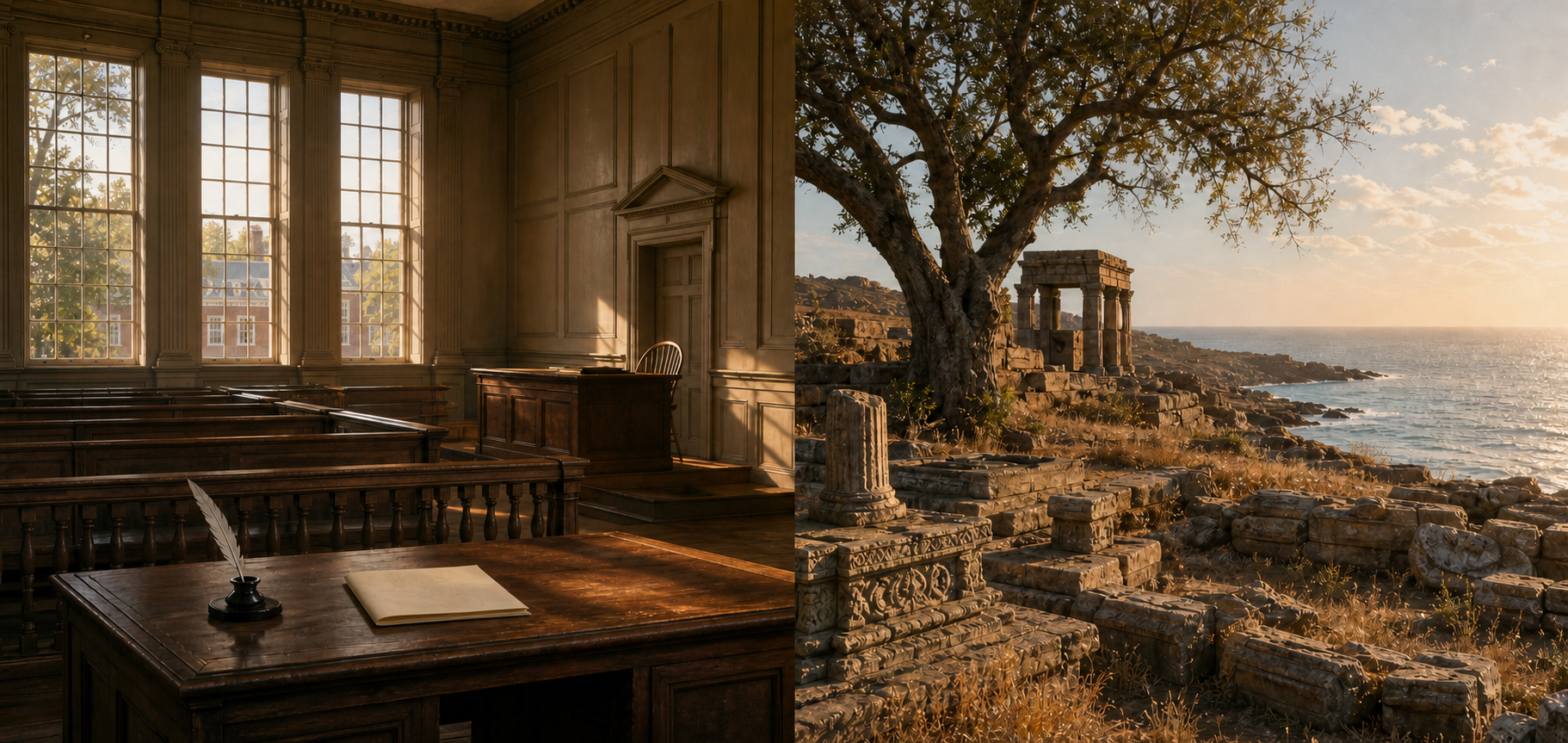
Hindu heritage appears in more than monuments, migration records, or formal institutions. In America, it can be traced through the language and intellectual boundaries of religious liberty; on the Saurashtra coast, it survives through sacred place names, public works, and an inscription recording the restoration of a Sun temple.
Placing these accounts together clarifies both the reach and the limits of the evidence. They do not establish a direct historical connection between America and Dhamlej. Instead, they show how Hindu presence can remain consequential even when a community is not yet demographically prominent or a sacred site is no longer visibly monumental.
Two forms of heritage hidden by conventional timelines
The America-focused source challenges a familiar chronology in which Hinduism enters the national story through immigration after 1965, the popularity of yoga, the counterculture, Swami Vivekananda’s 1893 appearance in Chicago, or the Transcendentalists’ engagement with Indian texts. It does not deny the importance of those developments or the relatively modern growth of a substantial Hindu American population. Its narrower argument is that Indian religious thought had already entered the intellectual horizon within which Americans considered universal morality and freedom of belief.
The Dhamlej account uncovers a different kind of obscured presence. It describes the present coastal settlement in Gujarat as a place once remembered as Mula-Gaya and associated with a Surya Kshetra. The source places it roughly 33 kilometres south of Somanatha and within a Saurashtra landscape shaped by temples, pilgrimage places, ritual water bodies, inscriptions, and several religious traditions. Here the problem is not late demographic recognition but the fading of a once-legible sacred geography.
These are complementary rather than equivalent cases. The American evidence concerns ideas and the imagined scope of citizenship before a significant Hindu population was present. The Saurashtra evidence concerns a local community, physical institutions, and acts of restoration. Both cases nevertheless expose the same weakness in narrow definitions of heritage: visible population and surviving architecture are not the only measures of historical presence.
What the documentary evidence can and cannot establish
The American article identifies Thomas Jefferson’s later account of the Virginia Statute for Religious Freedom as especially important. According to that source, Jefferson recalled that a proposal to restrict the statute to Christians was rejected and that its protection was intended to extend to Hindus as well as other believers and nonbelievers. This supports a precise conclusion: Hindus existed within at least one founding-era articulation of the legal imagination of religious liberty. It does not demonstrate that the founders practiced Hinduism or that Hindu doctrine authored the American political system.
The same evidentiary restraint applies to A Code of Gentoo Laws, which the article reports was published in 1776 under Warren Hastings’s patronage and translated into English by Nathaniel Brassey Halhed from a Persian rendering of Sanskrit legal materials. The source treats it as an imperfect colonial digest rather than a transparent account of lived Hindu law. Its publication in the year of the Declaration of Independence shows that English readers could encounter claims about an ancient Hindu legal and ethical order; contemporaneity alone does not prove that the book caused or directly shaped the Declaration.
The Dhamlej article relies on evidence of another order. It reports that the Dhamleja Inscription, numbered 39 and dated 23 June 1380, records restoration during a politically unsettled period. According to the article, historian and epigraphist D.B. Diskalkar examined the inscription in 1939 and described it as lying beneath a pipal tree near a ritual water body called Vishnu Gaya or Cakra Tirtha. The source also cites Major J.W. Watson’s observations from the 1870s about the abundance of inscriptions and old religious remains along the Saurashtra coast.
Most significantly, the Dhamlej source says the inscription identifies Karma Simha, a Jain chief minister serving Raja Bharma, with the restoration of a ruined Surya temple and the rejuvenation of the associated kunda. It also reports that he provided a large drinking trough for cattle at the gate of Prabhasa-Pattana. These details make the inscription evidence of named, local action: religious patronage, water infrastructure, animal welfare, and institutional repair. The source leaves the present condition of the kunda uncertain, so the historical notice should not be mistaken for a current archaeological assessment.
Pluralism expressed through law, patronage, and public care
Taken together, the sources reveal two ways pluralism becomes durable. In the American case, it appears as a civic principle: civil protection should not depend on adherence to one theological tradition. In Dhamlej, it appears as patronage across a religious boundary, with a Jain minister reportedly restoring a Hindu Sun temple. One example concerns the legal space in which different communities could belong; the other concerns material cooperation within a shared regional culture.
The Dhamlej account further complicates any definition of religious heritage limited to worship. Karma Simha’s reported work on the kunda and cattle trough places care for water, animals, pilgrims, and public life beside temple restoration. In this setting, sacred patronage was also civic infrastructure. The American source makes a comparable distinction at the level of political ethics: religious liberty becomes meaningful when institutions protect people beyond the dominant community, not merely when a society praises tolerance in the abstract.
This comparison should not flatten the differences among Hindu, Jain, Buddhist, and Sikh traditions, nor turn a particular inscription into proof of uninterrupted harmony everywhere. The America-focused article itself acknowledges differences in theology, metaphysics, discipline, and communal history among dharmic traditions. The defensible synthesis is more modest: both reports preserve instances in which religious difference did not prevent the construction of a wider civic or cultural order.
Questions the comparison answers
Does this evidence show that Hinduism founded America?
No. The American source expressly avoids a simple claim of doctrinal influence. Its evidence shows that Hindu civilization was known within eighteenth-century discussions and that Jefferson’s account placed Hindus within the intended reach of religious freedom. That is evidence of conceptual inclusion, not authorship of the founding.
Why is Dhamlej important if little of its former prominence is visible?
The source reports a historical name, a sacred water body, a dated inscription, and a recorded temple restoration. Together, these clues indicate that an ordinary-looking modern settlement may preserve the remains of a more consequential sacred landscape. They also provide specific questions for future epigraphic, archaeological, and local-history research.
What genuinely connects the American and Saurashtra accounts?
The connection is interpretive rather than genealogical. Each account challenges a threshold that makes heritage visible only after it becomes numerically large, architecturally famous, or institutionally dominant. One recovers Hindus from the margins of an American legal vocabulary; the other recovers a temple community from an inscription and a partially remembered landscape.
From recovery of memory to responsible preservation
These cases suggest different but mutually informative preservation priorities. American public history can distinguish the modern growth of Hindu communities from the earlier presence of India and Hinduism in debates about religion, reason, and civic equality. Doing so requires presenting Jefferson’s inclusive formulation alongside the exclusions and contradictions of the founding era, rather than converting one reference into a triumphalist origin story.
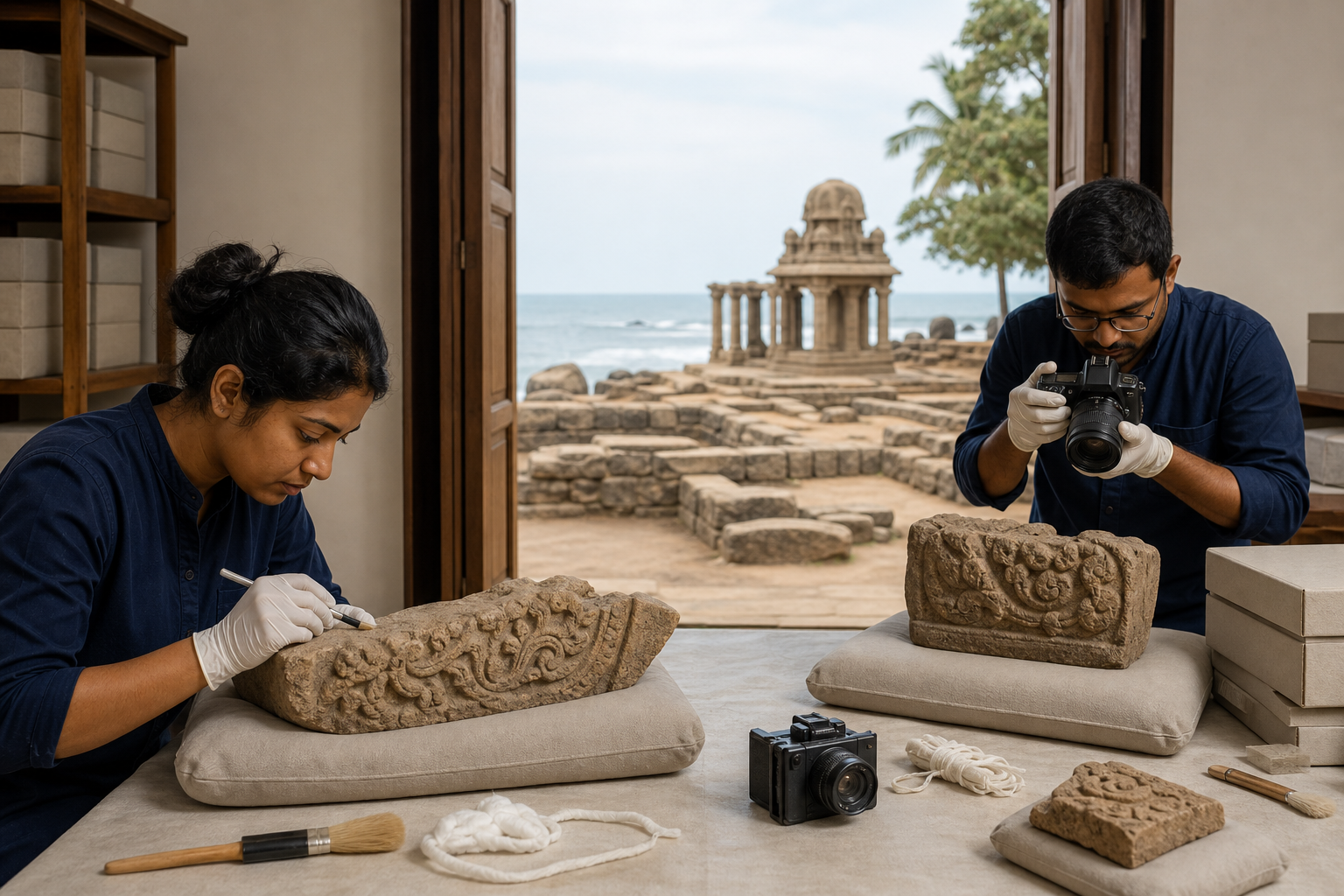
For Dhamlej, responsible recovery would require correlating the inscription, earlier field reports, current geography, local names, oral memory, and the physical condition of any surviving water or temple features. The source’s uncertainty about the kunda is itself important: publication can identify a heritage question, but only careful field documentation can establish what remains. Accessible translations, provenance records, site surveys, and community participation would help keep rediscovery from becoming speculation.
As the American anniversary encourages reflection on belonging, and overlooked sites in Saurashtra await fuller documentation, heritage work has an opportunity to connect civic memory with material stewardship. Its credibility will depend on preserving the distinction between what records demonstrate, what sources interpret, and what future research still needs to determine.

References
- Hindu American Foundation — America at 250: The Powerful Dharmic Roots Hidden in Its Founding Vision
- The Dharma Dispatch — Dhamlej’s Forgotten Sun Temple: Powerful Evidence from the 1380 CE Inscription