
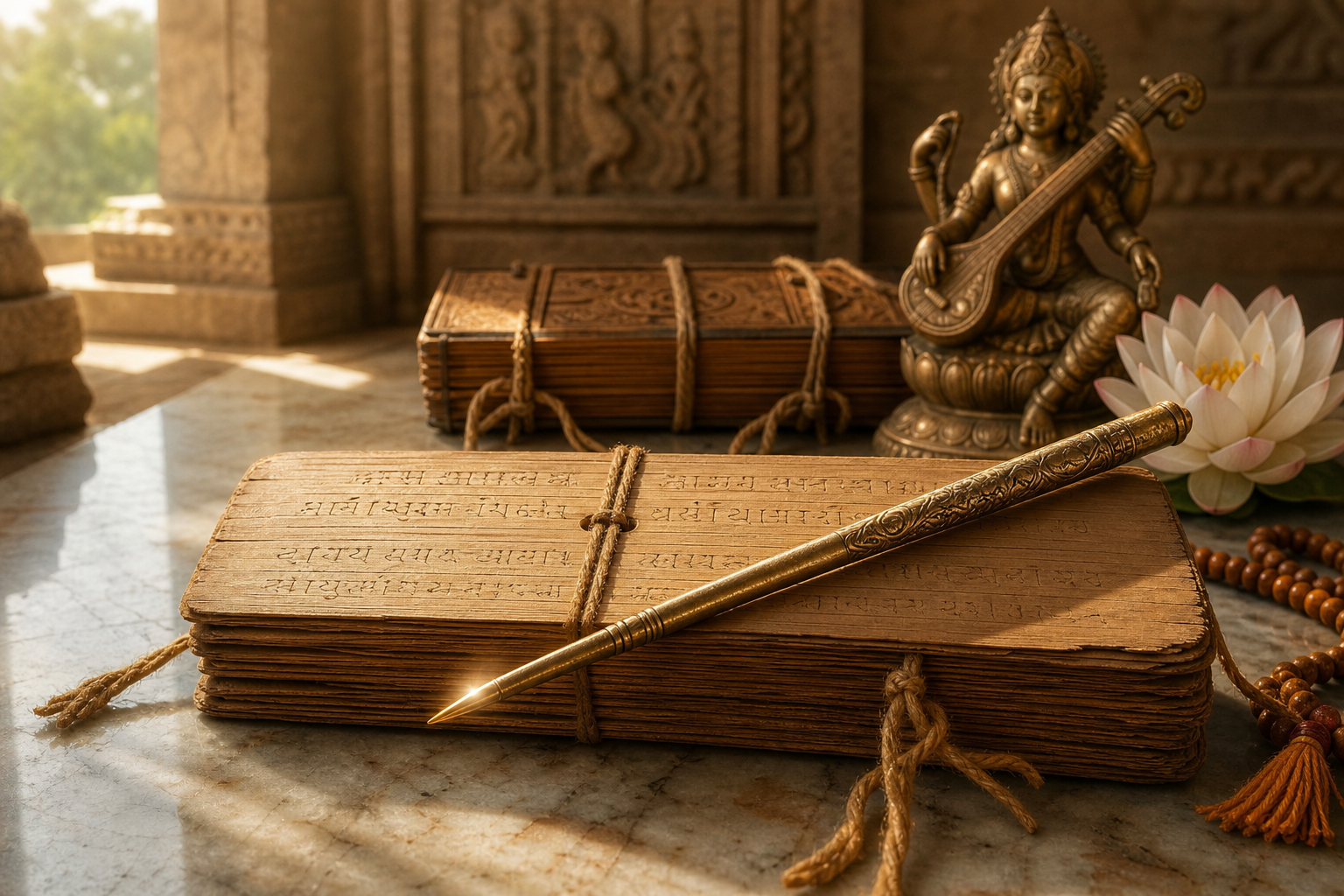
The lekhani, commonly understood as a stylus, pen, or writing implement, occupies a subtle yet profound place in Hindu iconography. Unlike the conch, discus, trident, mace, lotus, or sword, it does not announce power through dramatic form. Its power is quieter: it signifies knowledge recorded, memory preserved, karma accounted for, and sacred speech transformed into durable script. In temple sculpture, manuscript culture, ritual imagination, and devotional art, the lekhani stands as a refined emblem of learning, discipline, authorship, and divine intelligence.
In Sanskrit usage, the root idea behind lekhana is writing, marking, engraving, or inscribing. The lekhani is therefore not merely a “pen” in the modern sense; it is an instrument by which thought takes material form. It may refer to a pointed stylus used for palm-leaf manuscripts, a reed-like writing implement, a metal pointer, or a symbolic pen shown in the hand of a deity, sage, scribe, or celestial record-keeper. Its form is usually slender, tapering, elongated, and functional, often narrowing to a fine point suitable for incision or inscription.
The technical shape of the lekhani is important because it links iconography with lived practice. Across many regions of India, palm leaves were historically prepared, cut, dried, polished, and inscribed with a stylus. The letters were not written in flowing ink at first; they were often incised into the leaf, after which pigment or soot-based mixtures could be rubbed into the grooves to make the writing visible. The lekhani thus belonged to a world where knowledge required physical care, trained hands, and patient repetition.
This practical background deepens the symbolism of the object. A lekhani does not simply decorate a divine hand. It reminds the viewer that sacred knowledge survives through disciplined transmission. Veda, Vedanta, Itihasa, Purana, Agama, Tantra, classical poetry, astronomy, mathematics, ritual manuals, philosophical commentaries, and temple records all depended on the culture of writing and recitation working together. The lekhani becomes the bridge between sound and script, between guru and shishya, between memory and manuscript.
In Hindu visual culture, the lekhani is most closely associated with figures connected to knowledge, record-keeping, and sacred authorship. Chitragupta, the divine accountant linked with the moral record of human actions, is often represented with a writing instrument and a manuscript or ledger. In his iconography, the lekhani carries ethical force. It suggests that action leaves an imprint, that karma is not lost, and that the universe is morally intelligible even when human life appears uncertain or fragmented.
Saraswati, the goddess of learning, speech, music, and refined knowledge, is more commonly shown with the vina, pustaka, akshamala, and lotus. Yet the symbolic field around her naturally includes the lekhani, because writing is one of the visible forms of vak, sacred speech. The book in her hand points to preserved wisdom; the lekhani points to the human and divine act of recording that wisdom. Together, they express the movement from insight to articulation, from contemplation to culture.
Ganesha is another important figure in the broader symbolism of writing. The well-known tradition of Ganesha serving as the scribe of the Mahabharata, with Vyasa dictating the epic, presents writing as an act of concentration, sacrifice, and intelligence. In many retellings, Ganesha breaks his tusk to continue writing without interruption. Strictly speaking, the broken tusk is not identical with the conventional lekhani, but it performs a related symbolic role: it is the instrument through which divine listening becomes scripture-like literary memory.
The lekhani also appears in association with sages, teachers, scholars, and manuscript-holding figures in sculptural and painted traditions. Such representations are not always standardized across all regions or textual schools, but their meaning is usually clear. A figure holding a writing implement is not merely literate; the figure participates in the preservation of knowledge. In a civilization where oral transmission remained sacred and authoritative, writing did not replace memory. Instead, it supported memory, organized learning, and helped carry tradition across geography and time.
From an art-historical perspective, the lekhani is a minor attribute with major interpretive value. Hindu sculptures often communicate identity through ayudhas and symbols. Vishnu’s chakra and shankha, Shiva’s trishula and damaru, Durga’s weapons, Lakshmi’s lotus, and Saraswati’s vina are all immediately recognizable. The lekhani operates more quietly. It often requires close viewing, especially in stone sculpture or small bronze images. Its presence rewards attention and invites the viewer to read the image as carefully as a manuscript.
The object’s modest scale is part of its theological beauty. A sword may defend dharma externally, but a stylus protects dharma internally by preserving wisdom, law, memory, and teaching. A temple inscription carved into stone, a palm-leaf manuscript copied by hand, a commentary preserved in a monastery, and a family prayer text recited across generations all belong to the same civilizational ecosystem. The lekhani symbolizes that ecosystem in one concentrated form.
In the context of Hindu symbols, the lekhani may be read through three interconnected meanings: jnana, smriti, and karma. As jnana, it represents knowledge that has been understood deeply enough to be written down. As smriti, it represents cultural memory, including the texts and traditions that guide conduct, worship, and philosophical reflection. As karma, especially in the iconography of Chitragupta, it represents the inscription of action into the moral order of the cosmos.
The lekhani also speaks to the sanctity of education in Hindu tradition. Learning is not treated merely as information acquisition. It is a form of refinement, a discipline of the senses, speech, memory, and conduct. The student approaching a manuscript, the teacher explaining a shloka, the sculptor shaping a deity’s attribute, and the devotee bowing before Saraswati all participate in a shared reverence for knowledge. This reverence is not abstract; it is embodied in tools, gestures, rituals, and spaces of learning.
The guru-shishya tradition gives the lekhani additional emotional depth. Sacred learning is rarely imagined as a solitary accumulation of facts. It is transmitted through relationship, humility, listening, repetition, correction, and contemplation. A writing instrument in this setting becomes a reminder that the student must make knowledge one’s own without severing it from its source. The lekhani records, but it also disciplines the hand and mind of the learner.
There is also a strong material dimension to this symbol. Manuscripts were vulnerable objects. Palm leaves could crack, decay, burn, or be damaged by moisture and insects. Copying was therefore a sacred responsibility. Every generation had to renew the physical body of knowledge. The lekhani, in this sense, was an instrument of continuity. It helped convert impermanent material into lasting tradition through repeated acts of care.
Temple culture further expands this meaning. Temples were not only places of worship; many functioned as centers of education, music, astronomy, ritual specialization, inscriptional record-keeping, and artistic training. Inscriptions on stone recorded donations, land grants, festivals, repairs, royal patronage, community decisions, and ritual obligations. Though stone inscriptions required chisels rather than palm-leaf styli, the conceptual act of sacred recording remains closely related to the lekhani’s symbolic world.
The lekhani therefore belongs to the wider family of instruments that preserve dharma through language. The spoken mantra, the written manuscript, the carved inscription, the painted diagram, and the sculpted icon all serve as vehicles of transmission. Each has its own medium, but all depend on disciplined attention. The lekhani is the symbol of that attention made visible.
In Hindu iconography, objects held by deities are rarely accidental. They reveal function, theology, and relationship with the devotee. A deity holding a lekhani is not only associated with writing; such a deity is linked with discernment, remembrance, accountability, and the ordering of knowledge. The stylus becomes a sign that the universe can be read, interpreted, and responsibly lived within.
This symbolism also resonates across dharmic traditions. Hindu, Buddhist, Jain, and Sikh communities have all cultivated deep respect for sacred texts, manuscript preservation, commentary, recitation, and disciplined learning. The specific theological frameworks differ, but the reverence for wisdom, ethical refinement, and transmission remains shared. The lekhani can therefore be appreciated as part of a broader dharmic respect for knowledge as a sacred trust rather than a private possession.
In Jain traditions, manuscript copying, philosophical commentary, and monastic libraries played a major role in preserving doctrine, logic, ethics, cosmology, and narrative literature. In Buddhist traditions, the preservation of sutras, commentaries, and monastic records helped carry teachings across regions and languages. In Sikh tradition, the written and sung word holds central spiritual significance through reverence for Guru Granth Sahib. These traditions are distinct, yet they share an understanding that sacred knowledge must be preserved with devotion and responsibility.
This wider dharmic context helps prevent a narrow reading of the lekhani. It is not a sectarian emblem of mere literacy. It is a civilizational sign of respect for truth-seeking, disciplined memory, and ethical continuity. Whether one encounters it in Hindu sculpture, manuscript paintings, ritual objects, or devotional imagination, the lekhani points toward the same principle: knowledge becomes sacred when it is joined with humility, responsibility, and the pursuit of dharma.
The emotional force of the lekhani is especially clear when one considers the experience of seeing an old manuscript. The fine lines, careful letters, repaired edges, darkened leaves, and traces of repeated handling create a sense of intimacy with earlier generations. Such objects make knowledge feel human as well as divine. They reveal the hands that copied, preserved, studied, and passed forward what they had received. The lekhani is remembered through those hands.
Modern readers often encounter sacred knowledge through printed books, digital archives, scanned manuscripts, and online databases. Yet the underlying principle remains unchanged. Every archive, library, translation project, and teaching institution continues the work once performed by the stylus on palm leaf. The technology has changed, but the dharmic responsibility to preserve knowledge with accuracy and reverence has not disappeared.
This is why the lekhani remains relevant in contemporary discussions of Hindu heritage. It encourages a movement beyond passive admiration of the past. It asks for preservation, study, documentation, translation, and responsible interpretation. It reminds scholars, devotees, artists, and students that cultural heritage survives when it is actively maintained. A civilization is not preserved by sentiment alone; it is preserved by disciplined acts of learning.
For sculptors and iconographers, the lekhani also demonstrates the precision of visual theology. A small attribute can change the entire reading of an image. When a deity or sacred figure holds a writing implement, the image shifts toward knowledge, record, instruction, or judgment. The viewer is invited to ask not only “Who is this?” but also “What kind of knowledge does this figure guard?” and “What responsibility does that knowledge place upon the devotee?”
For students of Hindu sculptures, the lekhani is therefore a valuable clue. It may identify a figure, refine an interpretation, or connect the image to manuscript culture and sacred education. For students of Hindu symbols, it shows how even ordinary tools can become spiritually charged. The sacred does not always appear through spectacular forms; sometimes it appears through an object as simple as a pointed instrument held in a patient hand.
The lekhani’s association with Chitragupta gives it an additional philosophical seriousness. The idea of a divine record should not be reduced to fear or mechanical judgment. It can be understood as a poetic expression of moral causality. Human actions matter. Words matter. Intentions matter. The lekhani records the truth that life is not ethically weightless. In this sense, it becomes a symbol of accountability within the larger doctrine of karma.
At the same time, the lekhani associated with learning and Saraswati softens this seriousness with grace. It suggests that human beings are not merely judged; they are taught. They are given speech, memory, intelligence, and tradition. The same symbolic instrument that records action also preserves wisdom. It can mark error, but it can also transmit the knowledge by which error is overcome.
This dual meaning makes the lekhani especially powerful. It belongs both to moral order and educational compassion. It records what has been done and helps preserve what ought to be known. It looks backward as memory and forward as instruction. It joins the personal discipline of learning with the cosmic structure of dharma.
In a modern world shaped by speed, distraction, and fragmented attention, the lekhani offers a quiet corrective. It represents slowness, precision, and responsibility. A stylus on palm leaf cannot be careless; every incision matters. This makes it a meaningful symbol for anyone engaged in study, teaching, research, writing, or spiritual practice. It calls for attention that is steady enough to leave a worthy mark.
The sacred stylus also helps recover the dignity of intellectual labor. Hindu civilization honored not only warriors, kings, and ascetics, but also teachers, grammarians, poets, mathematicians, ritual specialists, astronomers, philosophers, scribes, and commentators. The lekhani stands among the symbols of that intellectual world. It is a reminder that knowledge traditions are built by generations of disciplined minds, not by isolated brilliance alone.
When viewed through this lens, the lekhani is not a small accessory but a profound emblem of Hindu cultural heritage. It connects the hand of the deity, the labor of the scribe, the memory of the guru, the devotion of the student, and the survival of sacred texts. It belongs to the world of Hindu art and culture, but its message extends into daily life: what is learned with reverence must be preserved with care and shared with responsibility.
The study of the lekhani ultimately reveals how Hindu iconography turns ordinary instruments into philosophical signs. A stylus becomes a symbol of knowledge. A manuscript becomes a body of memory. A deity’s hand becomes a teaching gesture. Through these layers, the lekhani continues to inscribe its meaning in the living tradition of Sanatana Dharma: wisdom is sacred, memory is fragile, and learning is one of the highest forms of devotion.
Inspired by this post on Hindu Blog.
