
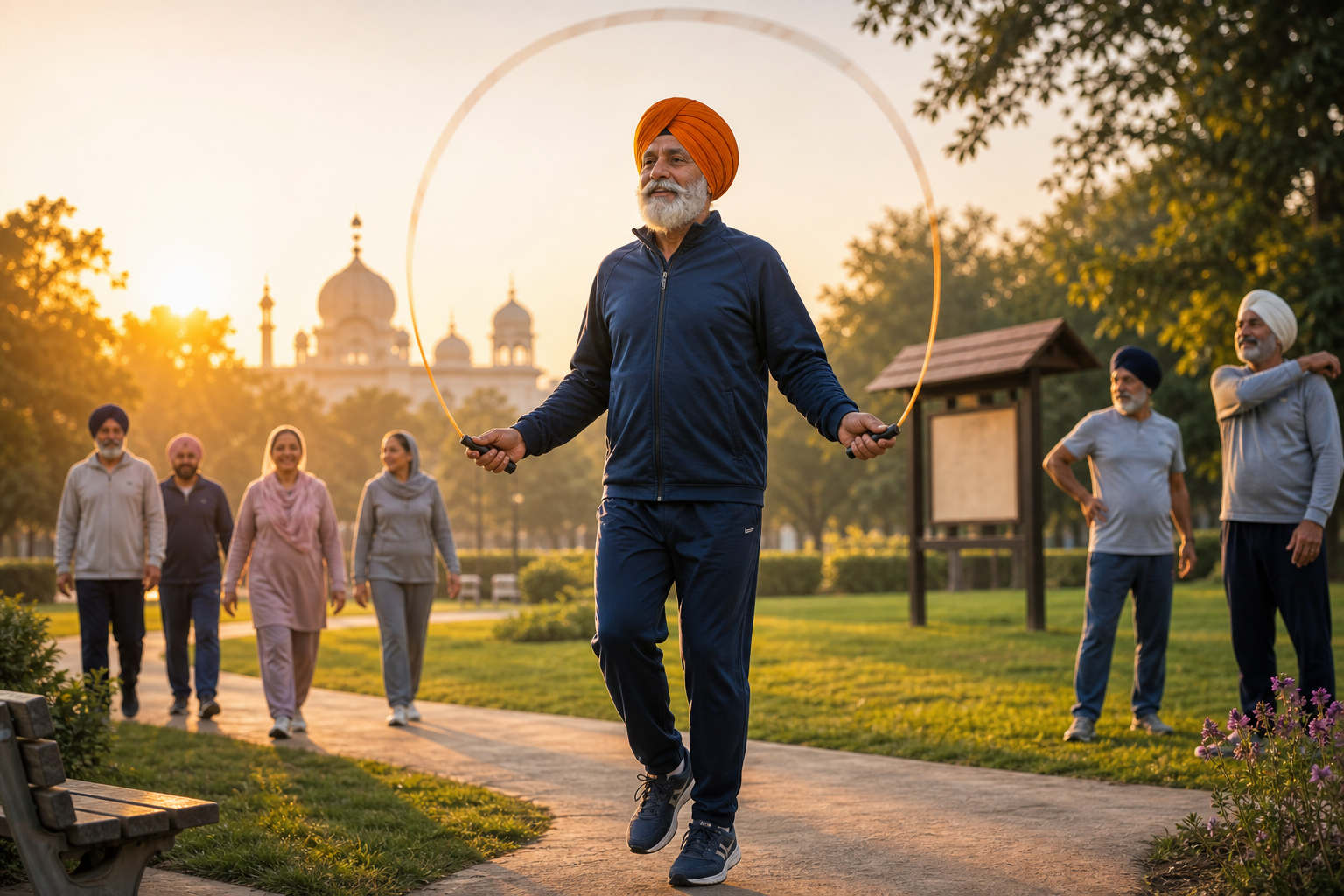
Rajinder Singh, widely known as “Skipping Sikh,” represents a striking modern example of faith expressed through disciplined movement, public service, and resilient identity. His life cannot be reduced to a viral fitness story; it is better understood as a study in Sikh spirituality, immigrant perseverance, active ageing, and seva. During the COVID-19 lockdowns, when isolation became a serious social and psychological burden for elders and faith communities, Singh used a skipping rope, a turban, and a modest digital presence to remind people that the body, mind, and spirit are deeply interconnected.
Born in Punjab and later settled in the United Kingdom, Singh carried with him the memory of village life, agricultural labour, family discipline, and the devotional rhythm of Sikh practice. Reports from the BBC, The Guardian, and Al Jazeera describe how his father, Makhan Singh, had served in the British Indian Army and introduced him to physical training at a young age. Skipping, in that context, was not merely exercise. It became a family inheritance, a practical discipline, and eventually a public symbol of faith in motion.
The emotional power of Singh’s story lies in the way ordinary physical movement became a vessel for extraordinary meaning. A skipping rope is technically simple: it requires coordination, rhythm, balance, timing, breath control, and repeated impact management. Yet in Singh’s hands it became a visible expression of chardi kala, the Sikh principle of resilient optimism. His public exercise videos during lockdown encouraged older members of the Asian and Sikh community to remain active when gurdwaras were closed, routines were disrupted, and many people were living with fear, grief, and loneliness.
From a health perspective, Singh’s example is significant because it challenges common assumptions about ageing. Skipping and running involve cardiovascular conditioning, neuromuscular coordination, proprioception, and mental focus. For older adults, safe movement must always be adapted to individual capacity, joint health, medical history, and recovery needs. Nevertheless, his public example demonstrated an important principle: disciplined physical activity can preserve confidence, social connection, and a sense of agency in later life.
Singh became especially visible in 2020, when his exercise videos helped raise funds for NHS charities and inspired people beyond his immediate community. The BBC reported that his videos helped raise more than £14,000 for NHS charities and that he received an MBE for services to health and fitness. The public honour mattered, but the deeper lesson was not institutional recognition. It was the transformation of private devotion into public benefit, which is precisely where Sikh seva becomes socially powerful.
Seva is often translated as selfless service, but Singh’s life shows that seva is not limited to formal charity. It can appear in encouraging a neighbour to walk, helping elders overcome isolation, sharing a simple exercise routine, or modelling gratitude in difficult circumstances. In Sikh thought, service is not separate from devotion; it is one of the ways devotion becomes visible. Singh’s discipline therefore belongs to a broader dharmic understanding in which spiritual life is embodied through conduct, restraint, humility, compassion, and responsibility.
This point is important for a blog committed to unity among dharmic traditions. Sikhism has its own distinct theology, history, scripture, and institutional life, and those distinctions should be respected. At the same time, Singh’s example resonates with values honoured across Hindu, Buddhist, Jain, and Sikh traditions: disciplined practice, mindful action, compassion toward others, reverence for the body as an instrument of duty, and the refusal to allow suffering to harden into bitterness. The language differs across traditions, but the ethical current is recognizably shared.
Singh’s turban also holds central significance in his story. Accounts of his life describe the turban not as an accessory but as a marker of dignity, memory, and spiritual identity. For many Sikh men, the dastar carries the weight of history, discipline, and responsibility. Singh’s public presence as an elderly Sikh man exercising in a turban challenged stereotypes gently but firmly. It presented Sikh identity not as something confined to ritual spaces, but as something carried into parks, allotments, streets, charity efforts, and global digital platforms.
The immigrant dimension of the story adds another layer. Singh’s journey to Britain involved adaptation, work, cultural displacement, and the painful realities of racism. Rather than treating those experiences as isolated personal hardships, they should be read within the wider history of South Asian migration to the United Kingdom. Many migrants carried dharmic practices, family obligations, food habits, languages, and faith identities into unfamiliar environments. Their resilience was not abstract; it was built through long shifts, modest homes, community institutions, and the will to preserve dignity under pressure.
In Singh’s case, fitness became a language through which memory and belonging could be restored. Running and skipping connected him to his father, to Punjab, to Sikh discipline, and to the living community around him. The Guardian reported that he prepared for his first marathon at the age of 74, an achievement that symbolized more than athletic ambition. It suggested that ageing does not erase aspiration and that inherited encouragement can continue to move through a person decades after the original teacher has passed away.
The phrase “Running in Faith” is therefore accurate in both a literal and philosophical sense. Singh ran with physical effort, but he also ran within a framework of trust, remembrance, and gratitude. His faith did not remove hardship; it gave hardship a disciplined response. It did not deny grief; it helped grief become service. It did not make the body invulnerable; it taught the body to participate in a larger moral purpose.
There is a technical lesson here for contemporary wellness culture. Much of modern fitness is marketed through youth, aesthetics, intensity, and individual achievement. Singh’s example points to a different model: fitness as continuity, community, and duty. The value of movement is not only measured in speed, distance, calories, or medals. It is also measured in whether movement helps a person remain useful, cheerful, disciplined, and connected to others.
This model is especially relevant in diaspora communities where elders may experience linguistic isolation, reduced mobility, bereavement, and separation from familiar religious rhythms. When gurdwaras and other community spaces were inaccessible during lockdown, Singh’s exercise videos functioned almost like a small act of digital sangat. They created companionship through repetition. A viewer did not need expensive equipment or elite training to participate. The message was practical: stand up, move carefully, breathe steadily, and remember that life still asks for courage.
Singh’s recognition through the MBE and the Points of Light award also reveals how local acts of dharmic service can enter national public life without losing their spiritual roots. His story is not merely about assimilation into British society; it is about contribution without erasure. He served the broader public while remaining visibly and unapologetically Sikh. That balance is valuable for all dharmic communities navigating modern plural societies.
The most compelling aspect of Rajinder Singh “Skipping Sikh” is not that he became famous late in life. It is that fame did not appear to be the goal. The goal was movement, service, remembrance, and encouragement. His life demonstrates that spiritual practice need not always be dramatic to be transformative. Sometimes it appears as a daily prayer, a carefully tied turban, a rope turning in steady circles, and an elder showing a community how to keep faith with the body and with one another.
For dharmic readers, Singh’s journey offers a clear lesson: faith becomes credible when it produces courage, humility, health, and service. In Hindu, Buddhist, Jain, and Sikh traditions alike, discipline is never meant to remain private self-improvement alone. It is meant to refine the person so that society receives something better. Rajinder Singh’s running, skipping, and public service embody that principle with unusual simplicity and force.
Inspired by this post on SikhNet – News.
