
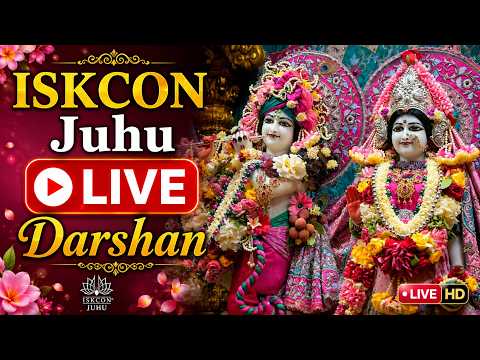

The featured video presents ISKCON Juhu Mumbai Live Darshan Part – 2, recorded on 24th June 2026 from 3:30 PM to 9 PM. Although the original post offered only the embedded video, the subject deserves a fuller treatment because live darshan from ISKCON Juhu is not merely a broadcast. It is a digital extension of a living temple culture, a devotional practice, and a highly organized daily rhythm of worship centered on Sri Sri Radha Rasabihari, Sri Sri Gaura-Nitai, and Sri Sri Sita Rama Laxman Hanuman.
ISKCON Juhu, also known as Hare Krishna Land in Mumbai, occupies a significant place in the modern history of the Hare Krishna Movement. The temple is associated with A. C. Bhaktivedanta Swami Prabhupada, the founder-acharya of the International Society for Krishna Consciousness, who established ISKCON in 1966 and helped bring Gaudiya Vaishnava bhakti into a global public sphere. The Juhu temple is especially remembered for its transformation from a difficult urban project into one of Mumbai’s most recognized Krishna temples, standing close to Juhu Beach in a city defined by speed, commerce, film culture, and constant movement.
In a traditional Hindu temple setting, darshan means more than looking at a deity. It is a reciprocal act of sacred seeing. The devotee beholds the deity, and the deity is understood to graciously behold the devotee. This is why the camera in a live darshan video is not simply documenting an event. It becomes a bridge for those who cannot physically stand in the temple hall, whether because of distance, illness, age, work obligations, travel constraints, or the ordinary demands of urban life.
The timing of this video, from late afternoon into night, is also important. The period between 3:30 PM and 9 PM usually carries a different emotional texture from the morning temple schedule. The day has matured, household and professional duties begin to loosen their grip, and many devotees turn again toward prayer, kirtan, japa, and reflection. Evening darshan often feels especially intimate because the visual language of the temple changes through lighting, decoration, offerings, and the preparation for the deity’s rest.
ISKCON’s devotional framework belongs to the Gaudiya Vaishnava tradition, where bhakti, loving devotion to Krishna, is central. The theology is not only philosophical but also deeply aesthetic. Music, flowers, food offerings, dress, fragrance, lamps, bells, sacred names, and carefully maintained ritual sequence all work together to form an integrated devotional environment. In this sense, a live darshan video allows viewers to observe how ritual is not a random collection of gestures but a disciplined cultural grammar.
Sri Sri Radha Rasabihari, the presiding Radha-Krishna deities of ISKCON Juhu, represent a devotional focus in which divine love is understood through Radha and Krishna’s relationship. In Gaudiya Vaishnava thought, Krishna is approached not only as supreme divinity but as the all-attractive personality of divine beauty, sweetness, and relational intimacy. Radha is revered as the highest expression of devotion. Together, their worship makes bhakti a path of refined emotion, ethical discipline, and spiritual remembrance.
The presence of Sri Sri Gaura-Nitai further connects the temple to Chaitanya Mahaprabhu and Nityananda Prabhu, whose teachings emphasized nama-sankirtana, the congregational chanting of the divine names. The well-known Hare Krishna maha-mantra remains central to ISKCON’s public and private devotional practice. Its repetition is not treated merely as sound, but as a form of spiritual discipline intended to purify attention, steady the mind, and awaken devotion.
The shrine of Sri Sri Sita Rama Laxman Hanuman widens the devotional scope of the temple and situates Krishna bhakti within the broader family of Hindu sacred traditions. This is important for understanding dharmic unity. Vaishnava devotion, Rama bhakti, reverence for Hanuman, and the wider Hindu ritual world are not isolated compartments. They are interconnected streams of Sanatana Dharma, often practiced together by families, communities, and pilgrims who move naturally among different forms of worship while retaining reverence for all.
Live darshan also reveals how temple practice adapts to modern technology without surrendering its sacred purpose. A camera, a streaming platform, and an embedded video player are modern tools, yet their use in this context serves an ancient devotional impulse: to remain connected with the deity, the temple, and the community of worship. The digital medium does not replace physical pilgrimage, but it meaningfully supports remembrance for those who cannot be present in person.
This has become especially relevant for the Indian diaspora and for devotees spread across time zones. A person in Mumbai may watch the live darshan as part of an evening routine, while someone in North America, Europe, Africa, or Southeast Asia may experience the same temple stream at a very different hour. The shared visual focus creates a subtle community of attention. Even when viewers are physically alone, they participate in a larger devotional field shaped by temple worship.
From a technical perspective, live darshan depends on continuity, framing, audio stability, lighting, and respectful camera placement. The camera must offer a clear view without disrupting temple sanctity. The sound environment should carry kirtan, bells, and temple ambience without becoming harsh or distracting. Lighting must respect the natural ritual atmosphere while still allowing viewers to see the deities and altar details. These practical considerations matter because poor presentation can reduce the contemplative quality of the experience.
The embedded YouTube format also makes the darshan accessible across devices. A devotee may view it on a mobile phone during travel, on a television with family members, or on a computer while pausing for prayer after work. This flexibility has changed the way many households relate to temple life. The home shrine and the temple livestream can complement one another, allowing families to align their own prayer time with the rhythm of a major temple.
At the same time, academic clarity requires acknowledging that digital darshan should be understood as an aid rather than a complete substitute for embodied temple experience. Physical presence involves sound, fragrance, crowd movement, prasada, the tactile discipline of standing in line, and the social dimension of shared worship. Yet digital darshan has its own value. It protects continuity of devotion when physical attendance is not possible and keeps sacred memory active in daily life.
ISKCON Juhu’s location in Mumbai gives this video an additional cultural resonance. Mumbai is often described through its financial institutions, cinema, infrastructure, and relentless pace. A temple livestream from Juhu interrupts that image with another reality: the city is also a space of ritual, chanting, food offerings, scripture, pilgrimage, and devotional service. The video therefore becomes a record of how Hindu spirituality continues to inhabit and reshape modern metropolitan life.
The emotional appeal of live darshan lies in its quiet familiarity. Many viewers do not approach such videos as entertainment. They return to them for steadiness, gratitude, and a sense of sacred order. The sight of the altar, the rhythm of worship, and the continuity of the temple schedule can help restore mental balance after a demanding day. This is one reason darshan videos often become part of a daily or weekly devotional routine.
For students of Hindu temples, this video also offers a useful case study in how ritual authority, aesthetics, technology, and public devotion converge. It shows a temple not as a static monument but as a living institution. Worship is performed, broadcast, received, remembered, and revisited. The archive of such videos may eventually become important for understanding how twenty-first-century Hindu practice expanded through digital media while retaining continuity with older forms of bhakti.
The broader dharmic lesson is one of shared reverence. Hinduism, Buddhism, Jainism, and Sikhism each preserve distinct practices and theological insights, yet they also value discipline, compassion, self-transformation, sacred memory, and community service. A darshan stream from ISKCON Juhu can therefore be appreciated not only by Krishna devotees but by all who recognize the importance of living spiritual traditions in a fragmented modern world.
Viewed in this way, ISKCON Juhu Mumbai Live Darshan Part – 2 is more than a dated video entry from 24th June 2026. It is a devotional document, a digital pilgrimage aid, and a reminder that sacred presence can still organize attention in an age of distraction. For those who approach it with respect, the video offers an opportunity to pause, observe, remember Krishna, and reconnect with the enduring culture of bhakti.
Inspired by this post on Dandavats.
