
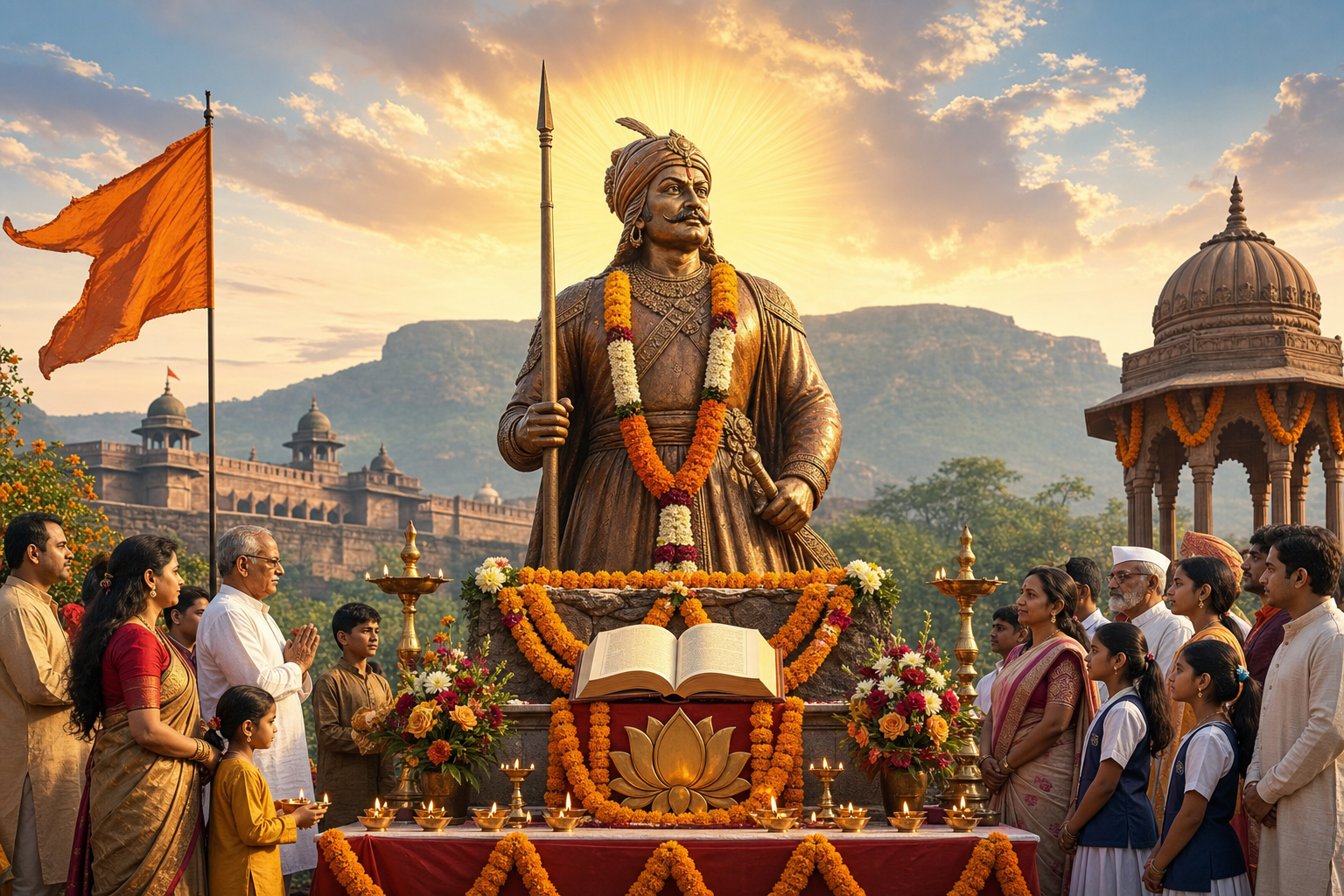
The Maharana Pratap Jayanti programme in Satara became an occasion not merely for ceremonial remembrance, but for a deeper reflection on courage, civilizational duty, and the moral vocabulary of resistance. Speaking at the event, Bhakti Dafle of the Hindu Janajagruti Samiti (HJS) described Hindu Surya Maharana Pratap as a true Dharmaveer who sacrificed everything for Dev, Desh and Dharma. Her statement placed Maharana Pratap within a long Indian tradition in which leadership is evaluated not only by political success, but by fidelity to principle under conditions of extreme pressure.
Satara, with its own historic association with Maratha memory, public mobilization, and Hindu cultural life in Maharashtra, offered a meaningful setting for such a programme. Commemorations of Maharana Pratap Jayanti often function as community events, but their deeper value lies in the way they revive public discussion about dharma, valour, self-respect, and social responsibility. In that sense, the Satara event was part of a broader cultural practice: using historical remembrance to inspire ethical clarity in the present.
Maharana Pratap, the 16th-century ruler of Mewar, occupies a distinctive place in Indian history because his life has come to symbolize steadfastness against imperial domination. His resistance to Mughal expansion, especially in the period associated with Emperor Akbar, has been remembered through chronicles, oral traditions, regional histories, ballads, and public commemorations. The Battle of Haldighati in 1576 is often treated as the central dramatic episode of his life, but the enduring meaning of Maharana Pratap cannot be reduced to one battlefield. His significance rests in a longer struggle for sovereignty, dignity, and the protection of a civilizational way of life.
The phrase Hindu Surya, often used for Maharana Pratap in devotional and cultural settings, expresses this symbolic role. It does not function merely as a title of praise; it conveys the idea of a radiant protector whose life illuminated the path of resistance when compromise would have been easier. Such language must be understood in its cultural context. It reflects the reverence of communities that see in Maharana Pratap a model of Kshatra Dharma, the disciplined duty of courage, protection, and righteous struggle.
Bhakti Dafle’s description of Maharana Pratap as a Dharmaveer is especially important because it frames heroism in ethical rather than purely militaristic terms. A Dharmaveer is not simply a warrior who fights; such a person is one who acts in alignment with dharma even when the cost is severe. In this framework, physical bravery is incomplete without moral restraint, public responsibility, and loyalty to a higher order of truth. Maharana Pratap’s story therefore becomes a study in character as much as a study in warfare.
The expression Dev, Desh and Dharma brings together three interlinked dimensions of Indian civilizational thought. Dev points toward sacred obligation and reverence for the divine. Desh points toward the land, community, and political responsibility. Dharma points toward the moral order that sustains personal conduct and collective life. When applied to Maharana Pratap, the phrase suggests that his sacrifices were not motivated by personal ambition alone, but by an integrated sense of sacred duty, homeland, and righteous conduct.
Historically, Maharana Pratap inherited a difficult political landscape. The Mewar kingdom faced military pressure, diplomatic isolation, and the practical challenge of survival against a far larger imperial power. Yet his refusal to accept subordination has been interpreted by many historians and cultural commentators as a conscious defence of autonomy. The hardships associated with his later years, including life in the Aravalli terrain and the rebuilding of power through persistence, form an essential part of his public memory.
This memory carries emotional force because it presents sacrifice in concrete human terms. Maharana Pratap is remembered not as a distant political figure insulated by palace comfort, but as a ruler who endured loss, displacement, scarcity, and uncertainty. For many participants in such Jayanti programmes, this is where history becomes personally relatable. Families, students, activists, and community members encounter in his life a question that remains relevant: what should be preserved when comfort and conviction come into conflict?
The Satara programme, through the participation of the Hindu Janajagruti Samiti (HJS), appears to have emphasized this moral dimension of remembrance. HJS has often positioned itself around Hindu awareness, cultural education, and public engagement. In a Maharana Pratap Jayanti context, such participation naturally directs attention toward Hindu history, Hindu heroes, and the duty of society to remember figures who embodied resilience. The academic significance of such events lies in their role as transmitters of historical consciousness outside formal classrooms.
Public programmes of this kind also raise an important question about how history should be taught and remembered. Modern education can sometimes reduce historical figures to dates, dynasties, and examination facts. Community commemorations, when conducted with discipline and accuracy, can restore the ethical and emotional depth of history. Maharana Pratap’s life then becomes more than a chapter from medieval India; it becomes a lens through which society discusses freedom, responsibility, leadership, and cultural continuity.
At the same time, responsible remembrance requires balance. Maharana Pratap’s legacy should be studied with seriousness, avoiding both shallow glorification and dismissive reduction. His life belongs to the historical experience of Mewar, Rajput resistance, and the wider Indian struggle to preserve autonomy under changing political conditions. It also belongs to a broader moral tradition in which dharma is understood as the foundation of social order. A mature commemoration can honour his courage while encouraging careful historical study.
The idea of dharma is central to this interpretation. In Hindu philosophy, dharma is not limited to religious identity; it includes duty, justice, ethical conduct, social harmony, and the protection of what sustains life. This wider understanding allows Maharana Pratap’s example to speak across Dharmic traditions. Hinduism, Buddhism, Jainism, and Sikhism all contain powerful reflections on courage, restraint, duty, truth, and the disciplined defence of righteousness. When remembered in this spirit, Maharana Pratap Jayanti can strengthen unity among Dharmic communities rather than narrow historical memory into hostility.
This inclusive Dharmic reading is particularly valuable in contemporary India. Public memory can either divide communities through careless rhetoric or elevate them through shared ethical reflection. Maharana Pratap’s life offers a way to discuss resistance without promoting hatred, courage without aggression, and pride without arrogance. His example calls for inner strength, cultural self-respect, and responsibility toward society. These are values that can be appreciated by anyone committed to justice, freedom, and civilizational continuity.
Satara’s connection to Maharashtra’s own heroic traditions gives the event another layer of meaning. Maharashtra’s public culture has long honoured figures such as Chhatrapati Shivaji Maharaj, whose life also represents sovereignty, dharma, and principled statecraft. When Maharana Pratap is remembered in such a region, the commemoration creates a bridge between Rajput History and Maratha memory. It reminds society that India’s historical defence of dignity was not confined to one geography, language, or community.
This pan-Indian quality is one reason Maharana Pratap remains relevant beyond Rajasthan. His memory appears in school discussions, cultural organizations, public speeches, poetry, local processions, and historical essays across India. The recurring theme is not merely regional pride, but national resilience. His life is invoked whenever communities seek examples of leadership that refused submission to pressure and preserved honour under adversity.
There is also a technical historical point worth emphasizing. Resistance in Maharana Pratap’s time was not only a matter of battlefield confrontation. It involved geography, supply lines, alliances, local support, mobility, terrain knowledge, and political endurance. The Aravalli landscape became part of his strategic world. His struggle shows that sovereignty is sustained not only through armies, but through social cohesion, resourcefulness, and the willingness of a people to stand with their ruler during hardship.
This is why his legacy continues to resonate in discussions of leadership. A leader is tested most severely not when victory is easy, but when defeat, exile, scarcity, or isolation appear unavoidable. Maharana Pratap’s refusal to abandon his principles under such conditions made his life a moral resource for later generations. His example suggests that public life requires more than administrative skill; it requires character, sacrifice, and the courage to bear consequences.
The emotional appeal of Maharana Pratap Jayanti lies in this fusion of history and moral imagination. People do not gather only to remember a ruler; they gather to remember a standard. The standard is that comfort should not become the highest aim of life, and that society must preserve the memory of those who protected its dignity. In a time when public culture is often shaped by convenience, speed, and forgetfulness, such remembrance has a corrective function.
For young participants especially, programmes like the one in Satara can provide a meaningful introduction to Hindu History and Indian cultural heritage. The message is not that the past should be mechanically repeated, but that it should be understood. Maharana Pratap’s life teaches that identity without responsibility becomes empty, and courage without dharma becomes dangerous. The most constructive lesson is therefore disciplined pride: pride grounded in knowledge, humility, and service.
The role of organizations such as the Hindu Janajagruti Samiti (HJS) in such events should be understood within this broader social function. Cultural organizations often serve as intermediaries between historical memory and public participation. Their speeches, gatherings, and commemorations can help communities reconnect with figures who might otherwise remain confined to textbooks. When guided by accuracy and social responsibility, this process can deepen civic awareness and cultural literacy.
Maharana Pratap Jayanti also invites reflection on the meaning of sacrifice in contemporary society. Sacrifice today may not resemble the hardships of a medieval ruler, but the underlying principle remains relevant. Citizens are still asked to sacrifice convenience for truth, selfishness for service, and division for unity. In that sense, Dev, Desh and Dharma can be interpreted as a living ethical framework rather than a slogan from the past.
The Satara event therefore stands as a reminder that historical commemorations are most valuable when they produce ethical seriousness. Bhakti Dafle’s tribute to Hindu Surya Maharana Pratap emphasized his identity as a Dharmaveer who gave everything for Dev, Desh and Dharma. The enduring importance of that message lies in its ability to connect history with duty, courage with restraint, and cultural pride with unity among Dharmic traditions.
Remembered in this way, Maharana Pratap is not only a heroic figure of the past. He remains a living symbol of Valour, Hindu Unity, Cultural Heritage, and principled resistance. The Satara programme offered one more opportunity to transmit that legacy to the present generation with clarity, dignity, and devotion to dharma.
Inspired by this post on Hindu Jagruti Samiti.
