
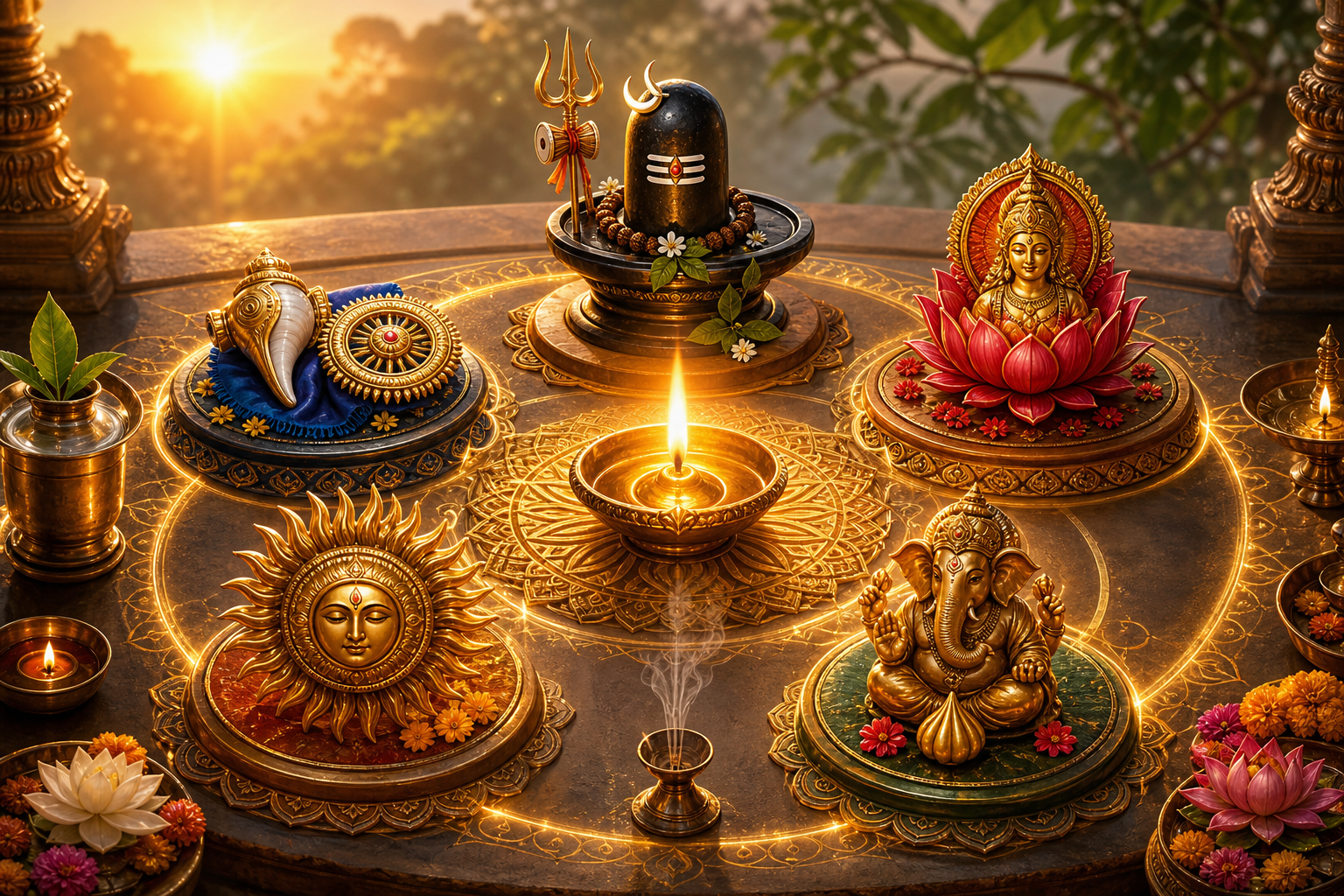
Panchopakas, Pancha Upakas, and the language of fivefold devotion
Panchopakas in Hinduism is best understood through the wider Sanskrit idea of Panchopasana, or fivefold worship. In popular usage, the term is sometimes written as Pancha Upakas or connected with Panchopasakas, meaning practitioners who approach the Divine through five respected devotional streams. The concept is closely related to Panchayatana Puja, a Smarta form of worship in which Shiva, Vishnu, Devi, Surya, and Ganesha are honored together as sacred manifestations of one ultimate reality. This is not merely a ritual arrangement of five deities; it is a philosophical grammar for religious pluralism, spiritual discipline, and unity in diversity within Sanatana Dharma.
The importance of Panchopakas lies in the way it addresses a recurring question in Hindu philosophy: how can one tradition hold many deities, many mantras, many temples, many forms of bhakti, and still speak of one supreme truth? The fivefold model answers this by refusing to reduce spiritual life to a single emotional temperament or ritual pattern. Instead, it recognizes that human beings approach the sacred through different dispositions. Some are drawn to the stillness and austerity of Shiva, some to the compassion and cosmic order of Vishnu, some to the living power of Devi, some to the illuminating presence of Surya, and some to the auspicious beginnings and wisdom of Ganesha.
In academic terms, Panchopakas functions as a theology of disciplined plurality. It does not say that all differences are meaningless. It also does not say that every practice is identical. Rather, it presents a sophisticated view: different devotional forms can be honored without dissolving their distinctiveness. This is one of Hinduism’s most important contributions to religious thought. It allows sectarian depth without requiring sectarian hostility, and it allows a practitioner to remain rooted in an Ishta Devata while still respecting other sacred paths.
The five devotional streams within Panchopakas
The first stream is Shaiva worship, centered on Lord Shiva. Shaivism includes temple ritual, mantra, yoga, ascetic ideals, philosophical inquiry, and profound devotional literature. Shiva is approached as Mahadeva, the great Lord; as the yogi beyond worldly attachment; as Nataraja, the cosmic dancer; as Dakshinamurthy, the silent teacher; and as the compassionate one who receives the prayers of all beings. Within Panchopakas, Shiva represents the path of interiority, dissolution of ego, and contemplative freedom.
The second stream is Vaishnava worship, centered on Lord Vishnu and his avataras such as Rama and Krishna. Vaishnavism gives special emphasis to preservation, dharma, divine grace, surrender, and loving devotion. The Bhagavad Gita, Ramayana, Bhagavata Purana, temple traditions, kirtan, and bhajans have shaped the emotional and philosophical life of countless devotees. Within the fivefold model, Vishnu represents order, compassion, protection, and the sustaining intelligence that upholds the cosmos.
The third stream is Shakta worship, centered on Devi or Shakti, the Divine Feminine. Shaktism views the Goddess not as a secondary power but as the living energy of existence itself. She is worshipped as Durga, Lakshmi, Saraswati, Kali, Tripura Sundari, Parvati, and countless regional forms. The Shakta vision is especially important because it corrects any narrow understanding of divinity as exclusively masculine. In Panchopakas, Devi represents power, creativity, nourishment, protection, wisdom, and transformation.
The fourth stream is Saura worship, centered on Surya, the Sun. The Saura tradition may be less visible today as a separate sectarian identity, yet Surya worship remains deeply embedded in Hindu practice through Sandhya, Surya Namaskara, Arghya to the Sun, temple worship, festivals, and Vedic hymns. Surya represents light, health, discipline, time, vision, and the visible presence of cosmic order. In the fivefold arrangement, Surya reminds the practitioner that spirituality is not an escape from the world but a clearer participation in the rhythm of life.
The fifth stream is Ganapatya worship, centered on Lord Ganesha. Ganesha is honored across Hindu traditions as Vighneshwara, the remover of obstacles, and as the deity invoked at the beginning of sacred and worldly undertakings. The Ganapatya tradition sees Ganesha not only as an auspicious beginning but as the supreme reality itself. In Panchopakas, Ganesha represents intelligence, humility, groundedness, auspicious action, and the capacity to begin again after confusion or difficulty.
Panchayatana Puja as the ritual expression of unity
Panchayatana Puja gives visible form to the philosophy behind Panchopakas. In this arrangement, five deities are placed in a sacred geometric pattern, often with one deity in the center and the other four placed around it. The central deity varies according to the practitioner’s lineage, family practice, or Ishta Devata. A Shaiva household may place Shiva in the center; a Vaishnava household may place Vishnu in the center; a Shakta household may place Devi in the center; and so on. The ritual logic is subtle: one path may be central for a practitioner, but the other paths are not rejected.
This arrangement carries a powerful social and psychological insight. Human beings naturally form deep attachments to particular symbols, names, stories, and forms of worship. A family that has prayed to Krishna for generations may experience Krishna not as an abstract theological category but as the intimate presence of grace in daily life. A devotee of Shiva may find in the Shiva Linga a direct encounter with stillness and transcendence. Panchayatana Puja respects such intimacy while preventing intimacy from hardening into contempt for other forms of worship.
The fivefold altar also reflects a technical feature of Hindu ritual culture: form is used to train perception. The murti, mantra, yantra, flower, lamp, water, and offering are not random decorative elements. They discipline the senses and direct attention toward sacred presence. In Panchopakas, the practitioner is trained to see unity without erasing difference. The eye moves from one deity to another, but the mind is gradually educated to recognize a shared metaphysical ground.
The philosophical foundation: Saguna Brahman and Nirguna Brahman
The deeper philosophical foundation of Panchopakas is the relationship between Saguna Brahman and Nirguna Brahman. Saguna Brahman refers to the Divine with attributes, name, form, quality, and relational presence. Nirguna Brahman refers to the ultimate reality beyond attributes, beyond conceptual limitation, and beyond sensory form. Hindu philosophy has long recognized that the human mind often needs form in order to approach the formless. The image, name, and ritual are not treated as final limits on truth; they are gateways into subtler realization.
From this perspective, Shiva, Vishnu, Devi, Surya, and Ganesha are not rival claimants in a competitive theology. They are honored as sacred modes through which the devotee approaches the same ultimate reality. This does not mean that all schools of Hindu philosophy explain the matter identically. Advaita Vedanta, Vishishtadvaita, Dvaita, Shaiva Siddhanta, Kashmir Shaivism, Shakta Tantra, and other systems have different metaphysical vocabularies. Yet the practical genius of Panchopakas lies in its ability to create shared ritual respect even where philosophical explanations differ.
The concept of Ishta Devata is essential here. Ishta Devata means the chosen or cherished form of the Divine. It acknowledges that spiritual life is not merely intellectual agreement with doctrine; it is also love, memory, temperament, family inheritance, guru guidance, and personal resonance. A mature religious culture does not force every seeker into the same devotional mold. Panchopakas preserves this freedom while grounding it in dharmic responsibility.
Adi Shankara and the broader Smarta context
Panchayatana Puja is often associated with Adi Shankara and the Smarta tradition, although evidence suggests that fivefold sacred arrangements and multi-deity worship patterns existed in older forms as well. The Smarta approach is especially important because it articulates a non-sectarian framework within Hinduism. It does not demand that the devotee abandon Shiva for Vishnu, Devi for Surya, or Ganesha for another deity. Instead, it interprets these forms as legitimate approaches to the same supreme truth.
In this sense, Panchopakas should not be reduced to a historical footnote or a household ritual. It is a civilizational method for managing religious diversity. Where religious identity can become a source of rivalry, the fivefold model places multiple sacred centers into a single field of reverence. The practical message is clear: devotion can be intense without becoming exclusionary, and philosophical conviction can be firm without becoming hostile.
Some traditions later speak of Shanmata, the sixfold system, by adding Skanda or Kartikeya to the fivefold pattern. This development does not weaken the Panchopakas idea; it extends the same principle. Hinduism has often expanded sacred frameworks to include regional, familial, philosophical, and devotional realities. The underlying principle remains consistent: divine truth may be approached through multiple valid forms, provided the approach is disciplined by dharma, humility, and sincere practice.
Why Panchopakas matters for Hindu unity
The unity represented by Panchopakas is not political uniformity or social sameness. It is a spiritual unity rooted in recognition. A Shaiva need not become a Vaishnava to honor Vishnu. A Vaishnava need not become a Shakta to respect Devi. A devotee of Ganesha need not diminish Surya. This is a refined form of pluralism because it does not ask people to dilute their own commitments. It asks them to understand their commitments within a larger dharmic ecology.
This distinction is especially valuable in modern discussions of Hindu identity. Unity is sometimes misunderstood as the elimination of difference. Panchopakas offers a more durable model: unity through properly ordered diversity. The temple, the household altar, the festival calendar, the mantra tradition, and the philosophical school can all differ, yet remain bound by dharma, reverence, and the pursuit of moksha.
For many practitioners, the emotional power of this idea is felt most strongly in ordinary family life. One person in a household may feel close to Krishna, another to Shiva, another to Durga, another to Ganesha. Rather than treating these preferences as conflict, Hindu practice often makes room for all of them. A single prayer room may contain several forms, and the family may move through the year with different festivals, vratas, and stories. Panchopakas gives theological dignity to this lived experience.
Dharmic harmony beyond sectarian boundaries
The broader dharmic significance of Panchopakas also supports respectful engagement among Hinduism, Buddhism, Jainism, and Sikhism. These traditions are not identical, and their doctrinal differences should not be carelessly erased. Buddhism has its own analysis of suffering and liberation. Jainism has a rigorous path of ahimsa, karma, and purification. Sikhism centers its devotional and ethical life around Ik Onkar, Guru Granth Sahib, naam, seva, and sangat. Yet all these dharmic traditions share a civilizational concern with discipline, liberation, ethical responsibility, and transformation of consciousness.
Panchopakas contributes to this wider dharmic harmony by modeling a principle that can be extended with care: sincere paths should be understood before they are judged. The fivefold Hindu model teaches that difference need not automatically produce rejection. When applied with intellectual honesty, this principle helps build mutual respect among dharmic communities while preserving the integrity of each tradition. Such unity is not a vague slogan; it is a demanding discipline of humility, study, and self-restraint.
Common misunderstandings about Panchopakas
A common misunderstanding is that Panchopakas means all deities are interchangeable in a simplistic sense. This is inaccurate. Shiva, Vishnu, Devi, Surya, and Ganesha carry distinct theological, ritual, mythological, and emotional meanings. Their mantras, iconography, festivals, scriptures, and modes of worship differ. The fivefold model does not flatten these differences. It places them within a shared sacred order.
Another misunderstanding is that multi-deity worship implies confusion. This objection usually arises from religious frameworks that expect one exclusive devotional focus for all practitioners. Hindu traditions generally operate with a different logic. Multiplicity is not automatically disorder. In Hindu thought, multiplicity can be a sign of abundance, relational depth, and symbolic precision. Just as one reality may be described through many philosophical categories, the Divine may be approached through many sacred forms.
A third misunderstanding is that Panchopakas is only a Smarta practice and therefore irrelevant to other Hindus. Historically, the ritual form may be strongly associated with Smarta households, but the underlying value of honoring multiple forms of the Divine is visible across Hindu culture. Many Shaiva temples include shrines to Ganesha, Devi, Vishnu, or Surya. Vaishnava communities honor Ganesha in auspicious contexts. Shakta worship often integrates Shiva as inseparable from Shakti. Hindu practice is rarely as rigid as abstract sectarian labels suggest.
Ritual, psychology, and spiritual discipline
The ritual structure of Panchopakas also has psychological depth. Each deity can be seen as cultivating a different inner quality. Shiva trains detachment, silence, and fearlessness. Vishnu trains trust, order, and ethical steadiness. Devi trains courage, care, and transformative power. Surya trains clarity, discipline, and vitality. Ganesha trains intelligence, patience, and auspicious action. A practitioner who contemplates all five is not merely performing external worship; the practitioner is educating the whole personality.
This is why Hindu ritual should not be dismissed as mechanical repetition. Repetition can become mechanical when the mind is absent, but when performed with attention, it becomes a method of refinement. Offering a flower, lighting a lamp, reciting a mantra, or bowing before a murti can reshape perception over time. Panchopakas uses the body, speech, mind, memory, and emotion as instruments of spiritual training.
The fivefold model is also practical for householders. It does not require withdrawal from society or rejection of family duties. It can be practiced through daily puja, festival observance, scriptural study, mantra japa, ethical living, and reverence for inherited traditions. This householder-friendly character is one reason the idea has remained culturally meaningful. It allows spiritual life to enter the rhythm of ordinary days rather than remaining confined to monastic or scholastic settings.
Panchopakas and modern relevance
In the modern world, religious identity is often pressured by two extremes. One extreme demands rigid exclusivism, where only one form, one doctrine, or one institution is treated as valid. The other extreme dissolves all traditions into vague spirituality without discipline or memory. Panchopakas avoids both errors. It supports rooted devotion while encouraging respect for other sacred forms. It allows specificity without hostility and openness without shallowness.
This balance is especially relevant for younger Hindus and the global Hindu diaspora. Many encounter Hinduism through family rituals before they understand its philosophical vocabulary. A child may see Ganesha before an exam, Lakshmi during Deepavali, Shiva on Mahashivaratri, Krishna during Janmashtami, and Durga during Navaratri. Without explanation, this can appear like a loose collection of customs. Panchopakas provides an interpretive key: the many forms are not a weakness of Hinduism; they are part of its spiritual architecture.
The model also matters for interfaith and inter-dharmic dialogue. It shows that Hindu pluralism is not a modern public-relations invention. It is rooted in ritual practice, philosophical reflection, and social memory. When presented carefully, Panchopakas can help explain why Hinduism has historically made room for many paths, gurus, deities, practices, and metaphysical systems while still maintaining a recognizable civilizational identity.
A disciplined vision of unity in diversity
The enduring lesson of Panchopakas is that unity does not require sameness. A sacred civilization can honor many forms without becoming fragmented, provided those forms are held within dharma. Shiva, Vishnu, Devi, Surya, and Ganesha are not merely five names on a ritual list. They are five profound ways of encountering reality: silence, preservation, power, illumination, and wisdom. Together, they form a spiritual mandala in which the human heart learns reverence without narrowness.
Panchopakas therefore remains a vital concept for Hindu philosophy, Hindu rituals, spiritual diversity, and dharmic unity. It invites practitioners to go deeper into their chosen path while widening their respect for other paths. It teaches that devotion can be personal, philosophical, communal, and universal at the same time. In a world often divided by identity and ideology, this fivefold vision offers a serious and humane model of sacred coexistence.
Further study may consult introductory references on Panchayatana Puja, Shanmata, Hindu denominations, and Shaktism, while also engaging primary Hindu scriptures, traditional commentaries, temple practice, and living sampradaya teaching for a fuller understanding.
Inspired by this post on Hindu Blog.
