
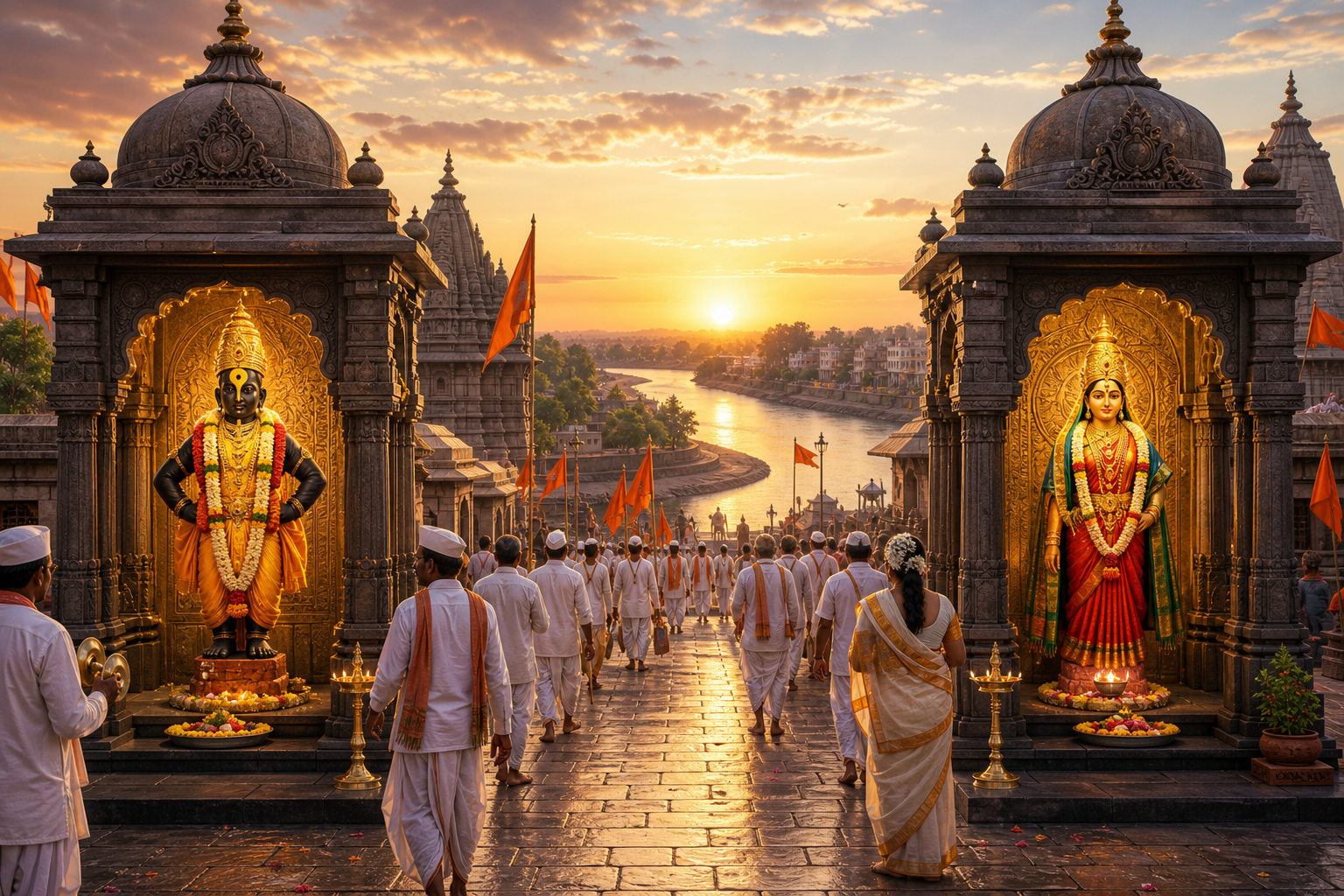
Pandharpur, situated on the banks of the Chandrabhaga or Bhima River in Maharashtra, is among the most cherished centres of bhakti in India. Its sacred geography is not merely a matter of temple placement, pilgrimage routes, or ritual architecture; it is a living theological map. At the heart of this map stand Lord Vitthal, also known as Vithoba or Panduranga, and his consort Rukmini, lovingly worshipped as Rakhumai and, in local devotional memory, associated with the name Padubai. The fact that Vitthal and Rakhumai are worshipped in separate temples within the same sacred complex has long invited reflection, reverence, and storytelling.
The separation should not be misunderstood as division in a worldly sense. In the devotional imagination of Pandharpur, it represents a profound spiritual teaching. The divine couple remains inseparable in essence, yet their distinct shrines allow devotees to approach each form with a particular emotional and theological sensitivity. Vitthal embodies patient presence, accessible divinity, and the grace that waits for the devotee. Rakhumai embodies dignity, inner strength, sacred feminine authority, and the emotional truth that even divine love must honour respect.
The popular story associated with the separate temples begins with Rukmini’s displeasure and withdrawal. In several oral traditions, she leaves after feeling slighted, often in connection with Krishna’s affectionate regard for another devotee or beloved. She comes toward the region of Pandharpur and resides apart. Krishna, seeking to reconcile with her, follows. Yet in Pandharpur, the narrative intersects with another foundational legend: the story of Pundalik, the devotee whose service to his parents becomes so spiritually powerful that the Lord himself waits for him.
According to the Varkari tradition, when Vitthal arrives at Pundalik’s dwelling, Pundalik is engaged in serving his parents. Rather than abandoning that duty, he offers the Lord a brick and asks him to wait. Vitthal stands upon the brick, hands placed on his hips, accepting the devotee’s priority of seva. This posture, now iconic, is central to the identity of Vithoba of Pandharpur. The Lord does not demand immediate attention; he sanctifies disciplined service, humility, and the ethical life of the householder.
Rakhumai’s separate shrine adds a complementary lesson. Her presence reminds devotees that bhakti is not sentimental escape from human relationships. It is a refining force that enters marriage, family, dignity, grief, anger, patience, and reconciliation. The story of Rukmini’s separation gives sacred language to emotional injury without reducing it to weakness. In this sense, Rakhumai becomes a powerful image of self-respect within devotion, showing that love is deepest when it is joined with honour.
The name Rakhumai itself expresses intimacy. It is not the distant name of a goddess approached only through royal protocol; it is the affectionate name of the divine mother as remembered in Maharashtra’s devotional culture. The suffix “mai” evokes motherhood, tenderness, and nearness. Devotees do not merely see Rakhumai as the consort of Vitthal; they experience her as a compassionate presence in her own right. Her temple affirms that the feminine divine is not secondary but fully worthy of independent worship.
This point is important for understanding Pandharpur’s theology. Hindu tradition contains many paired forms of divinity, such as Lakshmi-Narayana, Radha-Krishna, Sita-Rama, Shiva-Parvati, and Vitthal-Rakhumai. These forms express unity, but they do not erase distinction. The divine feminine is not merely an ornament to the divine masculine. She is shakti, moral intelligence, compassion, abundance, and the principle through which relationship becomes sacred. The separate temple of Rakhumai gives this principle architectural expression.
The arrangement also reflects the inclusive and emotionally rich nature of the Varkari sampradaya. The Varkari movement, associated with saints such as Dnyaneshwar, Namdev, Eknath, Tukaram, Janabai, Chokhamela, and others, emphasizes devotion that is accessible across social boundaries. Its songs and abhangas bring high philosophy into ordinary speech. In that world, divine stories are not remote myths; they become mirrors for daily conduct. The pilgrim walking toward Pandharpur sees in Vitthal and Rakhumai a theology of relationship, service, longing, and return.
The sacred separation therefore carries a pedagogical purpose. Vitthal’s temple teaches that God waits for the devotee who is absorbed in righteous duty. Rakhumai’s temple teaches that devotion must honour emotional truth and relational dignity. Together, they form a complete spiritual lesson: love must be patient, duty must be sacred, and reconciliation must never erase respect. These are not abstract ideals; they are embodied in stone, ritual, pilgrimage, and collective memory.
From a cultural perspective, the temples of Pandharpur demonstrate how sacred geography preserves layered traditions. The town is not organized only around royal grandeur or monumental spectacle. Its holiness is carried by movement: the Wari pilgrimage, the singing of abhangas, the dust of the road, the rhythm of cymbals, the saffron flags, the tulsi malas, and the collective cry of “Gyanba Tukaram.” Pilgrims do not encounter Vitthal and Rakhumai as isolated icons; they encounter them through a shared devotional civilization.
The Wari itself gives the story wider significance. Every year, especially around Ashadhi Ekadashi and Kartiki Ekadashi, lakhs of devotees travel toward Pandharpur in disciplined pilgrimage. Many walk in palkhis associated with saints such as Dnyaneshwar and Tukaram. The journey is physically demanding, but its emotional power lies in equality and shared remembrance. In this collective setting, the separate temples of Vitthal and Rakhumai invite devotees to contemplate both the Lord who waits and the Mother who must be approached with reverence.
The story also offers a subtle corrective to superficial readings of divine conflict. In many Hindu narratives, apparent disagreement among divine beings is not meant to suggest ordinary discord. It dramatizes philosophical truths. Rukmini’s withdrawal is not a denial of love; it is a revelation that love without attentiveness becomes incomplete. Vitthal’s waiting is not passivity; it is divine humility. The devotee is asked to learn from both gestures rather than reduce the tale to domestic quarrel.
In this way, Pandharpur preserves an unusually humane theology. It does not deny hurt, longing, or misunderstanding. Instead, it sanctifies the process by which relationship matures. Many devotees find this deeply relatable because spiritual life often unfolds within imperfect human circumstances. Families carry duties, tensions, memories, and hopes. The story of Vitthal and Rakhumai allows these realities to enter the sacred space, where they can be contemplated with tenderness rather than shame.
The figure of Pundalik is crucial to this interpretation. His service to his parents is not treated as a distraction from God. It becomes the very act that brings God to his doorstep. This is a distinctively dharmic insight: spiritual realization is not always found by abandoning responsibility; it may be found by performing responsibility with purity, humility, and unwavering attention. Vitthal’s willingness to stand on the brick confirms that seva, when performed without ego, becomes worship.
Rakhumai’s shrine deepens the same principle. If seva is sacred, then the people within relationships must also be treated as sacred. A culture that honours parents must also honour spouses, mothers, daughters, sisters, devotees, and the feminine principle in all forms. The temple of Rakhumai therefore stands as a spiritual reminder that devotion cannot be selective. A person cannot claim bhakti while neglecting dignity, compassion, and mutual respect in everyday life.
The association of Rakhumai with Padubai in local devotional vocabulary also points to the regional nature of sacred memory. Hindu worship often allows pan-Indian deities to take local names, forms, songs, and emotional textures. This does not fragment the tradition; it enriches it. The same Rukmini revered in broader Vaishnava theology becomes Rakhumai in Maharashtra’s bhakti landscape, intimate to the speech, music, and domestic devotion of the people.
This regional intimacy is one reason Pandharpur has remained so powerful across centuries. The devotee does not need elite learning to approach Vitthal. The path is opened through nama-smarana, kirtan, seva, humility, and pilgrimage. Yet the simplicity is not intellectually shallow. Beneath the accessible language lies a sophisticated theology of presence, embodiment, relational ethics, and divine accessibility. Pandharpur is both folk memory and philosophical depth.
The separate temples also illuminate the Hindu understanding of unity in diversity. Unity does not require uniformity. Vitthal and Rakhumai are united in divine essence, but their distinct shrines preserve distinct modes of devotion. This principle resonates across dharmic traditions more broadly. Hinduism, Buddhism, Jainism, and Sikhism have different metaphysical languages and spiritual disciplines, yet they share deep concerns with ethical conduct, self-transformation, compassion, remembrance, and liberation from egoic narrowness.
Seen through that wider dharmic lens, the Pandharpur tradition encourages harmony rather than rivalry. The sacred does not become smaller when approached through multiple forms. A shrine to Vitthal does not diminish Rakhumai; a shrine to Rakhumai does not diminish Vitthal. Their devotional separation teaches that reverence can accommodate distinction without creating hostility. This is a valuable lesson for any society seeking unity without flattening its spiritual diversity.
Architecturally and ritually, separate shrines shape the pilgrim’s experience. Moving from Vitthal to Rakhumai is not simply a change of location; it is a change of devotional mood. Before Vitthal, the devotee may feel the nearness of a Lord who waits patiently for human awakening. Before Rakhumai, the devotee may feel the gaze of the Mother who knows sorrow, honour, affection, and strength. The body moves through space, and the mind moves through meaning.
The emotional intelligence of this arrangement is striking. Many religious traditions speak of divine love, but Pandharpur gives that love a domestic and relational vocabulary. The divine couple is not presented only in cosmic abstraction. They are encountered through waiting, longing, separation, return, and worship. This allows ordinary devotees to recognize their own lives within sacred narrative. The temple becomes a place where human complexity is not rejected but elevated.
At the same time, the story must be handled with care. It should not be read as a license for ego, resentment, or permanent estrangement. The deeper teaching is balance. Rakhumai’s dignity must be honoured, and Vitthal’s patience must be understood. Pundalik’s seva must be admired, but not distorted into neglect of other duties. The tale asks for integration: devotion to God, service to family, respect for the feminine, and humility in relationships.
This is why the story remains relevant in modern life. Many people experience tension between spiritual aspiration and family responsibility. Others struggle to balance love with self-respect. Some mistake patience for weakness, while others mistake assertion for separation. The sacred geography of Pandharpur offers a more mature framework. It teaches that patience, dignity, service, and reconciliation are not opposing values. They are parts of a complete dharmic life.
For devotees, the darshan of Vitthal is often described as intensely personal. The standing form, dark and compact, hands on hips, feet upon the brick, conveys immediacy. Vitthal is royal yet approachable, transcendent yet village-like, Vishnu-Krishna yet distinctively Maharashtrian in devotional personality. He stands as the Lord who has entered the rhythm of the people’s songs. His stillness is not distance; it is availability.
Rakhumai’s darshan, by contrast, carries the tenderness and authority of the Mother. Her separate presence creates a devotional pause. The pilgrim is invited to remember that no spiritual life is complete without honouring the feminine source of grace. In bhakti, the Mother is not merely a figure of comfort; she is also moral clarity. She sees whether devotion has softened the heart or merely decorated the ego.
The story also highlights a recurring feature of Hindu sacred narratives: divine play, or lila, often uses human emotions to communicate higher truths. Anger, longing, waiting, and reconciliation are not presented as final realities. They are symbolic movements through which the devotee learns. Rakhumai’s separation becomes a spiritual mirror. Vitthal’s waiting becomes an ethical instruction. Pundalik’s service becomes a model of embodied dharma.
In academic terms, the Pandharpur tradition can be read as a convergence of Vaishnava theology, regional devotional practice, pilgrimage culture, saint literature, and household ethics. Its power lies in the fact that these layers are not artificially separated. The philosophical and the domestic, the temple and the road, the Sanskritic and the vernacular, the individual and the community, all meet in the worship of Vitthal and Rakhumai.
This convergence is especially visible in abhang literature. The saints of Maharashtra often addressed Vitthal with intimacy, complaint, surrender, humour, and philosophical insight. Their poetry demonstrates that bhakti is not passive emotionalism. It is a disciplined transformation of the heart through remembrance, humility, and truthfulness. Within this world, Rakhumai’s presence ensures that the devotional field remains relationally complete.
The separation of the temples can therefore be understood as a sacred grammar. It teaches devotees how to read the divine relationship without collapsing its meanings. Vitthal and Rakhumai are one, yet they are approached differently. Their distinction preserves reverence. Their unity preserves love. Their story preserves the tension through which mature spiritual understanding emerges.
There is also a social lesson here. A community shaped by Pandharpur’s bhakti is reminded that spiritual greatness is not measured only by scholarship, ritual privilege, or institutional authority. Pundalik’s service, the Varkari’s walk, the saint’s song, the mother’s prayer, and the labourer’s remembrance all become valid offerings. Vitthal stands for the devotee who serves. Rakhumai stands for the dignity that must accompany devotion.
Such a message remains important in a time when religious identity can sometimes become loud without becoming deep. Pandharpur’s wisdom is quieter and more demanding. It asks whether devotion has made one more patient, more respectful, more truthful, and more compassionate. It asks whether the sacred feminine is honoured not only in ritual but in conduct. It asks whether family duty is performed as seva rather than burden.
The temples of Vitthal and Rakhumai also preserve a vision of companionship that is spiritually mature. Their separation is not abandonment. It is a contemplative distance through which devotees learn the value of reunion. In human life too, distance can sometimes reveal what closeness has neglected. The story encourages reflection, humility, and the restoration of honour where it has been wounded.
For the pilgrim, this lesson becomes tangible. One may arrive tired from the road, carrying personal burdens, family memories, unanswered prayers, or quiet regrets. The darshan of Vitthal offers assurance that the divine waits. The darshan of Rakhumai offers assurance that dignity is sacred. Together, they create a devotional experience that is both consoling and corrective.
The enduring relevance of Pandharpur lies in this union of tenderness and discipline. It does not present bhakti as escape from the world. It presents bhakti as a way of transforming the world through service, remembrance, and right relationship. The separate temples of Vitthal and Rakhumai are therefore not an anomaly to be explained away. They are a sacred teaching preserved in architecture.
Ultimately, the story of Vitthal and Rakhumai at Pandharpur reveals a central dharmic insight: divine love is vast enough to include longing, separation, duty, dignity, and reconciliation. The Lord waits on the brick because devotion must honour seva. The Mother stands in her own shrine because love must honour self-respect. The pilgrim moves between them and discovers that the path of bhakti is not merely emotional devotion; it is the cultivation of a whole and ethical heart.
In that sense, Pandharpur’s sacred separation is not separation at all. It is a form of teaching. Vitthal and Rakhumai remain united in the consciousness of the devotee, while their distinct temples preserve the fullness of their message. One shrine teaches patience; the other teaches dignity. One recalls service; the other recalls honour. Together, they offer a timeless model of devotion rooted in love, dharma, and spiritual unity.
Inspired by this post on Hindu Blog.
