
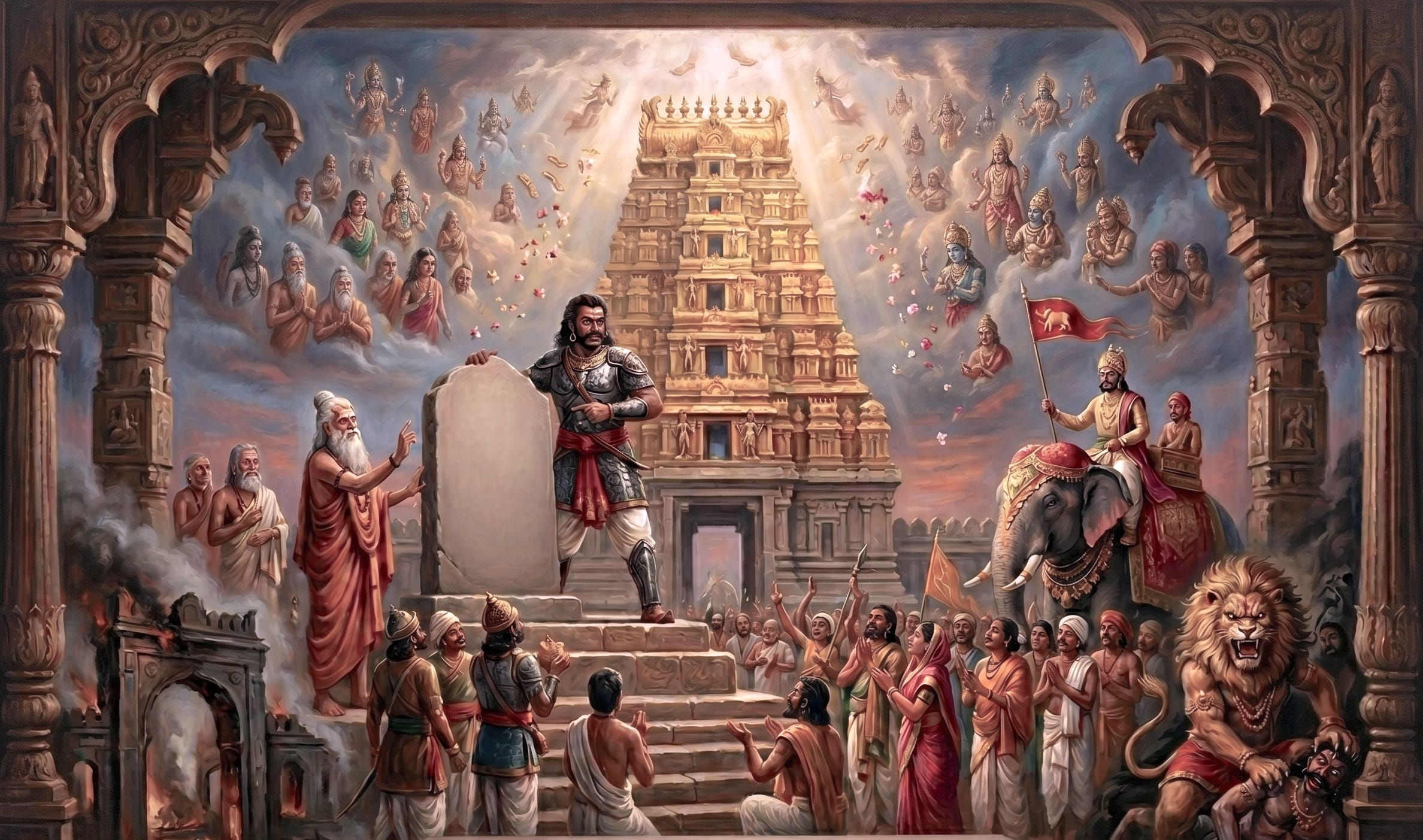
The Chennakeshava Temple at Belur, Karnataka, preserves in stone and inscription an extraordinary account of resilience. In 1397 CE, contemporary records describe an assault from Kalaburagi (Gulbarga) that broke and burned the temple’s monumental gateway. In the immediate aftermath, Dandanayaka Gunda (Gunda Dandanatha), serving under Harihara II of the Vijayanagara Empire, rebuilt the gateway tower to a height of seven storeys. This reconstruction, commemorated in a celebrated Belur inscription, reaffirmed the continuity of worship, public life, and urban pride in the heart of the Hoysala–Vijayanagara cultural landscape.
Understanding the inscription’s spirit benefits from the emblematic language of the Vijayanagara age. Courtly and devotional sources repeatedly invoke Yajna Varāha Swami and Narasimha Swami as metaphors of liberation and protection. Varāha Swami functioned as the Rāja Lānchana (royal emblem), while Narasimha Swami was the favoured Deity of several Vijayanagara monarchs, including Śrī Krishna Devaraya. Numerous Narasimha temples across Andhra, Telangana, and Karnataka date to this epoch, echoing a civilizational vision in which the protection of dharma and the safeguarding of cultural institutions moved in tandem.
Politically, the inscription belongs to a period when the Vijayanagara Empire consolidated a fractured Dakṣiṇāpatha after decades of turbulence. Guided by Vidyāraṇya Swami and Sāyaṇācārya, the Sangama founders built a durable Hindu polity that rivalled the earlier Hoysala Empire in scale, wealth, and splendourstretching, at its peak, from Cuttack to Kanyakumari and from Dabhol to the Malabar. Literature such as Nori Narasimha Sastry’s historical novel Mallareddy has vividly imagined the on-the-ground consequences of the preceding upheavals, helping modern readers grasp why communities rallied so forcefully around their temples and civic institutions.
At Belur, the epigraphic voice is both precise and poetic. It records, in translational paraphrase: “Turuka Ganga-Salaara of Kalaburagi invaded, broke and burned the gateway of the Chennakeshava Temple. In response, this temple gateway tower (gopura) was caused to be rebuilt to a height of seven storeys.” It then celebrates the finished tower as “the ornament of the city,” comparing it to Sumeru, Himavan, Malaya, and Mandara, the great mountains associated with the wielder of the Śārn’ga bow (Lord Vishnu). One soaring metaphor declares that its peak rises so high as to brush the celestial realm, loosening the golden anklets from the lotus feet of the divine maidens (Sid’dhāṅganas).
Architecturally, the project reflects a Vijayanagara interventionoften called a Rayagopurafronting a Hoysala core. While the Hoysala shrine and mantapas are executed in chloritic schist (soapstone) with a stellate plan, lathe-turned pillars, and filigreed sculpture, the entrance tower belongs to the Drāviḍa typology favoured by Vijayanagara patronage. A seven-storeyed (sapta-tala) gopura typically rises from a sturdy granite base, with superstructure tiers of brick and lime mortar diminishing in mass as they ascend. Characteristic elements include repeated kapota cornices, hāra moldings, and rhythmic kuta–śālā–pañjara arrangements, creating the mountain-evoking profile that epigraphic poetry extols.
Technically, such a tower demanded careful engineering at the foundation and lower talas to distribute vertical loads, with lighter materials above to reduce thrust on the base. The alignment of the mahā-dvāra with the sanctum axis, the placement of the bali-pīṭha and dhvaja-stambha in the forecourt, and the calibrated sightlines to the Kesava vimana ensured ritual coherence and processional flow. The gopura thus functioned not only as architecture but also as a ritual instrument: it framed the sacred threshold, mediated the passage between the civic street and temple prākāra, and signalled both welcome and protection.
Financing and execution in the late fourteenth century would have involved a matrix of royal orders from Harihara II, local village assemblies, artisan guilds (śreṇi), sthapatis, and ritual specialists overseeing consecration (kumbhābhiṣeka). Material procurement from regional quarries, timber yards, and lime kilns indicates a resilient supply chain, the reactivation of whichimmediately after conflictspeaks to the organizational capacity of the Vijayanagara state and the solidarity of stakeholders. Inscriptions across the realm attest to similar collaborative frameworks in which grant-holders, merchants, farmers, and craftsmen co-produced sacred infrastructure.

The inscription at Belur also exemplifies a distinctive Vijayanagara ethos frequently encapsulated in the phrase Pūrvada maryāde“ancient etiquette, laws, customs and manners.” Rather than replacing local norms, the state emphasized continuity and protection, reiterating rights, festivals, endowments, and ritual obligations village by village. In practical terms, this meant that restoration after destruction was framed as a return to order, not merely a royal gift. The rebuilt gopura, therefore, embodied constitutional memory: it re-established customary pathways of worship and civic exchange that knit society together.
Within this framework, Gunda Dandanatha emerges as a pivotal figure. As a dandanāyaka (commander-administrator), he combined martial responsibility with custodianship of public works. The Belur inscription credits him, alongside Harihara II, with restoring the Chennakeshava Temple’s dignity and urban centrality. Public history, museum labels, and site signage sometimes compress such multifaceted contributions into generic attributions. A more rigorous heritage interpretationnaming figures like Gunda Dandanathawould anchor visitors’ understanding in verifiable epigraphy and highlight the many hands that sustained the temple’s life.
Because the objective of heritage work today is civic cohesion, the Belur narrative is best read as a case study in how communities across dharmic traditionsHindu, Buddhist, Jain, and Sikhcan approach cultural resilience: by repairing institutions, renewing ethical norms, and prioritizing shared public spaces. Medieval inscriptions often use the vocabulary of their age to describe conflict; responsible interpretation places those terms in context while emphasizing the constructive response that followedrebuilding, rededication, and renewed service to society.
Belur’s Hoysala ensembles, today inscribed on the UNESCO World Heritage List, remain living places of worship, scholarship, and craft appreciation, not mere “tourist attractions.” Visitors frequently report a hush at the threshold: the seven-storeyed vision evoked by the inscription invites them to imagine how a community, still shaken by assault, chose not retaliation in stone but restoration in stone. Interpreting the site through this lensresilience, ritual coherence, and urban well-beingresonates across India’s plural dharmic fabric.
Several practical steps could further align site experience with the inscription’s spirit. A high-quality, bilingual reproduction of the 1397 text at the pura-dvara, accompanied by transliteration and an accessible, academically grounded translation, would let every pilgrim and visitor encounter Gunda Dandanatha’s commission on its own terms. QR-linked epigraphic dossiers, brief notes on Vijayanagara–Hoysala architectural interfaces, and acknowledgments of artisan lineages would strengthen place-based learning and nurture respectful stewardship. In this way, the gopura’s story can continue to do what it has always done: welcome, orient, and elevate.
Ultimately, the 1397 Belur inscription is less a relic than a guide. It teaches that prosperity and stability return when communities uphold Pūrvada maryāde, when rulers and residents collaborate in good faith, and when sacred architecture is treated as a public trust. Remembering Gunda Dandanatha and Harihara II in the very space their work ennobled is not merely nostalgic; it is a disciplined act of cultural memory that strengthens a unified, dharmic approach to heritage preservation in Karnataka and beyond.
Inspired by this post on Dharma Dispatch.
