
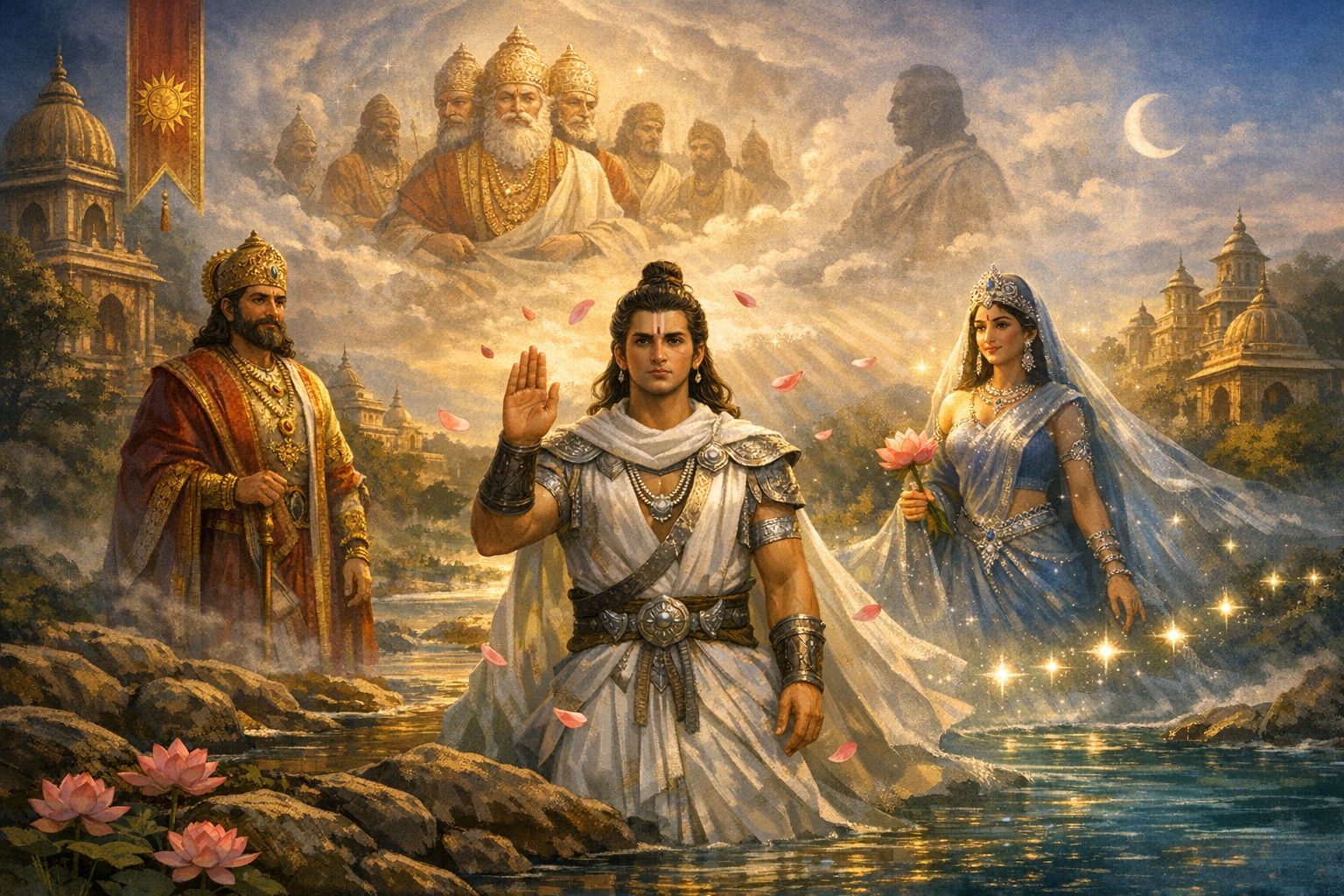
Long before the Kurukshetra War and the towering presence of Bhishma, a quieter, older current began to flow that would eventually shape the Mahabharata. That current is the story of King Mahabhisha, a famed ruler of the Ikshvaku (Suryavamsha) lineage, whose single lapse in celestial decorum led to a chain of rebirths, vows, and dynastic turns. Read within the Mahabharata’s Adi Parva and echoed in later Puranic retellings, this narrative is a precise study in karma, dharma, and consequencehow a momentary indulgence ripples across cosmic and human time.
The core scene unfolds in Brahma’s court. Mahabhisha, whose austerities and righteous rule had earned him access to the highest assembly, beheld the river-goddess Ganga as she entered. A sudden breeze displaced her garments. While the devas and rishis lowered their gaze in modesty and reverence, Mahabhisha continued to look. In that fraction of a momentsubtle yet decisivecelestial etiquette was breached and cosmic order, ṛta, was challenged by human desire.
Brahma’s pronouncement was immediate and exacting. Mahabhisha would be reborn on earth to learn restraint and humility where the senses are most severely tested. Ganga too would descend, and their fates would intersect in a terrestrial drama whose outcomes would bind gods, kings, and sages alike. In this classical dharmic frame, karmic causality does not punish for its own sake; it educates, restores balance, and realigns being to dharma.
The rebirth is preserved in the Mahabharata’s Sambhava Parva: Mahabhisha is born as Shantanu in the Chandravamsha (Kuru) line, son of King Pratipa. This crossing of Suryavamsha (Ikshvaku) virtue into the Lunar dynasty is not a contradiction but a narrative instrumentone that links two great royal houses and prepares the ground for the epic’s central tensions. Textual traditions vary on minor points, but the mainstream account keeps the Mahabhisha–Shantanu identification intact.
On earth, Ganga appears in human form and chooses Shantanu as spouse, but with a single condition: he must not question her actions. Shantanu agrees. The vow tests the king’s inner discipline; silence becomes his tapas. Soon, however, a deeper karmic layer emergesone that explains the mysterious and heart-wrenching acts that follow.
The Puranas and the Adi Parva recount the backstory of the vasuseight celestial beings who incurred the sage Vashistha’s wrath after an attempt (instigated by the wish of a spouse) to seize his divine cow, Nandini. Cursed to be born mortals, they seek mitigation. Vashistha decrees that seven will be swiftly liberated from worldly bonds, while the eldest will endure a long life on earth, fully conscious and burdened by memorya life not of punishment but of transformative responsibility.
Ganga, aligned with compassion and cosmic justice, undertakes to mother the vasus on earth and release seven of them quickly. Thus, each time a child is born to Shantanu and Ganga, she consigns the infant to the river’s embrace. To contemporary readers the act can appear stark, even unbearable. Yet in the epic’s cosmology, this is not infanticide but liberation from a karmic sentence, executed by the river-goddess whose waters purify and return beings to their proper state.
On the birth of the eighth child, Shantanu can endure no more. He breaks his silence, pleads, and stops Ganga. The condition is broken, and Ganga reveals the entire tapestrythe curse of the vasus and the necessity of her deeds. She then departs, taking the child with her to raise in the realms of the river and the gods. Years later, she returns the youth to Shantanu. He is Devavrata, destined to be known as Bhishmathe grand patriarch whose life and vows would become the moral spine of the Mahabharata.
What follows is among the most pivotal moments in the epic: the Bhishma Pratigya. To secure the marriage of Shantanu with Satyavati and the continuity of the Kuru line, Devavrata vows life-long celibacy and renounces his claim to the throne. The earth shakes at the force of that resolve, and devas shower flowers. In that instant, personal desire is reined in by duty; the grammar of dharmaand the seeds of future conflictare both sown.
The dynastic arc that proceeds is well known: Satyavati’s sons, Chitrangada and Vichitravirya, die without secure heirs. In a duty-bound yet emotionally fraught act of niyoga, Maharishi Veda Vyasa fathers Dhritarashtra, Pandu, and Vidura. From this branch rise the Kauravas and Pandavas whose rivalry culminates in the Kurukshetra War, a Dharma-Yuddha that interrogates justice, loyalty, and the limits of righteous violence. Step back across this lineage-map, and the slender hinge on which it first turned is unmistakable: Mahabhisha’s lapse before Ganga in Brahma’s court.
Ethically, the Mahabhisha episode teaches that dharma is often guarded or broken in silences and glancesin “small” acts. The epic’s moral psychology is exacting: drishti (the gaze) itself carries ethical weight. In that sense, the curse is less retribution than pedagogy, a return to the classroom of earthly life where the senses are to be disciplined and the mind clarified through viveka (discernment).
Dharmic traditions share this insistence on inner governance. The Mahabharata and Puranas extol indriya-nigraha (control of the senses) and humility as prerequisites for wise rule. Buddhism articulates a parallel path through samyak smṛti (right mindfulness) and śīla (ethical conduct), emphasizing how heedlessness at a single moment magnifies suffering across time. Jainism underscores aparigraha (non-possessiveness) and brahmacharya (chastity) as disciplines that still the restless pull of desire. Sikh thought points to nimrata (humility) and hukam (alignment with the divine order) as checks on haumai (ego). Across these dharmic perspectives, the lesson aligns: when the gaze is mindful and conduct is restrained, destiny bends toward harmony rather than rupture.
Textually, the narrative relies chiefly on the Adi Parva’s Sambhava Parva, with resonances in later Puranas and the Harivaṁśa. Recensions differ on certain details: which of the eight vasus bears the principal weight of the curse, the exact naming of the vasus, or the emphasis given to Mahabhisha’s Ikshvaku identity vis-à-vis Shantanu’s Kuru rebirth. Such variation is characteristic of ancient texts transmitted across regions and centuries. Yet the thematic throughline remains consistent: a lapse in cosmic propriety, a corrective descent to earth, and an educative unfolding of karma through lineage, vows, and choices.
It is equally important to read Ganga’s role with nuance. As a mother and as a goddess, she enacts both compassion and law, releasing seven beings from undeservedly prolonged mortal bonds while preserving the eighth for a higher task. In the frames of Ancient Texts, the sacred feminine is not ancillary but constitutive of order; agency and accountability flow through her, not around her. The Mahabharata thereby resists simplistic moral binaries and calls for layered understanding of motive, context, and cosmic responsibility.
The cultural and genealogical bridge between Suryavamsha and Chandravamsha embedded in the Mahabhisha–Shantanu cycle also mirrors the epic’s integrative vision. Civilizational memory is carried in lines of descent, but also in vows, renunciations, and teachings that reorient those lines. In this way, the story serves less as a mere prelude and more as a framework for reading the epic’s central debates on statecraft, personal sacrifice, and familial duty.
For contemporary readers, the narrative’s psychology remains piercingly relevant. A careless gaze in a public space, a momentary lapse in digital conduct, or an impulsive act in leadership can imprint consequences across families and institutions. The Mahabharata’s counsel is not puritanical but practical: cultivate mindfulness, honor boundaries, and act with foresight. Karma and reincarnation in this setting are not abstract metaphysics; they are the vocabulary of cause, effect, and ethical memory.
Finally, the unity of dharmic wisdom shines through the arc from Mahabhisha to Bhishma. Whether expressed as dharma in the Mahabharata, śīla and prajñā in Buddhism, ahiṁsā and aparigraha in Jainism, or nimrata and seva in Sikh tradition, the shared message is coherence of inner and outer life. When desire is disciplined and duty is illumined by compassion, the chain of consequences ennobles rather than entangles. In that sense, the “curse” that set the Mahabharata in motion is also a teaching that can set modern life aright.
Inspired by this post on Hindu Blog.
