
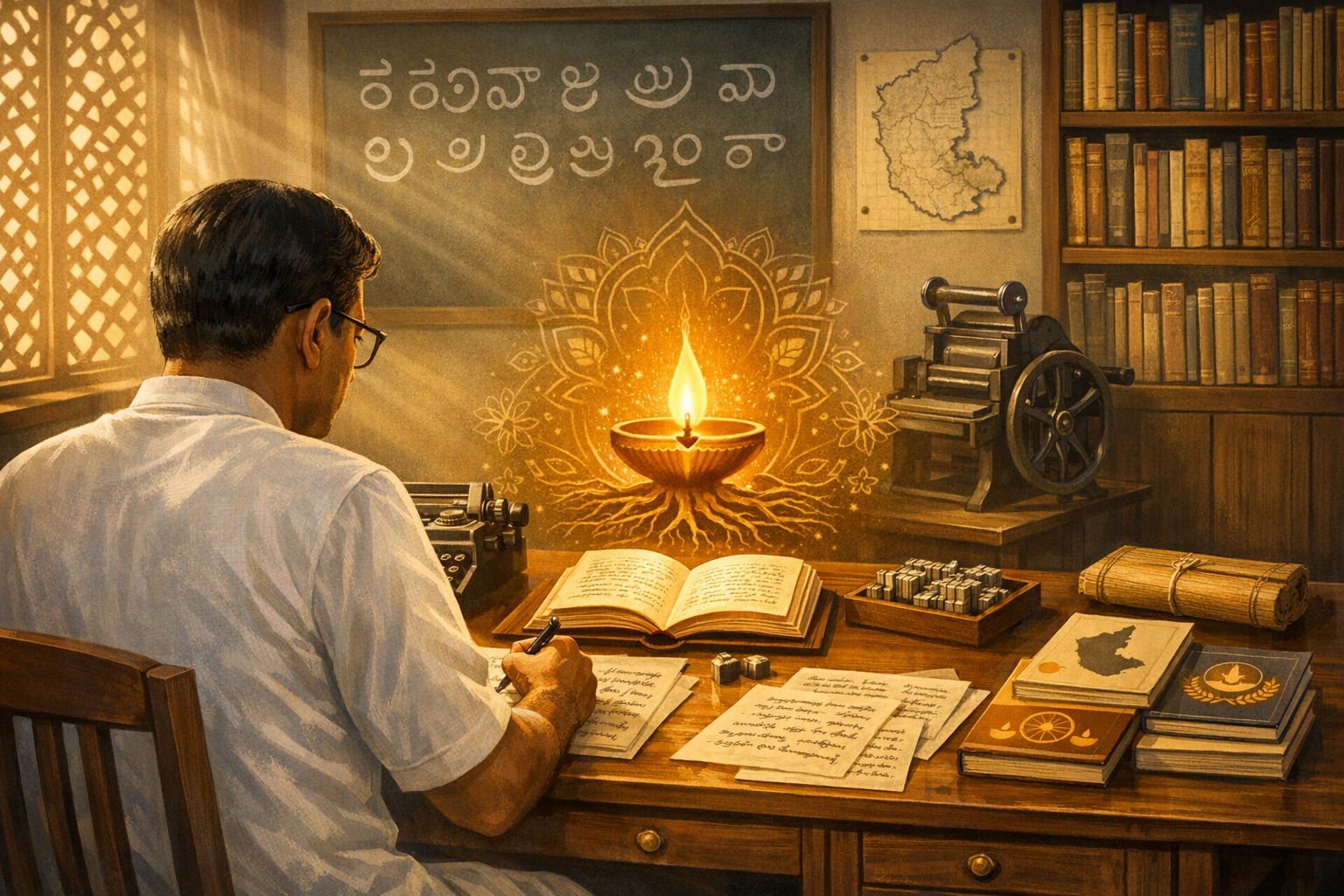
Betageri Krishna Sharma (1900–1982), better known by the evocative pen name Anandakanda, stands as a compelling figure in twentieth-century Kannada literature. As a primary-school teacher turned editor of the journals Matru Bhumi and Svadharma, and the founder of the literary magazine Jayanti, his career maps directly onto the rise of modern Kannada Sahitya, where pedagogy, print culture, and public ethics converged to shape readers, writers, and the broader cultural imagination.
Positioned historically between late colonial and early post-Independence India, his life and work illuminate how regional periodicals nurtured Kannada literary modernity. This was the era of vigorous small and mid-circulation journals, often called “little magazines,” that amplified emergent voices, experimented with form, and cultivated a critical reading public. Within this intellectual milieushared by contemporaries such as D. V. Gundappa (DVG), Masti Venkatesha Iyengar, D. R. Bendre, and KuvempuSharma’s editorial and educational commitments reflected a sustained effort to deepen the expressive range and social reach of Kannada Sahitya.
The choice of the pen name “Anandakanda” is itself a meaningful clue to his literary disposition. Combining “ananda” (bliss) with “kanda” (root, essence, or section), it gestures toward a poetics anchored in joy and ethical inquiryan aesthetic-ethical synthesis that resonates strongly with Kannada’s long-standing attention to rasa (aesthetic flavor) and dharma (values). Even where records are succinct, the name signals a writer-editor intent on eliciting thoughtful delight and responsible reflection from a wide reading community.
His documented beginning as a primary-school teacher situates him at the bedrock of language formation: the classroom. In that role, he engaged with grammar, vocabulary, reading habits, and the formative stages of literary appreciationprecisely the foundations upon which later literary discernment is built. The move from teaching to editing was not a rupture but a natural extension of the same vocation: enabling readers to meet texts, and texts to find readers, with clarity, care, and purpose.
Editorial stewardship at Matru Bhumi and Svadharma framed literature as a public trust. The very titles“Motherland” and “One’s guiding dharma”announce a synthesis of cultural rootedness and ethical responsibility. Within such journals, editorial labor typically encompassed commissioning and curating manuscripts, refining prose style, guiding younger authors, and building a framework for fair but rigorous criticism. Sharma’s work, by all available descriptions, aligned literature’s aesthetic pursuits with a civic imagination: Kannada Sahitya as a forum for argument, empathy, and nation-building.
Periodicals like Matru Bhumi and Svadharma did more than disseminate content; they constructed the Kannada public sphere. In practical terms this meant generating recurring conversationson language reform, genre experimentation, translation, and comparative poeticswhile ensuring editorial continuity, house style, and quality thresholds. Through such infrastructural work, editors like Sharma transformed sporadic writing into a sustained literary culture, enabling a reliable cadence of essays, poems, and critical exchanges.
The founding of Jayanti further underscores a strategic commitment to literary institution-building. “Little magazines” of this kind were incubators where emerging writers found mentorship, where short forms (essay, column, review, lyric) were honed, and where editorial ideation could respond swiftly to cultural needs. Jayanti’s very existence speaks to Sharma’s conviction that Kannada literature required not only talent but also venuesrecurring spaces where the craft of writing could be tested, refined, and shared.
Within this ecosystem, Kannada Sahitya functioned as a meeting ground of aesthetics and ethics, blending form with moral imagination. Even in the absence of voluminous bibliographic listings, extant references to Sharma’s career profile a figure devoted to enriching the literary language, elevating editorial standards, and fostering inclusive discourse. The emphasis on editorial clarity, argumentation, and accessibility suggests a belief that literary excellence is, ultimately, a public good.
Crucially, the journals’ framingespecially Svadharmaresonates with the dharmic pluralism long integral to the subcontinent’s intellectual life. Kannada literature itself has historically welcomed contributions from across dharmic traditions: Jaina poets and acharyas, the Veerashaiva Vachana movement, and a broader Indic conversation that includes Hindu, Buddhist, Jain, and Sikh streams. By foregrounding ethical self-understanding (svadharma) without sectarian boundary-making, Sharma’s editorial paradigm affirms the unity-in-diversity that defines dharmic civilizational thought.
This pluralist sensibility also aligns with the Navodaya turn in Kannadaan era that, while stylistically broad, consistently prized humane values, cultural rootedness, and experimental vigour. In that shared horizon, the work of editors becomes pivotal: to juxtapose classical inheritance with modern inquiry, to frame debates on poetics and public ethics, and to mediate between global literary currents and Kannada’s specific historical memory. Sharma’s biography offers a clear illustration of this mediation, balancing continuity with change.
From a technical standpoint, editorial leadership in such journals entailed establishing selection criteria, refining copy for idiomatic precision, and nurturing genre diversitypoetry, short fiction, criticism, reportage, and reflective essays. It also meant amplifying translation and intertextual dialogue, so that Kannada readers could encounter Sanskritic, Prakrit, and other Indic sources alongside modern voices, widening access while protecting linguistic integrity. The implicit outcome is what readers still value today: a coherent, high-standard Kannada print culture.
Equally significant is the way a teacher’s sensibility travels into editorial practice. The attention to reader comprehension, scaffolding of ideas, graded difficulty across issues, and a strong copy desk are all pedagogical in spirit. In this respect, Sharma’s trajectoryfrom classroom to journal officeilluminates how educational method can underpin literary craft, creating a feedback loop where reading communities grow in competence and taste.
For contemporary readers, the arc of Betageri Krishna Sharma’s life remains relatable and instructive. The progression from nurturing a single classroom to shaping a much larger reading public mirrors the journey many educators and culture workers undertake todaytranslating local responsibilities into broader civic impact. His biography models a path where devotion to Kannada language and literature leads naturally to institution-building and to a generous curation of multiple voices.
As with many editors who privileged service over self-promotion, the surviving traces of Sharma’s corpus are scattered across periodical archives. This makes primary-source work essential: consulting bound volumes and loose issues of Matru Bhumi, Svadharma, and Jayanti; building indices of contributors; and reconstructing editorial policies from forewords, columns, and letters to the editor. Such research would refine the chronology of his editorships, delineate his stylistic preferences, and more completely document his role in shaping twentieth-century Kannada literature.
What remains most clear, however, is the coherence of his vocational aims. Whether under the signature of Anandakanda or in the administrative anonymity of the editor’s desk, the through line is consistent: to enrich Kannada Sahitya by expanding access, elevating standards, and nurturing a pluralist public ethic rooted in dharmic values. In an age that again depends on independent journals, small presses, and digital platforms to sustain serious discourse, Sharma’s example is not merely historical; it is prescriptive.
As an educator, editor, and literary organizer, Betageri Krishna Sharma contributed to the making of Kannada’s modern reading publiclinking classroom literacy to civic literacy, and individual expression to collective conversation. That accomplishment, while modestly recorded, is foundational. It invites continued archival work and renewed appreciation, ensuring that the story of Kannada literature remains inclusive of the many handslike histhat built its enduring institutions.
Inspired by this post on Hindu Blog.
