
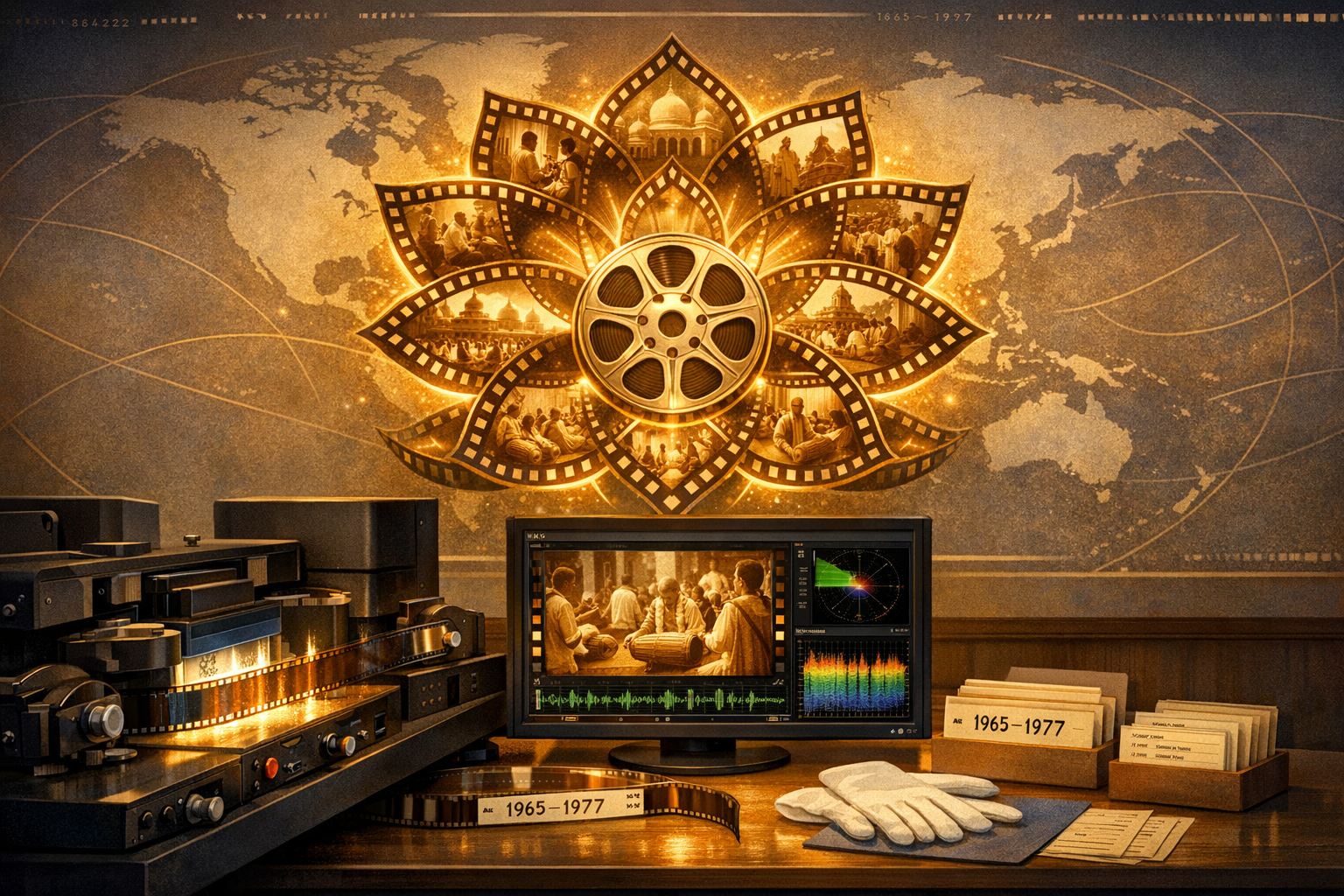
All known motion-picture recordings of Srila Prabhupada and the early International Society for Krishna Consciousness (ISKCON) produced between 1965 and 1977 have been transferred and restored in 4K, ensuring that these primary visual sources are safeguarded for long-term cultural, spiritual, and scholarly use. This work represents a significant milestone in cultural heritage preservation, uniting archival best practices with careful historical interpretation to maintain authenticity, historical accuracy, and emotional resonance.
The collection captures the formation and rapid global spread of the Hare Krishna Movement, documenting kirtans, festivals, public lectures, community life, and interfaith encounters that shaped a pivotal chapter in modern spiritual history. For many viewers across the dharmic spectrumHinduism, Buddhism, Jainism, and Sikhismthese films embody living traditions of devotion, service, and ethical practice that transcend sectarian boundaries while illuminating shared civilizational values.
From a heritage perspective, the films are more than devotional memory; they are rare audiovisual testimonies of a transnational spiritual renaissance. The recovered footage provides visual context for themes often explored textuallyseva, satsanga, pilgrimage, scriptural discourse, and communal harmonythereby enhancing interpretive richness for researchers and communities alike. In the spirit of unity in spiritual diversity, the restored materials serve as a bridge across dharmic traditions and diasporas, inviting inclusive engagement without privileging any single path.
Provenance work began by consolidating scattered film elements held by individuals, temples, and private collections worldwide. Archivists conducted item-level inventories, verified chain of custody, and stabilized materials in climate-controlled environments. Elements included reversal originals, prints, and dupes across 8mm, Super 8, and 16mm formats typical of the period; some reels carried optical or edge-striped magnetic sound, while others required separate audio-source identification and conforming.
Each reel underwent detailed condition assessment: base type identification (cellulose triacetate or polyester), shrinkage measurement, vinegar syndrome checks, perforation stability testing, splice integrity review, color-fade profiling, and surface abrasion mapping. This diagnostic phase guided bespoke conservation plans, balancing physical risk mitigation with maximal information retention. Where necessary, leaders were replaced, splices reconstituted, and vulnerable sections stabilized to withstand gentle transport through scanning paths.
Pre-scanning conservation involved ultrasonic or gentle-solvent cleaning to remove embedded particulates, fungal residues, and oily deposits while preserving emulsion integrity. Wet-gate transfer was prioritized for scratch concealment on projection prints and selected reversal elements, as the refractive liquid fills surface abrasions, improving contrast uniformity and scan fidelity. Sprocketless, capstan-driven transports minimized stress on shrunken or brittle films.
Scanning was performed at native 4K across full apertures, with overscan to capture edge codes and contextual markers. For 16mm, 4K (typically 4096-wide) oversampling preserved fine detail and grain structure; for 8mm and Super 8, 4K capture preserved small-gauge texture and handwriting on slates. Image data were recorded as high bit-depth log DPX or equivalent, retaining extended dynamic range for downstream grading. Optical soundtracks were digitized using dedicated readers; magnetic tracks and dual-system audio were digitized at high resolution (commonly 24-bit, 96 kHz) for alignment and preservation.
Color science and grading emphasized historical fidelity over modernized aesthetics. Densitometric references, gray-scale targets, and period stock characteristics (for example, reversal stocks common in the 1960s–1970s) informed scene-referred color decisions. When feasible, contextual anchorsskin tones, saffron garments, temple stone hues, and daylight balanceswere used to calibrate likely intent. Final access masters were generally conformed to Rec.709 for wide compatibility, while maintaining archival log masters for future remastering.
Digital restoration targeted defects that obscured content without erasing the filmic signature. Stabilization corrected gate weave and transport jitter; flicker mitigation addressed exposure pulsation; scratch and dust concealment algorithms targeted transient defects; gentle grain management improved legibility in low-light scenes while retaining authentic texture. Restoration teams deliberately avoided over-smoothing or aggressive noise reduction to preserve the historical look and feel.
Audio restoration addressed hiss, hum, wow and flutter, broadband noise, crackle, and intermittent dropouts. Techniques included spectral denoising, click/pop repair, de-essing, dynamics leveling, and, where supported by reference sources, pitch and speed correction. Dialogue intelligibility and kirtan clarity were prioritized while preserving room tone and crowd ambiance that convey the historical environment.
To enhance access and scholarship, time-coded transcripts, descriptive captions, and multilingual subtitles were prepared where feasible. This step expands the films’ educational impact across regions and traditions, supporting inclusive pedagogy in courses on Indian history, cultural heritage, religious studies, musicology, and diaspora studies, as well as community screenings that encourage interfaith dialogue rooted in respect.
Rich metadata were created using established schemas (for example, Dublin Core, PREMIS, and PBCore) to describe titles, dates, locations, persons, rites, festivals, and technical characteristics. Controlled vocabularies and authority control improve search precision. Critical contextual identifierssuch as 26 Second Avenue (New York), early kirtans, public festivals, and global travel sequencesfacilitate cross-referencing with documented historical events and publications.
Preservation storage follows OAIS-aligned workflows and accepted digital preservation practices. Master files (for example, 16-bit log DPX image sequences and high-resolution WAV audio) are stored redundantly using the 3-2-1 rule across on-premises servers and geographically separate sites. LTO tape (for example, LTO-9) complements cloud or offsite storage. Routine fixity checks (for example, SHA-256) and periodic media migrations guard against bit rot and obsolescence, aligning with FADGI and NDSA guidance for sustainable stewardship.
Distribution-ready deliverables include mezzanine encodes (for example, ProRes 4444 or ProRes 422 HQ), access files (for example, H.264/AVC), and study copies suitable for streaming platforms and classroom use. Where appropriate, preservation encodings such as FFV1 in Matroska (MKV) were generated to ensure long-term, lossless access parallel to DPX masters. All formats are documented with embedded and sidecar metadata for unambiguous provenance.
Rights and ethics were treated with rigor. Clearances prioritized respectful representation and lawful access, with usage terms tailored for education, research, and community engagement. When third-party appearances or music arose, due diligence and, where required, contextual disclaimers were applied to maintain integrity, privacy, and cultural sensitivity.
The restored corpus offers substantial value to historians, archivists, devotees, and students of global religion and culture. It documents lived spiritualitydaily puja, kirtan, teaching, festival organizationand reveals how a dharmic movement interfaced constructively with diverse societies. In doing so, it promotes unity in spiritual diversity by illustrating how devotion, discipline, and compassion can be practiced and shared without coercion, affirming the plural ethos central to dharmic traditions.
Highlights frequently cited by researchers include early temple life, public sankirtana, and landmark gatherings that catalyzed broader recognition of the Hare Krishna Movement. Some reels capture intergenerational exchangechildren, householders, monks, and well-wishersshowing a community model based on seva and shared responsibility. Such sequences help scholars compare devotional modalities across Hinduism, Buddhism, Jainism, and Sikhism, underscoring convergences in ethical life and communal harmony.
As primary-source visual records, these films enable re-interpretation of textual narratives with corroborating evidence: spatial arrangement of rituals, musical structures of kirtan, attire and iconography, and the vernacular of public outreach. Researchers in anthropology, musicology, religious studies, and diaspora history will find the 4K restorations particularly instructive for frame-accurate analysis, gesture study, and performance practice.
Technically, the project demonstrates how modern film-scanning workflows can respect analog character while delivering high-resolution clarity. Typical parameters included 4K (4096-wide) overscan for 16mm, careful handling of 18 fps and 24 fps sources, retention of native grain, and scene-referred grading based on film response rather than stylized looks. The result is a faithful historical record that is both aesthetically compelling and academically reliable.
This 4K restoration also future-proofs access. By retaining high bit-depth log masters alongside access derivatives, future scholars and conservators can re-grade, re-encode, or re-contextualize materials as standards evolve. The careful documentation of workflows, metadata, and rights ensures that subsequent custodians can sustain the collection without guesswork.
Ultimately, the restored films invite viewers into a vivid, compassionate, and disciplined spiritual world that speaks to universal values cherished across dharmic lineages: truth-seeking, selfless service, mindful community, and reverence for knowledge. By safeguarding these moving images with modern archival rigor, the project preserves a shared inheritance and encourages dialogue grounded in respect, scholarship, and the timeless aspiration toward inner transformation.
Inspired by this post on Dandavats.
