
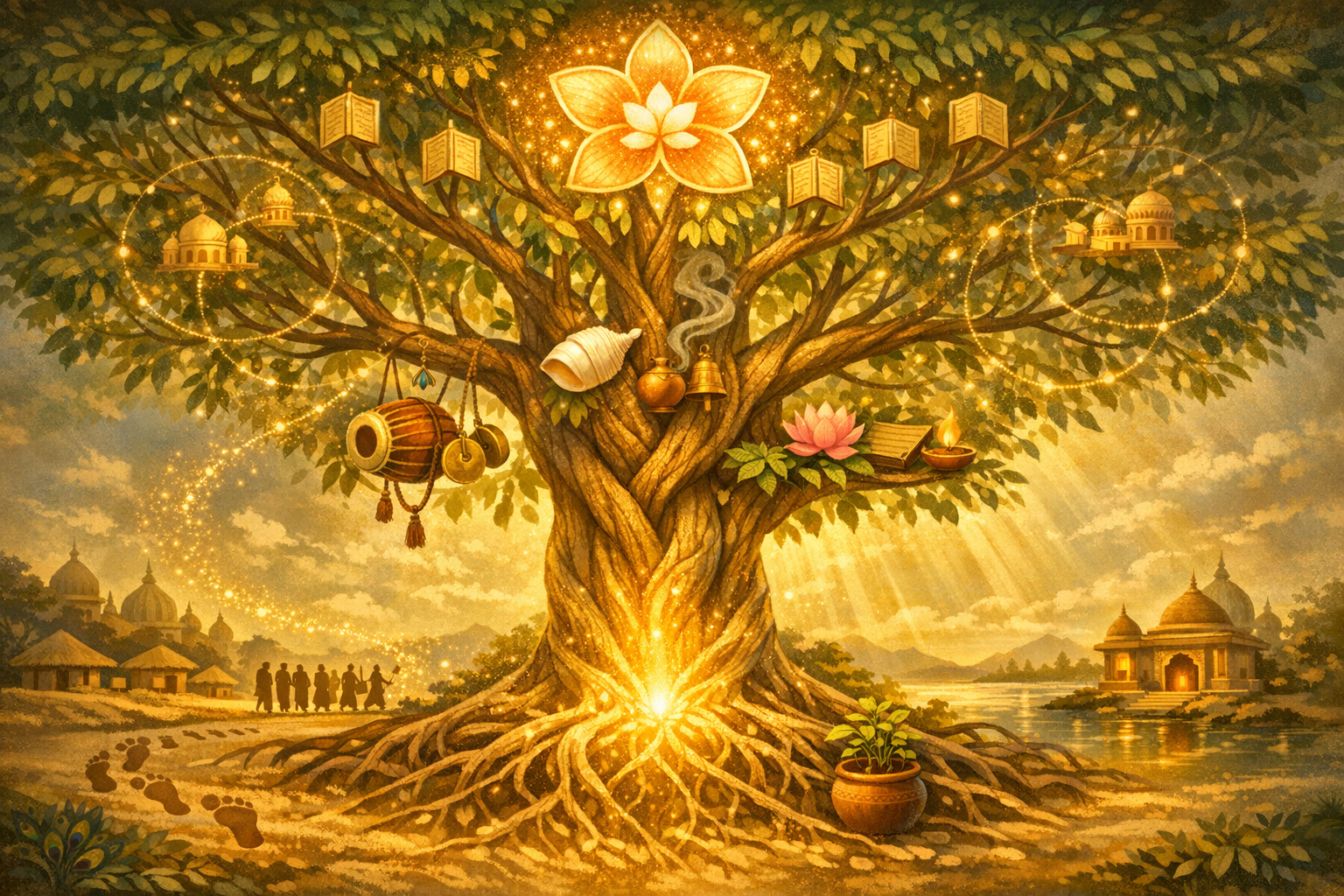
The Sri Caitanya Mahaprabhu Treeoften described in Gaudiya Vaishnavism as a living, wish-fulfilling kalpataruoffers a precise theological, historical, and experiential map of how divine love (prema-bhakti) branches into the world. In the Chaitanya tradition, this metaphor is not merely poetic; it is an organizing principle for understanding sacred lineage, devotional practice, and the social transmission of spiritual virtues across regions, generations, and, in modern times, continents.
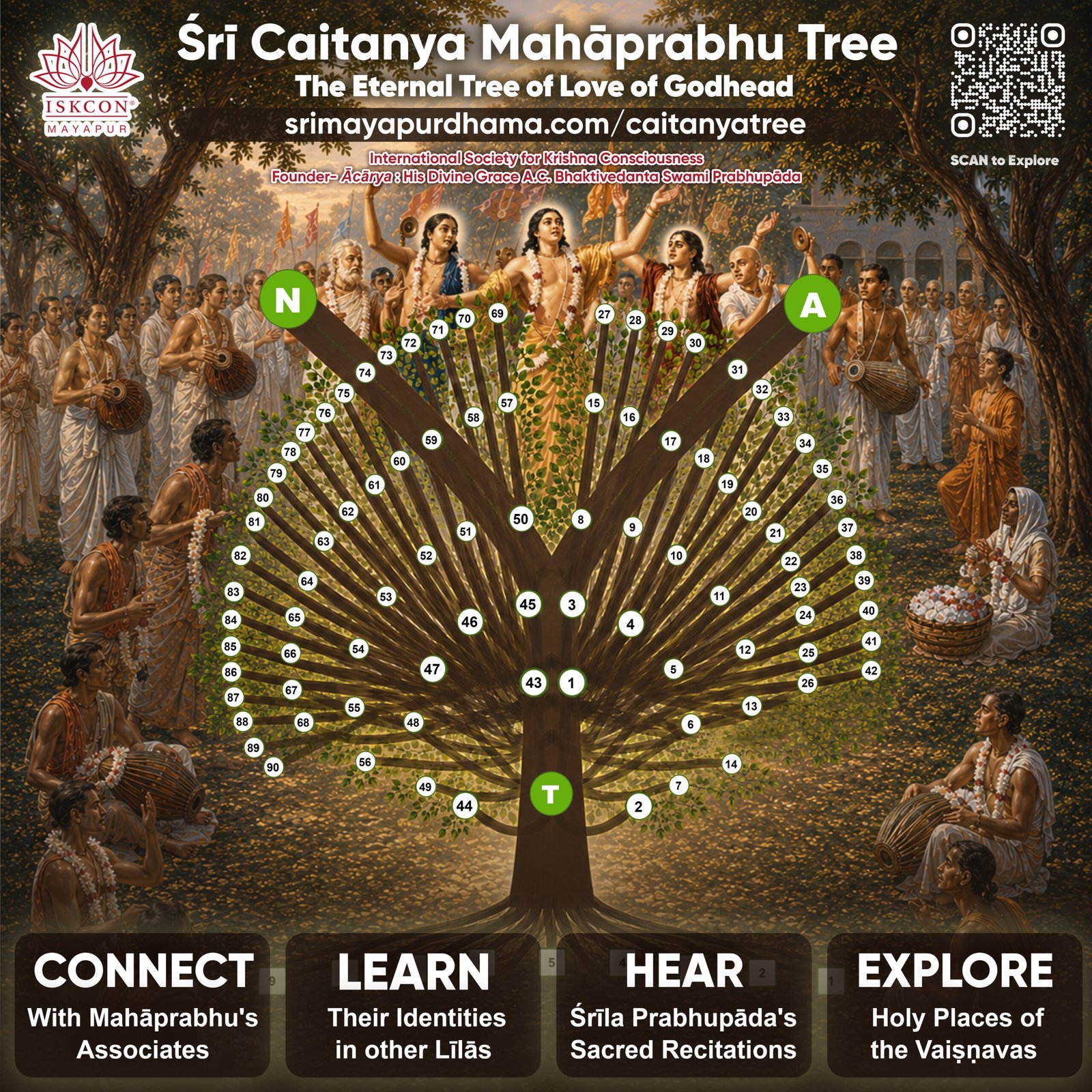
Śrīla Prabhupāda: “Simply by remembering the names of all these branches and subbranches of the three trunks I have described [Nityānanda, Advaita and Gadādhara], one attains freedom from the entanglement of material existence. Simply by remembering the names of all these Vaiṣṇavas, one
As this excerpt indicates, remembrance of the saintly community is central to the Caitanya tradition. The “Caitanya Tree” presents a structured theology of relationship: Sri Caitanya as the inexhaustible source of devotion, manifesting through three great trunksNityānanda, Advaita, and Gadādharafrom which countless branches and subbranches extend. The branches are the practitioners, teachers, and communities who preserve, refine, and distribute prema-bhakti through kīrtana, study, service, and ethical living.
Within this framework, the Pancha Tattva theology provides ontological clarity: Sri Caitanya is the fountainhead of divine love, with Nityānanda, Advaita, Gadādhara, and Śrīvāsa representing complementary energies and functions within the devotional whole. The “three trunks” emphasized hereNityānanda, Advaita, and Gadādharahighlight distribution, invocation, and nourishment of devotion, respectively, while the wider canopy includes Śrīvāsa and innumerable associates who model congregational practice (sankīrtana) as the public heart of the movement.
Historically situated between 1486 and 1534, Sri Caitanya Mahaprabhu’s life catalyzed a devotional renaissance. Centered in Navadvīpa and later in Jagannātha Purī, the movement balanced intense inward absorption in the names of Sri Krishna with outwardly accessible, musical, and communal worship. It is in this matrix that the tree’s branches proliferated: householder-saints, renunciants, poets, musicians, and scholars who shaped an integrated culture of devotion grounded in scripture and lived practice.
The remembrance Prabhupāda references is a disciplined practice (smaraṇa) aligned with the Bhagavata paradigm of devotional limbs such as śravaṇa (hearing) and kīrtana (chanting). In cognitive terms, the names of Vaiṣṇavas function as anchors of memory and identity, creating an affective map that orients conduct, stabilizes values, and heightens receptivity to grace. In soteriological terms, such remembrance is a conduit for liberation because it reconstructs attention and intention around exemplars of divine love.
The Nityānanda trunk is characterized by boundless accessibility and compassionate outreach. Nityānanda Prabhu is remembered for bringing the practice of the holy name to streets and homes, collapsing barriers of class, learning, and status. Theologically, this trunk embodies the distributive power of devotionprema proactively seeking the marginalized and the busy alike, an impulse that shaped Gaudiya Vaishnavism’s public-facing kīrtana culture.
The Advaita trunk represents invocation and scriptural gravitas. Advaita Ācārya’s pleas and worship are traditionally narrated as pivotal to Sri Caitanya’s descent, linking Vedantic insight with bhakti’s affective core. This trunk illustrates how learned hermeneutics, ritual depth, and personal yearning can converge to invite divine presence into collective life.
The Gadādhara trunk is associated with inner nourishment and emotional refinement. In Jagannātha Purī, Gadādhara Paṇḍita’s tender serviceexemplified in the worship of Ṭoṭā Gopīnāthasignifies devotional ecology from the inside out: the careful cultivation of sacred moods, scriptural recitation, and contemplative steadiness that sustains the entire canopy.
As the three trunks flourish, the tree unfolds into famous branches. The Six Gosvāmis of VṛndāvanaRūpa, Sanātana, Raghunātha Dāsa, Raghunātha Bhaṭṭa, Jīva, and Gopāla Bhaṭṭasystematized theology, aesthetics, and practice. Rūpa Gosvāmi’s Bhakti-rasāmṛta-sindhu articulated the grammar of devotional emotion, while Jīva Gosvāmi’s Sandarbhas provided rigorous Vedantic foundations. Temples in Vṛndāvana anchored community life, sacred geography, and pilgrimage in enduring ways.
Subsequent branchesŚrīnivāsa Ācārya, Narottama Dāsa Ṭhākura, and Śyāmānanda Prabhucarried the tree’s gifts across Bengal and Odisha. Kīrtana traditions matured into portable liturgies; devotional literature propagated ideals in vernacular forms; and guru–śiṣya communities preserved continuity without stifling regional inflections. The result was a networked devotional commons: diverse in expression, united in purpose.
Modern history witnessed a striking botanical metaphor come alive on a global scale. Through the Sarasvata lineage, Bhaktisiddhānta Sarasvatī Ṭhākura revitalized monastic discipline and publishing, while A. C. Bhaktivedanta Swami Prabhupāda’s founding of ISKCON in 1966 carried nāma-saṅkīrtana and Gaudiya theology to universities, towns, and villages worldwide. Temples, farm communities, and publishing houses formed new rings in the tree’s trunk, with the Hare Krishna movement taking root as a visible expression of Gaudiya Vaishnavism in over a hundred countries.
To appreciate how the tree functions, it helps to consider Indian thought’s broader tree metaphors. The Bhagavad Gita’s inverted aśvattha emphasizes disidentification from entangling material roots, while the Gaudiya kalpataru emphasizes the positive flowering of love, service, and remembrance. Together they present complementary optics: detachment from illusion and attachment to divine relationship. The Caitanya Tree leans into the latter, making the interiority of devotion outwardly legible through congregational practice.
Practically, the tree’s sap is soundnāma. Public kīrtana and private japa activate shared attention, regulate breath and mood, and synchronize hearts through rhythm. Many families, students, and travellers report that the first encounter with the tradition often happens as dusk kīrtana spills into marketplaces or campus quadrangles; the atmosphere reduces social distance, inviting participation without prequalification. The pedagogy is affective before it is discursive.
Scripturally, the Chaitanya-caritāmṛta (especially Adi-lila 9–10) codifies the tree’s architecture, enumerating branches and subbranches to preserve memory and meaning. Kavi Karṇapūra’s Gaura-gaṇoddeśa-dīpikā locates associates in Krishna’s Vṛndāvana pastimes, adding a mytho-historical cross-reference that deepens the sense of continuity between eternal play and historical mission. Such catalogs are not mere lists; they are maps that guide practice by keeping exemplars close to mind.
The remembrance emphasized by Śrīla Prabhupādanaming and recalling Vaiṣṇavasthus performs three tasks. First, it confers continuity by stitching past, present, and future into a living lineage. Second, it installs ethical exemplars into ordinary decision-making, raising the standard of speech, diet, livelihood, and relationships. Third, it focalizes the mind on the source of all virtuesSri Krishnathrough those who embody love of Godhead without ostentation.
From a comparative dharmic perspective, the Caitanya Tree resonates with practices valued across Hinduism, Buddhism, Jainism, and Sikhism. Buddhist and Jain traditions foreground disciplined memory, ethical vows, and compassion; Sikh kīrtan and nām simran elevate the Name as the pulse of communal life. In each case, remembrance and sound shape character and community. The Caitanya Tree participates in this shared dharmic grammar, demonstrating how plural lineages can thrive in harmony while remaining anchored in their distinctive insights.
In social terms, the tree metaphor also clarifies how inclusive communities sustain themselves. Roots draw from scripture and sacred places; the trunk encodes lineage and pedagogy; branches diversify applicationeducation, music, cuisine, service projects, and scholarship; leaves photosynthesize sunlight into nutrition, much as congregations transform teaching into daily sustenance. When storms comepolitical, economic, or culturalthe healthiest trees are those with deep roots, supple branches, and a biodiverse understory of allied traditions.
For those engaging the tradition today, a simple, structured reflection can operationalize the metaphor. Begin with śravaṇa: read a brief passage from the Chaitanya-caritāmṛta. Move to kīrtana: sing or listen to the mahā-mantra or a classic kīrtana melody. Add smaraṇa: recall three associates from the Caitanya Tree, noting one virtue of each. Close with sevā: identify one concrete act of kindness or service to offer before day’s end. This protocol aligns memory, sound, and actionturning a metaphor into a formative habit.
Ethically, the Caitanya Tree invites humility. The saints remembered in its branches did not seek visibility; they sought fidelityto guru, to śāstra, to community, and to the inner call of compassion. Their biographies repeatedly stress forbearance, truthfulness, and generosity. In contemporary civic life, these qualities translate into respectful dialogue, conscientious work, and shared civic responsibilitiesbridge-building practices that strengthen unity among dharmic communities.
Historically verifiable outcomes also support the metaphor’s vitality. The Gosvāmis’ textual corpus systematized aesthetics and practice; temple ecologies in Vṛndāvana and Navadvīpa fortified sacred geography; devotional music shaped classical and folk repertoires; modern institutions disseminated teaching globally. Each accomplishment corresponds to a part of the treeroot, trunk, branch, leafdemonstrating how doctrine, art, and social life can interpenetrate fruitfully.
While the language of love is universal, Gaudiya theology refines it technically through categories of rasa and bhāva, explaining how emotions become sanctified when harmonized with selfless service to Sri Krishna. Acintya-bhedābhedathe doctrine of inconceivable simultaneous oneness and differencesecures devotion against both rigid dualism and dissolving monism, allowing intimacy with the Divine without erasing distinction. The Caitanya Tree is the experiential ecosystem where these ideas become lived realities.
In the present century, the tree’s canopy continues to widen. Academic collaborations, interfaith dialogues, and cultural festivals place nāma-saṅkīrtana alongside other dharmic arts of remembrance, generating mutual respect and shared learning. This is not syncretism; it is hospitalitya confident openness rooted in Sanatana Dharma’s vision that diverse paths can uplift and enlighten without competition.
Ultimately, the Caitanya Tree stands as a clear, testable proposal: people formed by sacred sound, anchored in lineage, and guided by saintly exemplars become more compassionate, truthful, and resilient. Communities ordered around such formation show higher degrees of trust and cooperation. Societies influenced by them gain cultural depth and moral ballast. These “fruits” justify renewed attention to the tree’s roots and branches in education, arts, and public life.
Remembering the names of the branches, then, is not antiquarianism; it is a soteriological technology and a cultural strategy. By situating personal devotion within a recognized canopy, individuals receive shade and direction; by contributing new leaves and fruitfresh scholarship, service, and songthey help the tree renew itself. The result is continuity without rigidity, creativity without amnesia.
In sum, the Sri Caitanya Mahaprabhu Tree demonstrates how a luminous theology can become a living ecology, extending compassion through Nityānanda’s outreach, depth through Advaita’s invocation, and nourishment through Gadādhara’s contemplative grace. Its invitation remains both intimate and expansive: keep the names close, keep the sound alive, and let the branches touch every life with shade, fragrance, and fruitwithin the Gaudiya lineage and in harmony with the broader dharmic family.
Inspired by this post on Dandavats.
