
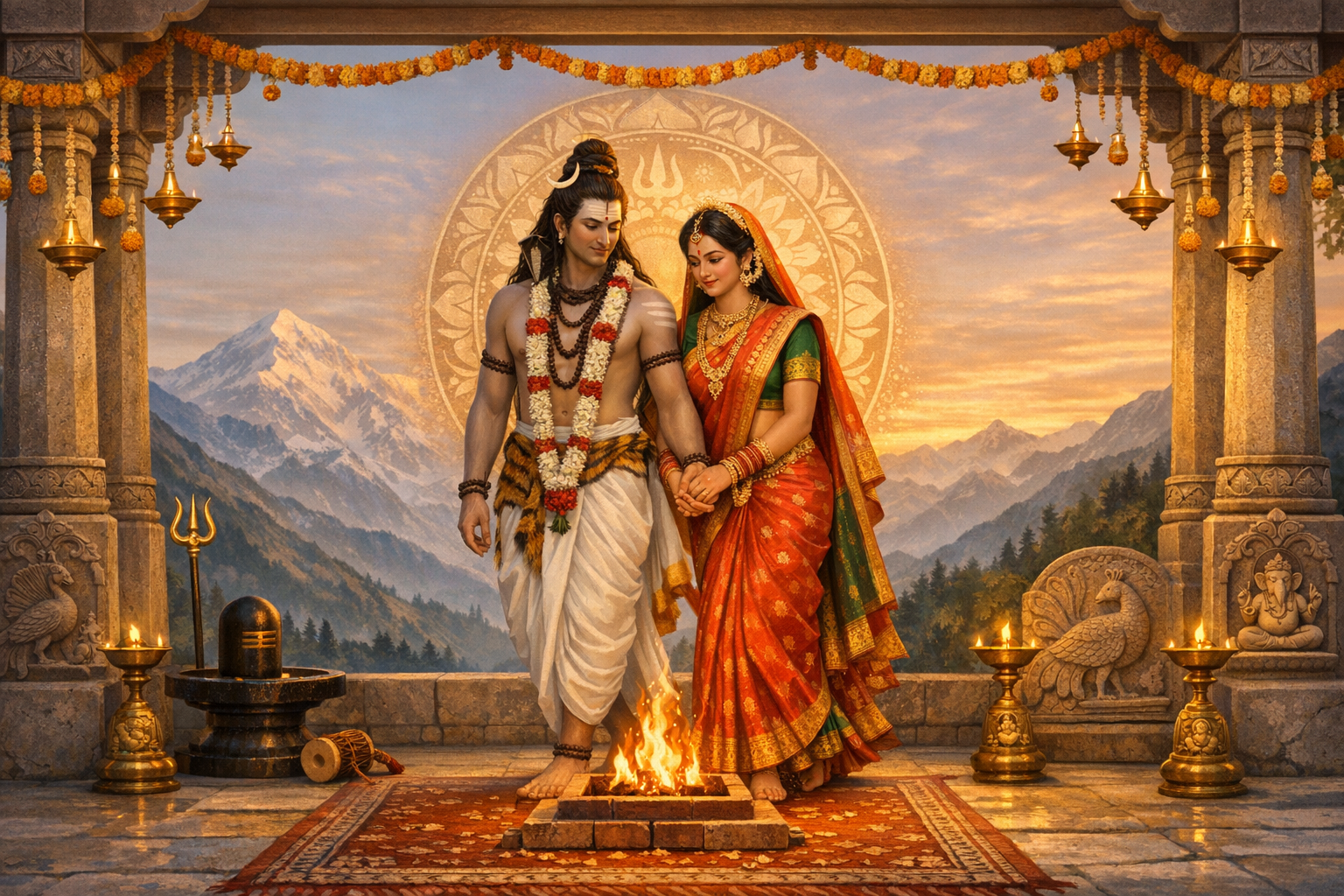
Tradition locates the primordial yogi Shiva on the crystalline peaks of Kailasa, eyes closed in unbroken meditation. In that stillness, consciousness appears self-complete, beyond need and beyond motion. Yet the cosmological drama of dharma does not unfold through isolation alone; it is awakened when Shakti appears as Parvati, the daughter of the mountain, and, as many retellings suggest, holds a mirror to that stillness so it can see itself in relationship.
Across the Shiva Purana (especially the Rudra-samhita), the Skanda Purana, and Kalidasa’s Kumarasambhava, the narrative arc runs from Sati’s self-immolation at Daksha’s sacrifice, through her rebirth as Parvati to Himavat and Mena, to a prolonged tapas that ripens into marriage with Shiva. This marriage is not merely personal; it is the pivotal transition by which the great ascetic enters grihastha ashrama (householder dharma), rendering transcendence socially fecund and ritually legible.
Parvati’s vow is rigorously ascetic: she undertakes severe tapas, observes restraints, and aligns intention (sankalpa) with cosmic order. The episode of Kama DahanaShiva opening the third eye and burning the god of desiresignals not the negation of eros, but its sublimation. In many tellings Kama returns as Ananga (bodiless), a literary cue that desire, disjoined from grasping, can be harnessed by dharma. Kalidasa lingers over this pedagogical moment: Parvati’s steadfast discernment awakens reciprocity in Shiva without compromising either one’s autonomy.
Texts and regional liturgies describe the Hara–Gauri wedding with Vedic rites recognizable in the Grihya Sutraskanyadana by Himavat, fire (Agni) as witness, mantras that sacralize companionship, and the saptapadi in several recensions as the decisive step that seals the samskara. Iconography such as Kalyanasundara Murti sets the moment in stone and bronze: the ascetic accepts relational duty (rta) without diluting spiritual fire (tapas).
Dharma literature consistently presents the grihastha ashrama as the supporting hub of social and spiritual life. The householder generates and shares resources, sustains lineage and learning, offers hospitality, and maintains the sacrificial economy through yajna and danacapacities that also enable vanaprastha and sannyasa to exist. In this light, Shiva’s marriage marks a paradigmatic integration: tapas receives a civic and familial vector; renunciation and responsibility cease to be opposites.
The metaphysics is encoded in Shaiva–Shakta symbolism. As Ardhanarishvara, the inseparability of awareness (Shiva) and energy (Shakti) is rendered as a single body. The linga set within the yoni-pitha signifies the same principle: consciousness and creativity, purusha and prakriti, are mutually completing. Without Shakti, Shiva is potentiality without expression; without Shiva, Shakti is motion without aim. Marriage makes this complementarity legible to society.
The narrative further ties householding to cosmic protection through offspring. From the union of Shiva and Parvati emerge Ganesha, the remover of obstacles who orders beginnings, and Skanda (Kartikeya), the commander who defeats Taraka. Private vows thus yield public goods: clarity, order, and defense of dharma. Somaskanda iconography in South India beautifully captures this triad, with the child Skanda between the divine couple, visualizing serenity, fertility, and guardianship.
A cross-Dharmic perspective underscores the breadth of this ideal. Buddhism celebrates exemplary householders such as Vimalakirti, whose realization flourishes within civic life; Jainism codifies sravaka-dharma for lay practitioners as a rigorous path of restraint and compassion; Sikh tradition sanctifies grihasth jeevan, affirming spiritual excellence amidst work and family. In convergent ways, these traditions echo the lesson of Shiva’s transformation: liberation is compatible with responsibility, and contemplative depth can animate social ethics.
The ritual and artistic afterlives of the wedding are equally instructive. South Indian bronzes and temple panels of Kalyanasundara and Somaskanda disseminate the template of balanced living; domestic worship employs Panchopachara or Shodashopachara to honor the couple as archetypes of auspicious companionship; festival calendars re-enact the nuptials to re-center communities around shared vow and mutual care.
Gendered hierarchy is not the point of this mythic pedagogy; complementarity and co-teaching are. Shaiva Agamas and Tantras frequently frame revelation as dialogues between Shiva and Parvati, alternating speaker and listener, wisdom and inquiry. In the Kena Upanishad’s celebrated vignette, Uma as Haimavati instructs the gods about Brahman, reinforcing the Shakta insight that knowing is a mode of the Goddess. The marriage, then, models reciprocal agency: Parvati humanizes transcendence; Shiva universalizes intimacy.
A psychological and yogic reading casts the union as integration. Parvati’s mirror is the relational world that reflects the Self back to itself; Shiva’s steadiness is the witness that prevents fusion from becoming confusion. In yogic physiology, one may see an echo of ida and pingala balanced into sushumna: energy and attention braided into a clear channel, where action is precise because awareness is calm.
For contemporary householders seeking a Shaiva–Shakta synthesis, several practices preserve the marriage’s insight. Daily remembrance through Om Namah Shivaya, compassionate action (seva) within family and community, and measured disciplinesahimsa and aparigraha from the wider Dharmic vocabularycreate conditions where tapas does not disappear but matures. Simple Panchopachara worship before a linga or Uma–Maheshvara image, complemented by mindfulness or breath regulation, anchors inward clarity to outward care.
Read in sum, Parvati’s marriage to Shiva is a civilizational charter for integrated living. It dignifies the householder path (grihastha), harmonizes ascetic intensity with relational virtue, and aligns multiple Dharmic traditions around a shared conviction: the highest consciousness does not flee the world but illumines it. When the Goddess holds up the mirror, the Primordial Yogi recognizes not a distraction, but a dharmic calling.
Inspired by this post on Hindu Blog.
