
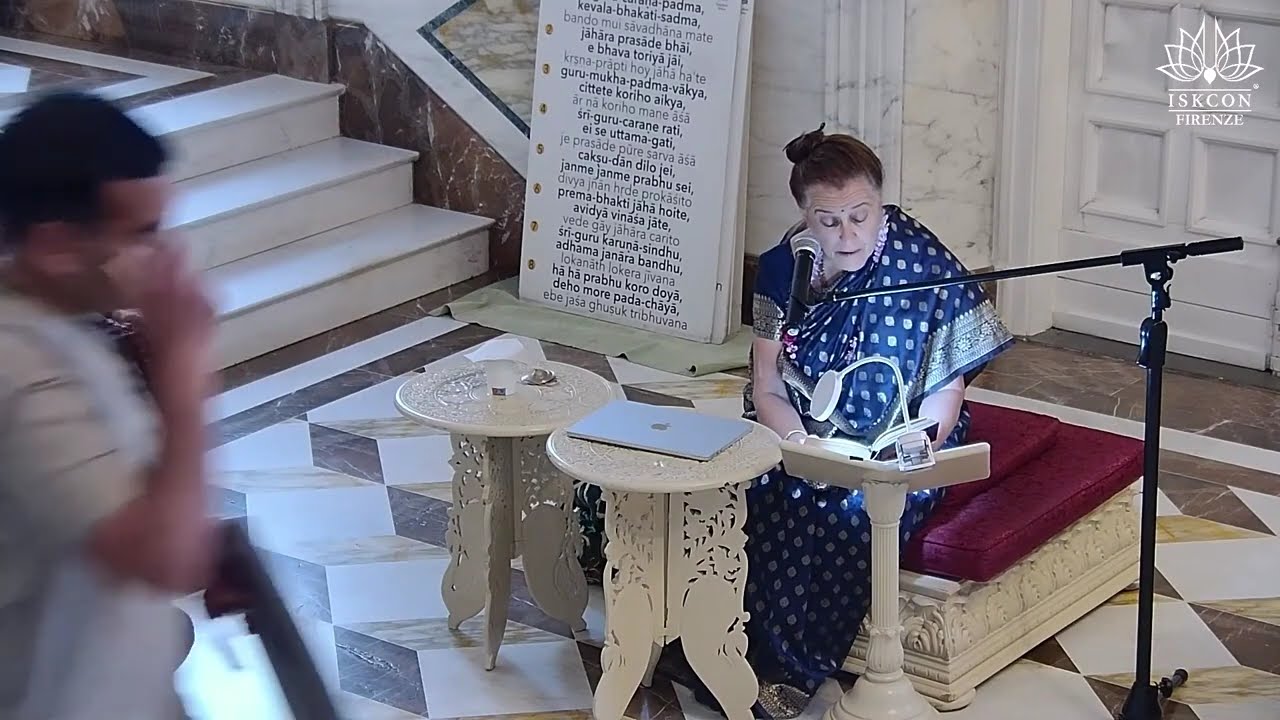
At the ISKCON Communications Retreat on 11/5/2026, hosted at Villa Vrindavana – ISKCON Firenze, Rukmini D.D acbsp guided a sustained reflection on Srimad-Bhagavatam (SB) 5.18.9, a revered verse associated with Prahlada Maharaja’s devotion to Lord Narasimha. Framed as “Prahlada’s hearth,” the session examined how this single śloka’s theology of omnipresent protection and refuge can function as a living center for community life, principled discourse, and service. The image of a hearthquiet, warm, and protectivebecame a practical metaphor for building trustworthy spaces of dialogue in contemporary society while remaining faithful to the Gaudiya Vaishnava bhakti tradition and welcoming to the broader dharmic family.
Textually, SB 5.18 forms part of the Bhagavata Purana’s account of the prayers offered by the residents of Jambudvipa. Within this chapter, verses 8–9 transmit the Narasimha-stuti taught by Prahlada, emphasizing the Lord’s presence both within the heart and without in the world, and culminating in śaraṇāgatitaking unequivocal shelter. The theological horizon is at once intimate and expansive: Narasimha is not merely a distant, transcendent guardian but an immanent presence that saturates experience, rendering authentic fearlessness possible. This is why the verse is cherished in Gaudiya Vaishnava liturgy, often accompanying kīrtana and āratī, and why it speaks so directly to the inner life required for ethical communication.
Philologically, “Nṛsiṁha” unites nara (human) and siṁha (lion), a compound that encodes a synthesis of compassion and valor. The verse’s structure juxtaposes locatives that indicate interiority (hṛdaye) and exteriority (bahir), mapping a 360-degree horizon of divine presence. Within Gaudiya Vaishnavism’s acintya-bhedābheda framework, this configuration holds together nearness and otherness: the Lord pervades consciousness yet exceeds it, inviting confidence without complacency. Semantically, the movement toward “refuge” (śaraṇa) indicates not passive resignation, but a lucid act of entrusting the self to a protective reality, aligning with the six limbs of śaraṇāgati in Vaishnava praxis: embracing the favorable, rejecting the unfavorable, trust in the Lord’s protection, accepting the Lord as maintainer, humility, and full self-offering.
Interpreted through the “hearth” metaphor, Prahlada’s prayer articulates an inner sanctuary where courage does not arise from control but from presence. The hearth warms, it does not scorch; it gathers, it does not scatter. In community practice, this translates into a felt sense of safety that allows truthfulness (satya) to coexist with non-harm (ahiṁsā), candor to coexist with kindness (dayā), and conviction to coexist with deep listening. Such a hearth is indispensable for Communications within ISKCON and for dialogue across the dharmic traditions of Hinduism, Buddhism, Jainism, and Sikhism.
Ethically, SB 5.18.9 complements the Bhagavad Gita’s standard for the “austerity of speech” (tapas of vāk) that privileges truth, benefit, and gentleness. The praxis is concrete: articulate truth clearly, ensure speech is beneficial to the listener’s uplift, and deliver it without agitation or contempt. Contemporary facilitation methods like nonviolent communication can be harmonized with these scriptural benchmarks. The verse’s assurance of omnipresent shelter reduces reactive defensivenessthe habitual fear that distorts conversationthereby enabling principled, compassionate, and skillful speech.
The resonance across dharmic traditions is evident and fertile. Buddhism’s mettā and karuṇā cultivate fearless goodwill and compassion, aligning with the verse’s assurance that one is protected within and without; mindfulness stabilizes attention so that speech is timely and kind. Jainism’s ahiṁsā and anekāntavāda reinforce humility about one’s viewpoint and care for all beings; this encourages multi-perspectival listening in which communication seeks understanding rather than victory. Sikh teachings such as “Nirbhau, Nirvair” and the ethic of seva (selfless service) likewise cultivate fearlessness without enmity; the aspiration “Sarbat da Bhala” (welfare of all) provides a civic and spiritual telos that dovetails with the hearth’s inclusive warmth. In each case, fearlessness is purified by compassion, yielding a common dharmic denominator.
From this foundation emerges a practical blueprint for dharmic dialogue in communities and institutions. Gatherings benefit from a brief centering period that orients attention to the heart’s “hearth”a minute of quiet breathing or a short kīrtana. Intention is then set to align with satya, ahiṁsā, dayā, and seva. Participants commit to speaking for the listener’s good, to acknowledging partiality in their own perspectives (anekāntavāda as a communicative virtue), and to inquiring before asserting. When tensions surface, the group returns to the hearth: slowing down, remembering the verse’s promise of inner and outer protection, and letting speech be firm without being harsh, clear without being unkind.
Rukmini D.D acbsp’s emphasis on “Prahlada’s hearth” also reframes the so-called “ugra” (fierce) aspect of Narasimha. The fierceness here is not aggression toward persons but uncompromising protection of dharma and the vulnerable. In leadership settings, this matures as kṣatra informed by bhaktiprotective strength governed by compassion. Such strength establishes psychological safety, in which honest assessment, accountability, and growth flourish. By removing the fear that corrodes conversation, the community recovers its capacity to unite around shared purpose.
Daily practice integrates the verse’s theology with lived experience. Individuals and teams can adopt short “micro-sādhanā” moments: morning remembrance of Narasimha’s shelter while setting intentions for truthful and beneficial speech; midday mindful listening breaks to re-anchor in the hearth; and evening kīrtana or reading from the Bhagavata Purana to close the day. Families and communities that normalize these rhythms find that trust accumulates, conflict de-escalates more quickly, and service becomes more collaborative. Across traditions, analogous practicesBuddhist loving-kindness recitations, the Jain Navkar Mantra, or Sikh Ardascan be shared in inter-dharmic settings to affirm unity without erasing difference.
Located at Villa Vrindavana – ISKCON Firenze, the retreat underscored that SB 5.18.9 is not only a devotional anthem but also a communications ethic. The verse offers a rigorous, portable discipline: when the presence that protects is recognized both within and without, dialogue can be courageous without aggression, principled without rigidity, and inclusive without relativism. In that synthesis, “Prahlada’s hearth” becomes a model for the unity of the dharmic familyHindu, Buddhist, Jain, and Sikhconverging on fearless compassion in service of Vasudhaiva Kutumbakam.
Inspired by this post on Dandavats.
