
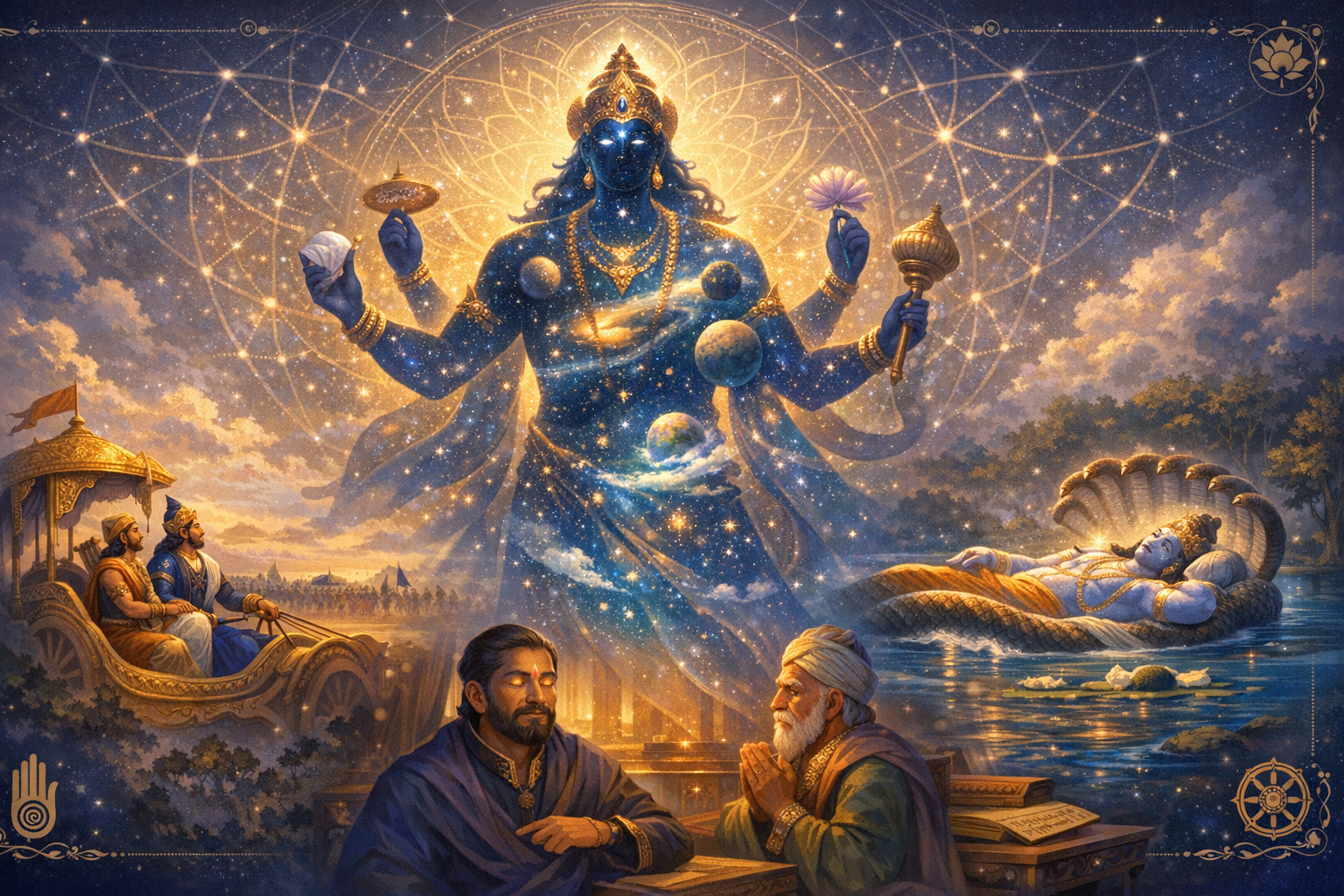
Eyes that saw the universe is not mere poetry in Sanatana Dharma; it names a rare historical-theological fact. Across the vast textual tradition, the viśvarūpathe infinite cosmic form of Bhagavan Krishnaappears before only a select few. This study surveys three principal witnesses recognized in the canon and commentarial memoryArjuna, Sanjaya, and Akrurawhile clarifying related moments such as Yashoda’s vision and Krishna’s revelation in the Kaurava sabhā. The aim is academic and integrative: to map sources, sift philological nuances, and draw resonances that nurture unity among the dharmic traditions of Hinduism, Buddhism, Jainism, and Sikhism.
The viśvarūpa is not simply a theophany among many; it is a comprehensive disclosure of reality where the distinctions between microcosm and macrocosm collapse into a single, overwhelming beholding. In Sanatana Dharma, this form is uniquely tied to Krishna as the avatāra of Vishnu, yet it is not reducible to any ordinary avatāra depiction. The texts consistently teach that such perception requires divya cakṣuḥdivinely empowered sightsignaling that spiritual epistemology, not just ocular capacity, governs what is seen and understood.
Defining terms matters. Viśvarūpa (literally, form-as-all) appears alongside cognate ideas such as virāṭ and aiśvarya-rūpa. While usage can overlap in Purāṇic and Itihāsa contexts, the Bhagavad Gita’s chapter 11 gives the most systematic account of the phenomenon and the conditions for beholding it. Other texts portray closely related revelations that communicate the same theological content: the Lord pervades, contains, and transcends all worlds simultaneously.
Arjuna: the battlefield witness (Bhagavad Gita, Chapter 11). The Kurukṣetra context in the Mahābhārata’s Bhīṣma Parva is pivotal. After receiving Krishna’s teachings, Arjuna requests to see the Lord’s supreme form: drashtum icchāmi te rūpam aiśvaram (BhG 11.3–4). Krishna then declares: na tu māṃ śakyase draṣṭum anenaiva svacakṣuṣā; divyaṃ dadāmi te cakṣuḥ (BhG 11.8). The requirement of divya cakṣuḥ establishes a hermeneutic key: even a kṣatriya of Arjuna’s caliberendowed with valor, insight, and proximity to the Lordneeds transformed perception to behold the totality that the viśvarūpa entails.
The Gita’s celebrated imagery follows. If a thousand suns rose at once in the sky, their brilliance might resemble that radiance (BhG 11.12, commonly paraphrased across traditions). Arjuna beholds innumerable mouths and eyes, countless wondrous sights, blazing ornaments and weapons, and the entire cosmos encompassed in a single, boundaryless being. The theophany does not only inspire; it unsettles. Arjuna confesses awe and fear, navigates intimacy and reverence, and ultimately returns to his relationship with Krishna as the charioteer and friend who is simultaneously the ground of all that is.
From a philosophical standpoint, Arjuna’s experience grounds several Vedantic themes. Ontologically, Brahman is not an abstract beyond; in Krishna’s viśvarūpa, being and becoming are seen as one living whole. Epistemologically, the divine eye signifies that knowledge is a mode of grace-enabled vision, aligning pramāṇa (means of knowledge) with bhakti (devotional disposition). Ethically, the darśana reintegrates Arjuna’s duty (svadharma) with universal welfare (loka-saṅgraha), dissolving false dichotomies between action and contemplation.
Sanjaya: the seer-narrator by Vyasa’s grace. While Arjuna’s vision is experiential and dialogical, Sanjaya’s is transmissive and contemplative. The Mahābhārata records that Vyasa conferred divya dṛṣṭi upon Sanjaya, enabling him to witness and report battlefield eventsand crucially, the Gita dialogue itself. Sanjaya states: vyāsa-prasādāc chrutavān etad guhyam aham param (BhG 18.75). He then adds that by recalling again and again both the dialogue and that most wondrous form of Hari, he is filled with amazement and joy (BhG 18.76–77: tac ca saṃsmṛtya saṃsmṛtya rūpam atyadbhutaṃ hareḥ… vismayo me mahān rājaṃ).
Commentarial traditions take these verses to mean that Sanjaya not only heard the discourse but also beheld the viśvarūpa through the visionary faculty granted by Vyasa. As a narratological device, Sanjaya’s witness builds a bridge between the unique intimacy of Arjuna’s encounter and the royal court that must interpret its meaning. Theologically, it underlines that revelation is not restricted to the primary interlocutor; it can be extended, mediated, and made available for communal reflection.
Akrura: the pilgrim whose devotion opened the cosmic window (Bhagavata Purana). The Bhāgavata Purāṇa (Skandha 10) preserves a third major witness in Akrura, the Yadava elder who brings Krishna and Balarama to Mathura. As Akrura halts by the Yamuna to bathe, he beholds a paradox: the Lords still seated upon the chariot, yet simultaneously manifest within the waters as the cosmic Narayana upon Ananta Sesha, attended by the devas. In Bhāgavata Purāṇa 10.39–10.40 (with textual parallels in Vishnu Purana 5.17), Akrura perceives the viśvarūpa contentthe deities, worlds, and principles residing in the Lord who also stands before him in human form.
Akrura’s darśana is significant for two reasons. First, it dramatizes the simultaneity of transcendence and immanence: Krishna is both the boy on the chariot and the cosmic ground of reality. Second, it emphasizes the devotional condition for vision. Akrura exemplifies śraddhā (trusting faith) and ananya-bhakti (exclusive orientation), suggesting that the same viśvarūpa can be glimpsed in the quiet of pilgrimage as truly as in the din of battle.
Related episodes and clarifications. Two additional moments are frequently cited and merit careful distinction. First, Yashoda’s vision when Krishna opens his mouth (Bhāgavata Purāṇa 10.8.37–45) reveals the universe within himplanets, beings, and elementsprompting a maternal-confessional bewilderment. While this is not labeled viśvarūpa in the Gita’s technical sense, it communicates the same metaphysical truth: the Lord contains all worlds even while playing in Gokula. Second, in the Mahābhārata’s Udyoga Parva, Krishna, as peace envoy, reveals a form dazzling and terrifying when Duryodhana seeks to bind him. The sabhā struggles to comprehend; tradition notes that the righteousBhishma, Drona, Vidura, and Sanjayaperceive more than the deluded. These episodes reinforce the pattern that spiritual character shapes what is seen.
Did Dhritarashtra witness the cosmic form? Some recensions and retellings preserve a detail that Dhritarashtra briefly obtained vision to behold Krishna’s revelation in the Kaurava court and then asked for his blindness to return. While this motif underscores the unbearable intensity of cosmic vision for an unprepared mind, its textual status varies by recension. Critical editions emphasize Sanjaya’s divya dṛṣṭi as the secure link between court and battlefield; careful readers should therefore distinguish between widely received narrative memory and the most conservative textual layers.
What unites the three principal witnesses? Arjuna, Sanjaya, and Akrura differ in rolewarrior-disciple, seer-narrator, and pilgrim-elderbut converge on three constants. First, vision is grace-enabled: divya cakṣuḥ is bestowed, not engineered. Second, vision is ethically mediated: humility, devotion, and dharmic integrity expand perception. Third, vision is pedagogical: each beholding returns the witness to clearer actionArjuna to righteous duty, Sanjaya to truthful narration, Akrura to service and steadfast faith.
Technical note on epistemology. The Sanskrit darśana suggests more than sight; it indicates a transformative encounter in which the seer and the seen interpenetrate. In Indian philosophy, pratyakṣa (perception) is a valid means of knowledge, yet the viśvarūpa forces a revision: ordinary pratyakṣa is insufficient until refined by śāstra (scripture), guru-upadeśa (instruction), and bhakti (devotional alignment). Hence the Gita’s insistence that yoga and trust are prerequisites, not afterthoughts, for cosmic understanding.
Philology and usage. Viśvarūpa in the Gita (BhG 11) is not only a name but a structured revelation followed by reversion to the saumya-rūpa (gentle form), which enables intimacy to be restored. Purāṇic passages such as the Akrura episode deploy overlapping imageryAnanta, devas, and cosmic auditorsto express the same truth within a different narrative genre. The Itihāsa-Purāṇa continuum thus exhibits both doctrinal unity and literary plurality.
Comparative dharmic resonances. The viśvarūpa’s integrative vision harmonizes with Jainism’s anekāntavāda, the doctrine that reality possesses multiple, irreducible facets requiring intellectual humility. In Buddhism, the imagery of interpenetrationfamously evoked through Indra’s Net in later Mahayana thoughtechoes the same intuition: every jewel reflects all others without loss of distinctness. Sikhism’s affirmation Ik Onkar articulates a unitive ground from which multiplicity unfolds. These traditions, while distinct in theology and practice, share a commitment to seeing the whole without erasing the part, a commitment that the viśvarūpa dramatizes in a uniquely personal, devotional register.
Ethical implications for plural societies. If the whole resides in and through the parts, then respectful coexistence becomes not a concession but a consequence of metaphysical insight. Unity in spiritual diversityan ideal deeply at home in Sanatana Dharmaemerges naturally from viśvarūpa logic: one reality, many approaches; one Lord, many names; one goal, many paths. The three witnesses stand as archetypes for how to perceive difference without division.
Arjuna’s return to action after the vision is instructive. The Gita never romanticizes theophany as an escape from responsibility. Rather, it refines agency. Recognizing Krishna as the inner ruler of all beings turns duty from self-assertion into service. In a secular register, this translates into institutions that pursue justice with humility, policies that honor the many while seeking the good of all, and scholarship that treats sources and communities with reverence.
Sanjaya models truthful mediation. He neither sensationalizes nor trivializes the adbhuta (wondrous). His testimony affirms a standard for public communication: fidelity to what was seen and heard, disciplined recollection, and openness to continuous amazement. In contemporary discourse, this invites historians, journalists, and educators to approach dharmic sources with the same balance of rigor and wonder.
Akrura’s pilgrimage mirrors an interior journey. He pauses to bathe, to purify, and to attendthen reality opens. The lesson is not antiquarian. It recommends rhythms of stillness within contemporary life, practices that are accessible across dharmic communitiesjapa, simran, meditation, svādhyāyaso that the capacity to perceive the whole may ripen quietly and steadily.
A note on reception and art. Across centuries, poets, sculptors, and ritualists have returned to the viśvarūpa to transmit awe. Temple murals in India, Southeast Asian iconography, and classical performances render the overwhelming into forms that the heart can bear. Such cultural transmissions serve not only Hindu communities but also contribute to a shared civilizational heritage where Buddhists, Jains, and Sikhs recognize familiar harmonies and ethical imperatives.
Addressing common misunderstandings. Sometimes the viśvarūpa is reduced to spectacle or conflated indiscriminately with all divine manifestations. The sources counsel otherwise. The Gita positions the viśvarūpa as pedagogically exceptional: a moment of total disclosure to realign understanding and vocation. Purāṇic parallels illuminate, not dilute, this focus. Recognizing these layers preserves the integrity of each text and honors the shared dharmic insight that seeing the whole changes how one lives among the parts.
In summary, three principal witnessesArjuna, Sanjaya, and Akruraanchor the tradition’s memory of Krishna’s cosmic form. Arjuna sees to act rightly, Sanjaya sees to speak truthfully, and Akrura sees to serve devotedly. Around them, Yashoda’s maternal astonishment and the Kaurava court’s partial perceptions frame a wider field in which character conditions sight. The viśvarūpa remains a living summons: to cultivate vision that is humble, ethical, and inclusive.
For readers and practitioners across Hinduism, Buddhism, Jainism, and Sikhism, the viśvarūpa invites a shared commitment: hold fast to the One without erasing the many; cherish the many without forgetting the One. In that balance, Sanatana Dharma recognizes both conviction and compassion, both clarity and communitya unity broad enough to welcome all who seek truth with reverence.
Inspired by this post on Hindu Blog.
