
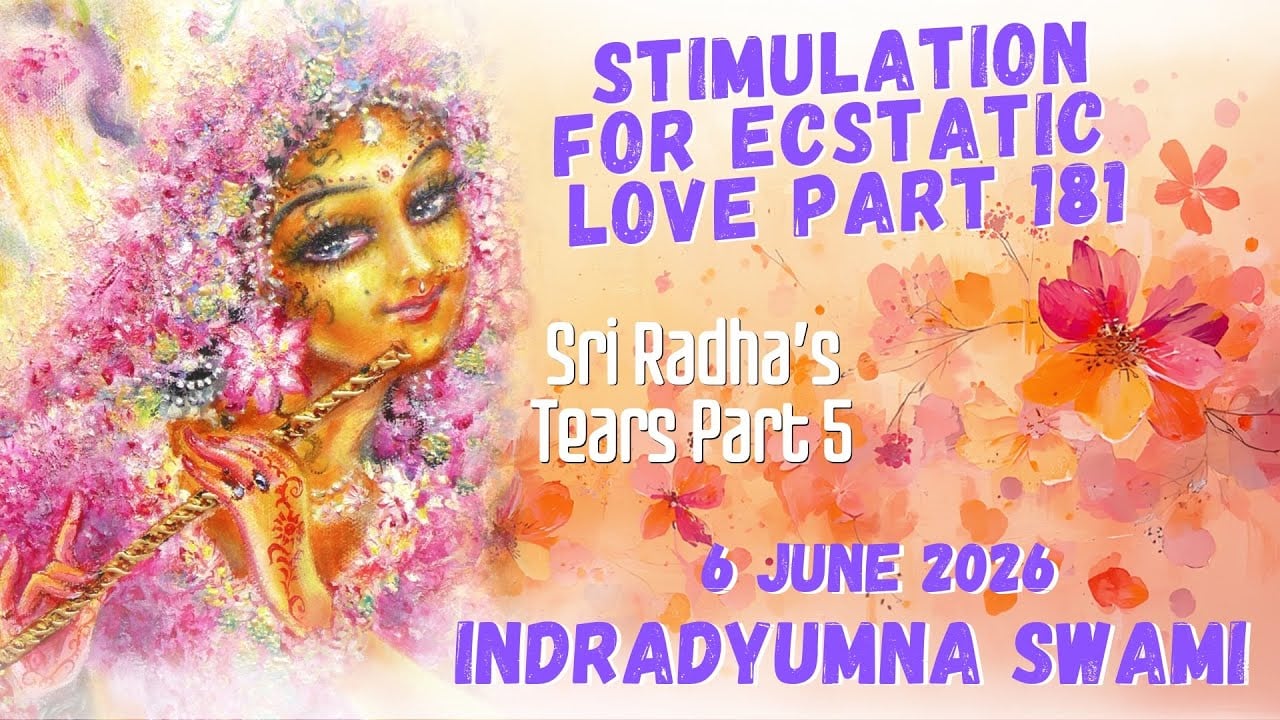
“Stimulation for Ecstatic Love” (Part 181) Sri Radha’s Tears (Part 5), presented on Indradyumna Swami Official, invites a rigorous examination of how devotional stimuli (uddīpana) awaken, shape, and refine bhakti-rasa within the Gaudiya Vaishnava tradition. The theme of Sri Radha’s tears is not merely poetic sentiment; it occupies a precise place in the theological aesthetics codified by Śrī Rūpa Gosvāmi. Read through the lens of Bhakti-rasamrita-sindhu and Ujjvala-nīlamaṇi, this exploration clarifies why tears, when arising from pure devotion, are counted among the hallmarks of spiritual maturity rather than passing emotion.
Classical rasa theory provides the grammar of devotion. In the Gaudiya tradition, rasa results from a dynamic interplay of vibhāva (the causes that evoke love, divided into ālambanathe belovedand uddīpanaauxiliary stimulants), anubhāva (observable expressions like smiling or bowing), vyabhicārī-bhāva (transitory emotions such as longing or humility), and the sthāyī-bhāva (the enduring sentiment of love for the Divine). When the sthāyī-bhāva is perfected in relation to Sri Krishna, it becomes rasatasted bhaktiexperienced with immediacy and certainty.
Within this architecture, tears (aśru) belong to the eight sāttvika-bhāvastransformations of the body that arise spontaneously from deep spiritual emotion: stambha (stupefaction), sveda (sweating), romāñca (horripilation), svara-bheda (voice faltering), vepathu (trembling), vaivarṇya (color change), aśru (tears), and pralaya (fainting). In bhakti, these are not theatrics but involuntary indicators that the heart-mind has been reshaped by devotion. Properly understood, aśru is an index of interior purification rather than an aim in itself.
Gaudiya Vaishnava literature locates Sri Radha at the summit of devotional experience, the personification of mahābhāvathe most intense and refined form of love for Sri Krishna. Her tears signal the apex of relational intimacy in madhurya-rasa (the conjugal mood), where the sacred feminine (the Divine consort) is revealed as the inexhaustible wellspring of compassion, fidelity, and ecstatic union. Theologically, these tears do not weaken resolve; they saturate the entire field of consciousness with unwavering remembrance and service-centered love.
In this light, Sri Radha’s tears function differently in two complementary modalities of love: vipralambha (separation) and sambhoga (meeting). In separation, tears sharpen remembrance, intensify longing, and keep the beloved present within the heart; in meeting, tears liquefy pride, sweeten intimacy, and safeguard humility before the overwhelming beauty of Sri Krishna. Far from being contradictory, these two currents spiral together, sustaining the devotee’s love across time, circumstance, and inner weather.
Uddīpanasauxiliary stimulants of lovehelp explain why Sri Radha’s tears surface with particular force: the name of Krishna, the music of the flute, the forests and moonlit groves of Vṛndāvana, the fragrance of tulasī, the sight of springall catalyze the sthāyī-bhāva until it crests as rasa. Such stimuli are not accidental props; they are the carefully noticed textures of sacred life that the bhakta learns to see everywhere. In everyday practice, they train attention to convert perception into devotion.
Because Sri Radha’s love exemplifies the highest refinement of madhurya-rasa, her tears can be read as a sacrament of relational completeness: full self-offering, total receptivity, and unbroken remembrance. This is why the Gaudiya tradition speaks of her as the crown-jewel of devotional love and why kīrtana in the Hare Krishna movement often extols Sri Radha alongside Sri Krishna. The cry of the heartembodied as tearsunites ontology (who one is) with sādhanā (how one lives), dissolving the distance between seeker and sought.
Such theology translates into practice through the nine processes of bhakti (śravaṇa, kīrtana, smaraṇa, pāda-sevana, arcana, vandana, dāsya, sakhya, ātma-nivedana; see Śrīmad-Bhāgavatam 7.5.23). Over time, these disciplines pass through sādhanā-bhakti (regulated practice), then bhāva-bhakti (incipient love) and finally prema-bhakti (fully blossomed love). Tears may arise at any stage but are stable and spiritually nourishing only when grounded in guru, śāstra, and sādhu-saṅgaguidance, revelation, and community.
Practitioners across the Bhakti Tradition consistently report that tears often appear during kīrtana, attentive japa, or while hearing rasika kathā (narratives of Krishna’s pastimes). Yet the same practitioners affirm an important guardrail: genuine tears cannot be manufactured. Gaudiya acharyas caution against imitation (sahajiyā tendencies), urging steadiness in service (seva), sincerity in chanting, and humility as the surest path to authentic transformation.
Read as a broader Indic contribution, Sri Radha’s tears exemplify a dharmic grammar of compassion that resonates far beyond a single lineage. Buddhism speaks of karuṇā as the living pulse of bodhicitta. Jainism emphasizes anukampā and ahiṃsācompassion and non-violenceas the ethical horizon of spiritual life. Sikh teachings on Naam Simran recount hearts softened in remembrance of the Divine, with Gurbani describing the eyes brimming in love and surrender. In each stream, tender-heartedness flows from disciplined practice; emotional refinement becomes a social ethic. This unity in diversity strengthens a shared dharmic commitment to inner purification and outer non-harm.
Psychophysiology sheds light on why devotional tears help consolidate spiritual states. Research in affective neuroscience associates emotionally triggered tears with parasympathetic activation and vagal tone, often followed by a sense of calm and integration. While devotion is irreducible to biology, these findings help explain a common after-effect of crying in bhakti: clearer attention, softened reactivity, and renewed focus for contemplation and service. In this way, aśru can stabilize, not scatter, the contemplative mind.
On the level of lived experience, many devotees describe a subtle arc: attention gathers through śravaṇa and kīrtana, the heart warms in smaraṇa, service deepens during arcana and dāsya, and then tears appear unbiddenbriefly opening an interior window where the beloved feels luminously near. The important lesson is methodological: practices come first, emotions follow; emotions then re-energize practices in a virtuous spiral. The center is always Krishna, and the measure is always service.
A balanced hermeneutic preserves devotion from sentimentality. Rūpa Gosvāmi’s categories safeguard this balance by giving clear names to experiences and the relations among them. When tears are read through vibhāva, anubhāva, vyabhicārī-bhāva, and sthāyī-bhāva, practitioners avoid both cynicism (“emotions do not matter”) and credulity (“emotions alone are enough”). The result is discernmentrasika appreciation grounded in śāstra.
The aesthetics of rasa do not undermine ethics; they nourish it. A heart that weeps for the Divine grows allergic to cruelty and falsehood. This is why bhakti naturally correlates with ahiṃsā, seva, and social responsibility. The unity of feeling and dutyof inner tenderness and outer integrityaligns with the wider Sanatan Dharma vision of human flourishing: purification of the self, protection of life, and the cultivation of wisdom across families, communities, and traditions.
In practical terms, cultivating sacred sensitivity can be supported by simple steps: dedicate daily time for śravaṇa and kīrtana; chant the Hare Krishna mahā-mantra with attentive breath; reflect on the qualities and pastimes of Sri Krishna and Sri Radha; engage the senses through tulasī seva, lamp offerings, and sacred food (prasāda); and anchor everything in humility and guidance. Over time, such practices reveal the uddīpanas already present in ordinary lifea fragrance, a melody, a verseuntil remembrance becomes spontaneous and steady.
Viewed through this integrative frame, “Sri Radha’s Tears” is not an invitation to perform emotion but to refine perception. The Gaudiya Vaishnava map shows how aesthetic insight and ethical clarity mature together, converging in a life of love-filled responsibility. As that maturation unfolds, tears come and go, but what remains is the unmistakable orientation of the heart: devotion to Sri Krishna, reverence for the Sacred Feminine, friendship toward all beings, and a patient commitment to unity among the dharmic familyHinduism, Buddhism, Jainism, and Sikhism.
For readers seeking deeper study, the anchor texts are clear: Bhakti-rasamrita-sindhu, Ujjvala-nīlamaṇi, and the relevant narratives in Śrīmad-Bhāgavatam. Commentaries by recognized Vaishnava saints help bridge doctrine and practice, while kīrtana-centered communities such as ISKCON (International Society for Krishna Consciousness) demonstrate how śāstra-based devotion unfolds in contemporary life. Taken together, these sources clarify why Sri Radha’s tears are a theological summit and a practical guidean emblem of perfected love and a beacon for everyday sādhanā.
Inspired by this post on Dandavats.
