
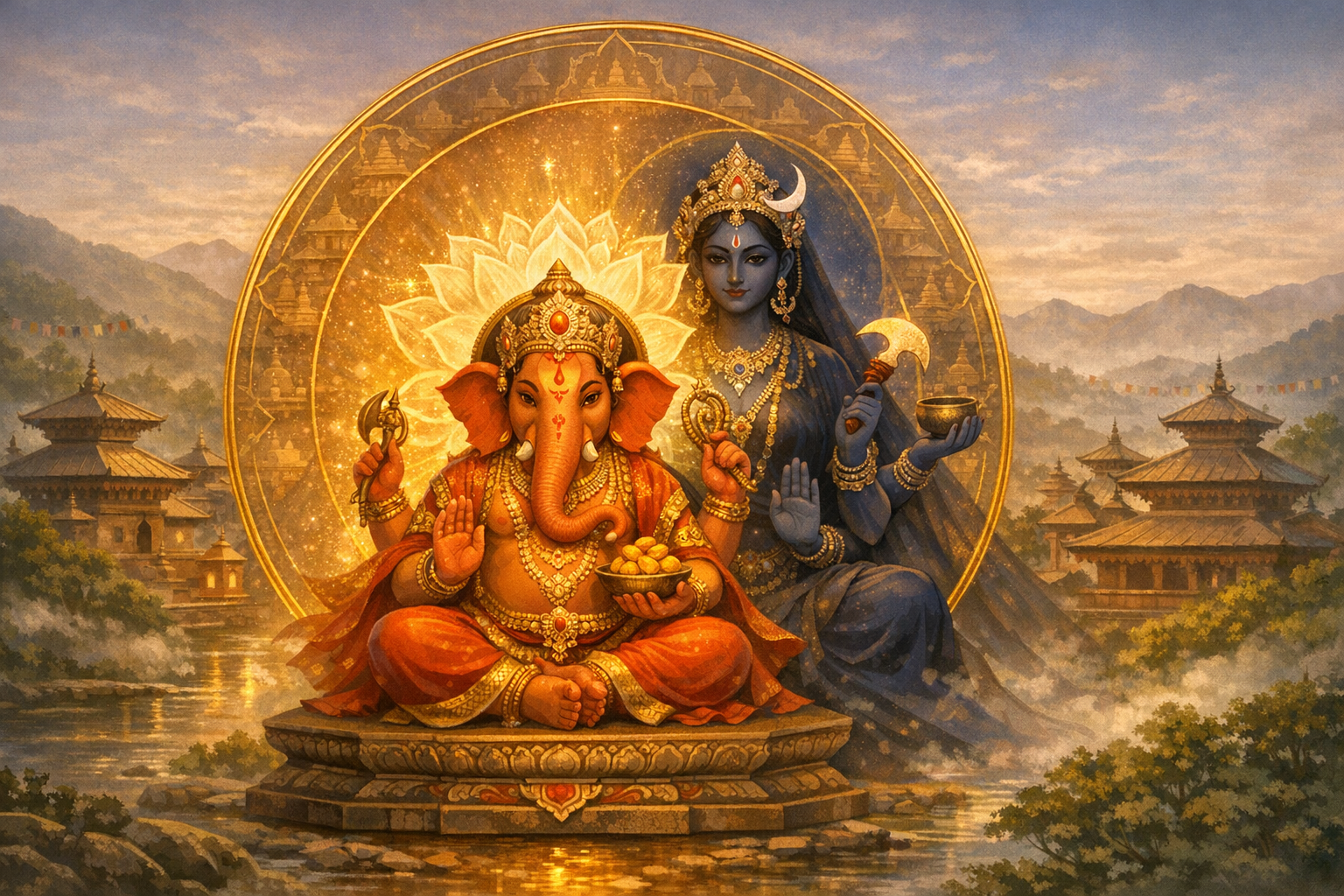
In the sacred geography of the Nepal Mandala, where Himalayan Shaiva, Shakta, and Vajrayana traditions have interwoven for centuries, two presences are ritually and philosophically inseparable: Siddhi Ganesh and Siddhikali (also encountered as Siddhi Kali or Siddha Kali). Their pairing is not merely local devotion; it encodes a foundational Tantric insightConsciousness (cit) and Power (shakti) are two sides of a single reality. To invoke one is to implicitly honor the other, a principle a living tradition sustains through temple networks, pilgrimage circuits, and daily sadhana.
Siddhikalithe Hidden Motherand Guhyeshwari, “She who is the Lady of Secrets,” together illuminate this mystery. Within the Kathmandu Valley, Guhyeshwari stands near Pashupatinath as a Shakti pitha, revered as the subtle womb of power from which forms arise. In parallel, Siddhi Ganesh represents the stabilizing, ordering intelligence that removes obstacles and renders latent potential manifest as accomplishment (siddhi). The lived unity of these two reveals how the Nepal Mandala operates both as sacred map and interior yogic diagram.
Nepal Mandala, a historical term for the cultural-cultic region centered on the Kathmandu Valley, is patterned as a mandala in the classical sense: shrines ring the landscape as guardians, nodes of transmission, and points of inner-outer alignment. The ring of mother goddesses (Asta-matrikas), circuits of Bhairavas, and the four Vinayakas (Chaturvinayaka) collectively demonstrate how place, rite, and philosophy converge. This layered topography embodies a broader Dharmic unity in which Hinduism and Buddhism share ritual technologies and metaphysical aims, while Jain and Sikh perspectives are respected within a civilizational ethos that values many paths toward wisdom.
Siddhi, in Sanskrit, denotes spiritual-performative accomplishmentthe ripening of intention, discipline, and grace into realized capacity. Classical lists of aṣṭa-siddhis (anima, mahima, laghima, garima, prapti, prakamya, ishitva, vashitva) are symbolic of mastery over limitation. Ganapati is universally invoked as the sovereign of thresholds, the one who grants siddhi and buddhi (accomplishment and discernment). Hence the epithet Siddhi Ganesh, pointing to the bestower of fruitful outcomes and the integrator of intelligence with action.
Complementing this, Siddhikali personifies the kinetic, time-cutting force of transformationKali as the compassionate intensity that dissolves constriction and reveals the real. In Nepalese Shakta practice, Siddhikali is venerated as living Shakti. When named together with Guhyeshwari, the reference deepens: the Hidden Mother (guhya) is the inner matrix of all mantras, rites, and liberating knowledges. Theologically, this is the innermost circle of power from which siddhithe flowering of possibility into actualityemerges.
The pair Pashupatinath–Guhyeshwari expresses the axial polarity of Consciousness and Power within the valley. Pashupatinath, the great Shaiva shrine, is the still, witnessing center; Guhyeshwari, immediately adjacent, is the luminous, creative matrix. Pilgrims often describe a perceptible shift when moving between the two temples: from a quiet clarity at Pashupatinath to a charged, intimate presence at Guhyeshwarian experiential teaching on cit and shakti enacted through space.
The ChaturvinayakaAshok Binayak (near the old royal heart of Kathmandu), Jal Binayak (Chobar), Karya Binayak (Bungamati), and Surya Binayak (Bhaktapur)form another protective circuit. These Vinayakas mark boundaries, direct auspicious movement, and ritually “seal” the mandala against disharmony. In local practice, devotees who circumambulate these four sanctums testify to a progressive sense of orientation and resolutionobstacles yield, intentions sharpen, and undertakings find right timing.
Within this sacred field, Siddhikali in Madhyapur Thimi is especially cherished. Community rituals and jatras vividly center the goddess as the one who empowers collective renewal. During the vibrant spring festivities that animate the Bhaktapur–Thimi corridor, palanquin processions, drumming, and the exchange of vermilion (sindur) dramatize the descent of Shakti into communal life. Ganesh deities also join such circuits, visually teaching the logic of partnership: wisdom removes barriers while power actualizes intent.
Iconographically, Ganapati and Kali articulate complementary functions. Ganapati’s trunk arches toward the bowl of wisdom; his hands may bear the broken tusk (sacrifice of the lesser for the greater), modaka (the bliss of realization), the goad (guidance), and noose (containment of wandering impulses). He is often flanked or conceptually accompanied by Siddhi and Buddhiaccomplishment and insightnaming the fruits he bestows. Kali, typically shown dark as the night sky of pure awareness, wields the kartrika (chopper) and kapala (skull-cup) to sever ignorance and drink its residues, with gestures that promise boons and fearlessness. In Nepal, Guhyeshwari is frequently honored in aniconic yoni form, emphasizing generative ground over figural display.
Tantric metaphysics frames their unity with precision. Consciousness (cit) is self-luminous awareness; Power (shakti) is its inherent capacity to know, veil, reveal, and manifest. As sound, this union appears as bija-mantrasGAM for Ganapati (a compact vibration of stability and threshold-clearing) and KRIM or KREEM for Kali (a current of incisive transformation). As form, it becomes yantraconcentric geometry used to align mind, breath, and space. As rite, it is puja, homa, nyasa, and mudraembodied methods for returning the dispersed psyche to its sovereign center.
Yogic anatomy presents a parallel map. Ganapati is traditionally associated with muladhara, the basal support where prana consolidates as grounded clarity; Kali, in her time-transcending mode, corresponds to the awakened kuṇḍalinī that rises, purifying stations of awareness. Their realized embrace at sahasrara is the archetype of siddhi: the system no longer works against itself. In practical terms, this yields steadiness, discernment, fearlessness, and compassionate strengthvirtues repeatedly affirmed by devotees who undertake pilgrimages in the valley’s circuits.
Historically, Nepalese Shaiva-Shakta and Vajrayana lineages have dialogued intimately. Buddhist sadhanas such as those preserved in the Niṣpannayogāvalī and Sādhanamālā include Ganapati forms, while Hindu Tantric manuals articulate yoginis and matrikas that Buddhists also honor in parallel modes. Guhyeshwari herself is venerated by both Hindus and Buddhists, exemplifying an inclusive Dharmic grammar: distinct idioms, shared aimswisdom, compassion, liberation, and noble conduct. This ecumenical fabric supports the blog’s central aim: unity among Hinduism, Buddhism, Jainism, and Sikhism through mutual respect and recognition of convergent ethical-spiritual horizons.
Ritually, siddhi is never divorced from ethics. Tantric texts repeatedly state that steadiness (dhriti), truthfulness (satya), non-harm (ahimsa), and self-mastery (dama) are preconditions for accomplishment. In Nepalese households and monasteries alike, this is witnessed in simple actssharing prasada, caring for elders, or supporting temple upkeepthrough which Shakti’s care becomes social practice. Power is measured not as domination but as the capacity to heal, include, and set right.
Visitors frequently report a felt arc while moving across the valley’s sacred nodes: the still assurance of Pashupatinath; the intimate, womb-like presence of Guhyeshwari; the clarifying thresholds of the four Vinayakas; and the celebratory, community-quickening rites surrounding Siddhikali. Such testimony, while personal, is strikingly patterned, indicating that the Nepal Mandala’s design is as much pedagogy as pietyan initiatory curriculum inscribed into streets, courtyards, and hills.
From a practitioner’s standpoint, even simple observances resonate with the Tantric union of Consciousness and Power. Beginning any undertaking with a quiet invocation of GAM, maintaining ethical clarity in speech and action, and reflecting on the Mother as the hidden source of resilience during difficultythese are accessible ways to honor Siddhi Ganesh and Siddhikali without transgressing the guardrails that properly reserve advanced rites for initiatory lineages and qualified guidance.
Read philosophically, “Siddhi Ganesh and Siddhikali” is a doctrine of potential becoming manifest: intelligence discerning the path, power walking it. Read ritually, it is the valley’s spatial liturgy: guardians who stabilize, a Mother who generates, and a Lord who removes impediments. Read ethically, it is a vow: to wield accomplishment in service of the common good. Across these lenses, the union remains the samecit and shakti as a single, compassionate reality.
Thus the Nepal Mandala’s enduring lesson is clear. Whether through the serene thresholds of Siddhi Ganesh or the fierce grace of Siddhikali and Guhyeshwari, the sacred landscape teaches unityof traditions, of philosophy and practice, of personal integrity and communal flourishing. In honoring both Consciousness and Power together, practitioners across Dharmic paths find a shared, elevating center.
Inspired by this post on Hindu Blog.
