
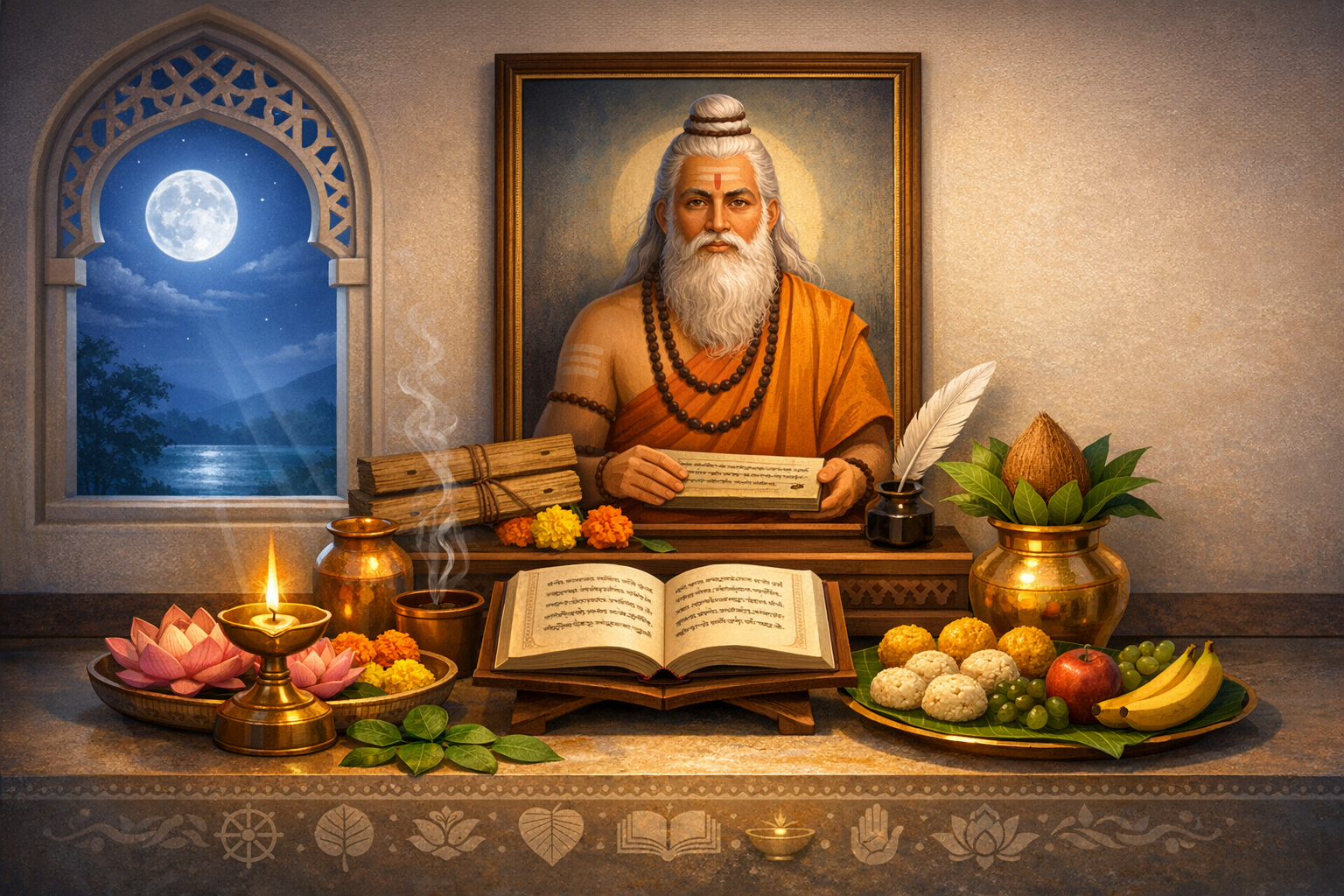
Ashada Purnimawidely revered as Guru Purnima or Veda Vyasa Purnimafalls on 29 July 2026. Celebrated across India and the global diaspora, the full moon of the Ashadha month honors the timeless Guru-Shishya Tradition in which knowledge is transmitted with rigor, compassion, and responsibility. The day pays homage to the archetypal Guru, Bhagavan Veda Vyasa, traditionally credited with classifying the Vedas, composing the Mahabharata, and systematizing vast bodies of sacred knowledge for the benefit of humanity. In contemporary practice, the festival integrates temple worship, scriptural study, acts of service, and heartfelt gratitude toward living teachers, family mentors, and community guides.
Calendrically, Ashadha Purnima is determined by the Purnima tithi (lunar day) prevailing during local sunrise according to the lunisolar Hindu calendar. Regional calendric conventionsPurnimanta in many northern traditions and Amanta in many southern traditionsboth converge on the same full-moon observance while labeling months differently. Because tithis are astronomical intervals (each spanning 12 degrees of lunar elongation), local observance can vary by geography and time zone. For 2026, major Indian almanacs align on 29 July for Ashadha Purnima, with communities typically performing Guru Puja during the morning and midday hours and taking darshan of the full moon in the evening where customary.
The scriptural anchor of this festival is the recognition of the Guru-tattva, the principle that illumines discernment (viveka), steadies conduct (achara), and transmits liberating knowledge (vidya). In Hindu tradition, Guru Purnima venerates Veda Vyasa (Krishna Dvaipayana Vyasa), whose intellectual labor preserved Vedic literature and framed the epic and Puranic canons. The day is thus also named Veda Vyasa Purnima or Vyasa Puja, honoring both the historical sage and the transpersonal function of guidance that Gurus embody across time.
A concise encapsulation of the Guru’s role is preserved in a widely recited verse:
Guru Brahma Guru Vishnu Guru Devo Maheshwarah; Guru Sakshat Parabrahma Tasmai Shri Gurave Namah.
In Vyasa Puja, a complementary verse honors the Sage of sages:
Vyasaaya Vishnu-roopaaya Vyasa-roopaaya Vishnave; Namo Vai Brahma-nidaye Vasisthaaya Namo Namah.
Philosophically, Guru Purnima foregrounds an ethical and epistemic framework: knowledge must be both true and transformative. The Guru is revered not as a personality cult but as a living axis of the Vedic Tradition that insists on disciplined inquiry (svadhyaya), conscientious action (dharma), and inner refinement (samskara). This framework naturally embraces diverse paths of sadhanabhakti, jnana, karma, and yogawelcoming plural modes of worship without hierarchy or exclusion.
Core observances on Ashadha Purnima are grounded and purposeful. Many undertake a sattvic vrata (simple fast) and perform Guru Puja or Vyasa Puja at home, in mathas, or in temples. A typical sequence includes: sankalpa (intention for learning and service), acamana (ritual purification), avahana (invocation), and panchopachara or shodashopachara offerings (fragrance, flowers, lamp, incense, naivedya, and other upacharas). Recitations may include passages from the Bhagavad Gita, Upanishads, or Guru Gita (Skanda Purana), alongside kirtana or stotra chanting. Dakshina offered to teachers or to institutions that preserve learning is traditional, with a parallel emphasis on annadana (food distribution) and book donations that extend knowledge equitably.
Household worship is often complemented by practical learning commitments. Devotees earmark the day to commence or deepen a course of studyscriptural, linguistic (such as Sanskrit), philosophical, or artisticguided by a teacher. Many communities hold satsanga, scriptural discourses, or reading circles, developing shared literacy in Vedas, Upanishads, Bhagavad Gita, and allied texts. Such study is not merely academic; it cultivates clarity in ethics, steadiness under uncertainty, and a spirit of inquiry that resists dogmatism.
Regionally, Ashadha Purnima resonates with rich variations. In the Himalayas and across North India, formal Vyasa Puja is conducted in gurukulas and ashramas with elaborate offerings, while in Maharashtra and Goa, the day integrates gracefully with monsoon-season devotional cycles. In the southern states, Aadi/Aashada Pournami is marked by temple events, special abhishekas, and communal worship. In the diaspora, Hindu organizations host lectures, residential retreats, and teacher-honoring ceremonies that strengthen community bonds and intergenerational continuity.
Importantly, Ashadha Purnima also reflects the unity-in-diversity ethos of the broader dharmic family. In Theravada Buddhism, the same full moon is observed as Asalha Puja (Asalha Purnima), commemorating the Buddha’s first discourse (Dhammacakkappavattana Sutta) and inaugurating Vassa, the rains retreat dedicated to disciplined practice and study. In Jain tradition, Gurupurnima honors the lineage of ascetic teachers (Upadhyayas and Acharyas), highlighting reverence for guidance in right knowledge (samyag-jnana) and right conduct (samyak-charitra). In Sikh tradition, while Gurpurabs are the central calendar markers and the Guru Granth Sahib is the eternal Guru, many communities use this full moon as a reflective moment to foreground gurmat valuestruthful living, seva, and remembrance of the Guru’s shabad. Read together, these observances affirm a shared civilizational proposition: true guidance liberates, reconciles reason and compassion, and serves all beings.
From a calendrical-scientific standpoint, Purnima coincides with the Moon at (or near) opposition to the Sun. Hindu tithis are based on the Moon’s relative angular distance from the Sun; Purnima tithi ends when the elongation crosses 180 degrees. Since local sunrise conventions determine calendar assignment, Ashadha Purnima may straddle two civil dates in some regions even as the ritual emphasis remains the same. Devotees typically avoid inauspicious intervals such as Rahu Kaal for ceremonial beginnings and favor calm, sattvic morning or midday windows; local panchangas provide exact spans.
To prepare responsibly for 29 July 2026, communities often assemble a concise puja kit: water and vessel for acamana, clean altar or study area, a portrait or symbol of the Guru (including Veda Vyasa), flowers and leaves (bilva where appropriate), lamp and incense, fruits and sattvic sweets for naivedya, and a text selection for recitation. Offerings are ideally eco-friendly and locally sourced. Charity aligns with the day’s intent when directed to educationscholarship funds, libraries, manuscript preservation, or institutions that sustain traditional and modern knowledge streams with integrity.
Scriptural study on Guru Purnima gains depth through focused selections that illuminate the Guru principle and the primacy of knowledge. Many choose the Bhagavad Gita’s fourth chapter (jnana-karma-sannyasa) for its transmission-of-knowledge theme; others turn to Upanishadic passages on the teacher-student dialogue (e.g., Kena and Mundaka), or to Guru Gita selections. Commentarial traditionsfrom classical acharyas to modern sagesoffer diverse vantage points while converging on the value of disciplined inquiry, humility, and service.
Beyond ritual, the day invites a social ethic: mentorship in families, schools, laboratories, and workplaces reflects the Guru idea in contemporary life. Honoring teachersacademic, artistic, scientific, or spiritualreinforces a culture of excellence with compassion. Communities often pair worship with literacy drives, study mentorship for students from underserved backgrounds, or collaborative projects that bring ancient insights into conversation with modern sciences and arts.
Frequently asked clarifications include the distinction between Guru Purnima and national Teachers’ Day observances; the former is a sacred lunar festival grounded in the Hindu calendar, while the latter are civic commemorations. Another query concerns fasting: traditions vary from complete fasts to light sattvic meals, with the constant guideline that practice should support clarity and steadiness, not strain. Finally, while Vedic astrology offers nuanced muhurta selection, the festival’s core intentgratitude, study, and sevaremains paramount regardless of precise timing.
In synthesis, Ashadha Purnima (Guru Purnima/Veda Vyasa Purnima) on 29 July 2026 is an invitation to renew the commitments that make learning sacred: truth-seeking, disciplined practice, reverence for teachers, and service to society. Observed across Hinduism and meaningfully paralleled in Buddhism, Jainism, and Sikhism, the full moon unites the dharmic traditions around the shared conviction that authentic guidance illumines the path from knowledge to wisdom. Marking the day with puja, study, and acts of goodwill honors a lineage that has, for millennia, kept the lamp of knowledge bright.
Inspired by this post on Hindu Pad.
