
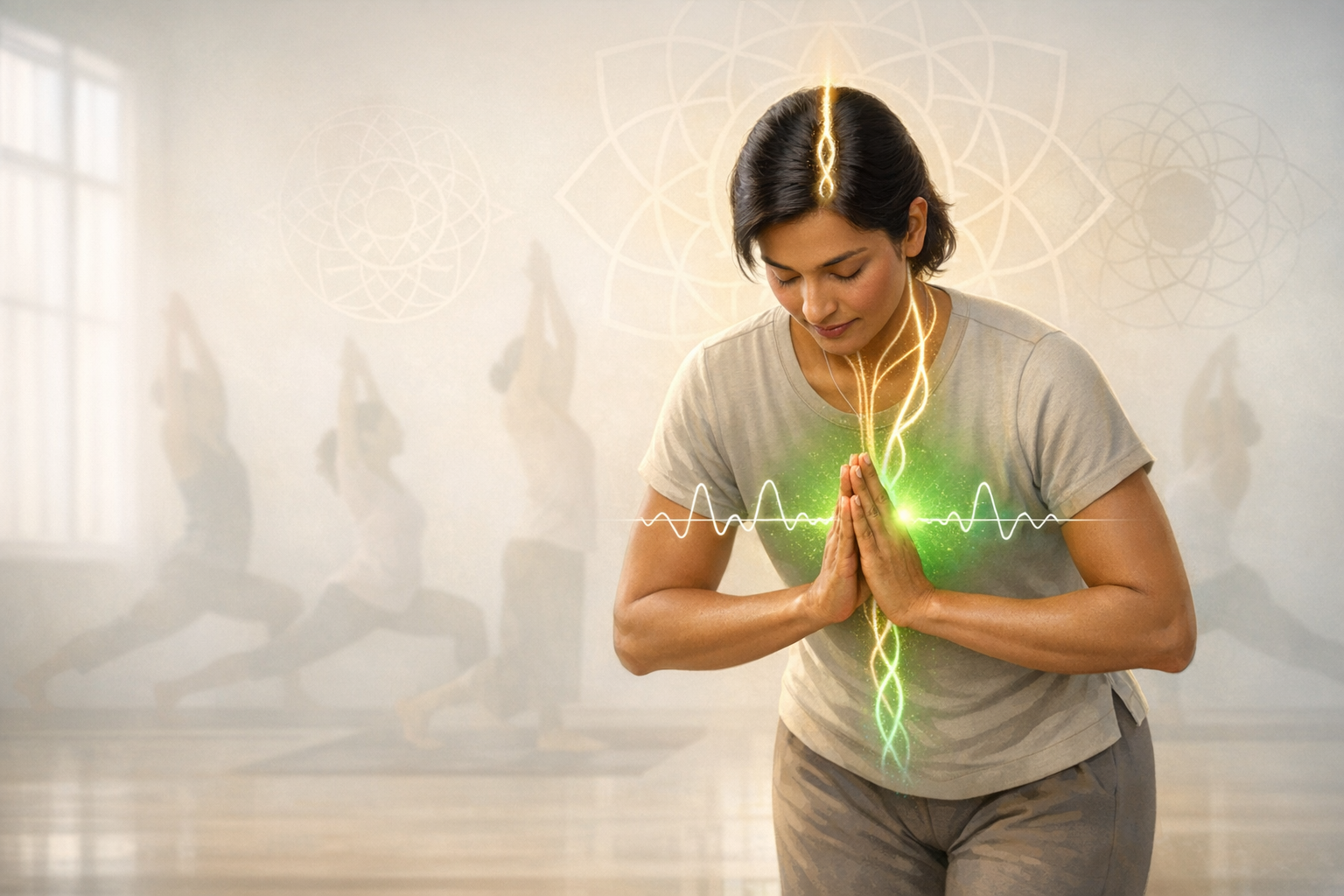
Namaskaralso expressed as Namaste or Namaskaramis more than a conventional salutation within Hindu dharma; it is a refined psycho-energetic and contemplative practice that integrates body, mind, and awareness. When both palms meet at the heart in Anjali Mudra, the gesture encodes humility, unity, and reverence, articulating a timeless insight: the recognition of the sacred in oneself and in the other. Contemporary understandings from physiology, psychology, and yogic anatomy together illuminate why this seemingly simple action consistently cultivates calm attention, prosocial connection, and a grounded sense of presence in daily life.
Philologically, “Namaste” derives from the Sanskrit namas (reverential bow, salutation) plus te (to you), signifying “I bow to you.” Across regions, related formsNamaskaram in the south, Pranam in the northshare the same semantic heart. In ritual, ethical, and social contexts, this salutation embodies the Hindu way of life by honoring dignity, interdependence, and the intrinsic worth of all beings.
From a biomechanical perspective, Anjali Mudra organizes the body around the midline. The palms press evenly, fingers aligned, with thumbs lightly touching the sternum; the scapulae stabilize as the shoulders soften and the sternum subtly lifts. This configuration promotes axial elongation of the spine, balanced cervical alignment, and gentle activation of the serratus anterior and deep stabilizers, supporting upright posture without rigidity. Such symmetrical stacking of joints can reduce unnecessary muscular effort, enhancing interoceptive awareness and setting conditions for steady breath and mental clarity.
Psychophysiologically, Namaskar pairs naturally with relaxed, nasal breathing that favors parasympathetic dominance. Slow, even respirationapproximately 4 to 6 breaths per minutetends to increase heart rate variability (HRV), a non-invasive marker associated with resilience, emotional regulation, and social engagement via vagal mechanisms. While Namaskar itself is not a medical intervention, its stable stance, tactile feedback, and breath pacing reliably support downregulation from stress and cultivates a calm, attentive state suitable for reflection or dialogue.
In the language of social and cognitive neuroscience, this gesture exemplifies embodied cognition. A respectful bow with joined hands signals cooperative intent, reduces perceived threat, and primes empathy through learned social cues and mirror-systems engagement. Combined with gentle eye contact and a softened facial expression, Namaskar invites reciprocity and trustkey elements in prosocial behavior and community cohesion.
Yogic anatomy interprets Anjali Mudra as an energetic “seal” (mudra) that harmonizes prana at the heart center, or anahata chakra. By aligning awareness at the chest and steadying breath, practitioners balance ida and pingala nadis and encourage a centered flow through sushumna. This placement at the heart is not incidental; it underscores the primacy of compassion, sincerity, and relational intelligence in the Hindu spiritual tradition while integrating mind-body connection with subtle awareness.
Namaskar’s inclusivity resonates across dharmic traditions. In Buddhism, the añjali gesture communicates reverence and loving-kindness; in Jainism, the Namokar Mantra begins with “Namo Arihantanam,” embodying salutations to enlightened beings; in Sikh tradition, folded hands are widely used as a sign of respect in everyday interactions alongside “Sat Sri Akal.” These cognate practices affirm unity in spiritual diversity and demonstrate a shared civilizational ethic: honoring the divine or dignity in every person while preserving humility and mutual respect.
Scriptural and ritual lineages reinforce this ethic. Vedic liturgies repeatedly invoke namas (e.g., the salutatory pattern in Śrī Rudram), while epics and puranas depict salutations to sages, deities, and elders as foundational acts of decorum and devotion. In temple darshan and domestic puja, Namaskar functions as an embodied vowcollecting attention, quieting the senses, and aligning intention with dharma. The gesture thus bridges formal worship and everyday courtesy in the Hindu way of life.
It is useful to distinguish Namaskar from Surya Namaskara. The former is a stationary mudra and bow oriented toward reverence and mindful connection; the latter is an asana vinyasa that integrates forward folds, lunges, and backbends to mobilize the musculoskeletal system and stimulate circulation. Both can be complementary: Surya Namaskara prepares and energizes, while Namaskar settles and centers.
Variations enrich both practice and accessibility. Hridaya (heart) Namaskar places the thumbs at the sternum; Ajna (brow) Namaskar refines attentional focus; Urdhva (overhead) Namaskar lengthens lateral lines and opens the thoracic cavity; Bhu (earth) Namaskar expresses gratitude toward the ground. Devotional prostrations such as Panchanga, Sashtanga, or Dandavat Pranam intensify surrender; Paschima Namaskarasana (reverse Namaste) mobilizes the shoulder girdle and wrists, with modifications as needed for shoulder impingement.
A clear method supports consistent results. Stand or sit with a neutral spine; ground evenly through feet or sit bones; soften the jaw and eyes. Join the palms with equal pressure across the finger pads and the base of the thumbs; allow the sternum to rise subtly into the thumbs. Inhale through the nose; on a longer, unforced exhale, make a small bow from the hip hinges while maintaining cervical length. Return to vertical on the next inhalation and pause, sensing the breath and heartbeat. Repeat for 3 to 5 minutes.
Breath pacing amplifies the effect. Many practitioners benefit from a 1:1 or gentle 1:2 inhale-to-exhale ratio (for example, 4 seconds in, 4–8 seconds out) at approximately 0.1 Hz breathing (about 6 breaths per minute). Nasal breathing, optional Ujjayi softening, and diaphragmatic expansion foster parasympathetic tone. These techniques align with the yogic emphasis on Breath and consciousness and complement meditative focus.
Mental orientation completes the practice. Silently repeating salutatory phrases while in Anjali Mudra reinforces intention and meaning: “Om Namah Shivaya,” “Om Namo Narayanaya,” “Namo Buddhaya,” “Namo Arihantanam,” or simply “Namaste.” Such mantras support a non-adversarial mindset, deepen compassion, and stabilize attention. In settings that favor secular language, brief gratitude statements or ethical aspirations serve the same integrative function.
Beyond ritual, Namaskar offers pragmatic social benefits. As a non-contact greeting, it preserves personal boundaries and reduces the risk of pathogen transmission while retaining warmth and respect. In schools, clinics, workplaces, and community events, it can gently set a collaborative tone, signal psychological safety, and honor cultural heritage without exclusion, affirming that all paths to truth deserve dignity.
Accessibility matters. Individuals with shoulder discomfort may lower the hands to the solar plexus or abdomen, or rest one hand lightly over the other. Seated or supported variations (e.g., back against a wall) maintain alignment with less effort. For wrist sensitivity, reduce palm pressure, interlace fingers loosely, or maintain a soft fist-to-fist contact at the midline. The essential element is the inner orientation of respect and steadiness, not a rigid form.
The evidence base is developing but instructive. While metaphysical claims about chakras and nadis belong to the yogic knowledge system, their practical corollariescalmer breath, improved HRV, prosocial intent, and mindful postureare measurable and widely corroborated. A prudent stance recognizes both domains: experimental findings explain the reliable psychophysiological correlates, while classical yogic frameworks offer a coherent map of meaning and practice.
Ethically, Namaskar encodes humility (lowering one’s head), equality (meeting at the midline), and unity (joining the hands). These values extend naturally to interfaith respect and intercultural dialogue, aligning with the dharmic axiom Vasudhaiva Kutumbakamthe world is one family. When adopted with sincerity rather than performance, the gesture transforms routine encounters into opportunities for mutual uplift.
In sum, Namaskar is a compact practice where symbolism, somatics, and science converge. It refines attention, steadies breath, and invites heart-centered awareness; it honors elders, teachers, and the sacred; and it nurtures unity across Hinduism, Buddhism, Jainism, and Sikhism without effacing distinct identities. Practiced consistently, this mudra becomes a daily discipline of dignity and claritya living expression of spiritual intelligence grounded in evidence-informed principles and the enduring wisdom of the Hindu way of life.
Inspired by this post on Hindu Blog.
