
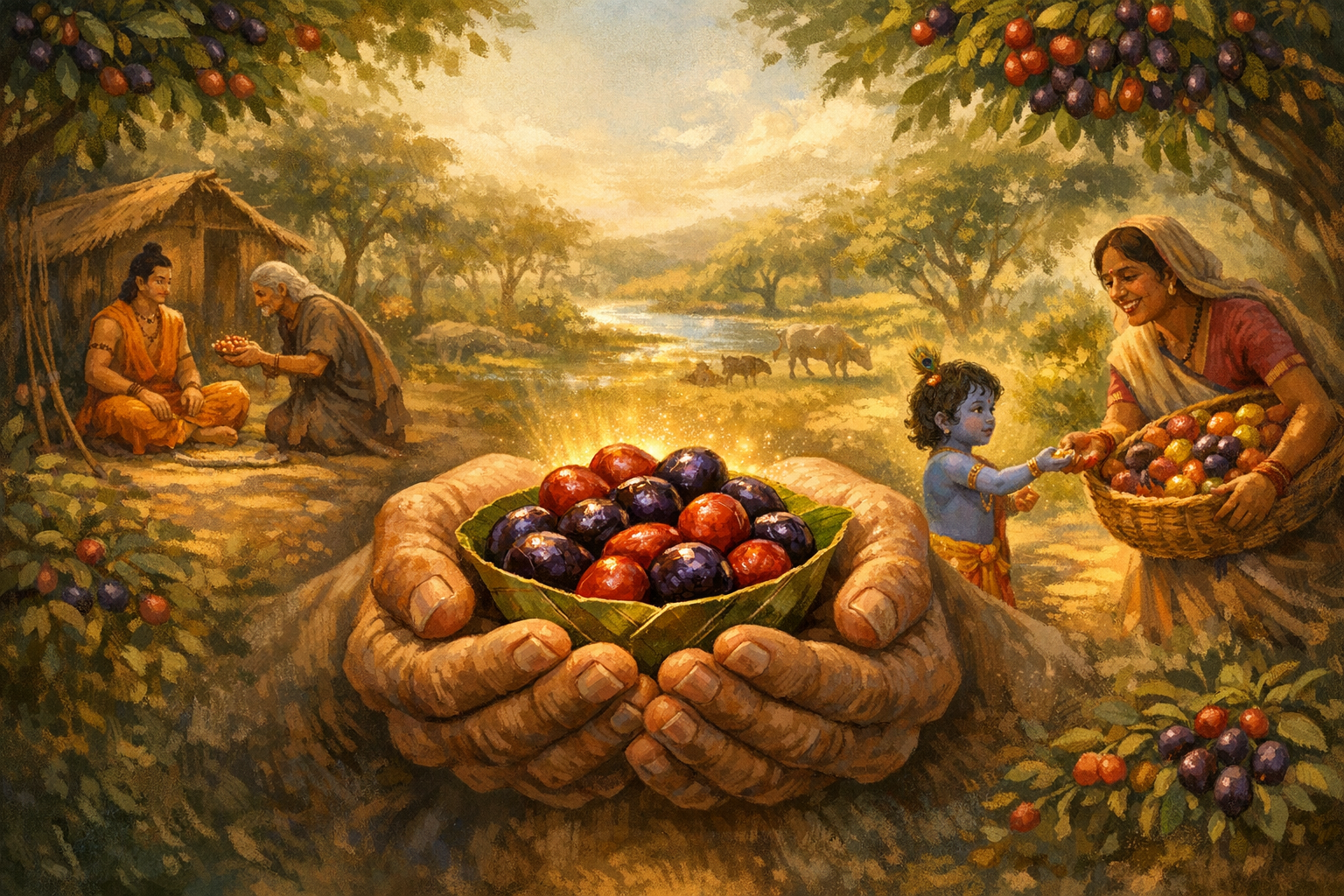
Across the vast landscape of Hindu storytelling, wild berries appear as humble yet luminous offerings. They surface in the Ramayana through Shabari’s simple “mūlāni phalāni,” and in Krishna traditions through the pastoral world of Vraja, where children gather forest fruits and a village fruit-seller trades her basket for grace. Read together, these motifs compress a sophisticated theology of bhakti, the social ethics of food-sharing, and a subtle ecological consciousness into a single image: a small fruit borne from the forest, offered with unguarded love, and received as sacred.
Two narrative clusters are especially instructive. In the Ramayana, Shabarian elderly ascetic living on the margins of Dandakaranyaawaits Rama’s arrival and offers foraged fruits with unalloyed devotion. In Krishna traditions, particularly those grounded in the Bhagavata Purana’s account of childhood pastimes in Vrindavan (Vraja), the Divine plays amid groves and riverbanks, sharing fruits with friends and accepting the modest gifts of ordinary village folk. Each scene renders food not as commodity but as relationship, and wild berries not as mere sustenance but as symbols of intimacy, inclusion, and spiritual equality.
Shabari’s story stands at the confluence of social history and sacred poetics. In Valmiki’s Ramayana (Aranya Kanda), she welcomes Rama and Lakshmana to her hermitage and offers roots and fruitsmūlāni phalānias an act of hospitality and surrender. Later devotional retellingsmost famously Tulsidas’s Ramcharitmanasamplify this scene into the cherished image of ber (jujube) fruits presented with such affection that every bite tastes of love. The well-known motif of Shabari tasting fruits to ensure their sweetness is a devotional elaboration that underscores intention (bhāva) over form, and love (prema) over rule-bound propriety.
Textual nuance matters. Valmiki’s account emphasizes the economy of ascetic life and the sanctity of simple hospitality; Tulsidas draws out the affective dimension of bhakti, highlighting how a marginal figure can become central in the moral universe through love. Read side by side, these sources do not conflict but rather complement one another: the former anchors the episode in the forest-ashrama ethic, while the latter reveals the rasathe experiential flavorof devotion that later bhakti movements sought to communicate to broad audiences.
Shabari’s offering also illuminates social ethics. A woman from a marginalized community extends food gathered from the forest to Maryada Purushottama Rama, and that food becomes prasādasanctified return-giftby the act of acceptance. In a single meal, the hierarchy between forest and city, ascetic and prince, peripheral and central is dissolved. The episode’s persistent popularity signals a civilizational intuition: spiritual worth is not indexed to status, scholarship, or wealth, but to sincerity of heart and the ethics of sharing.
Anthropologically, this is legible through the gift paradigm: the offering is not a transaction but a relationship-making act. In bhakti traditions, prasāda constitutes a sacred circulation of carefood moves from devotee to Divine and back to the community, binding participants in a moral economy. In Shabari’s hands, the ber fruit becomes a portable theology of inclusion, extending welcome across perceived lines of purity, caste, and power.
The botanical substratum of the story is not incidental. Ziziphus mauritiana (ber/jujube), common to many dry and forested zones of the subcontinent, is easily foraged, nutritionally dense, and culturally resonant. Ethnobotanical surveys repeatedly note that berand other “wild” fruits like jamun (Syzygium cumini) and phalsa (Grewia asiatica)figure in seasonal diets and ritual exchanges, especially in communities living close to the forest. Within the Dandakaranya setting, the prevalence of such fruits makes the scene of Shabari’s gift both plausible and symbolically precise: the forest shares its abundance through those who know it best.
Contemporary custom preserves this sensibility in charming ways. In parts of western India, the bor nahan ceremony showers toddlers with ber and sugar sweets during Makar Sankranti, ritually welcoming the child into a community of abundance and good will. Across regions, families pass plates piled with jamun or ber at temple anniversaries and village festivals, delighting children who wear the season’s joy on purple-stained tongues. The memory of such sharingfamiliar to countless householdskeeps alive the intuition that the simplest fruits can become the most profound prasāda.
Aesthetically, the episode articulates bhakti-rasa. The sweetness (mādhurya) is not merely gustatory; it is a metaphor for the affective texture of devotion. When later teachers praise Shabari’s ber, they are not adjudicating dietary codes; they are pointing to a grammar of love in which the qualitative interior of an act eclipses its quantitative or social exterior.
In Krishna traditions, wild and cultivated fruits serve as anchors for pastoral intimacy. The Bhagavata Purana (Book 10) repeatedly locates Krishna and the gopas in woodlands ringed by the Yamuna, where they forage leaves and fruits and share their finds with carefree generosity. The geography of Vrajagroves, hillocks, riverside thicketsfurnishes a living classroom where children learn reciprocity with landscape: to take lightly, to give gladly, and to sit together while eating.
Among the most beloved vignettes is the story of the fruit-seller (phalika). A village woman, carrying a basket of fruits, calls out in the lanes of Gokul. The toddler Krishna runs to her with tiny palms full of grains, much of which spills as He toddles along. She offers fruits anyway, and her basketafter the exchangeis miraculously filled with jewels. The narrative’s force lies not in spectacle but in ethic: both sides over-give relative to price because the act is not a market bargain but a trust-filled offering. Berries and fruits become tokens of a shared moral field in which affection, not arithmetic, determines value.
Daily life in Vraja builds similar lore from small gestures. Children pluck jamun from riverbank trees, stain lips and cheeks a regal purple, and compare treasures found under leafy shade. In these micro-scenes, foraged berries cue a pedagogy of friendship and enoughness: what the land gives is plentiful if shared; what companions bring is delicious if eaten together.
Even the cosmography of the Purāṇic world nods to this vegetal symbolism. The name Jambūdvīpathe terrestrial realm in classical Indian cosmologytakes its title from the jambu or jamun tree. Whether read literally or allegorically, the gesture is striking: a fruit tree of the commons stands as emblem for the human world, yoking cosmology to the everyday ethics of seasonal abundance and neighborly sharing.
Seen through a dharmic-unity lens, the moral of these fruit-offering scenes resonates across Hindu, Buddhist, Jain, and Sikh traditions. In Buddhist narratives, dana (generosity) is perfected not by the lavishness of objects but by the tenderness of intention; numerous Jātaka tales foreground humble foodsoften forest-gatheredgiven with metta (loving-kindness). In Jain practice, gochari (alms) underscores aparigraha (non-possessiveness), reminding householders that even a small, non-violent offering carried in right spirit is spiritually potent.
Sikh lore carries the same chord. The well-loved account of Guru Nanak favoring the simple bread of Bhai Lalo over the rich feast of Malik Bhago teaches that purity flows from honest labor and compassionate intent, not from opulent surfaces. Across dharmic lineages, therefore, the smallest morsel can carry the weight of the sacred when devotion transforms it.
Read as cultural semiotics, the wild berry marks a bridge between cultivated village and untamed forest, between settled order and liminal space. Shabari’s foraged ber signals both her ecological intimacy with Dandakaranya and the ethical invitation she extends to Rama: accept the forest on its own terms, and in doing so, accept those whom the forest sustains. In Vraja, village life leans into the grove rather than away from it, and children learn that friendship with the land is the precondition for friendship with each other.
The ethics of food implicit in these stories is quietly radical. Sharing erodes hierarchy; gratitude disarms suspicion; and the conversion of food into prasāda universalizes dignity. When Rama accepts Shabari’s offering, he authorizes an economy of esteem in which a tribal ascetic becomes the host and a royal exile becomes the grateful guest. When Krishna accepts the fruit-seller’s gift, He dignifies the labor of women whose daily commerce sustains village life.
The stories also address common anxieties around purity. By foregrounding love (bhāva) and intention (saṅkalpa), the narratives sidestep rigid ritualism without dismissing the value of discipline. They clarify that spiritual discernment concerns the interior alignment of giver and receiver; when that alignment is true, the boundaries of high and low, rich and poor, center and margin, are rendered morally irrelevant.
Ecologically, the scenes model the economy of foraging: take what is ripe, leave what is not, and share what one cannot use. The forest supplies abundance without depletion when approached with restraint, and berriessmall, seasonal, and easy to gatherbecome emblems of sustainable delight. Many temple communities today quietly renew this ethic by sourcing local, seasonal fruits for naivedya and prasāda, thereby linking worship to watershed and liturgy to landscape.
For readers, these motifs remain immediately relatable. Most households retain a memory of receiving prasāda that was ordinary in substance yet extraordinary in feelinga small fruit, a pinch of sugar, a few leaves of tulasi placed with care. In such moments, one recognizes the enduring truth the epics teach: sacredness is not an ingredient; it is a relationship.
In sum, the symbolism of wild berries in the stories of Rama and Krishna is neither rustic decoration nor sentimental flourish. It is the narrative vehicle for a precise spiritual and social vision: that devotion dignifies the giver, acceptance sanctifies the gift, and sharing consecrates the community. Shabari’s ber and the fruits of Vraja thus converge in a dharmic grammar that is at once scriptural and lived, philosophical and practical, intimate and universal.
These stories invite a contemporary vow: to honor intention over display, to receive simply and gratefully, and to let the smallest offerings become the seeds of unity. In that vow, the forest’s sweetness still ripensquietly, generouslyinto the taste of prasāda.
Inspired by this post on Hindu Blog.
