
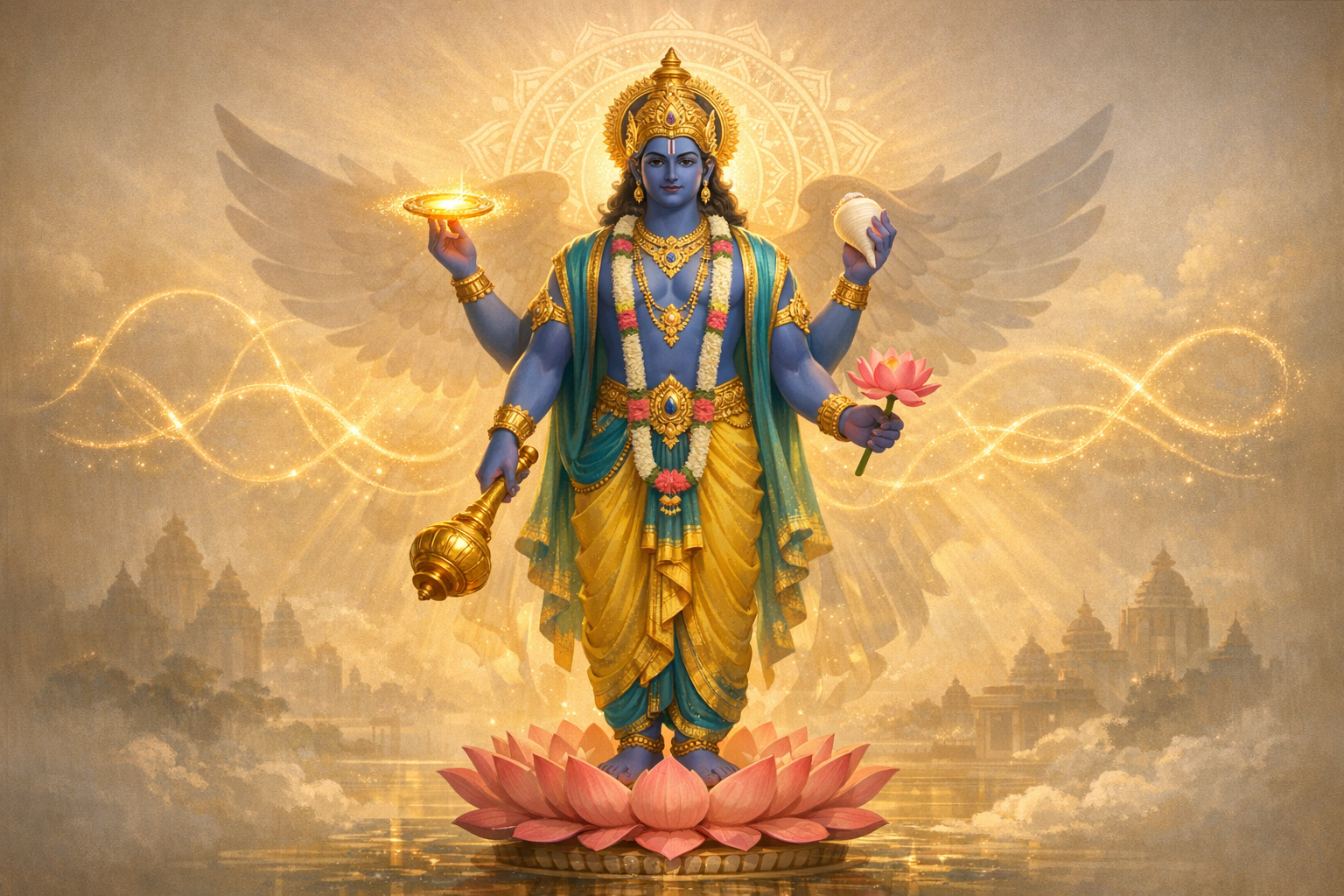
Across the sophisticated grammar of Hindu iconography, every ayudha carried by a deity functions as a theological statement encoded in form. Among these, the pāśathe noose fashioned from rope, sinew, or serpentconveys the power to bind, restrain, and arrest motion. Notably, Vishnu and his avatāras are almost never depicted with a pāśa. Understanding why clarifies core Vaishnava principles and illuminates how Hindu symbols, read carefully, harmonize with broader dharmic ideals across Hinduism, Buddhism, Jainism, and Sikhism.
In Vedic and Purāṇic usage, the pāśa operates as both object and metaphor. Varuṇa’s pāśa binds those who transgress ṛta, the cosmic order; Yama’s pāśa draws the jīva from embodiment at death. In Śaiva and Śākta contexts, pāśa can symbolize the bonds of karma, māyā, and attachment that fetter the individual soulan idea systematized in the Śaiva Siddhānta triad of paśu (the bound soul), pāśa (bondage), and pati (the liberating Lord). Ganeśa’s ubiquitous pāśa, likewise, represents the capacity to restrain obstacles and gently draw devotees toward auspicious conduct.
The noose appears not only as a hand-held emblem but also as a class of weaponized mantra and missile in the epics. The nāgapāśaserpent nooseis a famous example, employed to immobilize adversaries. In the Rāmāyaṇa, Indrajit uses nāgapāśa to bind Rāma and Lakṣmaṇa before Garuḍa’s presence dissolves the serpentine bonds, a narrative that itself anticipates the Vaishnava impulse to release rather than restrain.
Set against this binding ethos, Vishnu’s canonical ayudhas articulate a complementary, liberating vision. Agamic and Purāṇic sources describing murti-lakṣaṇa (iconographic canons)including the Viṣṇudharmottara Purāṇa, Agni Purāṇa, and Pāñcarātra Samhitāsstandardize the four emblematic attributes: śaṅkha (conch), cakra (Sudarśana disc), gadā (Kaumodakī mace), and padma (lotus). Avatar-specific emblems also appearRāma’s bow (Kodanda), Paraśurāma’s axe, Balarāma’s plough (hala) and pestle (muśala), Vāmana’s umbrella, Varāha’s uplifted earthwith an overarching consistency: the pāśa is absent.
Each Vaishnava emblem is saturated with philosophical intent. Sudarśana literally means “good vision” and functions as the radiance of discernment that slices through avidyā; the śaṅkha’s blast summons beings to dharma and proclaims protection; the gadā expresses the strength to correct adharma; the padma, born unsullied from mire, signals purity, prosperity (Śrī), and sattva. In many Vaishnava images, Abhaya and Varada mudrās underline reassurance and boon-bestowal. The resulting visual lexicon is not of constraint but of clarity, refuge, and uplift.
Theologically, this matters. Vaishnava thought emphasizes the Lord’s anugraha (grace) as the force that unties the heart’s knot (hṛdaya-granthi) and releases beings from saṃsāra. The cakra, whose very motion can be read as time, law, and knowledge, cuts bonds; it is not a loop that tightens. A noose implies subjection and custody; Vishnu’s instrumentsshaped by the Pāñcarātra’s contemplative semanticscommunicate protection, discrimination, and tender auspiciousness rather than coercion.
This orientation carries through the avatāras. Rāma’s bow restores order without binding souls; Kṛṣṇa’s flute charms hearts while the Sudarśana protects dharma; Narasiṃha’s nails tear through tyranny, not through captives; Vāmana’s umbrella encompasses the cosmos in a gesture of inclusion; Paraśurāma’s axe chastens unrighteous power; Balarāma’s plough re-lines the furrows of society. None relies on a noose; all, in different ways, realign beings with freedom.
Consider, too, how narrative motifs reinforce the same grammar of liberation. In Rāmāyaṇa’s nāgapāśa episode, GaruḍaVishnu’s vahanaundoes serpent-binds with a presence synonymous with Vaishnava grace. In the Bhāgavata Purāṇa’s Gajendra-mokṣa, the Lord frees an elephant trapped by a crocodile’s grip; the emblem of rescue is Sudarśana, not a restraining noose. In the story of Ambarīṣa and Durvāsā, the safeguarding agent is again the cakra, whose pursuit dispels adharma, not a pāśa that detains devotees.
Iconographic treatises corroborate this pattern. The Viṣṇudharmottara Purāṇa and Pāñcarātra Samhitās enumerate Vishnu’s attributes and their placements across two, four, and more-armed forms with impressive precisiondetailing which hand bears śaṅkha or cakra in upper or lower positions, and how mudrās complement the ayudhas. Across these prescriptions, pāśa does not appear as a standard attribute of Viṣṇu or his avatāras. Where regional workshops occasionally innovate, those additions rarely displace the core semiotics that Vaishnava worship relies upon.
The absence of the pāśa in Vaishnava images also aligns with the metaphysical architecture of Pāñcarātra theology. The vyūhas (Vāsudeva, Saṅkarṣaṇa, Pradyumna, Aniruddha) distribute cosmic functionsknowledge, will, actionwithout resorting to the imagery of physical restraint. Vishnu’s sovereignty communicates consent, refuge, and clarity; it does not visualize salvation as a capture but as an awakening and a return to one’s eternal relation with the Divine (śeṣa-śeṣi-bhāva).
Some viewers ask whether the coiled Ananta-śeṣa beneath Vishnu might figuratively be a noose. In iconographic logic, the serpent-bed is an emblem of infinite time and support, not an instrument of binding. Ananta encircles as foundation, not fetter; Garuḍa releases fetters, he does not tighten them. The same serpentine motif thus functions in Vaishnava art as shelter and transcendence, not captor and custody.
Field evidence from temples broadens the picture. From Gupta sculpture to Pallava and Chola bronzes, from Hoysala friezes to Vijayanagara pillars, Vishnu’s iconography remains strikingly consistent: śaṅkha, cakra, gadā, padma predominate, with avatāra-specific variations. Even in Southeast AsiaAngkor Wat’s Viṣṇu panels or Javanese reliefsthe visual language preserves the same quartet. The pāśa’s absence in Vishnu iconography is not an anomaly of one region but a civilizational throughline.
Why this visual restraint? Vaishnava practice foregrounds śaraṇāgati (surrender) and bhakti as relational movements born of trust, not force. In mandirs, devotees commonly narrate an immediate feeling of safety at the sight of Abhaya-mudrā and the lotus, and a sense of clarity at the memory of the Sudarśana’s meaning. The emotional register is intentionally pastoral, not punitive; it prepares the heart for grace, not for fear.
This reading harmonizes, rather than competes, with other dharmic symbol systems. The same noose that in Śaiva or Śākta Tantra can represent the binding power to rein in passions appears in Vajrayāna Buddhism as a saving instrument: Avalokiteśvara as Amoghapāśa wields a “faultless noose” to draw beings out of suffering. In Sikh Gurubani, the “noose of Yama” is a poetic marker for mortality and attachment that spiritual practice helps transcend. In Jain doctrine, bandha (bondage) describes karmic accretion that must be shed for kevala-jñāna. Across these traditions, symbols adjust to theology, yet all aim at the same liberation. Interpreted this way, the absence of pāśa in Vaishnava images is a complementary choice, not a contradictionVishnu liberates by cutting bonds, while other traditions may visualize compassionate control that calms the mind before release.
Addressing potential exceptions strengthens the conclusion. Occasional lists of “ayudhas” in narrative texts sometimes include pāśa among general astras available to deities; such mentions belong to mythic arsenals, not to murti-lakṣaṇa. Murti canons are stricter: they govern what worshippers see in sanctums so that symbolism reliably supports theology. Hence, while nāgapāśa is an epic device and pāśa appears in tantric sādhanā, the Vaishnava sanctum retains its liberating quartet and avatar-specific tools.
Several well-known episodes deepen the pattern. In Gajendra-mokṣa, a trapped elephant embodies the soul’s helplessness; Vishnu’s intervention communicates that divine grace arises unbound by ritual precision when the heart cries for help. In the Ambarīṣa narrative, the Sudarśana’s pursuit educates rather than confines, demonstrating that cosmic law protects devotion over ascetic pride. In both, the operative motif is release and instruction, not restraint and incarceration.
From a semiotic viewpoint, the pāśa’s exclusion in Vaishnava imagery avoids conflating divine care with carceral force. The lotus and conch lighten the visual field with ānanda and śrī; the disc and mace promise clear discernment and just strength. The viewer’s inner responsereported by countless pilgrimsaligns with the theology: a felt lifting of burden, not the anxiety of capture. Iconography thus becomes pedagogy.
This distinction also guards against a common modern misunderstanding that all Hindu weapons are indistinguishably “violent.” In fact, ayudhas are symbolic technologies. A noose communicates stoppage; a disc communicates precision; a lotus communicates unsoiled purity. By reserving pāśa for deities and contexts where restraint is the lesson and by excluding it from Vishnu’s standard repertoire, the tradition keeps messages crisp and non-contradictory.
The same clarity informs temple worship. In Vaishnava spaces, the śaṅkha’s sound (Pañcajanya) ritually clears cognitive clutter; the sight of the cakra atop the dhvaja-stambha reassures that order is defended; the padma evokes Lakṣmī’s nourishing presence; and the gadā hints at firm but benevolent guardianship. The cumulative experience is one of refugetraditional communities consistently describe a calm confidence rather than the bracing vigilance a noose might imply.
Scholarly surveys of sculpture and painting support these observations across regions and centuries. Whether examining Gupta reliefs at Deogarh, Pallava panels at Mahabalipuram, Chola bronzes of Viṣṇu and Nārāyaṇī, Hoysala temple iconography, Vijayanagara murals, or Khmer depictions in Cambodia’s Angkor complex, one meets the same visual thesis: Vishnu’s identity is best taught by conch, disc, mace, and lotus, not by the vocabulary of restraint.
For those navigating inter-traditional conversations within the dharmic family, this insight is unifying rather than divisive. Where one lineage employs a pāśa to symbolize compassionate control over the senses, another opts for the cakra to symbolize the insight that makes control unnecessary. All point toward the same telos: freedom from suffering, realization of the Self, and a life aligned with dharma. Appreciating these complementary symbol sets strengthens mutual understanding among Hindus, Buddhists, Jains, and Sikhs.
In sum, the pāśa’s absence from Vishnu’s standard iconography is deliberate, consistent with scriptural canons, and theologically resonant. Vaishnava images prioritize liberation over restraint, clarity over capture, refuge over fear. Read as a coherent system, Vishnu’s ayudhas teach that dharma is upheld not by binding beings but by awakening themprecisely the message that unites the dharmic traditions in their shared quest for mokṣa, nirvāṇa, kevala-jñāna, or sahaj ānanda.
Inspired by this post on Hindu Blog.
