
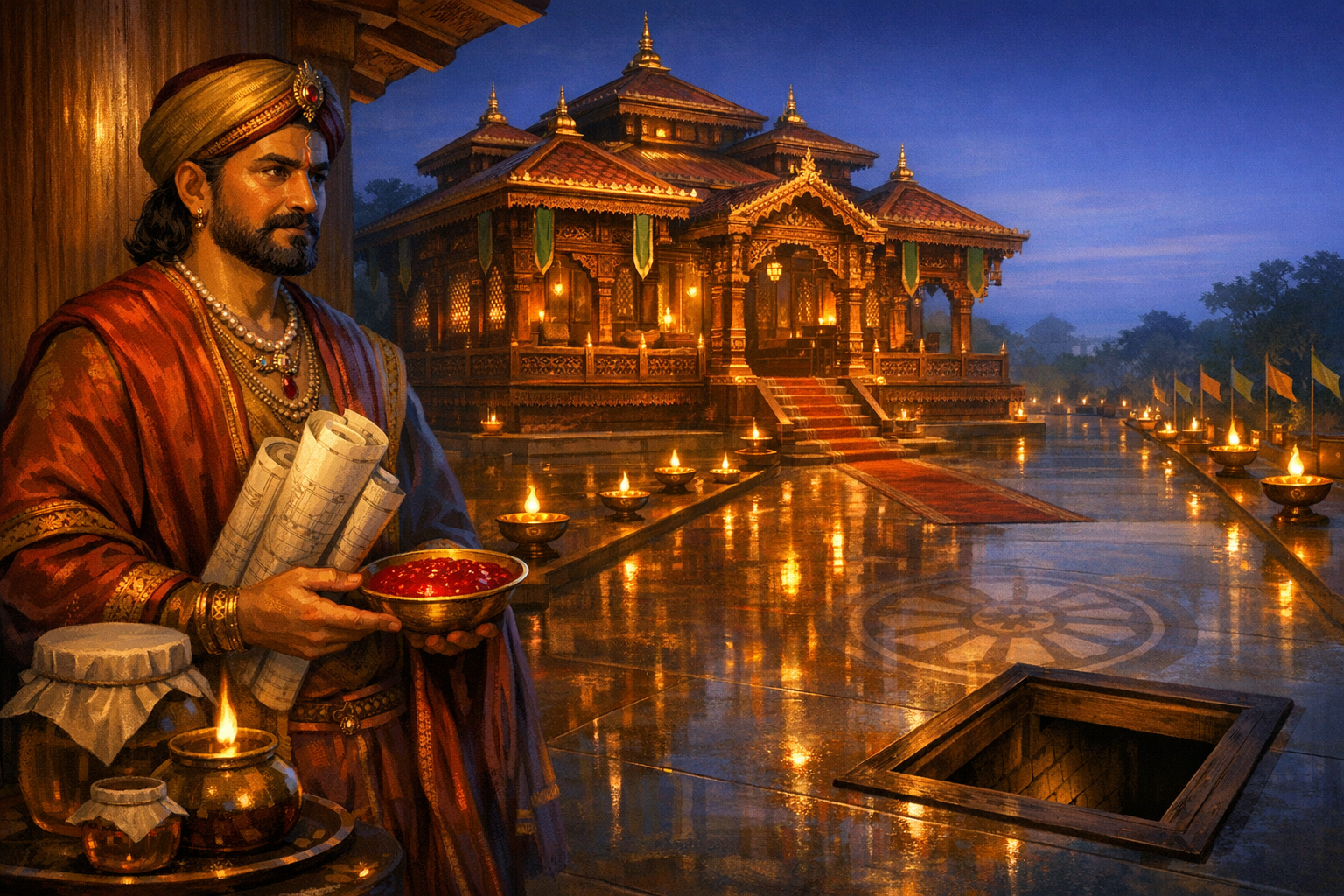
Purochana in the Mahabharata occupies a pivotal yet cautionary place in epic literature, remembered as the operative behind the Lakshagrahathe flammable “lac palace” engineered to eliminate the Pandavas under a veil of royal hospitality. His story fuses political intrigue, material science, and moral philosophy, revealing how ruthless loyalty can consume the very agent who serves it.
Set in the Adi Parva, the Lakshagraha conspiracy emerges when the Kaurava court in Hastinapur, guided by Shakuni and endorsed by Duryodhana, resolves to remove the rivals to succession without open warfare. Purochana, styled as a trusted minister and capable builder, is dispatched to Varanavata to design an ornate residence whose hidden purpose is arson masked as accident.
The term Lakshagraha derives from lākṣāshellac or lac resinan organic polymer known in Ancient India for its adhesive and highly combustible properties. Mixed with ghṛta (ghee), taila (oils), and other resinous binders, the material produces a structure that is exquisitely finished yet catastrophically flammable. The design intent was architectural entrapment: once ignited, the house would burn swiftly, compromising exits and ensuring no time for escape.
Varanavata is selected for its festive fair and plausible deniability; a sudden conflagration in a timbered, resin-rich pavilion could be attributed to lamps, incense, or celebratory fires. Purochana oversees supply chains, storage of accelerants, and the aesthetic facade meant to disarm suspicion. The plot underscores sophisticated planning, logistics, and careful calibration of motive and means in ancient statecraft.
Yet counter-intelligence within the Kuru polity checks the scheme. Vidura, renowned for Vidura-nitiprudent counsel grounded in dharmasuspects the sudden hospitality and, through a coded warning, alerts the Pandavas to the hidden danger. A subterranean tunnel is quietly excavated, creating an egress route that transforms the would-be death trap into a stage for strategic reversal.
The night of the fire is narrated across recensions with nuanced differences, but the central arc is stable: the Pandavas time their escape and the palace erupts in flames. A Nishada woman and her five sons perish in the conflagration, their remains later misidentified as those of Kunti and the five brothers. In the dominant narrative, Purochana himself dies in the blaze, rendering the architect of treachery its most conspicuous victim.
The characterization of Purochana is technically significant. He is neither a monarch nor a primary claimant to the throne; he is a functionary whose value to his patrons lies in competence, discretion, and deniability. The epic uses his fate to interrogate a perennial question of political ethics: when loyalty is severed from dharma, does service become complicity, and does complicity inevitably exact a personal cost?
Mahabharata’s moral grammar situates the plot within the larger tension between dharma and adharma. Vidura’s counsel illustrates that righteous statecraft is not passivity; it is alertness that refuses immoral means even when political stakes are high. By contrast, Purochana’s success parameters are amoralsecrecy, speed, and plausible accidentcriteria that, while prized in clandestine operations, corrode the ethical basement of rajadharma.
The materials science of the Lakshagraha sharpens this ethical portrait. Lākṣā softens with heat, saturates timber, and, when combined with oils, accelerates flame spread by capillary action along joints and seams. What looks like luxurythe lustrous finish and aromatic resinsdoubles as an ignition matrix. The palace’s beauty is weaponized; aesthetics and arson become one strategy.
Political design choices are equally telling. Varanavata’s fair attracts crowds, ensuring confusion about the origin of a blaze and complicating accountability. The project’s governance avoids written orders and centralizes control in a loyal operative, leaving minimal traces back to the court. The episode maps cleanly onto modern concepts of covert action, cut-outs, and expendable assets.
Textual scholarship notes variant emphases across the vulgate and the Critical Edition of the Mahābhārata (BORI). Some strands describe Bhima as the one who finally sets the fire after confirming the tunnel’s readiness, while others imply that the very flammability designed by Purochana makes ignition nearly spontaneous under ritual lamp-light. Across versions, however, Purochana’s culpability and the ethical critique of the plot remain intact.
Toponymic traditions identify Varanavata with present-day Barnawa (or Barnava) in Uttar Pradesh, where local memory speaks of a “Lākha Mandap” and associated mounds. While archaeological certainty remains debated, such associations illustrate how epic memory imprints landscapes, guiding pilgrimage, folklore, and the interpretive communities that sustain India’s ancient history.
The death of the Nishada family is a sobering narrative vector. Their anonymity in royal calculations highlights the human collateral of elite rivalriesa theme the epic repeatedly surfaces. Modern readers can recognize in this subplot the ethical imperative to factor the vulnerable into any calculus of power, a principle consistent with dharma across Hinduism, Buddhism, Jainism, and Sikhism.
From a cross-dharmic perspective, the Lakshagraha episode converges on a shared ethic. Ahimsa, valorized in Jainism and Buddhism, rejects the instrumentalization of life for strategic gain. Sikh teachings on sat (truth) and seva (selfless service) caution against deceit and exploitation. Hindu discourse on viveka (discernment) and dharma insists that artha (political and material aims) be bounded by moral law. Together, these streams affirm: means matter.
Vidura’s role models conscientious dissent within a hierarchical system. He neither stages a public rupture nor acquiesces; instead, he practices protective wisdomquietly building resilience and escape options for the intended victims. This subtle ethiccourage yoked to prudenceoffers a template for ethical action under constraint that resonates across dharmic traditions.
Organizationally, Purochana’s story is a case study in the failure modes of loyalty. Unbounded loyalty rewards short-term compliance and punishes moral clarity, encouraging teams to outrun conscience. Institutions that valorize such cultures often produce Purochanascapable agents incentivized to deliver results without regard to right or wronguntil a crisis consumes morale, reputation, and, ultimately, the agents themselves.
The episode also invites reflection on risk, deniability, and accountability. Covert architectures of harm are unstable by design; they rely on secrets that many must keep and events that no one can fully control. The lac palace collapses not only as a building but as a governance model; its flammability mirrors the volatility of policies that trade righteousness for expedience.
Materially, the Lakshagraha encapsulates an advanced understanding of combustibles in Ancient Indiaknowledge that, in ethical hands, enables craft, art, and ritual, and in unethical hands, becomes a weapon. Agni, sacred in Vedic ritual, is here deployed as arson, underscoring the Mahabharata’s recurring caution: sacred powers misused rebound upon their wielder.
Some regional retellings mitigate Purochana’s agency, portraying him as cornered by patronal pressure or as a professional who underestimates the plan’s human cost. Such nuance does not absolve culpability but deepens the analysis that the epic appears to seek: agency exists even under orders, and dharma requires resistance when commands are unjust.
Dhritarashtra’s ambivalence frames the constitutional failure of Hastinapur. A king who allows adharma to be plotted in his name, even indirectly, weakens the social contract. Rajadharma demands more than plausible deniability; it demands visible commitment to justice. The silence of power amplifies the voice of intrigue.
For students of ethics, the Lakshagraha is a laboratory of concepts. It illuminates the distinction between prudence and cunning, between protection and manipulation, between state security and personal vendetta. When examined alongside Vidura-niti, it yields principles that travel well beyond epic chronology into contemporary governance and civic life.
For readers navigating modern workplaces and communities, the narrative has relatable analogues. Projects that ask contributors to “just get it done” without transparent ends, teams that normalize secrecy over integrity, and leaders who reward results untethered to values reproduce the lac palace in miniature. The corrective lies in cultures that elevate ethical inquiry as a competency, not a hindrance.
In pedagogical settings, the episode supports interdisciplinary studycombining philology (terms such as lākṣā, ghṛta, taila), material culture (resins, oils, timber), political theory (succession, coercion, deniability), and comparative dharma (ahimsa, satya, seva, viveka). Treating the Mahabharata as a living text rather than mere legend opens pathways to integrative learning within India’s civilizational knowledge systems.
Importantly, the epic does not glorify retaliatory harm. The Pandavas’ escape avoids direct killing; the tragedy that unfolds is presented as a moral indictment of the conspiracy’s authors, not as a triumph of counter-violence. The text thereby reinforces a central dharmic intuition: survival aligned with righteousness is preferable to victory aligned with wrongdoing.
Purochana’s legacy is ultimately instructive rather than merely condemnatory. He demonstrates how technical mastery and political access, unmoored from ethical north, can destroy the practitioner. Conversely, Vidura demonstrates that courage coupled with wisdom can save lives without inflaming conflict, keeping open the possibility of just resolution.
Seen through the unifying lens of dharmic traditions, the Lakshagraha episode becomes a shared parable. It warns communities against weaponizing knowledge, exhorts leaders to anchor power in moral law, and encourages citizens to practice discernment, compassion, and truthful action. In that unity lies the antidote to the culture that produced Purochanaand the promise that epic memory can guide ethical modernity.
Inspired by this post on Hindu Blog.
