
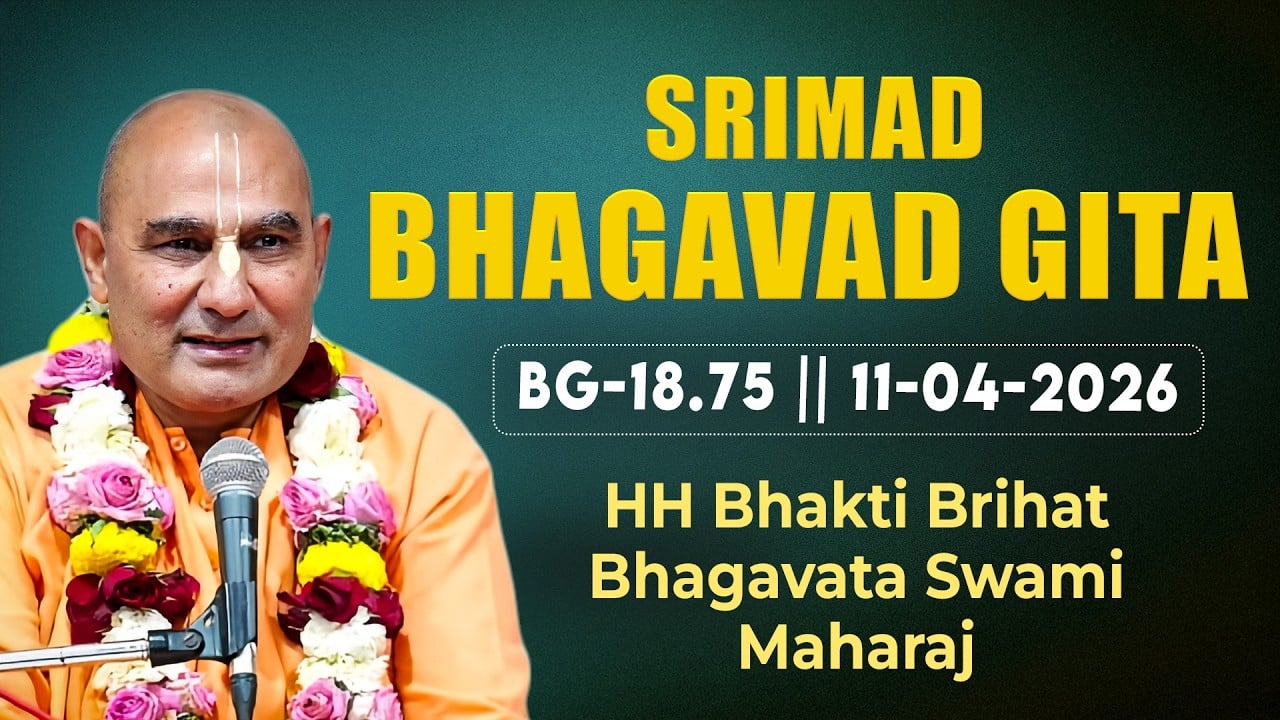
Bhagavad-gītā 18.75 presents one of the text’s most revealing self-descriptions: the knowledge transmitted to humanity is not merely philosophical abstraction but a living, grace-enabled disclosure. The verse voices Sañjaya’s testimony that, through Vyāsa’s compassion, he directly heard Kṛṣṇa conversing with Arjuna. In the Gaudiya Vedānta stream, including the teachings shared by His Holiness Bhakti Brihat Bhagavata Swami, this statement anchors how scriptural wisdom flowsthrough lineage (paramparā), grace (prasāda), and attentive receptivitywhile remaining fully accessible to sincere seekers across dharmic traditions.
“By the mercy of Vyāsa, I have heard these most confidential talks directly from the master of all mysticism, Kṛṣṇa, who was speaking personally to Arjuna.”
Contextually, Sañjaya speaks to Dhṛtarāṣṭra, summarizing the climactic dialogue at Kurukṣetra. The verse frames the Gītā as both historical and revelatory: a specific exchange in a precise time and place, and simultaneously a perennial, universal teaching. Its central claim is epistemichow the most confidential (guhyatama) knowledge is truly knownthrough grace-enabled hearing (śravaṇa) from a realized source.
“By the mercy of Vyāsa” (vyāsa-prasādāt) signals the Guru–Śiṣya Relationship at the heart of Sanātana Dharma. In Vedic epistemology, reliable knowing (pramāṇa) often culminates in śabda-pramāṇaauthoritative testimony transmitted by a trustworthy lineage. Sañjaya’s confession does not center personal prowess; it centers dependence on a lineage whose compassion opens the inner ear to truth. This preserves humility while affirming the indispensable function of teachers who embody and transmit Vedic wisdom.
Classical Indian thought recognizes three core pramāṇaspratyakṣa (perception), anumāna (inference), and śabda (authoritative testimony). The Gītā’s self-presentation privileges śabda not as blind belief but as experiential disclosure conferred by qualified guidance. Vyāsa’s grace bestows divya-dṛṣṭian elevated capacity to witness and comprehend otherwise hidden realitiesfusing testimony with a form of spiritual perception. The narrative thereby unites empirical attentiveness with contemplative insight under the stewardship of a realized guide.
“Most confidential” (guhyatama) invites careful hermeneutics. Across the Gītā, knowledge progresses from duty-centered karma-yoga to contemplative jñāna-yoga and culminates in integrated bhakti-yoga. Guhyatama denotes not secrecy for the sake of exclusion but interior profundity requiring refinement of intention, character, and attention. The deepest teaching is accessible to all yet unlocked through disciplined ethics, concentrated reflection, and devoted receptivityprinciples shared across Hinduism, Buddhism, Jainism, and Sikhism in different accents of practice and doctrine.
“Master of all mysticism” (yogeśvaraḥ) identifies Kṛṣṇa as the Lord of Yogathe ground of integration that harmonizes action, insight, devotion, and meditation. Here, yoga is not merely posture or technique but the science of inner integration that discloses the nature of self (ātman), duty (dharma), and reality (Brahman/Īśvara). To hear directly from Yogeśvara is to receive a unitive vision that reconciles seeming oppositesaction and renunciation, intellect and love, individuality and universal belonginginto a coherent path of liberation.
“Speaking personally to Arjuna” (sākṣāt kathayataḥ svayam) stresses immediacy: wisdom is not an impersonal abstraction but a living voice. The Gītā’s authority is inseparable from encounterteacher and student engaging in a real moral crisis. This pedagogical form matters. Dialogue allows context-sensitive guidance, balances general principles with personal nature (svabhāva), and models compassionate instruction rather than dogmatic imposition. It answers the perennial need for a path that honors universal truths while respecting individual journeys.
Historically, Vyāsa stands as the redactor of the Mahābhārata and a touchstone for Vedic knowledge. Within the Itihāsa-Purāṇa ecosystem, the Gītā is smṛti that carries Upaniṣadic gravitas, often hailed as “Gītopaniṣad.” The narrative deviceSañjaya endowed with insight by Vyāsasignals that remembrance (smaraṇa) in a lineage is not mere recall; it is inspired recollection suffused with spiritual clarity.
Commentarial traditions illuminate this verse’s layered claims. Śaṅkarācārya highlights knowledge (jñāna) as liberating insight, Rāmānujācārya emphasizes loving surrender (prapatti) to the Supreme, and Madhvācārya underscores real difference within divine unity. Gaudiya Vedānta integrates these through bhakti as the crown of yoga, where grace and effort coact. Read together, these commentaries exemplify unity in spiritual diversitydistinct accents converging toward liberation, rather than sectarian rivalries.
Viewed through a dharmic-unity lens, the verse’s structure resonates widely. In Theravāda and Mahāyāna Buddhism, lineage (paramparā) and teacherly compassion frame transmission; in Vajrayāna, adhiṣṭhāna (blessing) marks catalyzing grace. Jainism honors the upadeśa of the Tīrthaṅkaras and disciplined śrāvakācāra that opens the way to kevalajñāna; the emphasis is not on divine intervention but on purified conduct guided by realized exemplars. Sikh tradition centers the Gurū’s śabad, with nadar (grace) and daily discipline uniting divine gift and human effort. These parallels, while not identical, show how dharmic paths harmonize teacher-guided insight, ethical refinement, and compassionate transmission without exclusivism.
Epistemically, BG 18.75 models a balanced pathway: grace (prasāda) initiates, guidance (guru-upadeśa) clarifies, and practice (abhyāsa) interiorizes. This triad prevents both intellectual pride and passive fatalism. It also explains why “most confidential” knowledge cannot be mass-broadcast as mere information. The content demands a corresponding transformation of the knowerethics, attention, and devotion become instruments of cognition.
For contemporary practitioners, several disciplines operationalize this insight. Śravaṇa (focused listening) to Bhagavad Gita recitations or commentaries fosters concentration. Manana (critical reflection) articulates doubts and refines understanding. Nididhyāsana (deep contemplation) stabilizes insight. Complementary practicesjapa (mantra recitation), dhyāna (meditation), and sevā (service)align intention with action. Yamas and niyamas (ethical vows) supply the moral architecture that renders one receptive to guhyatama wisdom. Across communities, these disciplines can be practiced in ways consonant with Hindu, Buddhist, Jain, or Sikh sensibilities while honoring a shared civilizational ethos.
The verse also carries methodological counsel for study. A multi-commentarial approachconsulting Śaṅkara, Rāmānuja, Madhva, and Gaudiya ācāryasreveals how one text supports rich yet coherent readings. Comparing smṛti passages with Upaniṣadic themes clarifies continuities and creative developments. Philologically, “yogeśvara” is better rendered “Lord of Yoga” than the ambiguous “mysticism,” preserving the Gītā’s technical sense of yoga as integration and mastery of mind, senses, and action.
Practitioners often report that this verse reframes spiritual progress. Rather than seeking esoteric secrets for their own sake, attention shifts to refining the vesselcultivating humility, ethical steadiness, and loving focus. The “secret” then resolves as a capacity to perceive what was always present: insight emerges when life becomes aligned with dharma. Many find that regular engagement with Gītā teachings, in satsanga and interfaith dialogue, softens defensiveness, strengthens clarity, and nourishes compassion.
In the Gaudiya Vaiṣṇava appreciation, Kṛṣṇa as Yogeśvara is the personal ground of unity who imparts the integrated yoga of action, knowledge, and devotion. Yet dharmic unity is honored by recognizing analogous structures across traditionseach articulating liberation through disciplined practice, realized instruction, and grace-like enabling. BG 18.75 therefore calls for respectful collaboration: shared study, joint service, and mutual recognition of the Guru–Śiṣya Relationship as a civilizational treasure.
Finally, the verse gathers the Gītā’s final movement into a concise theology of transmission. The living voice of wisdom, the humility to receive, and the ethical courage to practice together birth understanding. As Sañjaya attributes his hearing to Vyāsa’s mercy, readers are invited to foster the same dispositionvaluing teachers, texts, and communities that embody Sanātana Dharma’s inclusive spirit. In that space, guhyatama knowledge ceases to be distant; it becomes lived clarity, offering a path toward inner freedom and social harmony grounded in unity in spiritual diversity.
Inspired by this post on Dandavats.
