
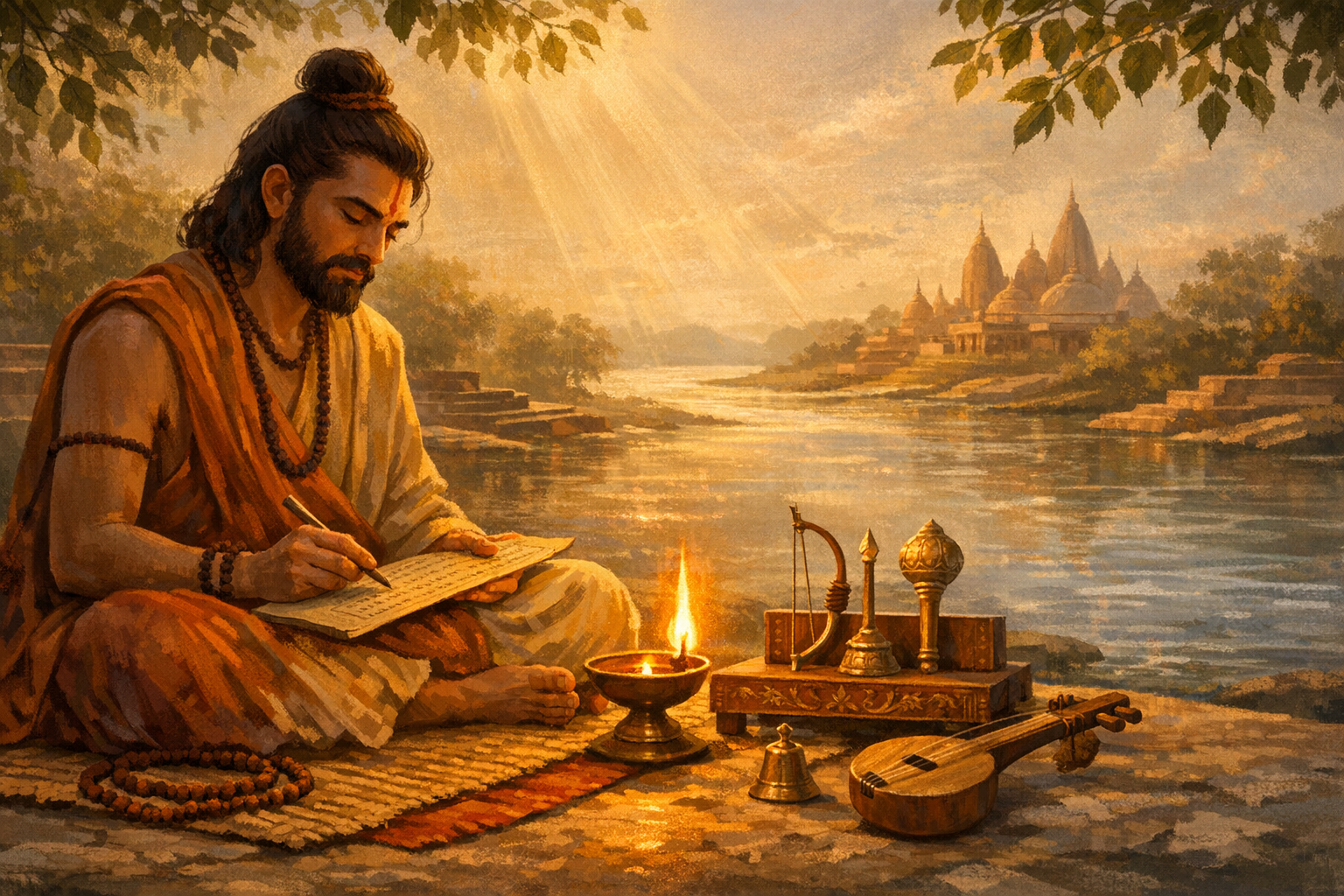
Sri Hanuman Das (1st century CE, per regional oral tradition) is remembered as a Hindu saint and Sanskrit poet renowned for steadfast devotion (bhakti) to Lord Rama and Lord Hanuman. Born as Ramachandra in a village of present-day Uttar Pradesh, he is celebrated locally under the name Hanumandas, a devotional epithet that foregrounds humility and service.
In the nomenclature “Hanuman Das” (Hanumān-dāsa), dāsya-bhāvathe devotional mood of servicedefines both spiritual orientation and literary agenda. The name signals a path in which Hanuman’s exemplary loyalty becomes the soteriological bridge to Rama-bhakti, aligning emotive piety with disciplined ethical practice (dharma, seva, śraddhā).
Reliable data for the early Common Era in North India is fragmentary. The dating to the 1st century CE appears in secondary compilations and regional kathā traditions rather than in securely dated inscriptions or colophons. Consequently, scholars approach Sri Hanuman Das as a figure preserved primarily through oral memory, temple lore (mahatmya), and later manuscript notices, while acknowledging the likelihood that his devotional activity belongs to the early centuries of the Common Era.
The cultural setting encompassed the Ganga–Yamuna doaban area marked by Vedic–Smārta praxis, emergent Purāṇic theism, and evolving forms of public worship of Rama and Hanuman connected to the Ramayana. This milieu fostered the composition and performance of Sanskrit stotras and locally inflected kirtans that nurtured communal identity and ethical resolve.
Given his Uttar Pradesh origins, proximity to Ayodhya and Chitrakoot offers plausible devotional coordinates. While no secure itinerary survives, it is historically reasonable to situate Sri Hanuman Das within pilgrimage circuits where recitation of the Ramayana and Hanuman-stuti became vehicles of collective remembrance and moral pedagogy.
Traditions credit Sri Hanuman Das with Sanskrit compositions in praise of Lord Rama and Lord Hanuman. Though specific titles are not securely established, the prosodic and rhetorical profile of early North Indian stotra literature suggests a blend of śloka-based hymns (anuṣṭubh), ornate lyric meters (such as vasantatilakā or śārdūlavikrīḍita), and refrain-driven laudatory verses suited to congregational recitation.
Within such hymnody, standard alaṅkāra (figures of speech) would be expected: anuprāsa (alliteration) to sustain mnemonic flow; upamā (simile) to clarify virtues such as valor, truth, and compassion; and yamaka (repetition) to emphasize nāma-smaraṇa (the meditative remembrance of the divine name). The diction typically centers on rama-bhakti and hanuman-bhakti, configured through epithets that bind theology to ethical exemplarity.
Hanuman is cast as archetype of unwavering service, fearless courage, and disciplined humility, while Rama embodies kingship of dharma and compassionate sovereignty. Together, they orient a practice that integrates interior devotion with outward sevaan ethic mirrored in daily routines of lamp-lighting, collective recitation, and vows that link moral conduct with sacred remembrance.
Values elevated in this devotional frameseva, ahiṃsā, karuṇā, aparigraha, and steadfast remembranceresonate across dharmic traditions. Buddhism’s emphasis on karuṇā, Jainism’s commitment to ahiṃsā and aparigraha, and Sikhism’s centrality of seva and nām-simran reflect a shared civilizational vocabulary that encourages mutual respect and unity. Read in this light, Sri Hanuman Das’s devotional corpus participates in a broader Indic conversation that honors diversity of paths while affirming common ethical ground.
Stotra traditions survive through performance. In village shrines and household courtyards, dawn and dusk recitations enable memory to carry texts forward when manuscripts do not. Variation in wording, expansion by oral commentators, and local melodies all contribute to a living textuality in which authorship is revered, even when textual fixity is elusive.
As a Sanskrit poet-saint, Sri Hanuman Das stands within pedagogical ecologies that linked recitation to learning (adhyayan) and transmission (adhyāpan). Sanskrit enabled liturgical coherence across regions, while vernacular explanation ensured accessible meaning. This bilingual dynamic helped ethical teachings travel widely without erasing local idiom or practice.
Attribution in early devotional literature benefits from philological and historical method: collation of manuscripts and colophons; paleographical assessment of scripts; metrical and stylistic profiling; and intertextual analysis with the Ramayana, early Purāṇas, and regional mahatmyas. Applying such methods to materials associated with Sri Hanuman Das could refine dating claims and illuminate networks of transmission in Uttar Pradesh and beyond.
Even in the absence of securely dated texts, the enduring remembrance of Sri Hanuman Das in Uttar Pradesh signals a legacy measured not only by lines preserved, but by virtues embodied. For many communities, the devotional image of Hanuman kneeling before Rama becomes a moral pedagogy in itselfcourage without arrogance, faith without bigotry, and service without expectation of reward.
In contemporary spiritual life, the synthesis of nāma-smaraṇa and seva associated with Sri Hanuman Das offers a practical model: regular remembrance disciplines the heart, while service disciplines the hands. This pairing fosters resilience and empathy, qualities urgently needed in plural societies seeking harmony across Hinduism, Buddhism, Jainism, and Sikhism.
Regional sources occasionally record the name in compounded form as Hanumandas. Both Hanuman Das and Hanumandas preserve the same devotional intent, marking an identity rooted in humility and service to Hanuman, with Rama as the supreme object of love and remembrance.
Viewed historically and devotionally, Sri Hanuman Das stands as a luminous node in the early Common Era landscape of North Indian bhakti. His memoryanchored in Uttar Pradesh and oriented to Lord Rama and Lord Hanumancontinues to nurture a dharmic ethos that prizes ethical action, inner clarity, and unity in spiritual diversity.
Inspired by this post on Hindu Pad.
