
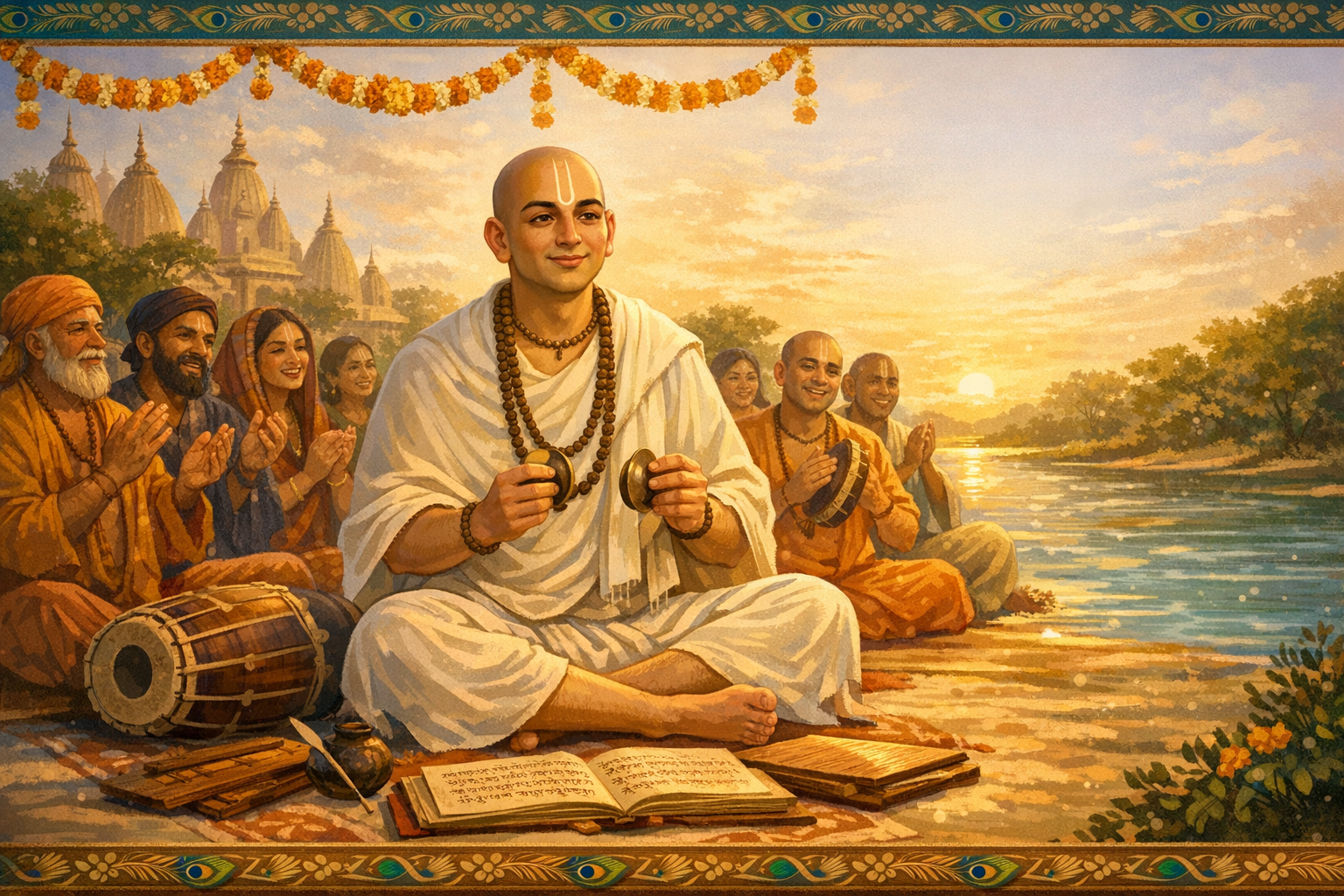
Narottama Dasa Thakura (16th–17th century) stands among the most influential Vaishnava saints in the history of Gaudiya Vaishnavism. Celebrated for advancing the bhakti of Lord Krishna across eastern India, especially in Bengal and the region of present-day Bangladesh, he combined rigorous theological clarity with a profoundly accessible devotional aesthetic. His legacy endures in congregational kirtana, refined devotional literature, and a unifying vision that continues to inspire seekers across Hindu spiritual traditions.
Historically situated in the generation after Shri Chaitanya, Narottama Dasa Thakura helped translate Chaitanya’s sankirtana movement into durable communities, liturgies, and literary forms. Alongside contemporary Vaishnava luminaries, he consolidated Krishna-bhakti through organized festivals, networks of disciples, and devotional pedagogy. In doing so, he modeled a socially integrative ethosopen, compassionate, and non-sectarianthat resonates with a broader dharmic commitment to harmony and mutual respect.
According to traditional accounts, Narottama Dasa Thakura was born in Kheturi of Gauda-desha (in today’s Bangladesh) into an aristocratic household associated with a local raja or zamindar. Hagiographies emphasize an early and intense attraction to Shri Chaitanya and describe the moment of receiving prema (divine love) at the Padma River as pivotal to his spiritual awakening. While such narratives carry the warmth of devotion, the historical consensus affirms his early devotion, disciplined learning, and eventual emergence as a key figure of the movement.
His education was methodical and deep. He attained proficiency in Sanskrit grammar, poetics, and theology, while also cultivating expertise in music and prosodyskills essential to Gaudiya devotional practice. This classical training enabled him to communicate Gaudiya siddhanta with precision and to render elevated theology into songs and prayers that ordinary devotees could understand and sing.
In Vrindavan, Narottama Dasa Thakura studied under Jiva Goswami, one of the foremost Gaudiya theologians, and received diksha from Lokanatha Goswami after prolonged, humble service. Sources consistently note his lifelong celibacy and renunciation, aligning his personal discipline with the bhakti ideal of single-pointed dedication (ekāgratā) to Krishna. The Vrindavan years provided him not only with scriptural mastery but also with the living experience of a devotional community centered on nama-sankirtana and seva.
His literary corpusmost notably Prema-bhakti-candrika and Prarthanadistills Gaudiya philosophy into mellifluous Bengali verses. These works are devotional manuals and meditative companions, guiding practitioners through stages of humility (dainya), surrender (śaraṇāgati), remembrance (smaraṇa), and loving service (seva). The texts remain widely read and sung, serving as touchstones for theological clarity, emotional depth, and practical guidance in sadhana.
Equally transformative was his contribution to kirtana culture. By shaping padavali kirtanadevotional lyrics set to ragas and rhythmic cycleshe helped standardize congregational singing as a primary mode of worship and instruction. Signature songs such as “Hari hari! bifale janama goainu” and “Gauranga bolite habe” combine doctrinal precision with an affective immediacy that continues to move congregations. The musical form itself functions as pedagogy: it teaches theology through melody, rhythm, and shared emotion.
The Kheturi Mahotsava, associated with Narottama Dasa Thakura, is often cited as the first pan-Gaudiya festival to gather diverse lineages in a spirit of unity. By installing Deities and organizing grand kirtana, the festival established a template for collective worship, doctrinal coherence, and coordinated outreach. Its enduring significance lies in demonstrating that robust devotional life can grow through unity-in-diversity rather than uniformityan insight of lasting relevance to plural societies.
Narottama Dasa Thakura’s outreach extended across Bengal and into neighboring regions. Through preaching circuits, training of disciples, and dissemination of literature, he strengthened devotional communities and facilitated the transmission of the Goswamis’ writings. His contemporaneity with figures engaged in transporting and teaching those texts (including to Bengal and Odisha) underscores the collaborative nature of Gaudiya expansion: a network of saints harmonizing scholarship, song, and social organization.
At the heart of his theology is the conviction that nama-sankirtana is both means and endpractice and realization. This emphasis elevates humility, service to guru (guru-tattva), and compassion as non-negotiable virtues. Theologically, it affirms that the holy name reveals Krishna directly; socially, it invites everyoneirrespective of caste, status, or genderinto a shared space of worship. In spirit, this inclusivity dovetails with broader dharmic values that prize non-violence, respect, and inner transformation.
The cultural geography of his lifespanning Kheturi (in present-day Bangladesh), Vrindavan, and the devotional heartlands of Bengalillustrates the historical depth of Krishna-bhakti across the eastern subcontinent. Sites connected to Narottama Dasa Thakura remain active centers of pilgrimage and memory, where kirtana, scriptural study, and festivals continue to nourish communities. For many devotees, singing his padavali fosters a living connection to both sacred history and immediate spiritual experience.
Beyond confessional boundaries, Narottama Dasa Thakura’s contributions point toward a dharmic pluralism grounded in shared ethical and contemplative ideals. The bhakti ethos he embodieddevotion, humility, and serviceharmonizes readily with values also honored in other dharmic streams of Hinduism, Buddhism, Jainism, and Sikhism. Such consonance offers a constructive path for inter-tradition understanding: unity without erasing difference, dialogue without diluting commitment.
Tradition holds that Narottama Dasa Thakura spent his later years consolidating devotional practice at Kheturi and that his disappearance (tirobhava) is commemorated annually by Gaudiya Vaishnavas. The continuity of these observances attests to the enduring authority of his example and the continued vitality of his songs, which function as portable sanctuaries of remembrance and aspiration.
For contemporary readers, three features of his legacy feel especially relatable. First, his literature offers a structured path for inner renewalclear, compassionate, and immediately actionable in daily sadhana. Second, his kirtana model demonstrates how community, music, and doctrine can reinforce one another to create resilient, welcoming spaces. Third, his unifying leadership shows that integrity in practice invites fellowship in spiritan insight as valuable in civic life as in spiritual life.
In sum, Narottama Dasa Thakura integrated scholarship, song, and service to anchor Gaudiya Vaishnavism in both heart and community. As one of the great Hindu Saints and a beacon among the Sages of India, he advanced Krishna-bhakti with intellectual rigor and devotional warmth. His work exemplifies how timeless kirtana, lived humility, and inclusive organization can deepen spiritual insight and strengthen unity across the varied currents of dharmic civilization.
Inspired by this post on Hindu Pad.
