
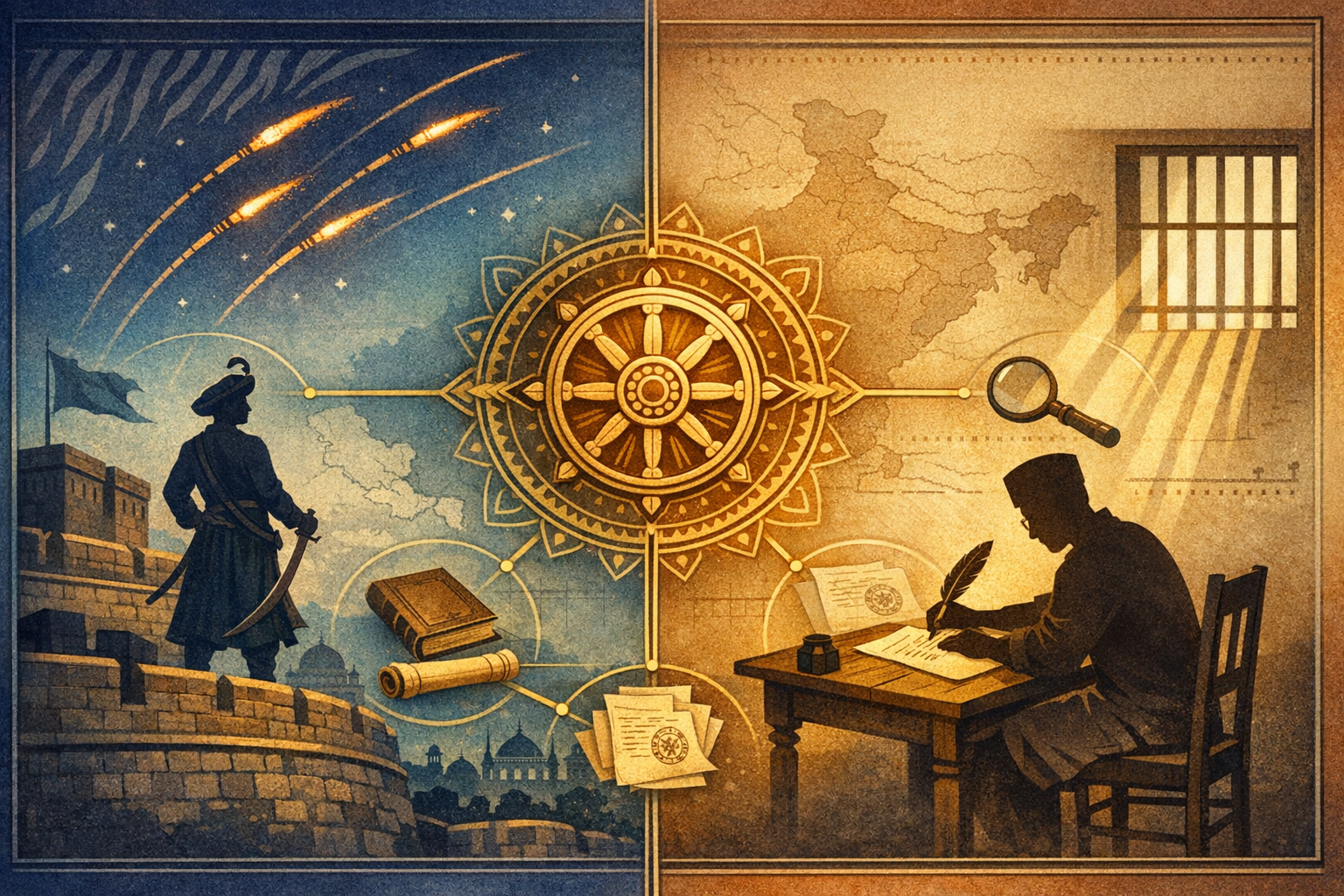
“Tipu Sultan died a martyr fighting the British, unlike Savarkar who wrote mercy petitions”, says Asaduddin Owaisi. The statement, widely quoted in Indian media discourse, has reignited a long-standing debate at the intersection of History, Politics, and British Colonial Rule. It juxtaposes two emblematic figuresTipu Sultan of Mysore and Vinayak Damodar Savarkarwithin a stark binary, inviting scrutiny of sources, context, and the responsibilities of public rhetoric in a plural society.
Beyond immediate controversy, the underlying questions are instructive: What do the historical records actually say about Tipu Sultan’s death in 1799? What did Savarkar’s clemency (often termed “mercy”) petitions entail within the British penal system? Most importantly, how can historical understanding be pursued in ways that reinforce inter-community trust and dharmic unityacross Hindu, Buddhist, Jain, and Sikh traditionsrather than deepen present-day divisions?
Tipu Sultan, the ruler of Mysore in the late eighteenth century, inherited a militarily dynamic state from Hyder Ali and positioned Mysore as a formidable counterweight to the British East India Company. His reign is widely noted for military innovation (including the famous Mysorean rockets), administrative initiatives in revenue and coinage, and a strategic diplomatic posture that leveraged ties with regional powers and the French. He operated in a fiercely competitive geopolitical environment that also involved the Marathas and the Nizam of Hyderabad.
Tipu’s death is a matter of robust historical record: he fell in combat during the storming of Seringapatam (Srirangapatna) on 4 May 1799, in the Fourth Anglo-Mysore War. Contemporary and later accounts concur that he died while resisting the assault. In this sense, any description of Tipu as having “died fighting the British” is consistent with documented events, even as the interpretive term “martyr” carries philosophical and political connotations that extend beyond the bare fact of battlefield death.
The word “martyr” (and its cognates such as “shaheed”) often functions sociopolitically as a marker of sacrifice for a perceived just cause. Scholars generally distinguish between descriptive facts (Tipu died in battle against a foreign power) and normative judgments (whether such a death should be valorized as martyrdom). The former is empirically grounded; the latter rests on ethical, cultural, and ideological frameworks that naturally differ in a plural society.
Discussion of Tipu’s legacy benefits from range and restraint. There is evidence for his statecraft, modernization efforts, and determined resistance to British expansionism. There is also a long-running historiographical debate about aspects of his rule, including allegations of harsh policies in certain regions. Responsible analysis avoids projecting present-day communal binaries backward onto eighteenth-century statecraft and, instead, foregrounds how regional, dynastic, and imperial logics coexisted with religious identities in complex ways. Such care is essential for Hindu–Muslim relations and broader interfaith harmony.
Turning to Veer Savarkar, the record shows a very different historical setting. An early twentieth-century revolutionary and later a prominent ideologue, Savarkar authored works such as “The Indian War of Independence 1857,” was arrested for revolutionary activities, and was transported to the Cellular Jail in the Andaman Islands. His incarceration unfolded under a British penal regime calibrated to break political offenders through isolation, labor, and surveillance.
“Mercy” or clemency petitions in the British system were a procedural mechanism commonly available to convicts, including political prisoners. Savarkar did submit petitions (notably in the 1910s), a point corroborated by archival references and long discussed in Indian historiography. Interpretations diverge: some view these as capitulation or contrition, while others see them as tactical instruments to exit an incapacitating carceral environment and resume public engagement under constraints. Both interpretations exist in academic and public discourse; neither should be asserted without acknowledging the other and the specific language of the petitions themselves.
It is also historically accurate that such petitions did not secure Savarkar’s immediate, unconditional freedom. He remained incarcerated for years, later moved under restrictions (including internment in Ratnagiri) before gradually re-entering political life under evolving conditions. These facts complicate any simplistic moral ledger and instead invite a contextual reading of British penal practice versus revolutionary strategy.
Set side by side, the contrast “a martyr in battle” versus “a petitioner in prison” is rhetorically powerful but analytically incomplete. The two figures belong to different centuries, institutional architectures, and strategic problem-sets. Tipu’s last stand occurred within a sovereign confrontation against an expansionist corporation-state; Savarkar’s struggle unfolded inside a carceral logic designed to neutralize anti-colonial networks. Reducing their legacies to a binary risks flattening history into a slogan.
Source criticism is therefore essential. Colonial-era records often carry ideological freight; nationalist hagiographies do as well. A careful method triangulates British dispatches and court documents with Indian-language chronicles, correspondence, regional memory, and the corroborated timeline of events. Historiographyhow history is writtenmatters as much as history itself, especially when public statements compress complex archives into quotable lines.
The British East India Company’s rise hinged on alliances and conflicts with Indian polities, not merely straightforward conquest. In Mysore, British advances were coordinated with other powers such as the Marathas and the Nizam, while diplomatic currents tied subcontinental dynamics to French and broader European rivalries. Recognizing this mesh of forces prevents retrospective monocausal explanations and helps explain why Tipu’s resistance became a symbol of anti-imperial defiance in later nationalist memory.
Public rhetoric, however, often privileges clarity over complexity. When political leaders collapse multi-decade archives into a single juxtaposition, public memory can harden into antagonistic camps. That dynamic risks overshadowing the deeper lesson of India’s past: diverse communitiesHindu, Muslim, Sikh, Jain, and Buddhisthave repeatedly found ways to cooperate in the face of imperial pressures, whether in shared resistance, institutional life, or cultural exchange. Recalling that cooperative inheritance is a civic responsibility in the present.
Many citizens encounter these figures first in family conversations and school textbooks, often as heroes or villains rather than as historically situated actors. Later exposure to archives and peer-reviewed research tends to replace sharp moral binaries with layered judgments. That shifttoward nuance, evidence, and contextadvances not only academic understanding but also social cohesion, because it resists instrumentalizing the past for present-day polarization.
A dharmic unity lens offers practical guidance for how to engage such debates. It asks whether a given narrative widens empathy across traditions, whether it recognizes the complex interplay of political power and ethical ideals, and whether it treats historical figures as resources for shared wisdom rather than weapons for present antagonism. Applied here, that lens affirms two factual pointsthat Tipu died in battle against the British and that Savarkar submitted clemency petitionswhile declining to weaponize either fact against India’s interfaith fabric.
Concrete heuristics can support readers and students navigating future claims of this kind: check chronology first; distinguish descriptive facts from normative labels; identify the institutional context (battlefield, court, or prison); read at least two independent sources with different vantage points; and ask finally whether the resulting narrative helps sustain Hindu–Muslim unity and broader interfaith trust. These steps keep inquiry rigorous and its social effects constructive.
In sum, Owaisi’s assertion spotlights two verifiable elements of the historical record while framing them in a polarizing contrast. A fuller picture acknowledges both the reality of Tipu Sultan’s battlefield death during the British assault on Seringapatam and the existence of Savarkar’s clemency petitions within a coercive colonial penal regimewithout converting either into a cudgel for contemporary division. History serves the common good best when its complexity is preserved and its lessons are harnessed to strengthen India’s civilizational commitment to unity in diversity.
Inspired by this post on Hindu Jagruti Samiti.
